Written by: Ryan Dunlop, CEO and Founder of Full Arch Masters and graduate from the Harvard School of Dental Medicine
Key Takeaways
-
Live-patient surgery is rare in U.S. implant CE because of state regulations, which makes Full Arch Masters’ Parker, CO course a notable exception.
-
Course formats range from 2–4 day private institutes to 12–24 month university continuums, and cost and credential pathways change with each format.
-
Full Arch Masters publishes transparent pricing from $6,995–$25,000 per course and offers a Fellowship bundle that saves $5,000–$10,000.
-
AGD PACE-approved courses like Full Arch Masters deliver 32 CE credits each, with the full Fellowship providing 90+ hours toward ABOI/ID requirements.
-
Clinicians who want to place and restore full arches independently can join an upcoming Full Arch Masters cohort and learn alongside hundreds of FAM-trained dentists.
How Much Do Dental Implant Courses Cost?
Cost is the most-searched and least-answered question in dental implant CE. Tuition ranges widely by format, and the format determines what a dentist actually receives.
Weekend lecture courses and model-only workshops typically run $1,500–$5,000. Mini-residencies and private institute programs that include cadaver or model-based hands-on work vary widely in cost. Some shorter or model-based programs fall in the $5,000–$15,000 range. University- or institute-affiliated mini-residencies of 12+ months typically cost $20,000–$45,000+. University-affiliated implant continuums usually cost roughly $12,000–$25,000, with some programs ranging $18,000–$25,000 depending on the host institution and included materials.
Live-surgical courses, where visiting dentists operate on real patients under supervision, are the most expensive format because of anesthesia costs, patient coordination, credentialing logistics, and low mentor-to-operator ratios. Live-surgical implant courses commonly cost in the five-figure range, with examples around $16,000–$20,000 per operator, though pricing varies by program.
Full Arch Masters publishes its pricing directly:
-
Flagship Course: $9,995 per dentist; $2,500 per additional team member
-
Live Surgical Course, Basic Operator: $20,000; Advanced Operator: $25,000; Doctor Observer: $4,995
-
Design and Finish Course: $6,995
-
FP1 Course: $7,995 dentist; $4,995 associate dentist; $1,495 assistant or technician
-
Treatment Coordinator Bootcamp: $6,995 dentist; $900 treatment coordinator attending with a dentist; $2,000 treatment coordinator solo
-
Fellowship Bundle: $5,000–$10,000 discount versus paying per course individually, with a 9–12 month payment plan available
Cost should be evaluated as a purchase decision, not a brochure line. A $20,000 live-surgical course where an operator performs two full arches under expert supervision is a different investment than a $3,000 weekend course where they drill on a typodont. That difference matters because the goal is to find the program that produces a clinician who can operate independently, not simply the cheapest option.
See Full Arch Masters’ published pricing and mentor ratios and review a curriculum built around making dentists clinically ready, not just more informed.
Cost is only one variable. The format of the training, especially whether it includes live-patient surgery, often matters more for clinical readiness.
Live-Patient Vs. Model-Only Training And The Legal Reality
The difference between live-patient and model-only training is a clinical and legal distinction, not a marketing label. In a model-only course, dentists drill on a typodont or resin model. In a live-patient course, they operate on a real volunteer patient. A typodont does not bleed, does not have variable bone density, and cannot recreate the moment when a patient’s anatomy does not match the preoperative plan and the surgeon must make a judgment call in real time. Most weekend implant courses are model-only. Buyers need to understand that fact before they spend five figures.
The reason live-patient surgery is rare as a CE format is regulatory. Most US states do not permit visiting US-licensed dentists to perform dentistry on volunteer patients during a CE course. The scope-of-practice permission a dentist holds in their home state does not automatically extend to performing surgery on patients in another state’s CE setting. This reality explains why most domestic implant CE programs, even those marketed as “hands-on,” involve model work, cadaver labs, or observation rather than live operating.
The Colorado Dental Board operates under a credentialing model that makes it one of the verifiable exceptions. Full Arch Masters submits each operator’s credentials to the Colorado Dental Board ten days before each Live Surgical Course, contingent on no pending marks against the dentist’s license in their home state. CRNAs provide general anesthesia onsite. Each Basic or Advanced operator performs two full arches across two surgical days in Parker, CO. These are real cases on real patients with real operating under expert mentor supervision.
International attendees can attend the Live Surgical Course as Observers because the Colorado Dental Board credentialing process requires a US dental license. Observers shadow cases without operating. Many report learning as much as hands-on participants from the case review, planning, and real-time surgical discussion.
Which Credentials Do These Courses Count Toward?
Three credentialing bodies are relevant to US dentists evaluating implant CE: the American Academy of Implant Dentistry (AAID), the American Board of Oral Implantology / Implant Dentistry (ABOI/ID), and the Academy of General Dentistry (AGD) through its PACE program approval.
The AAID Associate Fellow credential requires over 300 hours of CE dedicated to implant dentistry, demonstrated competency through standardized cases, and presentation of the clinician’s own patient cases. The AAID Fellow credential requires over 400 hours and a minimum of five years of hands-on experience. Some longer implant training programs are specifically structured to prepare candidates for this pathway.
The ABOI/ID Diplomate credential requires 670 hours of implant-related CE recognized by AGD PACE, documented case submissions, and a two-part examination. AAID Fellows receive 200 CE hours toward the 670-hour requirement and are exempt from the ABOI/ID Part I written exam. University or hospital-based programs such as a 1-year GPR/AEGD or Fellow program (100 hours) or a 2-year program (200 hours) satisfy additional CE credits toward the ABOI/ID Diplomate 670-hour requirement. International applicants must complete 300 of the 670 hours through a continuum program in implant dentistry.
AGD PACE is a program approval system that approves CE provider organizations, not individual courses. Full Arch Masters is an AGD PACE-approved provider. Each main Full Arch Masters course delivers 32 continuing education credits. The full FAM Fellowship delivers 90+ CE hours. These hours count toward state license renewal requirements and can be applied toward the ABOI/ID’s 670-hour CE requirement. Dentists should verify their state board’s specific CE requirements. State-by-state rules vary, and the AGD publishes a directory of state CE requirements as a starting reference.
University Continuums Vs. Private Institutes Vs. Study Clubs
The three structural models differ on cost, time commitment, mentorship depth, and credential value in ways that matter for a dentist’s buying decision.
University Continuums are longer programs, typically about 12 months, with some extending to 24 months, tied to a teaching institution. They are credential-oriented, often structured to satisfy AAID or ABOI/ID hour requirements, and may include supervised live-patient experience depending on the host program. Cost typically runs $12,000–$25,000. The tradeoff is time. A dentist commits to a year or more of recurring sessions, which affects practice scheduling and production.
Private Institutes are shorter and more operator-focused, typically 2–7 days per course. Quality varies significantly. The strongest private institute programs include live-patient surgery, low mentor-to-operator ratios, and post-course support. The weakest are model-only weekends with no follow-up. Cost ranges from under $5,000 for a basic weekend course to $25,000 for a credentialed live-surgical program. Verification of live-patient status, mentor credentials, and CE accreditation is essential before enrolling.
Study Clubs are ongoing, low-cost, and mentorship-light. They serve a peer-learning function such as case review, technique discussion, and vendor presentations. They do not provide the supervised clinical experience or structured curriculum that builds surgical readiness. CE credits earned through study clubs vary and are generally not tied to a formal credential pathway.
Which Dental Implant Courses Include Live-Patient Surgery?
Live-patient surgical training is rare as a domestic CE format for the regulatory reasons described above. Full Arch Masters’ Live Surgical Course in Parker, CO is one of the few programs in the United States where visiting US-licensed dentists can legally operate on real volunteer patients under expert mentor supervision, using the Colorado Dental Board credentialing pathway.
The FAM Method, Full Arch Masters’ proprietary digital workflow, is the system each operator learns and executes across their two surgical cases. It takes a patient from no teeth or heavily decayed teeth to a screwed-in, same-day restoration in 2 to 4 hours. The seven steps of the FAM Method are:
-
Preoperative records and data acquisition
-
Photogrammetry and intraoral scanning
-
CBCT and digital treatment planning
-
exocad design
-
Immediate-load conversion
-
Final zirconia design and finishing
-
FP1-specific design, team implementation, and workflow scaling
Alumni report adding $1M+ per year in practice revenue after adopting the FAM Method. That outcome comes from a faster workflow that allows more arches per week at higher margin. It also reflects the marketing and treatment coordination content that helps close more of the consultations a practice already sees.
Full Arch Masters offers five courses and a Fellowship bundle: the Flagship Course, the Live Surgical Course (Basic Operator, Advanced Operator, and Observer tracks), the Design and Finish Course, the FP1 Course, and the Treatment Coordinator Bootcamp. Every attendee joins a continued alumni community of hundreds of FAM-trained dentists through private group chats. Attendees also gain access to the KOL (Key Opinion Leader) buying group, which provides vendor discounts on implants, software, and equipment at no recurring cost.
Explore the Live Surgical Course and the full FAM curriculum to see how this workflow fits your practice.
An Experience-Level Decision Framework
The right Full Arch Masters course depends on where a dentist is starting.
Beginner, Never Placed A Full Arch: Prioritize a course that teaches the full system, including records, surgery, immediate load, and team delegation. The FAM Flagship Course in Fresno, CA, capped at eight dentists per cohort, covers every step of the FAM Method end-to-end. It includes marketing, treatment coordination, and team delegation at the same depth as the clinical content. The Basic Operator track of the Live Surgical Course is the natural next step for dentists with fewer than 200 career arches who want live-patient operating experience.
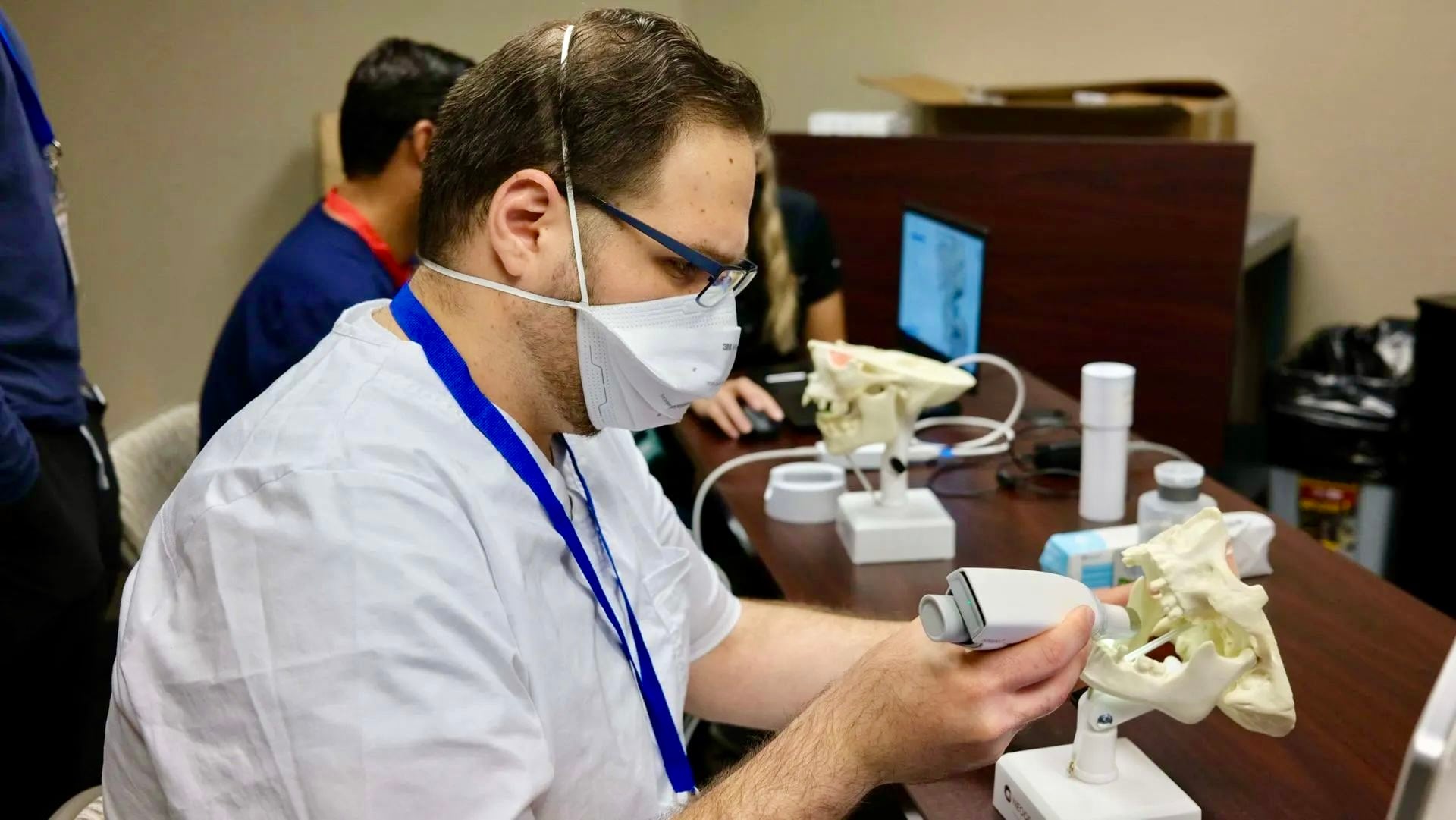
Dentist Already Placing Single Implants: Prioritize a course that adds full-arch workflow and lab integration. The Design and Finish Course covers digital design in exocad and hands-on aesthetic finishing on zirconia. The FP1 Course adds the FP1 prosthetic workflow, a higher-margin, more aesthetic restoration option that most general full-arch programs do not cover.
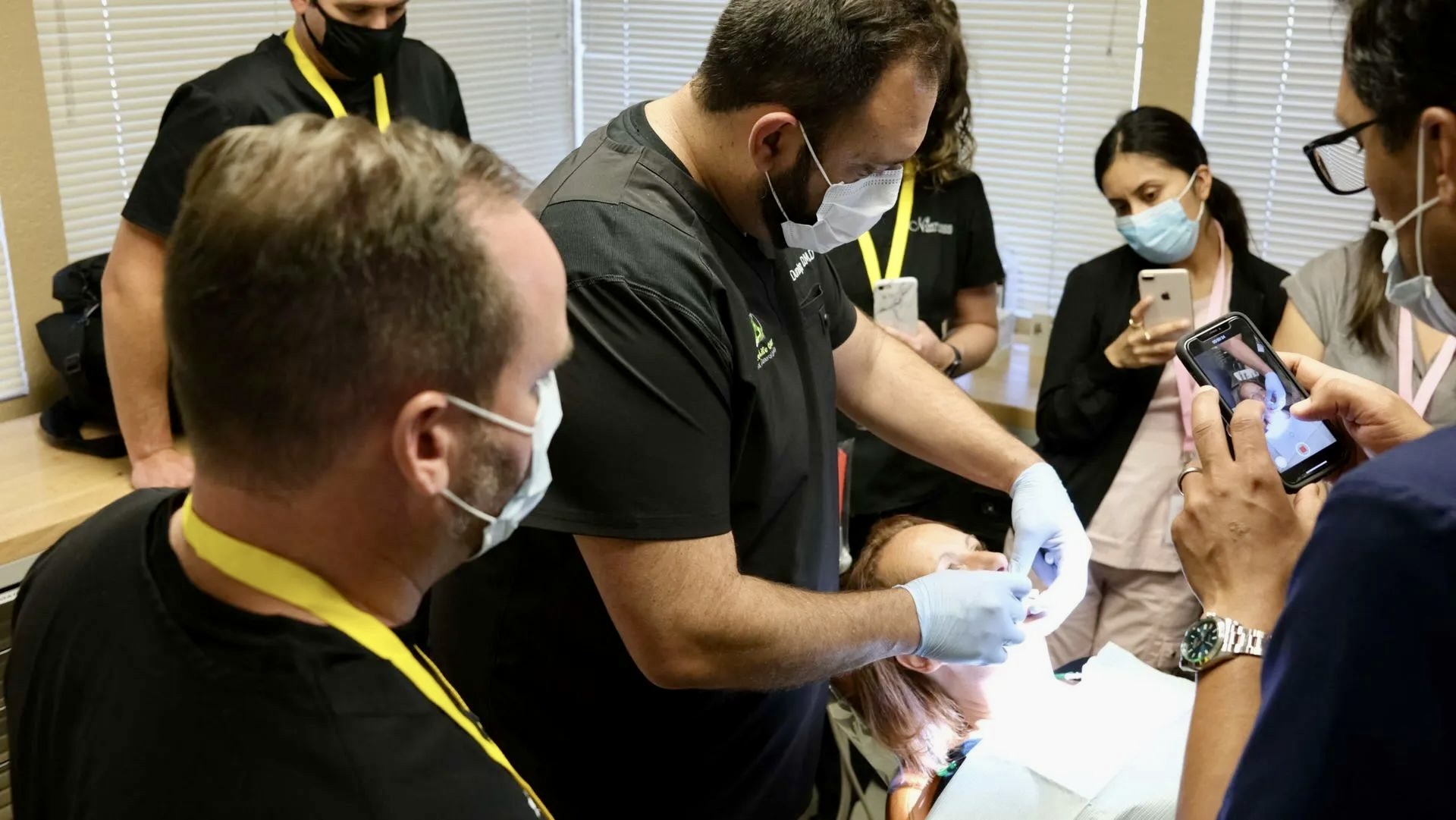
Dentist Scaling To Full-Arch At Volume: Prioritize advanced surgical technique and post-course support. The Advanced Live Surgical track in Parker, CO is gated to dentists with 200+ career arches and covers zygomatic, pterygoid, trans-sinus, custom subperiosteal, and palatal-approach placements for atrophic cases. These techniques rarely appear in general full-arch programs.
How To Spot A Low-Value Course
The following red flags indicate a course that is unlikely to build real surgical readiness. For each, a practical mitigation is listed.
-
Model-only curriculum with no live-patient pathway. Ask in writing whether the course includes live-patient surgery and what the legal mechanism is that permits it.
-
No named mentors who actually operate. Ask for the names and verifiable credentials of every surgeon-instructor, and confirm they are active practitioners, not primarily educators.
-
No post-course support or peer community. Ask what access continues after the course ends and whether there is an alumni network with ongoing case support.
-
No published credential or CE hour count. Ask which accrediting body approves the CE, what the AGD subject code is, and how many hours are awarded, then verify the accreditation independently.
-
No team training option. Ask whether treatment coordinators, assistants, and lab technicians can attend, and what the pricing structure is for team members.
Once you have identified the red flags, use the following questions to get written answers before you commit.
What To Ask Before You Pay
Before committing to any dental implant CE course, get written answers to the following questions:
-
Is the training live-patient or model-only, and what is the legal mechanism that permits live-patient surgery if applicable?
-
What is the mentor-to-operator ratio during surgical sessions?
-
What credentialing or CE hours does the course earn, and through which accrediting body?
-
Can my treatment coordinator, assistant, and lab technician attend, and what is the pricing for each?
-
What support continues after the course ends, such as alumni community, case help, or a resource library?
-
Does the course teach the business side, including marketing, closing, and team delegation, or only the surgery?
Get written answers to these questions from Full Arch Masters before you reserve a seat.
Frequently Asked Questions
How Much Does A Dental Implant Course Cost?
Tuition ranges by format, as detailed in the cost section above. Model-only weekend courses typically run $1,500–$5,000, while live-surgical courses commonly cost in the five-figure range. Full Arch Masters publishes its pricing directly, with its Flagship Course at $9,995 and its Live Surgical Course at $20,000–$25,000. The Fellowship bundle discounts the total versus paying for each course separately.
Can You Learn Implants Through A Dental School Program?
Yes. University-based implant continuums and fellowship programs offer structured, credential-oriented training that can satisfy AAID and ABOI/ID hour requirements. These programs typically run about 12 months, with some university programs extending to 24 months, and cost $12,000–$25,000. They are well-suited to dentists who want a formal credential pathway and can commit to a multi-year schedule. The tradeoff versus a private institute is time. A dentist commits to recurring sessions over a year or more, which affects practice scheduling and production. University programs vary in whether they include supervised live-patient surgery, so that detail must be confirmed with each program directly.
What Is The Difference Between A Weekend Implant Course And A Mini-Residency?
A weekend implant course, typically 2–3 days, provides entry-level exposure to implant concepts and is often model-only. It is rarely sufficient for surgical confidence on its own. A mini-residency spans multiple sessions over weeks or months, includes more supervised clinical experience, and is generally considered a more durable format for building operative skill. The most important distinction is the format. Dentists should confirm whether the program includes live-patient surgery under supervision, what the mentor-to-operator ratio is, and what post-course support continues. A weekend course with live-patient operating and a 1:1 mentor ratio can produce more clinical readiness than a multi-month program that is primarily lecture and model work.
Which Dental Implant Courses Include Live-Patient Surgery?
Live-patient surgical training is rare as a domestic CE format because most US states do not permit visiting dentists to operate on volunteer patients during a CE course. Programs that offer domestic live-patient surgery typically do so through a specific state dental board credentialing mechanism. Full Arch Masters’ Live Surgical Course in Parker, CO uses the Colorado Dental Board credentialing pathway. FAM submits each operator’s credentials to the board ten days before the course, contingent on no pending marks against the dentist’s license in their home state. CRNAs provide general anesthesia onsite, and each Basic or Advanced operator performs two full arches across two surgical days. Other programs offer live-patient surgery in international settings such as Mexico or the Dominican Republic, where regulatory frameworks allow supervised placement volumes that are difficult to arrange domestically. In all cases, buyers should confirm the licensed facility, named supervising clinicians, informed-consent process, and CE accreditation in writing before enrolling.
Conclusion: The Final Pitch
Throughout this guide, five criteria have separated high-value courses from low-value ones: live-patient status, cost, credential, mentorship, and post-course support. Every program on the market should be compared against those criteria before a dentist commits. The strongest dental implant courses leave a clinician able to operate independently, not merely informed. A course that earns 32 CE credits but leaves a dentist hesitant to place their first arch has not delivered real value.
Clinicians ready to bring the FAM Method into their practice can join the next Full Arch Masters cohort and train on a complete clinical and business system.
If closing more full-arch consultations is the next bottleneck in your practice, the Full Arch Masters Treatment Coordinator Bootcamp trains your front-office team on the same closing system FAM uses in-house, where the in-house treatment coordinator maintains an 80% closing rate.