Written by: Ryan Dunlop, CEO and Founder of Full Arch Masters and graduate from the Harvard School of Dental Medicine
Key Takeaways
- Full-arch implant CE trains dentists and teams on a complete digital workflow for same-day fixed prostheses on four to six implants.
- Smart program selection depends on live-patient surgical hours, experience-tier matching, team attendance, photogrammetry, post-course support, and fee structure.
- Structured full-arch workflows can generate $20,000–$35,000 per case and grow revenue without adding operatories or staff.
- Training the entire team on one shared workflow removes bottlenecks and supports scaling to five or more arches per month.
- Register for an upcoming Full Arch Masters course to master the FAM Method and gain lifetime alumni community and KOL buying group access.
Seven-Step Checklist for Choosing Full-Arch Implant CE in 2026
Select programs by working through these seven dimensions in order. Each step narrows your options and clarifies fit.
- Live-patient surgical hours. Confirm the exact number of full-arch cases each operator performs, not observes. Programs that refuse to provide a per-participant case count are a documented red flag. Live-patient repetitions per participant carry the highest weight in any structured scoring of implant CE programs.
- Experience-tier matching. Verify that the program segments attendees by career arch volume. A beginner and a surgeon with 200+ arches placed need different curricula. Mixing them in one track wastes one and overwhelms the other.
- Team attendance options. Confirm whether the treatment coordinator, surgical assistant, and lab technician can attend with the dentist, and review the per-member fee structure. A dentist who returns alone cannot implement a team-based workflow at scale.
- Photogrammetry integration. Determine whether photogrammetry is taught as a core workflow step or treated as an optional add-on. An end-to-end digital workflow relies on photogrammetry for accurate implant-position capture. Hybrid approaches that substitute analog impressions at this step reintroduce chair-time and fit problems that digital workflows are meant to remove.
- Post-course community access. Ask exactly what support exists after the final day of class, such as alumni group chats or mentor case review. Ongoing mentor access for reviewing cases back in practice is often more valuable than additional lecture time.
- Recurring vs. one-time fees. Identify whether post-course community access, vendor discounts, or buying-group membership involve ongoing subscription costs. Some programs bundle these features into tuition. Others charge separately or require paid organizational membership.
- AGD PACE credit value. Confirm the total AGD PACE-approved CE credits and whether the breakdown separates lecture hours from hands-on and live-patient hours. This breakdown matters because state dental boards may require documentation that distinguishes live-patient hours from didactic time, and a CE certificate alone may not satisfy state-specific thresholds.
Use this checklist as a reference when you compare any program in this guide.
How Full-Arch CE Impacts Practice Revenue
A single full-arch case often generates $20,000–$35,000, compared with $3,500–$6,000 for a single implant placement, abutment, and crown. The revenue gap between these procedure types is structural, not incremental. Six full-arch cases at $27,000 each can match the annual production of 36 single-implant cases at $4,500 each. A practice can therefore match its single-implant output at roughly one-sixth the case volume once a full-arch workflow is running smoothly.
The FAM Method, Full Arch Masters’ proprietary end-to-end digital workflow, moves a patient from no teeth or heavily failing dentition to a screwed-in, same-day restoration in a single appointment. Alumni report adding more than $1M per year in practice revenue after adopting this workflow. A faster workflow reduces chair time per case, which allows more arches per week without adding operatories or staff.
Scaling from one to five arches per month depends on more than surgical skill. A treatment coordinator must close high-fee consultations. A surgical assistant must acquire preoperative records without consuming the dentist’s chair time. A lab technician must design and finish the prosthetic side of each case in-house. CE programs that train only the dentist leave the rest of the system unchanged, so the bottleneck shifts from technique to operations.
Register for an upcoming Full Arch Masters course and bring your full team to learn one workflow together.
Key Evaluation Criteria for Comparing Programs
The table below converts the seven-step checklist into specific evaluation questions. Use it to score any program you are considering.
| Dimension | Evaluation Questions |
|---|---|
| Live-patient surgical hours |
How many full-arch cases does each operator personally perform, not observe? Is the case count guaranteed or estimated? Are cases upper arch, lower arch, or both? |
| Experience-tier matching |
Does the program segment operators by career arch volume? Is there a separate advanced track for dentists with 200+ arches placed? Are prerequisites verified before enrollment? |
| Team attendance options |
Can the treatment coordinator, surgical assistant, and lab technician attend? What is the per-member fee? Is team-based curriculum integrated or parallel? |
| Photogrammetry integration |
Is photogrammetry taught as a required workflow step or an optional module? Which system is used? Is immediate-load conversion performed digitally on-site? |
| Post-course community access |
What alumni support exists after the course ends? Is mentor case review available? Is community access time-limited or ongoing? |
| Recurring vs. one-time fees |
Does post-course community or buying-group access involve a subscription fee? Are vendor discounts contingent on ongoing membership? What is the total cost of ownership beyond tuition? |
| AGD PACE credit value |
What is the total AGD PACE-approved CE credit count? Does the breakdown separate lecture, hands-on, and live-patient hours? Will the documentation satisfy state-specific board requirements? |
Matching Courses to Your Experience Level
Beginner (0–10 implants placed). Dentists at this stage gain most from programs that teach the full workflow from preoperative records through final delivery before live-patient surgery. A progression-based framework that starts with foundational diagnosis and treatment planning before full-arch rehabilitation is the standard recommendation for documented clinical readiness. For beginners, the priority is learning the system, including team roles, digital workflow steps, and case selection, before operating independently.
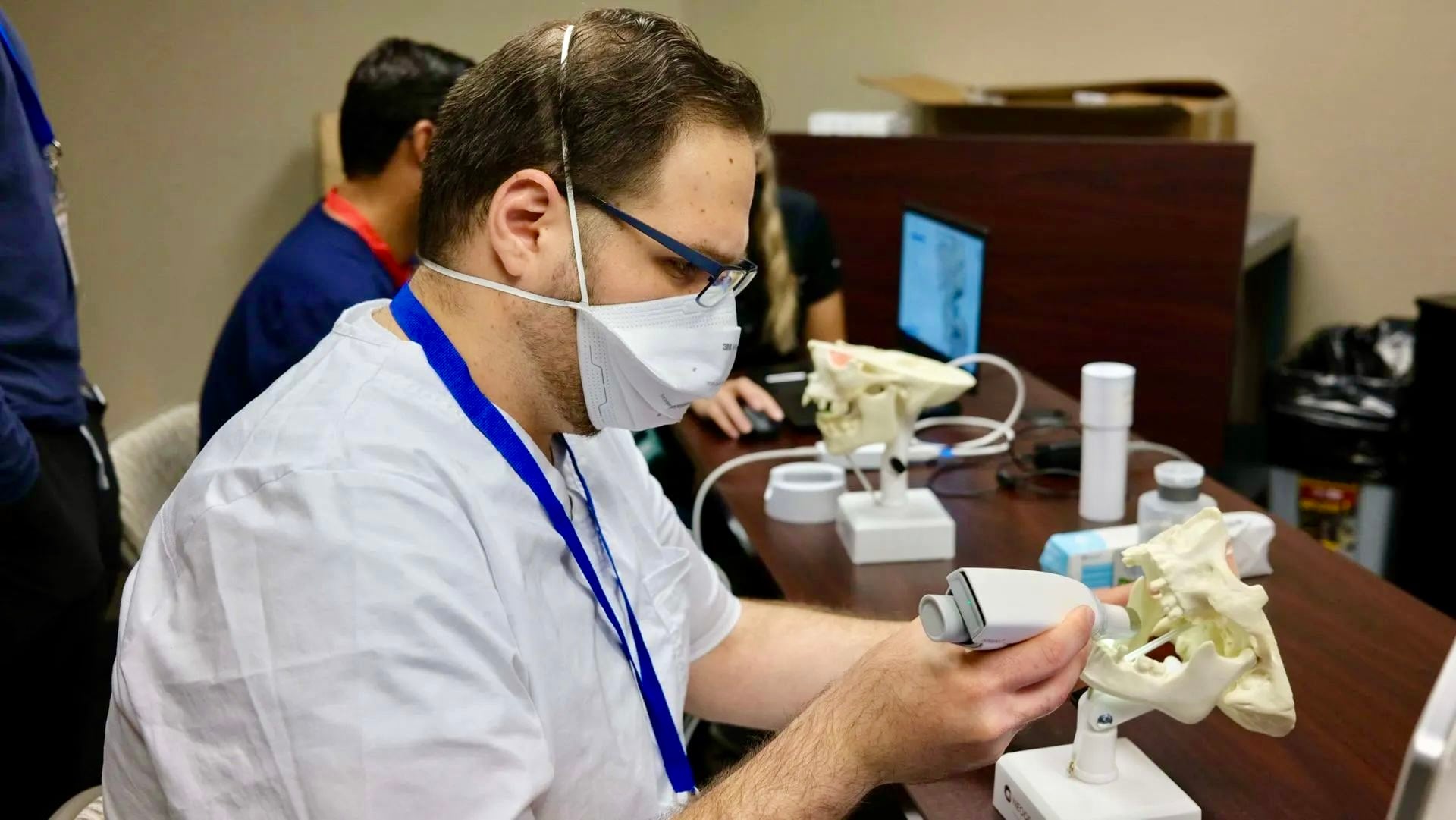
Intermediate (10–50 implants placed). Dentists in this range usually benefit from live-patient surgical hours under mentor supervision. Evaluation should focus on participant-to-mentor ratio, case complexity, and whether the program teaches the business and team systems needed to move beyond one or two arches per month. Participant-to-mentor ratio carries the second-highest weight in structured implant CE scoring frameworks.
Advanced (200+ full arches placed). High-volume surgeons typically need two things that standard full-arch programs rarely provide. They need advanced surgical techniques for atrophic cases, including zygomatic, pterygoid, trans-sinus, palatal-approach, and custom subperiosteal placements. They also need a more efficient digital workflow that reduces chair time per case. Programs that do not gate their advanced track by career arch volume often dilute the curriculum to fit all experience levels, which limits depth for experienced operators.
Team Training and Long-Term Support
Full-arch implant restoration functions as a team procedure, not a solo effort. The treatment coordinator closes the consultation. The surgical assistant acquires preoperative records and manages chairside delegation. The lab technician designs and finishes the prosthetic. When any of these roles is undertrained, the workflow slows and the dentist absorbs the slack as non-billable chair time.
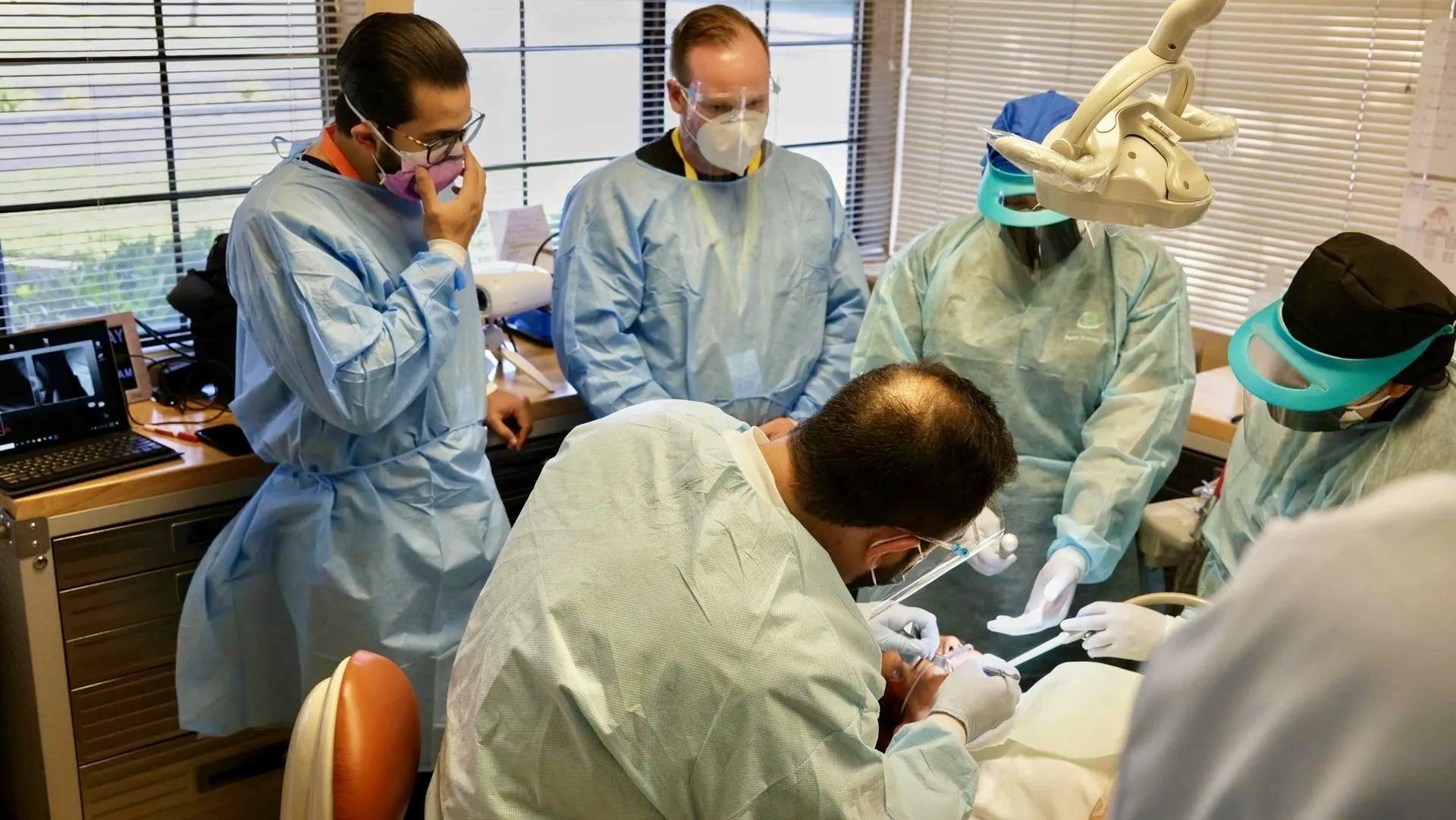
Training the full team together closes the implementation gap that causes many post-course failures. A dentist who returns alone with new technique knowledge but an unchanged team cannot run the workflow at volume. A practice that trains together leaves with a shared operating system.
The FAM Method follows seven sequential steps that the entire team executes together:
- Preoperative records and data acquisition
- Photogrammetry and intraoral scanning
- CBCT and digital treatment planning
- exocad design
- Immediate-load conversion
- Final zirconia design and finishing
- FP1-specific design, team implementation, and workflow scaling
Each step has a designated team role. Training the dentist on steps two through five while leaving the assistant untrained on step one, or the lab technician untrained on steps four through seven, recreates the same hybrid-workflow problems the program aims to solve.
Post-course support keeps that workflow working in real practice. When a difficult case appears three months after training, the dentist needs access to peers who have handled similar scenarios, not only a binder and a phone number. Full Arch Masters provides continued access to alumni group chats with hundreds of FAM-trained dentists, lab technicians, and team members, plus access to the KOL buying group, which delivers vendor discounts on implants, design software, and equipment at no recurring cost. You attend one course and keep the access.
Register for an upcoming Full Arch Masters course to secure lifetime access to the FAM alumni community and KOL buying group.
Cost vs. Live-Patient Hours: Program Types
The table below offers a reference framework for comparing program types by tuition range and live-patient full-arch case volume. Insert data from any program you are evaluating into the appropriate row. All figures below come from publicly available course listings as of mid-2026.
| Program Type | Typical Tuition Range | Live-Patient Full-Arch Cases Performed per Operator |
|---|---|---|
| Lecture and model-based only (no live patients) | $4,000–$7,000 | 0 |
| Live-patient observation only (no operating) | $6,000–$10,000 | 0 (observation only) |
| Live-patient surgical operator (hands-on) | $11,000–$21,000 | varies, at least one program allows 2 full arches per operator |
Tuition alone does not define value. A $5,000 lecture-only program and a $20,000 live-surgical program cannot be compared on cost without factoring in live-patient hours, post-course support, team attendance options, AGD PACE credit value, and the other criteria in the table above. Use the seven-criteria table together with this cost reference when scoring any program.
Common Questions Dentists Ask
What does full-arch implant CE typically cost in the US?
Tuition ranges vary by format and scope. Lecture and model-based programs without live patients generally run $4,000–$7,000. Programs that include live-patient surgical operating typically range from $11,000 to $21,000, depending on the number of cases performed and the track level. Observer-only options at live surgical full-arch implant programs are generally available in the $6,000–$10,000 range. Full program bundles that combine multiple full-arch implant CE courses typically range from a few thousand dollars up to around $28,000 before discounts. Full Arch Masters’ Fellowship bundle combines three core courses plus a fourth elective at a $5,000–$10,000 discount versus individual course pricing, with payment plans available up to 9–12 months.
How many AGD PACE CE credits does a full-arch course typically award?
AGD PACE-approved programs vary widely in credit hours. Single-course programs generally award 16–39 CE credits, depending on duration and format. Full Arch Masters’ main courses each award 32 AGD PACE-approved CE credits. The full FAM Fellowship program delivers more than 90 CE hours across all courses combined. When you evaluate any program, confirm that the AGD PACE credit breakdown separates lecture hours from hands-on and live-patient hours, because some state dental boards require this distinction for license renewal documentation.
Should a dentist who has never placed a full arch start with full-arch CE?
A dentist with no prior full-arch experience can attend a well-structured full-arch program if the program offers a beginner track and does not require prior arch volume as a prerequisite. Full Arch Masters’ Flagship Course is designed for the full experience range, from dentists who have placed zero full arches through mid-career surgeons, and the Live Surgical Course includes a Basic Operator track for dentists with fewer than 200 career arches placed. The key factor is whether the program teaches the complete operating system around the procedure, including team roles, digital workflow, treatment coordination, and case acceptance, not only the surgical steps.
How long does it take to scale to five full-arch cases per month after training?
Timeline depends on existing implant volume, team readiness, marketing infrastructure, and local demand. Practices that bring the full team to training and return with a shared workflow and a trained treatment coordinator usually operationalize faster than practices where only the dentist attended. The constraint after training is rarely surgical skill. More often, the constraint is consultation closing rate, records acquisition workflow, or lab turnaround time. Full Arch Masters’ alumni community offers ongoing case support and peer benchmarking that helps practices identify and resolve these bottlenecks after the course ends.
Why does photogrammetry matter more than a hybrid scanning workflow?
Photogrammetry captures the three-dimensional positions of multiple implants at once with accuracy that intraoral scanning alone cannot reliably match across a full arch. In a hybrid workflow, where photogrammetry is replaced by analog impressions or partial digital capture, passive fit of the prosthesis becomes harder to achieve. That difficulty increases chairside adjustment time and the risk of prosthetic complications. An end-to-end digital workflow that treats photogrammetry as a required step, rather than an optional one, supports predictable same-day delivery at scale.
What happens after a Full Arch Masters course ends?
Every Full Arch Masters attendee joins private alumni group chats with hundreds of FAM-trained dentists, lab technicians, and team members, including a dentist-only chat for sensitive practice and personnel questions and a main multi-role chat for clinical and operational case help. Alumni also receive a digital resource library that covers surgical room setup checklists, finishing techniques, treatment coordinator forms, consent templates, and Dr. Dunlop’s lecture materials. KOL buying group access, which provides vendor discounts on Neodent implants, exocad licenses, 3D printers, and photogrammetry systems, is included at no recurring cost for the life of the alumni relationship. Community access has no subscription fee and no expiration date.
Conclusion: Applying the Seven Criteria to Your Next Course
Selecting the best continuing education course for full-arch dental implants in the US means scoring programs on seven objective dimensions, including live-patient surgical hours, experience-tier matching, team attendance options, photogrammetry integration, post-course community access, recurring versus one-time fees, and AGD PACE credit value, then matching the program to your current volume and growth goals. Register for an upcoming Full Arch Masters course and bring your team to train on the FAM Method’s photogrammetry-first digital workflow, with continued alumni community and KOL buying group access included at no recurring cost.