Written by: Ryan Dunlop, CEO and Founder of Full Arch Masters and graduate from the Harvard School of Dental Medicine
Key Takeaways for Choosing a Full-Arch Implant Course
-
Most full-arch implant courses teach the surgery but skip the digital workflow, team delegation model, and post-course support needed to move beyond one or two cases per month.
-
Strong programs show clear proof of live-patient surgical volume, photogrammetry-first digital integration, immediate-load training, full-team participation, post-course mentorship, CE accreditation, and reported revenue outcomes.
-
Full Arch Masters structures its curriculum by experience level, with tracks for beginners through advanced operators plus dedicated lab technician and treatment coordinator courses.
-
Programs that ignore integrated digital workflows or team training create two common failure points: workflow fragmentation and post-course isolation.
-
Full Arch Masters delivers an end-to-end same-day teeth system with lifetime alumni support and measurable revenue results. Explore the Full Arch Masters curriculum to see how the training supports implementation in your practice.
How to Evaluate Any Dental Implant Course for Full-Arch Success
Seven criteria separate programs that build scalable full-arch practices from those that produce a binder and a stalled workflow.
-
Live-patient surgical volume. Simulation and model work develop motor patterns, while live patients develop clinical judgment. Live-patient training develops clinical judgment, sequencing, and confidence under real conditions that cannot be fully developed in simulation alone. Evaluate how many live arches each operator performs, not just observes, during the course.
-
Photogrammetry-first digital workflow integration. In 2026, the biggest trend in dental photogrammetry is reducing hidden implant position errors that contribute to long-term complications such as implant stress, screw loosening, and bone loss appearing 2–5 years after delivery. A course that teaches intraoral scanning without photogrammetry teaches a hybrid, not a fully digital workflow. Confirm that the curriculum integrates intraoral scanning, photogrammetry, CBCT, facial scanning, exocad design, and immediate-load 3D printing as a single system.
-
Immediate-load and same-day delivery training. Spear Education’s April 2026 All-on-X clinical restorative guide identifies surgical placement with immediate prototype prosthesis, including intraoral scanning, photogrammetry, fiducial alignment, and immediate prosthesis fabrication, as a standard workflow step. Courses that skip immediate-load training leave practices unable to deliver same-day results.
-
Full-team training and delegation. A dentist who returns from a course without a trained assistant, treatment coordinator, and lab technician cannot operationalize the workflow. Check whether team-member attendance is structurally supported and priced into the program.
-
Post-course community and mentorship access. Post-course mentorship programs bridge the training-to-production gap by providing ongoing support for building case volume, troubleshooting complications, and developing clinical judgment in a dentist’s own operatory. Ask specifically what access looks like after the course ends, such as group chats, case review, or no support at all.
-
CE credit accreditation. Confirm the accrediting body and credit hours. Full Arch Masters courses are accredited through the American Academy of General Dentistry (AAGD) for 32 CE credits per course, with more than 90 hours across the full Fellowship program.
-
Reported revenue outcomes and regulatory transparency. Programs that report alumni revenue outcomes give prospective attendees a measurable benchmark. Separately, confirm that any live-patient surgical component operates under a clear legal framework. Full Arch Masters’ Live Surgical Course runs under Colorado Dental Board credentialing, which authorizes US-licensed dentists to perform surgery on volunteer patients.
Matching Course Tracks to Your Full-Arch Experience Level
Experience level shapes which full-arch course will move a practice forward fastest. A dentist placing first full-arch cases needs different training than an operator handling complex atrophic arches. Full Arch Masters structures its curriculum around where a practice is today, not a single entry point. The table below maps career arch volume to the recommended course track.
|
Career Arches Placed |
Recommended FAM Course Track |
Primary Focus |
|---|---|---|
|
0–50 arches (or adding full-arch for the first time) |
Flagship Course + Live Surgical Basic Operator |
End-to-end FAM Method, team alignment, live surgical experience on two full arches under mentor supervision |
|
50–200 arches |
Flagship + Design and Finish + Treatment Coordinator Bootcamp |
Digital workflow integration, lab-side capability, closing system to scale case volume |
|
200+ arches |
Live Surgical Advanced Operator + FP1 Course |
Zygomatic, pterygoid, trans-sinus, palatal-approach, and custom subperiosteal techniques for atrophic cases, plus FP1-specific prosthetic workflow |
|
Lab technicians (any level) |
Design and Finish Course + FP1 Course |
exocad digital design, aesthetic finishing on zirconia, MIYO ceramic layering, FP1-specific design instruction |
|
Full team (dentist + TC + assistant) |
FAM Fellowship Bundle |
All three core courses plus a fourth elective at $5,000–$10,000 off individual pricing, with more than 90 CE hours |
Best Didactic Implant Courses for Full-Arch Foundations
Didactic programs, which are lecture-based with no live patients, build conceptual fluency in anatomy, biomechanics, treatment planning, and prosthetic classification before a dentist operates. Programs from organizations such as Spear Education, the American Academy of Implant Dentistry (AAID), and university-affiliated maxicourses provide structured theoretical foundations. The AAID Associate Fellow credential requires completion of at least 300 hours of postdoctoral or continuing education in implant dentistry within the past 12 years, with at least 75 hours in participatory format for exams after September 1, 2019, while the Fellow credential requires 400 hours plus five years of experience and a comprehensive case examination.
Purely didactic programs have a clear limitation. Short-term workshops can produce modest conversion lifts that decay without ongoing feedback loops and workflow changes. The same pattern appears in clinical skill. Conceptual knowledge without live-patient repetition does not translate to chairside confidence.
For full-arch specifically, didactic training serves as a prerequisite, not a destination. The workflow requires integration of CBCT imaging, intraoral scanning, photogrammetry, and immediate-load 3D printing into a single repeatable system. That integration does not transfer from slides alone.
Best Hands-On Implant CE for Full-Arch Implementation
Hands-on full-arch CE programs vary widely in what “hands-on” means. Some programs offer model work or pig jaw simulation. Others provide live-patient surgical experience. This distinction matters. Live-patient training allows dentists to encounter real clinical variables including differences in bone density, anatomical structures, surgical access limitations, and soft tissue conditions.
Full Arch Masters’ Live Surgical Course in Parker, Colorado is one of the few programs in the United States where visiting US-licensed dentists can legally perform full-arch surgery on volunteer patients. The Colorado Dental Board authorizes this under a credentialing process FAM submits ten days before each course. Each Basic Operator performs two full arches across the two surgical days. The Advanced Operator track, which is limited to dentists with more than 200 career arches placed, focuses on zygomatic, pterygoid, trans-sinus, palatal-approach, and custom subperiosteal techniques for atrophic cases.
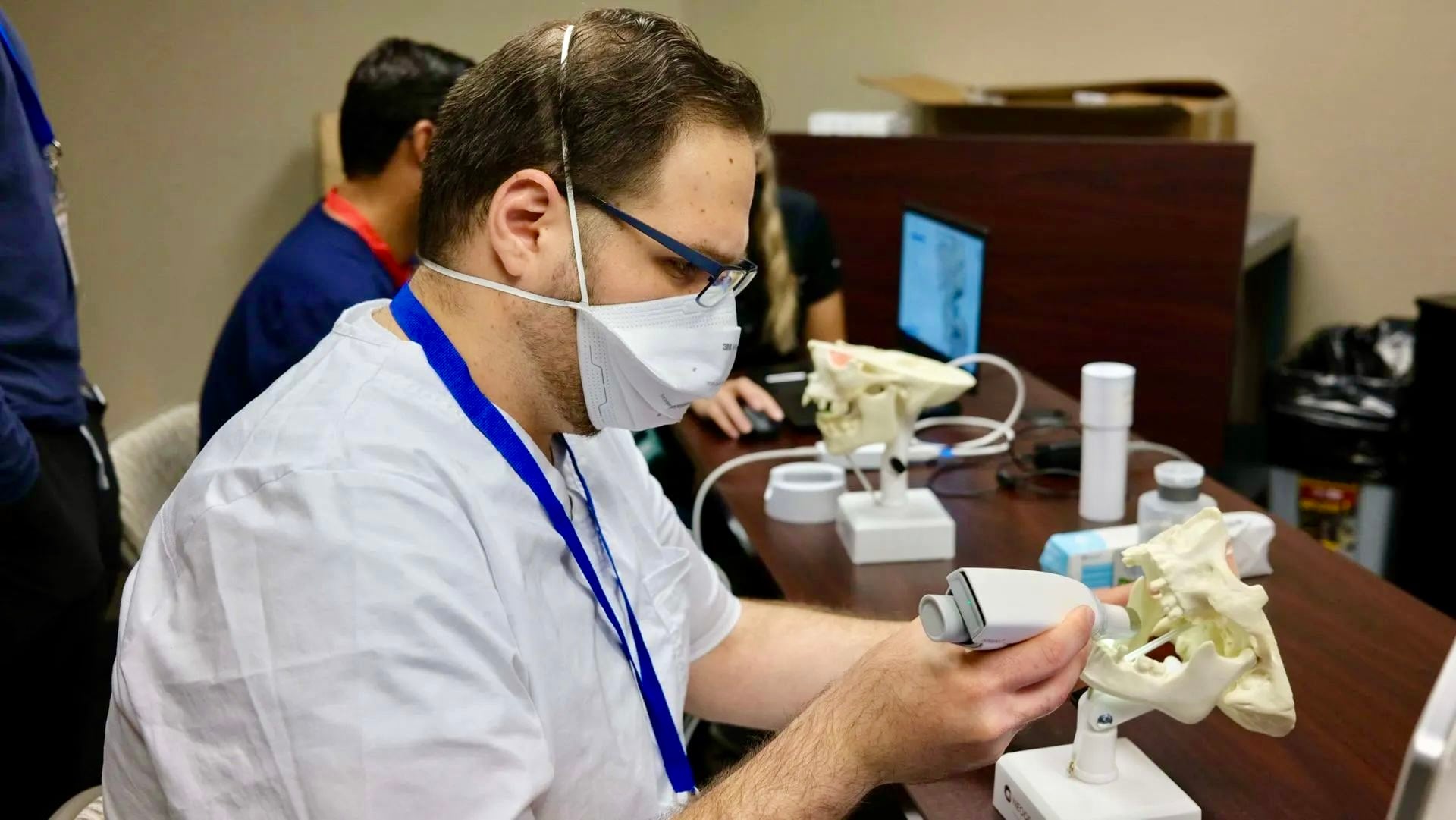
FAM’s curriculum teaches photogrammetry as the foundation of the workflow, not as an add-on. The iCam4D system from Imetric4D, a FAM technology partner, captures direct vectors of implant positions relative to one another via ICamBodies attached to multi-unit abutments, avoiding cumulative stitching errors that occur with intraoral scanners when capturing multiple splinted implants in edentulous arches.
Courses That Include Team Training and Post-Course Support
Full Arch Masters is built around the principle that a dentist who returns from training without a trained team cannot operationalize the workflow. The FAM Method, which is FAM’s proprietary end-to-end digital workflow, requires a coordinated assistant for records acquisition, a treatment coordinator running the closing system, and a lab technician handling design and finishing. Training one person and leaving the rest of the team behind is the most common reason practices stall after a course.
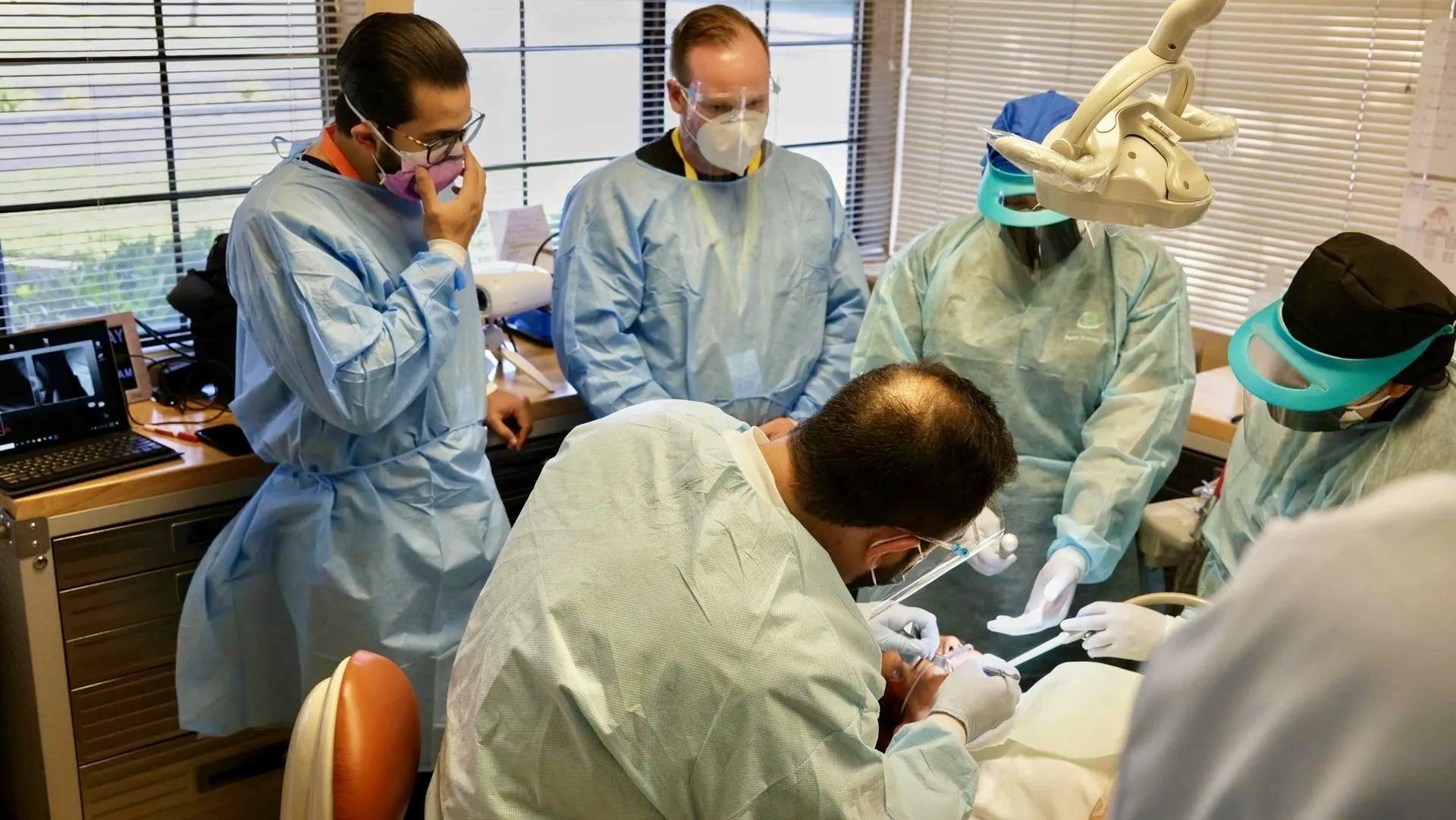
The FAM ecosystem addresses this directly:
-
Full-team pricing: $2,500 per additional team member at the Flagship Course, with team-member pricing built into every course in the catalog.
-
Continued alumni community: Every attendee joins private group chats spanning dentists, assistants, lab technicians, and treatment coordinators, creating a network of hundreds of FAM-trained professionals available for case help on demand for the life of the relationship.
-
KOL (Key Opinion Leader) buying group: Alumni receive vendor discounts on Neodent implants, exocad licenses, 3D printers, and photogrammetry systems at no recurring cost, with no GPO membership fees and no DSO affiliation required.
-
Digital resource library: A complete reference library covering surgical room setup checklists, finishing techniques, treatment coordinator forms and presentations, consent templates, and Dr. Dunlop’s lecture materials.
-
Treatment Coordinator Bootcamp: A dedicated two-day course taught by FAM’s in-house treatment coordinator, who maintains an 80% closing rate on full-arch consultations, compared to untrained treatment coordinators who close at lower rates.
Common Post-Course Failure Points and How FAM Addresses Them
Two failure patterns account for most practices that complete a full-arch course and never scale.
The first pattern is workflow fragmentation. Most “digital” full-arch workflows are hybrids that rely on partial impressions, off-site lab work, and multi-day appointments. An Error Control Framework for full-arch implant rehabilitation identifies cumulative error propagation, from scanning strategy through scan-body geometry to final manufacturing, as the primary source of fit failures rather than individual user error. Courses that teach isolated tools without teaching the integrated system leave practices exposed to exactly this failure mode.
The second pattern is isolation. Full-arch implant dentistry is competitive and often secretive. Many programs end support when the course ends. When a difficult case appears, such as an atrophic arch, an unexpected bone deficiency, or a prosthetic complication, there is no peer network to ask. FAM’s continued alumni community exists specifically to close this gap. The open-book philosophy, which means giving out the full recipe rather than guarding it, encourages FAM-trained dentists to share workflows, case photos, and clinical decisions in real time across the alumni group chats.
Conclusion: Choosing a Full-Arch Course That Scales Your Practice
The best dental implant course for full-arch restoration in 2026 teaches implementation, not just technique. That means live-patient surgical volume, a photogrammetry-first integrated digital workflow, full-team training, post-course community access, and measurable revenue outcomes. Full Arch Masters alumni report same-day teeth in 2–4 hours and more than $1M per year in added practice revenue. Register for an upcoming Full Arch Masters course at fullarchmasters.com.
Frequently Asked Questions
What should I look for in a full-arch implant CE course if I am already placing single implants?
The transition from single-implant placement to full-arch is primarily a systems leap rather than a surgical leap. A dentist placing single implants already has foundational surgical competency. Full-arch work adds an integrated digital workflow covering intraoral scanning, photogrammetry, CBCT-based planning, immediate-load 3D printing, and exocad design. It also requires a team trained to execute records acquisition and case coordination without consuming the dentist’s chair time, plus a treatment coordination system capable of closing high-ticket consultations. When evaluating courses, prioritize programs that teach the full operating system, not just the surgical steps, and that include live-patient experience, team training, and post-course community access. Full Arch Masters’ Flagship Course is designed for this transition and covers every component of the FAM Method across four days with the dentist and full team attending together.
How many live-patient cases should a full-arch implant course include?
No universal minimum exists, but the key standard is whether each attending operator performs cases rather than only observing them. Observation builds familiarity, while operating builds clinical judgment. Full Arch Masters’ Live Surgical Course in Parker, Colorado provides each Basic or Advanced operator with two full-arch cases across the two surgical days, performed on volunteer patients under expert mentor supervision and Colorado Dental Board credentialing. For context, the Adin Dental Full-Arch Live Patient Masterclass provides three cases per operator across three days. Programs that offer only observation, model work, or pig jaw simulation do not replicate the clinical variables, including bone density variation, soft tissue management, and anatomical access, that determine whether a dentist can execute independently in their own practice.
Is full-arch implant training worth the investment for a general dentist?
The economics favor practices that commit to building a full-arch workflow. A single full-arch case runs $20,000–$35,000 nationally, with two-arch cases running $40,000–$70,000. A comprehensive implant dentistry course costing $15,000–$25,000 can generate $200,000 or more in additional annual revenue for practices that systematically build the workflow, with typical 12-month ROI in the range of 400–600%. Full Arch Masters alumni report adding more than $1M per year in practice revenue after adopting the FAM Method. That figure reflects a faster workflow with same-day teeth in 2–4 hours, a higher-converting treatment coordination system with an 80% closing rate in-house at FAM, and a team delegation model that allows the practice to run more arches per week without consuming the dentist’s chair time on non-billable tasks. Most dentists who actively build their implant workflow recover their training investment within 6–12 months of beginning to place cases.
What is the difference between photogrammetry and intraoral scanning for full-arch implant cases?
Intraoral scanning captures soft tissue and tooth structure with high accuracy over short spans, but cumulative stitching errors increase as the span length grows. This limitation becomes significant in full-arch edentulous cases where four to six implants must be captured with passive-fit precision. Photogrammetry captures implant positions directly via encoded scanbodies and delivers micron-level precision that eliminates many fit failures common in analog workflows. The clinical consequence of a non-passive fit includes implant stress, screw loosening, and marginal bone loss appearing two to five years after delivery. A photogrammetry-first workflow does not replace intraoral scanning. It complements intraoral scanning, with scanning capturing soft tissue and photogrammetry capturing implant positions. Full Arch Masters teaches this integration as the foundation of the FAM Method, using the iCam4D system from Imetric4D alongside intraoral scanning, facial scanning, and CBCT as a single coordinated workflow.
Can my lab technician attend Full Arch Masters courses, and is there a course specifically for lab work?
Lab technicians can attend Full Arch Masters courses, and FAM offers a dedicated lab-focused track. The Design and Finish Course is a four-day program taught in Fresno, California. The first two days focus on digital design in exocad, covering preop records, digital mockups, surgical alignment devices, immediate-load prosthetics, and final zirconia design. The final two days focus on hands-on aesthetic finishing on pre-sintered and post-sintered zirconia with MIYO ceramic layering. FAM surveys attendees in advance and separates beginners from advanced designers so each track runs at the appropriate level. Lab technicians can also attend the FP1 Course for FP1-specific design instruction and can attend the Flagship Course alongside the dentist they support, which keeps the clinical and lab sides of the practice aligned on the same workflow. In-house lab technicians attending the Flagship Course pay $2,500 as an additional team member. Every lab technician who completes a FAM course joins the alumni group chats and gains access to the KOL buying group at no recurring cost.