
Written by: Ryan Dunlop, CEO and Founder of Full Arch Masters and graduate from the Harvard School of Dental Medicine
Key Takeaways
Before you compare specific courses, keep these core points in mind.
-
Dental implant continuing education ranges from $1,000 weekend workshops to $25,000+ year-long university programs, and the choice directly affects clinical competence, case acceptance, and practice revenue.
-
Effective implant CE should be evaluated across six dimensions: clinical feasibility, workflow efficiency, team readiness, technology requirements, financial implications, and ongoing support.
-
Full-arch implant restoration is a high-value niche that calls for integrated training in digital workflow, advanced surgical techniques, prosthetic design, and team coordination, rather than isolated implant placement skills.
-
Programs that combine hands-on live-patient experience, team training, and post-course mentorship tend to deliver the fastest ROI, with many dentists recovering costs within 6–12 months and adding significant annual revenue.
-
Full Arch Masters provides implementation-focused, full-arch-specific training with team-based learning and continued alumni support, and you can see how it can transform your practice.
How To Evaluate Implant CE Programs With A Clear Framework
Consistent evaluation criteria help you compare very different programs side by side. Use these six dimensions to assess any dental implant continuing education option.
-
Clinical feasibility. Check whether the curriculum matches your current skill level. Confirm that you can realistically implement what you learn in your practice setting.
-
Workflow efficiency. Favor programs that teach an integrated, end-to-end workflow instead of isolated techniques you must piece together later.
-
Team readiness. Look for training options for assistants, treatment coordinators, and lab technicians. A dentist trained alone cannot operationalize a team-dependent procedure.
-
Technology requirements. Identify the equipment, software, and digital tools the curriculum assumes. Confirm that you can acquire them without excessive additional investment.
-
Financial implications. Calculate the total cost including travel, materials, and team member tuition. Estimate a realistic timeline to recoup the investment.
-
Ongoing support. Prefer programs that continue after graduation with access to mentors, alumni communities, and case support.
Evaluate Full Arch Masters against every one of these dimensions, because it was built to satisfy all six.
Types Of Dental Implant CE Programs To Consider
The implant CE landscape falls into four broad categories. Each format carries different expectations for cost, time, and clinical outcomes.
-
University-based continuums. Programs like Harvard School of Dental Medicine’s Implant and Digital Dentistry program ($20,000, 155 CE credits, blended online and in-person format) offer academic depth and prestige. Harvard’s program is observation-based, so participants do not treat patients. University continuums typically cost $15,000–$25,000 and require a significant time commitment.
-
Institute hands-on courses. Specialized institutes offer intensive, focused training with live-patient surgical experience and small attendee-to-mentor ratios. Costs vary widely depending on format and live-surgery components. Full Arch Masters occupies a distinct position as a specialized institute offering full-arch-specific training accredited for 32 CE credits per main course through the American Academy of General Dentistry (AAGD). The curriculum integrates digital workflow, surgical technique, lab design, and team systems into a single program.
-
Online and hybrid options. Online courses offer flexibility and lower cost ($1,000–$5,000) but cannot develop tactile surgical skills. Most state boards cap online CE at 25–50% of total required hours. Hybrid models that combine online theory with in-person hands-on training are increasingly common and represent a growing share of dental CE.
What To Look For In Curriculum, Mentorship, And Live-Patient Exposure
Three factors tend to separate transformative CE from expensive lectures.
-
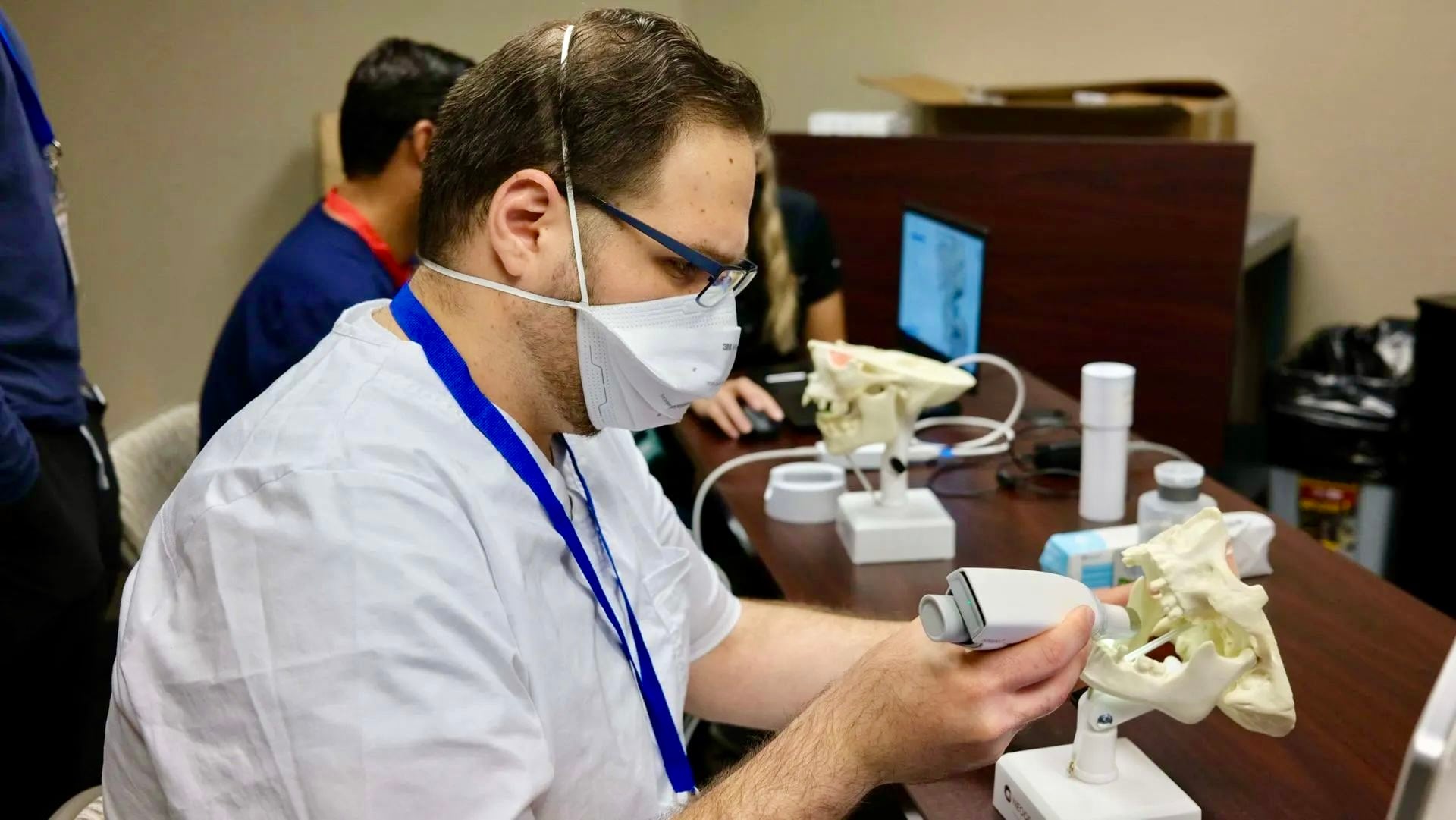
Curriculum depth. Choose programs that teach a complete system instead of isolated procedures. For full-arch work, this includes digital workflow, surgical technique, prosthetic design, and team delegation in addition to implant placement.
-
Mentorship quality. Confirm that instructors actively practice what they teach. Full Arch Masters’ instruction team is cross-trained, and every senior instructor has worked the clinical, lab, and front-office roles they teach.
-
Live-patient exposure. Observation alone does not build competence. Full Arch Masters’ Live Surgical Course in Parker, Colorado provides the closest possible analog to independent practice. There, the Colorado Dental Board credentials visiting U.S. dentists to operate on volunteer patients. Small cohorts, with a maximum of 8 dentists per Flagship cohort, ensure meaningful hands-on time.
Cost And ROI: What Implant CE Really Returns
Typical costs by program type appear below.
-
Online courses: $1,000–$5,000
-
Institute hands-on courses: $5,000–$20,000
-
University continuums and MaxiCourses: $18,000–$25,000
-
Live surgical programs: $20,000–$25,000+
These ranges show that higher cost does not always guarantee better outcomes. Evaluate the curriculum and support alongside the price tag.
Return on investment depends heavily on implementation speed. Most dentists who actively build their implant workflow recover their training investment within 6 to 12 months. Practitioners with over 200 hours of hands-on implant training achieved 30% higher case acceptance rates for complex cases compared to those with under 50 hours.
Full Arch Masters alumni report adding over $1M per year in practice revenue after adopting the FAM Method, the proprietary digital workflow taught across all courses. A faster workflow that delivers same-day teeth in 2–4 hours allows more arches per week at higher margin, and the marketing and treatment coordination content helps close more of the consultations practices already see.
See how the FAM Method translates directly into practice revenue by exploring upcoming course dates on the Full Arch Masters site.
Why Full-Arch Implant CE Is A High-Value Niche
Full-arch implant restoration ranks among the highest-value procedures in modern dentistry. A single patient who arrives with missing, failing, or heavily decayed teeth can leave the chair the same day with a full, fixed prosthesis. Full-arch restorations such as All-on-4 or All-on-6 often range from $18,000 to over $35,000 per arch. As noted in the ROI section, practices that build an efficient workflow can achieve substantial annual revenue gains from these cases.
Full-arch work requires skills beyond basic implant placement. Dentists need digital workflow integration, advanced surgical techniques such as zygomatic and pterygoid for atrophic cases, prosthetic design, and team coordination. Many training programs cover the procedure itself but do not address the full system around it.
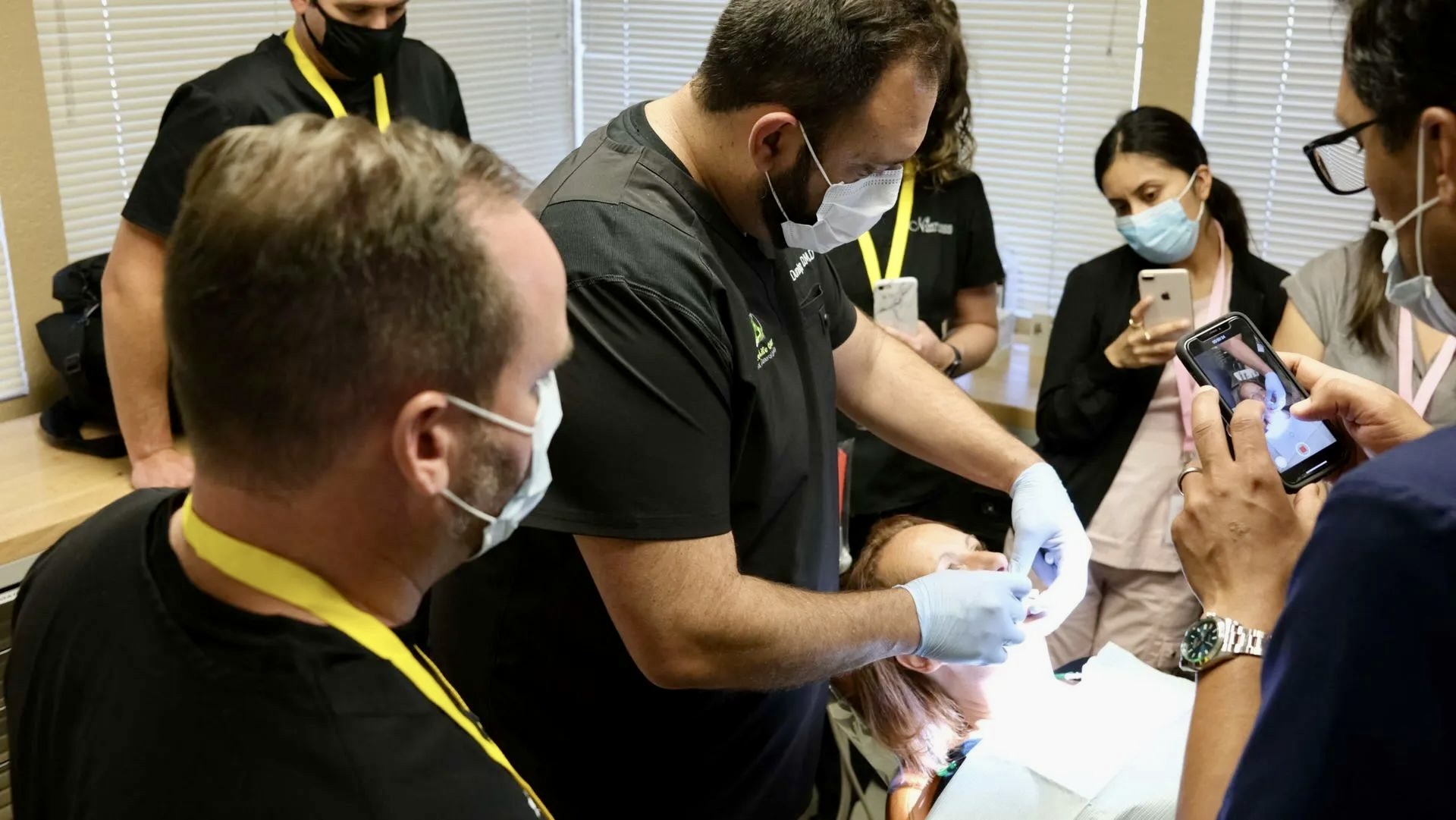
Full Arch Masters teaches the FAM Method, a proprietary digital workflow that integrates intraoral scanning, photogrammetry, CBCT imaging, exocad design, and 3D-printed immediate-load conversion into a single repeatable system. The seven steps below show how each phase builds on the last to take a case from records to final restoration.
-
Preoperative records and data acquisition
-
Photogrammetry and intraoral scanning
-
CBCT and digital treatment planning
-
exocad design
-
Immediate-load conversion
-
Final zirconia design and finishing
-
FP1-specific design, team implementation, and workflow scaling
Choosing Based On Experience Level: A Decision Framework
Any licensed general dentist can legally place implants, yet the right CE program depends heavily on where a dentist currently sits in their implant journey.
-
Beginners (never placed a full arch). Start with a comprehensive course that covers the entire workflow and team systems. Full Arch Masters’ Flagship Course (4 days, Fresno, CA) teaches the complete FAM Method, from new patient acquisition and case presentation to surgical planning and final restoration delivery, with hands-on records acquisition on live patients.
-
Intermediate (placing some full arches). Focus on gaining supervised surgical experience. Full Arch Masters’ Live Surgical Course Basic track, designed for dentists with fewer than 200 career arches, provides two full-arch cases per operator under expert mentor supervision.
-
Advanced (200+ arches placed). Pursue advanced techniques for atrophic cases. The Advanced Live Surgical track covers zygomatic, pterygoid, trans-sinus, and palatal-approach placements, procedures that most full-arch programs do not teach.
Common Pitfalls And How To Avoid Them
-
Choosing a program without hands-on experience. Lecture-only or observation-based programs cannot build surgical competence. Verify how many implants you will personally place before enrolling.
-
Ignoring team training. A dentist who returns from training without a trained team cannot operationalize a team-dependent workflow. Full Arch Masters’ team-based model, described as one team and one workflow, helps your assistant, treatment coordinator, and lab technician stay aligned from day one.
-
Overlooking post-course support. Full Arch Masters provides continued access to private group chats with hundreds of FAM-trained dentists, lab technicians, and team members. The course ends, and the community continues.
-
Underestimating the learning curve. Full-arch is a different competency from single-implant placement. It requires coordinated diagnosis, surgery, provisionalization, restoration, and long-term maintenance. Budget time and resources for the transition.
Bring your full team to a Full Arch Masters course, because the FAM Method is built for the whole practice, not just the dentist.
Frequently Asked Questions
What Is The Difference Between A University Continuum And A Hands-On Institute Course?
University continuums offer academic depth, broad curricula, and prestigious credentials, typically delivered over 10–12 months. Programs like the AAID MaxiCourse provide 300+ CE hours and include cadaver and live-surgery components, while programs like Harvard’s Implant and Digital Dentistry course are observation-based and do not involve treating patients. Institute courses are intensive and focused, often compressing training into 2–5 days with more hands-on and live-patient exposure. University programs cost more ($18,000–$25,000) but provide extensive CE hours. Institute courses range from $5,000–$25,000 depending on live-surgery components. The right choice depends on whether a dentist’s primary goal is broad credentialing or fast, implementation-focused skill acquisition.
How Many CE Credits Do I Need For Implant Dentistry?
State requirements vary, but most states require 30–50 CE hours every 2–3 years for license renewal. For implant-specific credentialing, the AAID Associate Fellow requires 300+ hours of implant-focused CE, and the ABOI/ID Diplomate requires 670 hours. Full Arch Masters courses are AGD PACE-approved for 32 CE credits per main course, with 90+ hours across the full Fellowship program. Always verify your specific state board’s current requirements, because rules on mandatory topics, online credit caps, and hands-on minimums vary by jurisdiction.
What Is The Best Dental Implant Course For Full-Arch?
For full-arch-specific training, focus on programs that teach the complete system, including digital workflow, surgery, prosthetics, and team delegation, instead of isolated technique. Full Arch Masters offers an integrated curriculum across five courses, with live surgical training under Colorado Dental Board credentialing and continued alumni community support. The seven-step FAM Method described earlier is taught as a single, repeatable system rather than a collection of disconnected techniques.
Do I Need To Bring My Team To Training?
For full-arch work, bringing the team is strongly recommended. The procedure is team-dependent, and your assistant, treatment coordinator, and lab technician must share the same workflow for the practice to run cases at volume. A dentist who returns from training without a trained team cannot operationalize a team-dependent procedure. Full Arch Masters’ team-based model includes team-member pricing ($2,500 per additional team member for the Flagship Course), which makes it structurally affordable to bring the whole practice. Most FAM attendees come as a group, such as a practice owner with their treatment coordinator and lead assistant, or a dentist with their in-house lab technician.
What Ongoing Support Should I Expect After A Course?
Look for continued access to mentors, alumni communities, and case support, going beyond a certificate and a digital resource library. Full Arch Masters provides lifetime access to private group chats with hundreds of FAM-trained dentists, lab technicians, and team members, including a dentist-only chat for sensitive practice and personnel questions. Alumni also gain enrollment in the KOL (Key Opinion Leader) buying group, which delivers vendor discounts on Neodent implants, exocad licenses, 3D printers, and other equipment at no recurring cost. Dentists attend one course and keep the discounts and the community.
Conclusion: Making The Right Investment In Your Practice
Dental implant continuing education is a career-defining investment. The right program teaches implementation, includes your team in the workflow, and provides ongoing support when difficult cases land on your schedule. Use the evaluation framework in this guide to assess your options consistently. Define your experience level, your practice goals, and your budget. Then choose a program that aligns with where you are and where you want to go.
For dentists seeking to add or scale full-arch implant cases, Full Arch Masters offers comprehensive, implementation-focused training. The FAM Method, a proprietary digital workflow delivering same-day teeth in 2–4 hours, is taught across five courses designed for the full team, with continued community support and a KOL buying group at no recurring cost.
For practices that want to close more of the full-arch consultations they already see, the Full Arch Masters Treatment Coordinator Bootcamp trains the front-office team on the exact closing system FAM uses in-house, where the treatment coordinator maintains an 80% close rate. This program serves as the natural next step after clinical training.