
Written by: Ryan Dunlop, CEO and Founder of Full Arch Masters and graduate from the Harvard School of Dental Medicine
Key Takeaways
-
Elite implant CE programs create real practice growth when they deliver hands-on case volume, full-arch readiness, post-course support, team training, and measurable ROI, not just credential hours.
-
Implant dentists can evaluate programs using six clear criteria: hands-on volume, credential pathways, full-arch workflow, mentorship access, team training, and operational systems for case growth.
-
Full Arch Masters stands out by pairing the FAM Method digital workflow with full-team training, alumni community access, and a no-cost KOL buying group that supports immediate implementation.
-
Practices that train the entire team together and implement the workflow within 30 days ramp faster and reach higher case volumes than those relying on dentist-only attendance.
-
Ready to transform your full-arch practice? Explore upcoming Full Arch Masters courses and join hundreds of alumni adding $1M+ in annual revenue.
How Full-Arch Implant Dentistry Reached Its Current Crossroads
Full-arch implant restoration has shifted dramatically over the past decade. For most of its clinical history, the procedure relied on analog steps: physical impressions, denture conversions cut chairside, off-site lab work, and multi-appointment sequences that kept most practices at one or two arches per month. The patient experience felt slow and uncomfortable, and chair time compressed the margin per case.
The convergence of intraoral scanning, cone-beam computed tomography (CBCT), facial scanning, photogrammetry, and 3D printing has changed what is operationally possible. A fully integrated digital workflow can now take a patient from preoperative records to a screwed-in, same-day prosthesis in 2 to 4 hours. The dental implant market reflects this momentum: Grand View Research projects the global dental implant market will grow from $5.56 billion in 2025 to over $11 billion by 2033.
In the United States, regulatory and economic factors shape how dentists access this training. The Colorado Dental Board is one of the few state boards that authorizes visiting U.S.-licensed dentists to perform surgery on volunteer patients during structured CE programs, which makes hands-on live full-arch surgical training possible outside a residency setting. State-level variation in scope-of-practice rules, combined with the absence of a federally mandated implant CE standard, means program quality and depth vary widely. Dentists must evaluate programs on their own merits rather than relying on regulatory minimums to guarantee rigor.
Economically, the gap between practices that can deliver full-arch predictably and those that cannot continues to widen. Implant case acceptance rates typically range from 40% to 50%, and cost is the primary barrier, so practices with strong treatment coordination and patient financing systems capture a disproportionate share of the available market. This economic reality has shaped how CE programs position themselves. Three broad CE models dominate the implant training landscape in 2026, and each one responds to a different constraint that limits a practice’s ability to capture that demand.
Three CE Models Implant Dentists See Most Often
Three broad CE models dominate the implant training landscape in 2026. Each model carries distinct implications for clinical execution, lab coordination, scheduling, and team responsibilities.
Credential-focused pathways are structured around documented CE hours and case submissions required for formal certification, not around team systems, digital workflow integration, or the operational infrastructure required to scale full-arch volume. They measure inputs such as CE hours and case submissions rather than a practice’s ability to deliver predictable full-arch volume.
Live-patient surgical programs prioritize hands-on case volume. Programs in this category vary widely. Some guarantee each operator a defined number of implant placements on real patients under faculty supervision. Others structure their curriculum around multiple full-arch cases from surgery through temporary insertion using a digital workflow. The clinical value of hands-on volume is well-established, and properly trained general dentists achieve strong outcomes when they build the necessary infrastructure. The limitation of surgical-only programs is that they address the clinical procedure without the surrounding operating system, including scheduling, lab coordination, team delegation, and case acceptance.
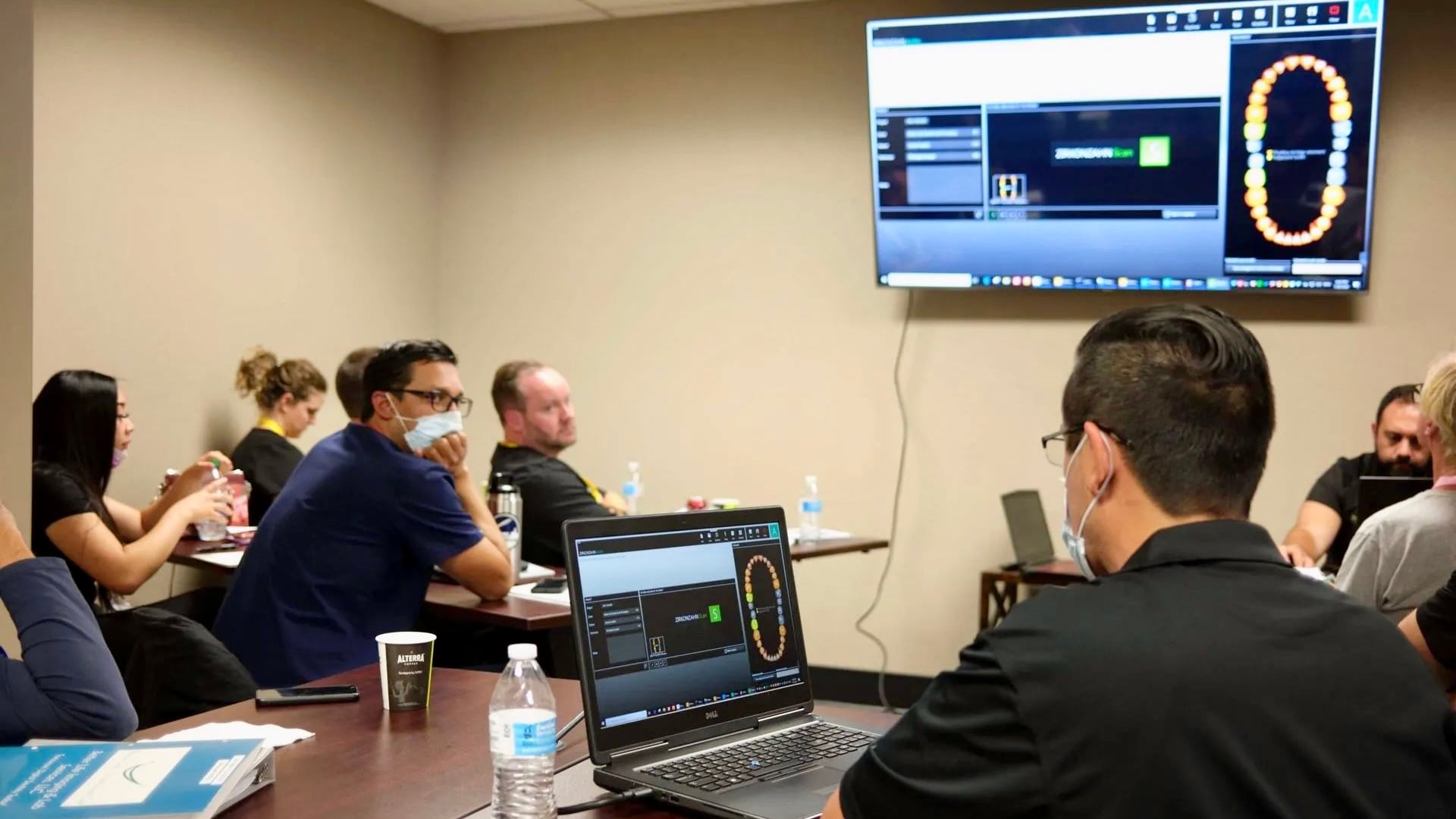
Implementation-focused team programs are the least common model and the one most directly correlated with practice-level revenue growth. These programs train the dentist, surgical assistant, treatment coordinator, and lab technician on the same workflow at the same time, so the practice can operationalize what it learned on day one of returning home. The key variable for ROI on implant CE is how quickly a dentist moves from course completion to consistent case volume; a dentist who places their first case within 30 days follows a fundamentally different trajectory than one who waits six months. Team-based programs shorten that gap by removing the re-training burden that falls on a dentist who returns from a solo course and must then teach the workflow to a team that was not there.
Explore Full Arch Masters team training options.
Strategic Trade-offs When Choosing an Implant CE Path
Understanding the three CE models is only the first step. Choosing among them, or among specific programs within each category, requires evaluating a set of strategic trade-offs that determine whether a program will actually fit your practice’s constraints.
Speed versus depth. Shorter courses of two to three days can introduce a technique or a specific prosthetic workflow efficiently. They work well for dentists adding a discrete skill to an existing full-arch practice. For dentists building a full-arch practice from the ground up, or for those who have attended shorter courses and still cannot operationalize the workflow, depth matters more than speed.
Single-provider versus team training. A dentist who attends a course alone returns to a team that has not been trained on the new workflow. The treatment coordinator still uses the old consultation script, so patients hear a message that does not match the new procedure. The surgical assistant still sets up the room the old way, which forces the dentist to stop mid-case and re-explain the protocol. The lab technician still works from the old records protocol, so the digital workflow breaks down at the handoff to fabrication. Standardized communication protocols for sharing records, prescriptions, and treatment plans, ensuring all providers access identical information throughout implant workflows, are a primary method for reducing handoff friction and later compromises. Team training removes the translation layer between what the dentist learned and what the team executes.
One-time course versus ongoing community access. The most common failure mode after implant CE is not a lack of clinical knowledge. The real problem is the absence of a peer network when a difficult case lands on the schedule. Full-arch implant dentistry is competitive and historically secretive, and practitioners who have figured out the workflow rarely share it. Programs that end when the course ends leave dentists without a resource for edge cases, equipment troubleshooting, or workflow questions that surface months later.
Operational Habits of High-ROI Implant CE Alumni
Dentists who extract the highest ROI from implant CE programs share a set of operational habits before, during, and after the course.
Pre-course preparation starts with auditing the current technology stack, including intraoral scanner, CBCT, 3D printer, and design software, and identifying gaps before arrival. Dentists who arrive at a course already familiar with their equipment can spend more cognitive bandwidth on workflow integration and less on basic tool operation. A retrospective study found that implant surgeries planned with panoramic radiographs alone were more likely to encounter unanticipated bone deficiencies compared to cases planned with CBCT imaging, which underscores the importance of having the right imaging infrastructure in place before scaling case volume.
Workflow integration involves mapping the course curriculum to the practice’s existing scheduling, lab, and consultation systems within the first two weeks of returning. Practices that delay this step consistently report slower ramp-up times and lower case volumes in the first quarter after training.
Documentation and benchmarking establish a baseline before the course and track measurable outcomes afterward, including cases per month, consultation-to-acceptance rate, average case revenue, and time per arch. Dentists who commit to building implant workflow systems and maintain consistent case volume can typically recover their training investment once they begin placing cases regularly.
Treatment coordination systems provide a measurable lever for growth. Given that cost is the primary barrier to the 40–50% baseline acceptance rate, practices that train their treatment coordinators on structured consultation scripts, patient financing options, and objection-handling protocols consistently close at higher rates than those that leave the consultation to the dentist alone.
Learn how Full Arch Masters trains your entire team.
Readiness and Opportunity Assessment for Your Practice
The best practices outlined above assume you have already selected and completed a program. The highest-ROI decision happens earlier, when you choose the right program in the first place. Before selecting a CE program, implant dentists benefit from an honest internal audit that reveals which type of training will close their specific gaps most efficiently.
-
Current case volume: How many full-arch cases does the practice complete per month? One to two arches per month usually indicates a workflow or team bottleneck, not a patient-demand problem.
-
Team readiness: Are the surgical assistant, treatment coordinator, and lab technician trained on the current full-arch workflow? Can the practice run a case without the dentist performing every non-billable step?
-
Technology stack: Does the practice have an intraoral scanner, CBCT, and a pathway to immediate-load prosthetics? Is the workflow end-to-end digital, or a hybrid with physical impressions and off-site lab work?
-
Consultation close rate: What percentage of full-arch consultations convert to accepted treatment? A rate below 60% usually indicates a treatment coordination gap rather than a clinical one.
-
Financial goals: What annual revenue target does the practice have for full-arch? Reaching $1M+ in full-arch revenue requires a workflow fast enough to run multiple arches per week, a team trained to support that volume, and a marketing system that generates consistent new patient flow.
-
Advanced case capability: Does the practice refer out atrophic cases, meaning patients with insufficient bone for standard implant placement, because the team lacks zygomatic, pterygoid, or trans-sinus technique training?
Common Pitfalls That Limit CE ROI
Even practices that complete a readiness assessment can still fail to extract ROI from their CE investment. The following failure patterns appear consistently among implant dentists who invest in CE but do not achieve the practice growth they expected, often because they selected a program that did not address the gaps identified in their self-audit.
-
Dentist-only attendance without team alignment. A dentist who returns from a course without a trained team cannot operationalize the FAM Method or any other full-arch workflow. The treatment coordinator still uses the old consultation script, the surgical assistant still sets up the room the old way, and the lab technician still follows the old records protocol, so every handoff creates friction. The workflow requires coordinated execution across every role, and training only one role produces a bottleneck at every other.
-
Programs lacking post-course support. Most implant CE programs end when the course ends. The dentist returns home with course materials and no community to consult when a difficult case arrives. Full-arch implant dentistry involves enough clinical complexity, including atrophic arches, immediate-load timing, photogrammetry accuracy, and prosthetic design decisions, that peer access after the course functions as a clinical safety net rather than a luxury.
-
Underestimating the operational changes required to scale. Scaling from one or two arches per month to five or more requires changes to scheduling, room setup, lab coordination, and patient flow, not just clinical technique. Regular case reviews and checkpoints throughout treatment maintain alignment between surgical and restorative workflows and enable early identification of issues such as poor implant positioning or inadequate prosthetic space. Practices that treat full-arch as a clinical procedure rather than an operating system consistently plateau at low volume.
-
Selecting programs based on credential hours rather than operational outcomes. CE hours are a necessary input for credential pathways, but they do not guarantee practice readiness. A program that delivers 300 CE hours without addressing team training, digital workflow integration, or post-course support produces a credentialed dentist who still cannot scale full-arch volume.
Frequently Asked Questions
What is the difference between credential-focused implant CE and implementation-focused programs?
Credential-focused programs, such as those leading to AO Master, AO Diplomate, or ABOI/ID Diplomate status, are structured around documented CE hours, hands-on training minimums, and case submissions for formal examination. They validate clinical knowledge and are recognized by professional bodies. Implementation-focused programs are structured around operationalizing a complete workflow, so the dentist, surgical assistant, treatment coordinator, and lab technician train together on the same system and can run full-arch cases predictably from day one of returning home. The two models are not mutually exclusive, and courses are accredited for 32 CE credits through the American Academy of General Dentistry, but they address different constraints. When the bottleneck is a credential for hospital privileges or professional recognition, a credential pathway is the right tool. When the bottleneck is case volume, team alignment, or workflow speed, an implementation-focused program closes the gap faster.
How long does it typically take to scale full-arch case volume after completing a CE program?
The timeline depends almost entirely on how quickly the practice operationalizes what it learned. As noted earlier, the 30-day threshold is critical, and practices that place their first case within a month of training ramp faster and reach higher volumes than those that delay for six months. Practices that attend as a full team, including dentist, assistant, treatment coordinator, and lab technician, and return home aligned on the same workflow consistently ramp faster than those where only the dentist attended. Alumni report adding $1M+ per year in practice revenue after adopting the workflow, driven by a faster workflow that supports higher case volume and treatment coordination systems that close more of the consultations the practice already sees.
What technology does a practice need before attending a full-arch implant CE program?
The minimum useful technology stack for a practice entering full-arch training includes an intraoral scanner, CBCT imaging capability, and a pathway to immediate-load prosthetics, either through an in-house 3D printer or a reliable same-day lab relationship. Practices that arrive at a course already familiar with their equipment extract more value from the training because they can focus on workflow integration rather than basic tool operation. The method is built around an integrated, photogrammetry-first digital workflow that includes intraoral scanning, photogrammetry, facial scanning, CBCT, exocad design, and 3D-printed immediate-load conversion. Alumni gain access to the KOL (Key Opinion Leader) buying group, which provides vendor discounts on Neodent implants, exocad licenses, Envisiontec and DentaFab 3D printers, and photogrammetry systems at no recurring cost. Practices that need to build or upgrade their technology stack can use the buying group to do so at preferred pricing.
What staffing changes are typically required to scale to high-volume full-arch delivery?
Scaling to five or more full-arch cases per month requires a defined delegation model in which the dentist is not performing every non-billable step. In a well-structured full-arch practice, the surgical assistant manages records acquisition, including intraoral scanning, photogrammetry, and facial scanning, which frees the dentist’s chair time for billable clinical work. The treatment coordinator manages the consultation pipeline, patient financing, and follow-up sequences. The lab technician, whether in-house or closely coordinated, handles design and finishing on a timeline that supports same-day delivery. All of these roles are trained simultaneously in the Flagship Course, so the practice leaves with a shared playbook rather than a dentist who must re-train the team from scratch. The Treatment Coordinator Bootcamp goes deeper on the front-office side and teaches the closing system used in-house, where the in-house treatment coordinator maintains an 80% closing rate on full-arch consultations.
Is the program appropriate for dentists who have never placed a full-arch case?
The Flagship Course is designed for the full experience range. General dentists who have placed zero full-arch cases and want to add the procedure as a revenue line train alongside mid-career implant dentists running one or two arches per month who want to scale, and experienced oral surgeons and periodontists already placing at volume who want advanced techniques for atrophic cases. The Live Surgical Course in Parker, Colorado includes a Basic Operator track for dentists with fewer than 200 full arches placed in their career and an Advanced Operator track for dentists with 200 or more career arches who want to add zygomatic, pterygoid, trans-sinus, palatal-approach, and custom subperiosteal techniques. Specialty is not a prerequisite, and intent to offer or scale full-arch serves as the qualifying criterion.
Conclusion and Next Steps
The evaluation criteria discussed throughout this article, including hands-on volume, credential pathways, full-arch readiness, post-course support, team training, and ROI, provide a consistent basis for evaluating any implant CE program. Applied honestly, they reveal a clear distinction between programs that teach a technique and programs that deliver an operating system.
The internal review process for any practice considering full-arch CE should include three steps. First, audit the current state, including case volume per month, consultation close rate, technology stack, and team training gaps. That audit reveals which constraints are blocking growth, such as clinical skill, team alignment, technology, or systems. Second, bring the team into the evaluation, because the treatment coordinator, surgical assistant, and lab technician all have a stake in which program the practice selects, and their buy-in determines whether the workflow gets adopted. Their input also surfaces operational constraints the dentist might not see. Third, use that combined perspective to compare training options not on credential hours alone but on what the practice will be able to execute on day one of returning home.
Full Arch Masters is built specifically for that third criterion. The FAM Method, an end-to-end digital workflow integrating intraoral scanning, photogrammetry, facial scanning, CBCT, exocad design, and 3D-printed immediate-load conversion, is taught as a single repeatable system rather than a collection of techniques. The Flagship Course trains the full team together. The Live Surgical Course in Parker, Colorado puts each operator hands-on with two full-arch cases under expert mentor supervision. The Design and Finish Course trains lab technicians on digital design in exocad and aesthetic finishing on zirconia. The Treatment Coordinator Bootcamp teaches the closing system that drives an 80% consultation acceptance rate. Every attendee, regardless of which course they take, joins a continued community of hundreds of FAM-trained dentists, lab technicians, and team members, plus the KOL buying group at no recurring cost, for the life of the relationship.
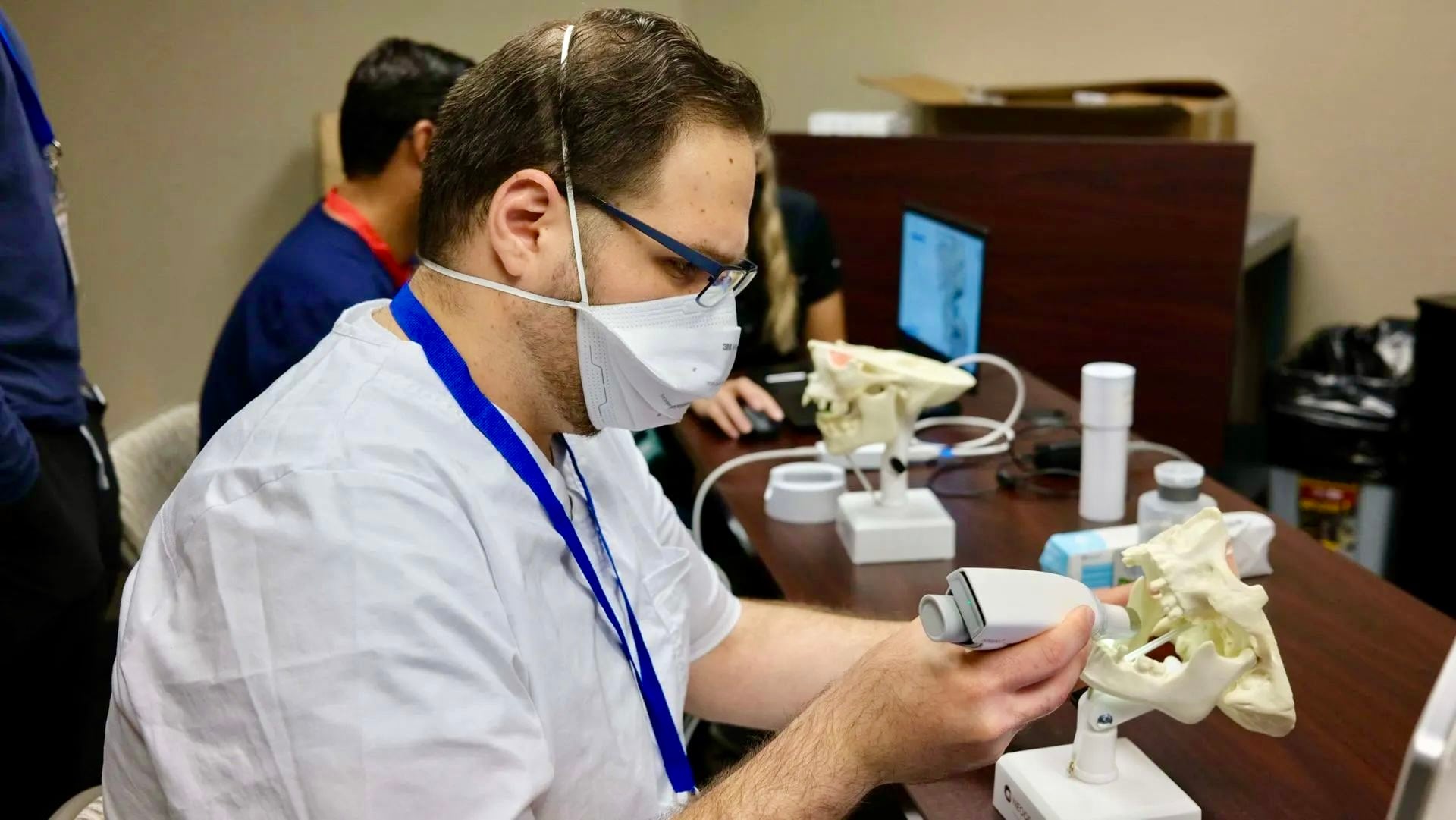
The FAM Fellowship bundles the three core courses plus a fourth course of the practice’s choice at a $5,000–$10,000 discount versus individual enrollment, with a payment plan of up to 9–12 months available. Over 90 CE hours are delivered across the full Fellowship program, accredited through the American Academy of General Dentistry.
The constraint for most practices is not patient demand. It is the operating system around the procedure. Full Arch Masters exists to fix that system and to stay in the room long after the course ends.
Build your full-arch operating system with Full Arch Masters.