Written by: Ryan Dunlop, CEO and Founder of Full Arch Masters and graduate from the Harvard School of Dental Medicine
How This Guide Helps You Choose Implant CE That Scales
- Implant CE that drives real growth teaches an end-to-end, repeatable digital workflow instead of isolated techniques.
- Effective training brings the full clinical team together on one system: dentist, assistant, treatment coordinator, and lab technician.
- Structured post-course support, including lifetime alumni access and digital resources, is essential for long-term implementation.
- Strong programs produce measurable outcomes such as same-day full-arch restorations in 2–4 hours and documented revenue gains.
- Full Arch Masters teaches the FAM Method, a photogrammetry-first digital workflow with full-team training and lifetime support—see upcoming course dates and formats to scale your full-arch practice.
Why Full-Arch Implant CE Matters in a Changing Industry
Full-arch implant restoration has shifted dramatically over the past decade. Analog workflows with physical impressions, chairside denture conversions, and off-site lab fabrication defined the procedure for most of its history. Each case consumed nearly a full day of chair time, required multiple appointments, and capped most practices at one or two arches per month before overhead erased margins.
The arrival of intraoral scanners, CBCT imaging, photogrammetry, and 3D printing expanded what is clinically possible. Hybrid digital full-arch workflows now require proficiency in multiple software platforms, add planning time and costs, and involve a learning curve that can limit adoption, which is why many practices advertising a “digital workflow” still run a hybrid model. They take partial impressions, capture partial digital records, send work to an off-site lab, and ask patients to return after swelling resolves for a second appointment.
This gap between digital potential and hybrid reality is not only a technology issue. It is also a training issue. The format of CE training often compounds the workflow limitation. A 2021 Cochrane review found that didactic sessions alone rarely change professional practice, while interactive formats can produce meaningful improvements in clinician behavior. Lecture-only programs build theoretical knowledge but do not develop motor skill, team coordination, or integrated workflows at volume.
Live-patient training closes much of that gap. Only live-patient training lets participants feel drilling through real bone, see how living tissue responds, and manage unexpected clinical situations in real time. Programs that combine live-patient surgery, integrated team training, and post-course community support currently sit at the top of what implant CE can deliver.
Explore Full Arch Masters course options and availability.
The FAM Method: A Complete Digital System, Not Just a Procedure
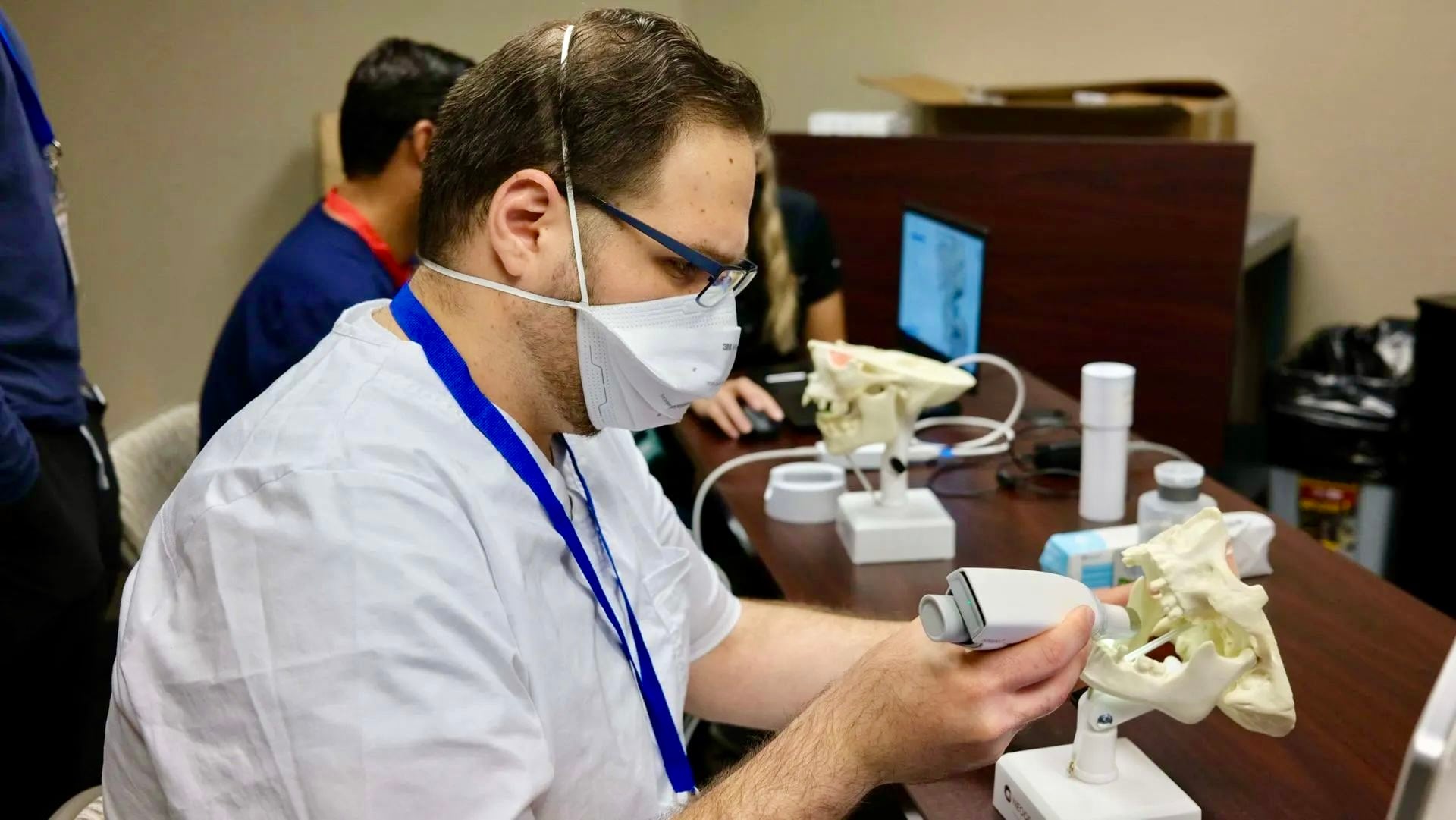
Most implant CE programs teach a procedure. Full Arch Masters teaches a system: the FAM Method, an end-to-end digital workflow built around photogrammetry as the core accuracy layer. The seven steps of the FAM Method are:
- Preoperative records and data acquisition, including facial scanning, photographs, and baseline clinical records that anchor the case plan.
- Photogrammetry and intraoral scanning, capturing implant positions with high precision using coded scan bodies, combined with soft-tissue capture via intraoral scanner.
- CBCT and digital treatment planning, merging scan data with cone-beam CT imaging to plan implant positions, bone availability, and prosthetic angles before surgery.
- exocad design, designing the immediate-load and final prosthetics inside exocad, the industry-standard CAD platform for which Full Arch Masters is a certified reseller.
- Immediate-load conversion, 3D-printing the same-day provisional prosthesis chairside so the patient leaves with a screwed-in restoration on surgery day.
- Final zirconia design and finishing, milling, contouring, and finishing the definitive zirconia prosthesis, including MIYO ceramic layering for aesthetics.
- Team implementation and workflow scaling, systematizing team delegation so the workflow scales to 5+ arches per month without consuming the dentist’s chair time on non-billable tasks, including FP1 prosthetic protocols where indicated.
The photogrammetry layer in step two carries outsized weight. Small inaccuracies in implant position data can create implant stress, screw loosening, bone loss, and prosthetic failures that appear several years after delivery, which makes accuracy at the impression stage the most consequential variable in long-term full-arch outcomes. Modern full-arch scanning systems now publish trueness values within clinically acceptable limits for passive framework fit, but only when the workflow stays integrated from scan through delivery.
Generic lecture programs and partial-digital approaches usually skip that integration. They teach the scanner, or the surgery, or the design software, but not the handoffs between them. The result is a workflow that looks digital on paper yet behaves like a hybrid system, with multi-day appointments and heavy chair time that resemble the analog era.
See how the FAM Method is taught across specific courses.
Key Trade-offs When Comparing Implant CE Programs
Choosing an implant CE program involves real trade-offs that affect clinical confidence and practice growth. The comparisons below highlight the most important decisions for a practice owner.
Live-patient hands-on depth versus lecture convenience. Lecture and weekend CE formats build knowledge for diagnosis, treatment planning, theory, and complications, but they do not build motor skill. Live-patient training closes the gap between knowing the protocol and performing surgery under real conditions, including bleeding, anesthesia, healing, patient communication, and irreversible decisions. Weekend lectures are convenient, yet they leave a clear skill gap.
Full-team integration versus dentist-only training. A dentist who returns from a course without a trained team cannot implement what they learned at scale. The FAM Method relies on full-team execution, because the assistant who gathers records, the treatment coordinator who closes the consult, and the lab technician who designs the prosthetic all carry critical responsibilities. Dentist-only training produces a knowledgeable dentist supported by a team still running the old workflow.
Lifetime community support versus one-and-done programs. Dentists should ask implant CE providers what mentorship exists after the course and how long it lasts. Full Arch Masters alumni join private group chats with hundreds of FAM-trained dentists, lab technicians, and team members, with case help available on demand for the life of the relationship. Programs that end when the course ends leave the dentist without a community when difficult cases appear.
Compare FAM course formats and team options.
What High-Volume Full-Arch Practices Do Differently
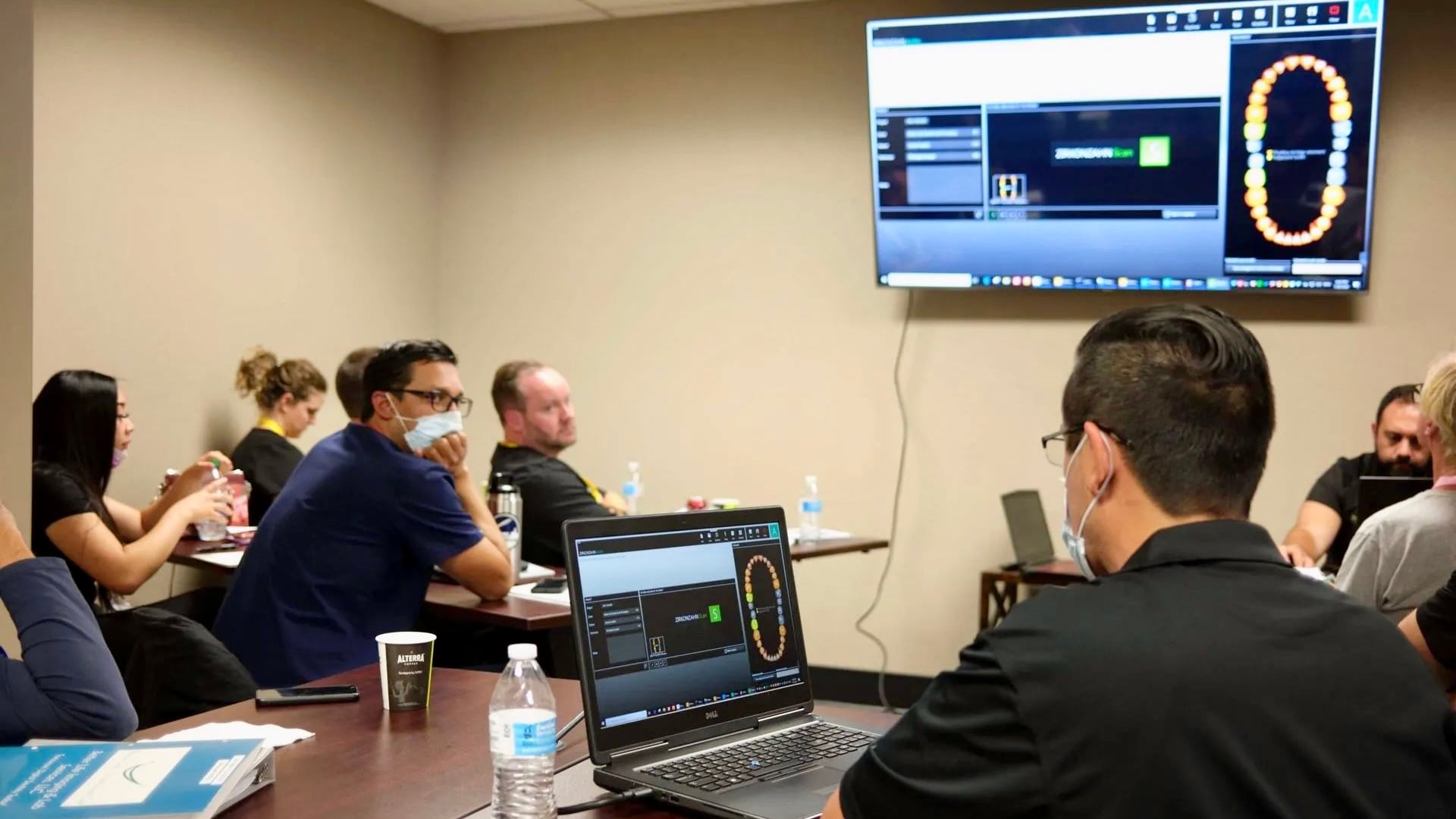
High-volume full-arch practices share consistent patterns, and Full Arch Masters teaches these as the baseline standard.
Workflow speed through integration, not shortcuts. Current photogrammetry trends focus on reducing hidden implant position errors that drive long-term complications, not just faster scans. The FAM Method reaches same-day delivery in 2–4 hours because every step connects cleanly to the next. Photogrammetry in step two sets the accuracy floor for all downstream work.
Team delegation as the main volume lever. Practices that reach 5+ arches per month remove the dentist from non-billable tasks. Surgical assistants trained in records acquisition, intraoral scanning, and photogrammetry setup handle those steps independently. Treatment coordinators trained in the closing system, including Full Arch Masters’ in-house TC with an 80% closing rate, convert more consultations without the dentist present. Delegation becomes the mechanism of scale, not a convenience.
Post-course mentorship as the bridge to production. Post-course mentorship accelerates the path from training to production by providing a feedback loop in the dentist’s own operatory. Full Arch Masters alumni access this loop through active group chats, a complete digital resource library, and the KOL buying group, which offers vendor discounts on Neodent implants, exocad licenses, and 3D printers at no recurring cost.
Full Arch Masters courses are approved through an AGD PACE-approved provider, delivering 32 CE credits per core course and more than 90 CE hours across the full Fellowship program. This structure supports competency through sustained, mentored education rather than isolated weekend seminars.
Review CE credit details and Fellowship pathways.
Is Your Practice Ready to Scale Full-Arch Volume?
A practice running 1–2 full-arch cases per month usually faces a workflow ceiling, not a demand ceiling. The self-assessment below helps identify where the constraint lives:
- Workflow: If patients return for a second appointment instead of receiving same-day completion, the workflow remains hybrid and chair time becomes the main constraint.
- Team: If the surgical assistant cannot independently manage records acquisition and the treatment coordinator cannot close a full-arch consult alone, the dentist becomes the bottleneck.
- Lab integration: If the lab does not receive digital files and return same-day prosthetics, lab turnaround often hides as the main delay in a “digital” workflow.
- Closing rate: If fewer than half of full-arch consultations convert, the issue usually sits in treatment coordination rather than clinical capability.
- Post-course support: If no peer community exists for difficult cases, isolation quietly caps volume and confidence.
Practices that find constraints in two or more of these areas are limited by their operating system, not by patient demand. When that operating system shifts to an integrated workflow, those constraints ease. Alumni who adopt the FAM Method report higher full-arch production because a faster workflow runs more arches per week at stronger margins, a trained treatment coordinator closes more existing consultations, and a trained team scales volume without consuming the dentist’s chair time.
See how practices use the FAM Method to break past 1–2 arches per month.
Common Full-Arch CE Mistakes That Stall Growth
Most failed full-arch CE investments share a few predictable patterns. Dentists attend a course, return home, and see no real change in volume or margin.
Calling a hybrid workflow “digital.” A scanner alone does not create a digital workflow. Digital dentistry often stays hybrid because intraoral scanning, CAD/CAM, 3D printing, and photogrammetry still require coordination, and proprietary file formats fragment data exchange. The FAM Method treats photogrammetry, intraoral scanning, CBCT, exocad design, and 3D-printed immediate-load conversion as one repeatable workflow, not a toolkit the dentist must assemble later.
Skipping team training. Systems for tracking implant consultations, presentations, and follow-ups directly influence adoption and revenue. A dentist who attends alone returns to a team still using the old systems. Full Arch Masters’ full-team model keeps everyone aligned on one workflow from day one.
Stopping support when the course ends. Mentorship in implant dentistry protects both clinicians and patients, and that principle extends to implementation. Every Full Arch Masters alumnus joins private group chats with hundreds of FAM-trained dentists, lab technicians, and team members, with case help available on demand.
Underestimating the closing gap. High-volume full-arch practices often see a similar number of consultations as their peers but convert more of them. Full Arch Masters’ Treatment Coordinator Bootcamp, taught by an in-house TC with an 80% closing rate, covers patient financing, objection handling, pipeline nurture, and drip campaigns tailored to high-ticket full-arch cases.
Get details on team training and TC Bootcamp dates.
Frequently Asked Questions
How do live-patient and lecture-format implant CE compare for outcomes?
Lecture formats build foundational knowledge in diagnosis, treatment planning, complication recognition, and theoretical workflow but do not build the motor skill or clinical judgment needed for independent full-arch surgery. Model and typodont workshops add drill sequencing practice yet still lack soft tissue, bleeding, and real patient management. Live-patient training closes the gap between knowing the protocol and performing surgery under real conditions, including variable bone density, anesthesia management, and irreversible decisions. Full Arch Masters’ Live Surgical Course in Parker, CO operates under Colorado Dental Board credentialing, which allows US-licensed dentists from any state to treat volunteer patients. Basic Operator track participants perform two full-arch cases across two surgical days under expert mentor supervision.
Why does photogrammetry matter for full-arch accuracy, and how is it taught?
Photogrammetry captures implant positions with coded scan bodies and dedicated camera systems, reaching trueness values that support passive framework fit. Standard intraoral scanners accumulate stitching errors across edentulous spans, which can create positional inaccuracies that later appear as implant stress, screw loosening, bone loss, and prosthetic failures. Full Arch Masters teaches photogrammetry as step two of the FAM Method, not as an optional add-on, because accuracy at the impression stage drives every downstream step, including exocad design, immediate-load conversion, and final zirconia delivery. Alumni learn to use photogrammetry systems such as those sourced through Neodent’s iCam partnership, with KOL buying group pricing available at no recurring cost.
What is the value of bringing the full team to implant CE?
The FAM Method functions as a team system. The surgical assistant who manages records acquisition, the treatment coordinator who closes the consult, and the lab technician who designs and finishes the prosthetic all support the workflow. A dentist who returns from training without a team aligned on the same system cannot fully implement the protocol. Full Arch Masters’ Flagship Course is built for teams, and most attendees arrive as a practice owner with their treatment coordinator and lead assistant, or as a dentist with their in-house lab technician. Team-member pricing, such as $2,500 per additional team member for the Flagship, keeps full-team attendance accessible.
What post-course support does Full Arch Masters provide?
Every Full Arch Masters alumnus, regardless of course, joins private group chats with hundreds of FAM-trained dentists, lab technicians, and team members. The community includes a dentist-only chat for sensitive practice issues, a main multi-role chat for clinical and operational questions, and lab and TC chats for course-specific topics. Support remains on demand and does not expire. Alumni also receive a complete digital resource library with surgical setup checklists, finishing techniques, treatment coordinator forms and presentations, consent templates, and Dr. Dunlop’s lecture materials, all shared via drive. KOL buying group access, which offers vendor discounts on Neodent implants, exocad licenses, and 3D printers, continues at no recurring cost.
How are the 32 CE credits structured and accredited?
Full Arch Masters is an AGD PACE-approved continuing education provider. Each core course, including the Flagship Course, Live Surgical Course, and Design and Finish Course, delivers 32 CE credits. The full FAM Fellowship program, which bundles three core courses plus a fourth elective, provides more than 90 CE hours across the curriculum. AGD PACE approval confirms that the provider meets the American Academy of General Dentistry’s standards for CE quality, content, and documentation.
View the current CE calendar and fellowship track.
Choosing Your Next Step with Full Arch Masters
Evaluating implant CE programs comes down to five core questions. A practice needs an integrated end-to-end workflow, live-patient surgical access, full-team training on one system, structured post-course support, and verifiable alumni revenue outcomes.
Full Arch Masters answers yes to all five. The FAM Method, a photogrammetry-first seven-step digital workflow that delivers same-day teeth in 2–4 hours, functions as a complete operating system. The Flagship Course, Live Surgical Course, Design and Finish Course, FP1 Course, and Treatment Coordinator Bootcamp together cover clinical training, digital workflow, laboratory integration, practice growth, and long-term mentorship. Alumni join a community of hundreds of FAM-trained dentists, lab technicians, and team members, gain access to the KOL buying group at no recurring cost, and earn 32 AGD PACE-approved CE credits per core course.
Practices currently running 1–2 arches per month often see revenue growth after implementing the FAM Method because the constraint usually sits in the operating system, not in patient demand. Full Arch Masters teaches that system in a way teams can apply on Monday.
Choose your Full Arch Masters course and start building a scalable full-arch workflow.