Written by: Ryan Dunlop, CEO and Founder of Full Arch Masters and graduate from the Harvard School of Dental Medicine | Last updated: July 15, 2026
Key Takeaways
These points summarize how the right full-arch CE program can change your day-to-day workflow and long-term revenue.
- Effective full-arch implant CE programs combine live-patient surgical volume, photogrammetry-first digital workflows, full-team training, post-course mentorship, and documented revenue outcomes instead of treating these elements separately.
- Photogrammetry-first workflows support predictable same-day teeth delivery in 2–4 hours with passive fit accuracy that hybrid or intraoral-scanning-only approaches rarely achieve at scale.
- Full-team attendance is essential. Dentists who train without their treatment coordinator, surgical assistant, and lab technician rarely operationalize the workflow when they return to practice.
- Post-course community support, including lifetime alumni chats and a no-cost KOL buying group, sustains performance gains long after the initial training ends.
- Practices ready to scale full-arch implant services can access the complete FAM Method and ongoing support by exploring FAM’s course options and alumni community.
How Full-Arch Implant Dentistry Is Evolving
Full-arch implant dentistry has shifted dramatically over the past decade. The analog workflow with physical impressions, chairside denture conversions, multi-day appointments, and patients sent home to swollen tissue defined the procedure for most of its history. The arrival of intraoral scanners, CBCT imaging, photogrammetry, and 3D printing expanded what is technically possible. The U.S. dental implant market is projected to reach approximately $2 billion annually by 2026, and the practices capturing the largest share of that growth are the ones that run a fully digital workflow instead of a hybrid one.
The distinction between hybrid and fully digital workflows affects daily operations. A hybrid workflow with partial impressions, partial digital records, and off-site lab work still dominates many practices that describe themselves as digital. A photogrammetry-first workflow integrates intraoral scanning, photogrammetry for implant-position capture, facial scanning, CBCT, exocad design, and immediate-load 3D-printed conversion into a single repeatable system. The 2026 clinical consensus frames photogrammetry as the precision standard for passive fit, occlusion management, and predictable same-day provisionals in full-arch rehabilitation, not an optional add-on.
U.S.-specific regulatory factors add another layer of complexity. Most states do not allow visiting dentists to perform surgery on volunteer patients in a CE setting, which makes live-patient full-arch surgical training legally inaccessible in much of the country. Colorado is one of the few exceptions, and the Colorado Dental Board’s credentialing process, which requires submission of each operator’s credentials ten days before the course, is what makes hands-on live full-arch surgery available as a CE format at all. The segment is also competitive and secretive. Practitioners who have built a working digital workflow rarely share it, and many training programs stop providing support the day the course ends. Given this fragmented and constrained landscape, understanding the core training models and their trade-offs helps you choose a program that fits your current capabilities and growth goals.
See how FAM structures live-patient training within this regulatory landscape.
Four Core Models for Full-Arch Implant CE
Full-arch implant CE programs fall into four broad models. Each model carries specific implications for clinical execution, lab coordination, and case volume.
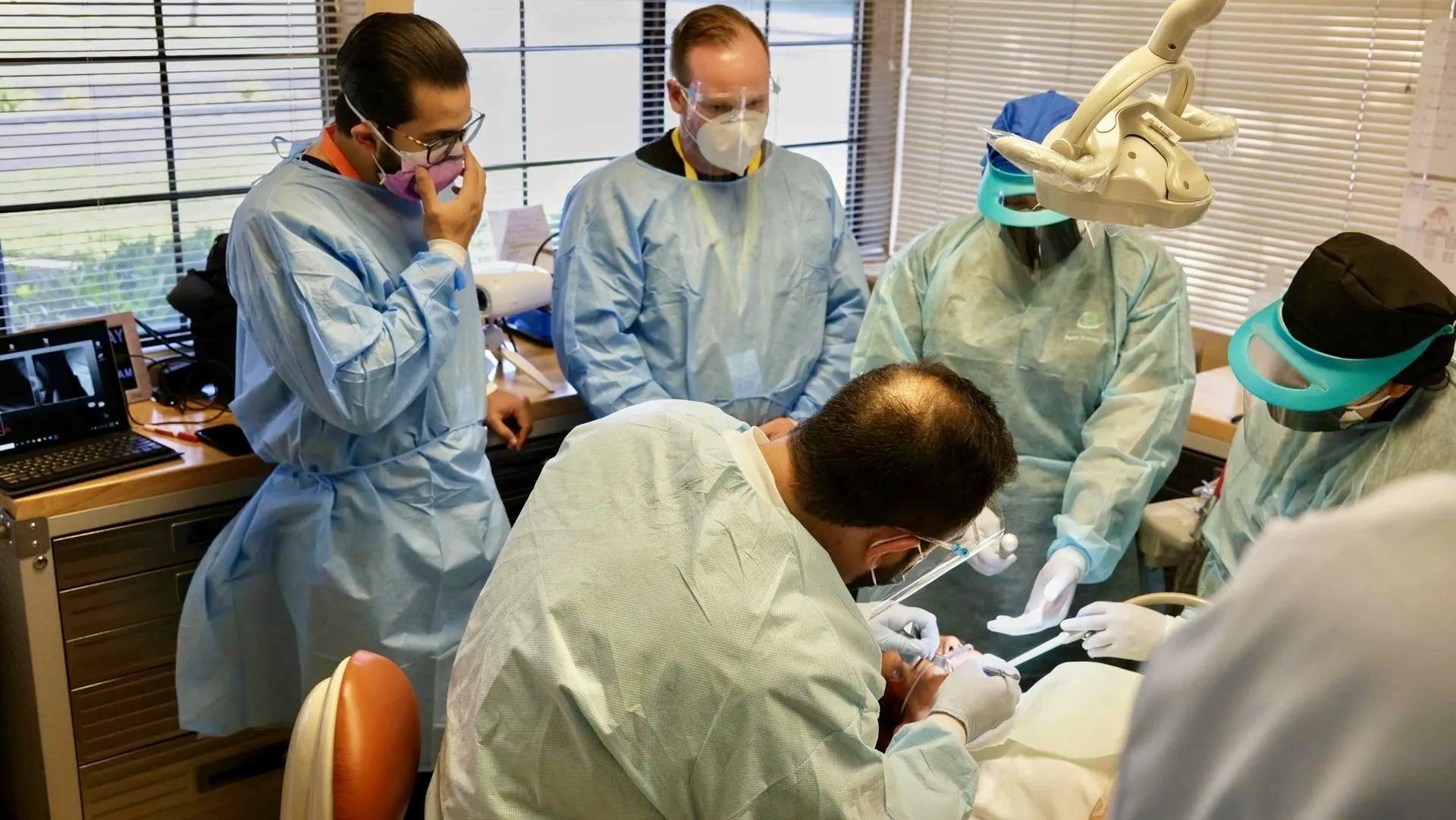
Live-patient surgical programs place the dentist in the operating role on real patients under mentor supervision. Live-patient training exposes dentists to real clinical variables such as bone density differences, anatomical structures, soft tissue conditions, and surgical access limitations that simulations cannot replicate. This model produces the most transferable surgical judgment. It remains legally constrained to states like Colorado that allow visiting dentists to operate under board credentialing.
Cadaver-based programs provide hands-on surgical repetition without the same regulatory barriers. Simulation training using cadaver specimens serves as an intermediate step and does not provide the intraoperative decision-making exposure required for developing surgical judgment in live cases. Cadaver programs are widely available and useful for building procedural familiarity. They still cannot replicate tissue response, bleeding, and patient-specific variables.
Digital-design-only programs focus on the lab and prosthetic side, including exocad design, immediate-load printing, and aesthetic finishing, without a surgical component. These programs remain underserved in the market and are critically important for lab technicians and in-house design teams. Photogrammetry integration, extraction sequencing for proper record relation, and lab communication protocols for same-day digital workflows now appear as core curriculum elements in leading digital design programs.
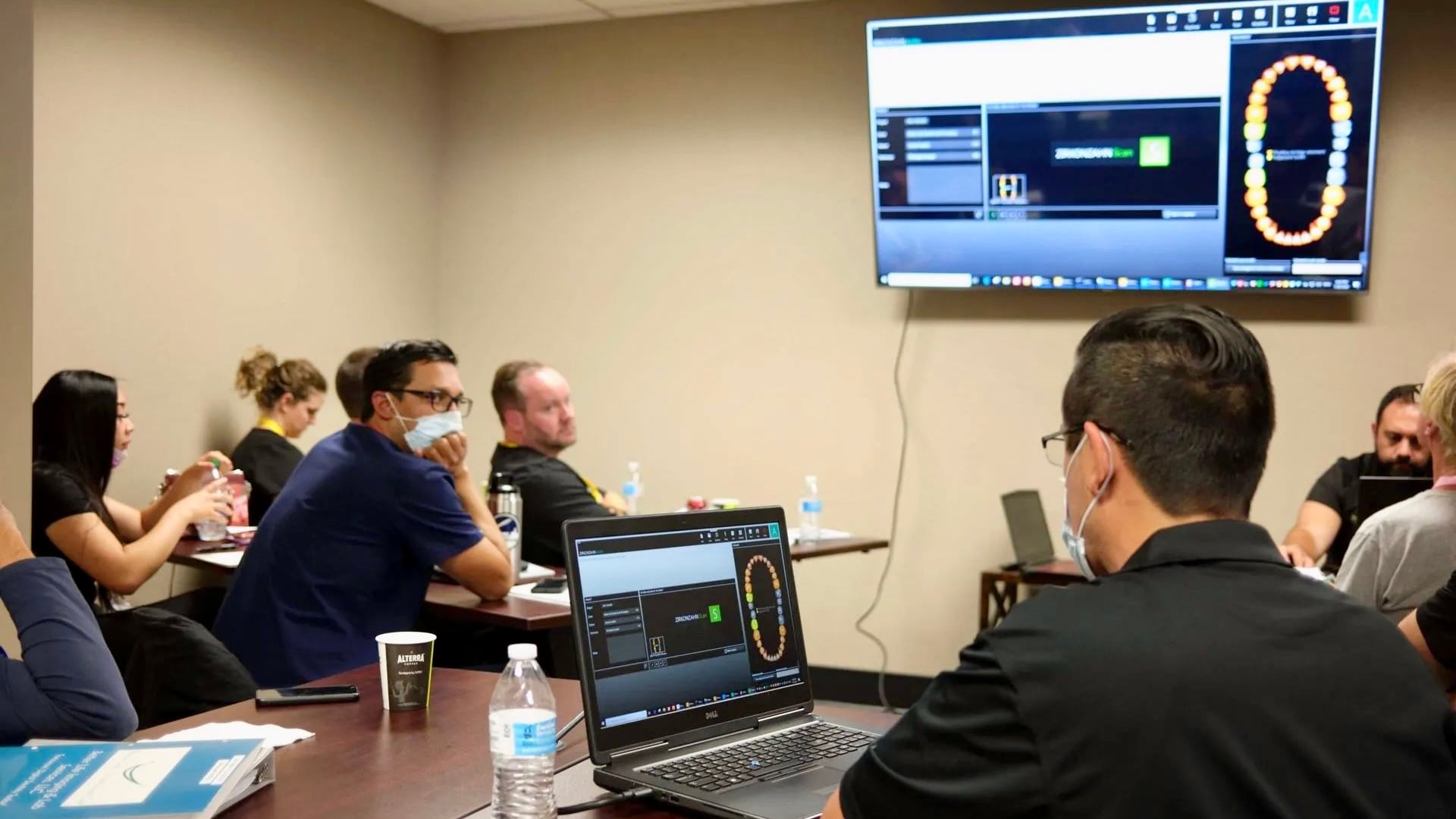
Team-implementation programs train the full practice, including dentist, surgical assistant, treatment coordinator, and lab technician, on the same workflow at the same time. Team-based training with written scripts, financing menus, and regular call review can raise close rates on seated full-arch consultations compared to untrained treatment coordinators. A dentist who returns from a surgical course without a trained team rarely operationalizes the workflow at volume.
Explore FAM’s live-patient surgical training and team-implementation programs.
Strategic Trade-offs When Choosing a Program
Every practice faces structural trade-offs when evaluating full-arch CE programs. These trade-offs vary by practice size, current case volume, and technology stack.
Speed versus complexity. A photogrammetry-first workflow delivers same-day teeth in 2–4 hours, and it requires the full team to be trained on records acquisition, digital handoff, and immediate-load delivery. Without that full-team investment, the workflow breaks down at the handoff points, which explains why practices that want speed without team training often revert to hybrid workflows within weeks of returning from a course.
Control versus outsourcing. Practices with in-house lab technicians can bring design and finishing in-house, which reduces turnaround time and lab costs. Practices that outsource lab work can still run a digital workflow. They depend on external labs for immediate-load delivery, which introduces scheduling risk on same-day cases.
Investment versus scalability. Practices with active implant programs report an average of $380,000 in annual implant-related production, and a practice completing several full-arch cases per year can add substantial production. The training investment, whether a single course or a Fellowship bundle, is typically recovered within 6–12 months for practices that operationalize the workflow. Most dentists actively building their implant workflow recover their training investment within 6 to 12 months of beginning to place cases.
Practice size and readiness. Solo practices with one assistant gain the most from a team-implementation program that trains every role simultaneously. Multi-doctor practices or DSO-affiliated groups may prioritize advanced surgical tracks and atrophic-case capability over foundational workflow training. A useful evaluation framework starts with current case volume and team composition, not course price.
Find the FAM course track that matches your practice’s case volume and team readiness.
Current Best Practices in Full-Arch CE
Evidence-informed practice in full-arch implant dentistry in 2026 converges on several operational standards that leading CE programs now teach directly.
Photogrammetry as the accuracy standard. The Digital Dentistry Society awarded DDS Certification in 2025 to the Aoralscan Elite scanner, recognizing its excellence in intraoral scanning and integrated photogrammetry. Intraoral scanning alone does not achieve the passive-fit accuracy required for immediate-load full-arch restorations at scale. Photogrammetry captures implant positions with a level of precision that intraoral scanners cannot match across a full arch.
Immediate-load protocols. Same-day delivery, from patient arrival to a screwed-in restoration, requires a workflow where every step is pre-planned and every team member understands their role. The FAM Method, Full Arch Masters’ proprietary digital workflow, integrates intraoral scanning, photogrammetry, facial scanning, CBCT, exocad design, and immediate-load 3D-printed conversion into a single system that delivers same-day teeth in 2–4 hours. Alumni report adding $1M+ per year in practice revenue after adopting this workflow.
Team delegation. No single management practice is identified in the evidence as separating any specific close-rate groups. Multiple variables such as talk-listen ratio and systematic call analysis separate teams with rates like 15% versus 40%+. This finding underscores why delegation extends beyond clinical tasks. It applies to records acquisition, consultation closing, and lab handoff, all of which require systematic training instead of ad-hoc skill transfer. When these systems are formalized and taught to the entire team, results improve significantly. FAM’s in-house treatment coordinator maintains an 80% closing rate using a system taught in the Treatment Coordinator Bootcamp.
Post-course support structures. Many implant training participants remain engaged in program ecosystems for years because the value of mentorship and peer connection increases as their practices evolve. FAM’s continued community, with private group chats that include hundreds of FAM-trained dentists, lab technicians, and team members, provides case help on demand for the life of the relationship. The KOL buying group delivers vendor discounts on Neodent implants, exocad licenses, 3D printers, and other equipment at no recurring cost, with no ongoing membership fee.
Review the FAM Method workflow and support structures in detail.
Readiness and Opportunity Assessment
Before selecting a full-arch CE program, practices benefit from an honest assessment of their current state across four dimensions. Evaluate your practice against each of these criteria to identify which training model and program features will deliver the highest return.
- Current case volume. Practices placing zero to one full arch per month are typically constrained by workflow and team readiness, not patient demand. Practices placing one to three arches per month are often constrained by closing rate and lab turnaround. Practices placing four or more arches per month are usually constrained by atrophic-case capability or team delegation.
- Team readiness. A dentist who attends training without their treatment coordinator and surgical assistant returns to a practice that cannot run the workflow. The one-team, one-workflow model requires that every role, including clinical, lab, and front office, is trained on the same system at the same time.
- Technology stack. Practices without an intraoral scanner, CBCT, or photogrammetry system cannot run a fully digital workflow regardless of training. The KOL buying group available to FAM alumni provides discounted access to the technology stack used in the FAM Method at no recurring cost.
- Budget alignment. A well-run implant program in a general practice can add $200,000–$500,000 in annual production without growing patient count. The training investment should be evaluated against that production potential, not against the cost of a single CE credit hour.
Use FAM’s course tracks to map training options to your current readiness level.
Common Pitfalls and How to Avoid Them
The most common reasons full-arch CE programs fail to produce practice-level results are operational, not clinical.
- Attending without the full team. A dentist who returns from a course without a trained treatment coordinator, surgical assistant, and lab technician cannot operationalize the workflow because each role owns critical handoff points that the dentist cannot execute alone. The mitigation is straightforward. Bring the team so everyone learns the same system at the same time and closes the knowledge gaps that cause workflow breakdown. FAM’s Flagship Course is built for this, and most cohorts include the dentist, lead assistant, treatment coordinator, and in-house lab technician attending together, with team-member pricing built into the course structure.
- Choosing programs without post-course support. Two-day workshops produce a 6% conversion lift that decays to zero inside eight weeks because treatment coordinators retain only a few techniques and lack ongoing feedback loops or accountability. Post-course community, not a binder or a single follow-up call, sustains the performance lift.
- Underestimating the learning curve for atrophic cases. Dentists who have placed more than 200 full arches often refer out zygomatic, pterygoid, and trans-sinus cases because they never received training on them. These cases represent some of the highest-margin procedures in full-arch dentistry. The Advanced Live Surgical track at FAM is gated to dentists with more than 200 career arches and focuses specifically on these placements on live volunteer patients under expert mentor supervision.
- Selecting a program based on price alone. The lowest-cost CE option rarely delivers the highest return. Even two to three implant cases per month can generate significant additional annual revenue for a general practice. A program that delivers a complete operating system, including clinical technique, digital workflow, team training, closing, and continued community, at a higher price point usually produces a faster return than a lower-cost program that teaches the procedure in isolation.
Compare FAM’s Flagship and Advanced tracks against these common pitfalls.
FAQ
What is the difference between a photogrammetry-first workflow and a hybrid digital workflow?
A hybrid digital workflow uses intraoral scanning for some records and physical impressions or off-site lab work for others, which results in multi-day appointments and patients sent home before their restoration is delivered. A photogrammetry-first workflow, which integrates the scanning, imaging, design, and printing steps described earlier into a single system, captures implant positions across a full arch with a level of precision that intraoral scanning alone cannot achieve. That precision makes passive-fit, same-day delivery clinically predictable instead of aspirational. The FAM Method is built around this integrated, photogrammetry-first approach.
Does my full team need to attend, or can I send just the dentist?
The team approach sits at the center of the FAM Method, which follows a one-team, one-workflow model. A dentist who attends without their treatment coordinator, surgical assistant, and lab technician returns to a practice where no one else knows the workflow, and the system cannot run at volume. FAM’s Flagship Course is built for full-team attendance. Most cohorts include the practice owner with their lead assistant, treatment coordinator, and in-house lab technician. Team-member pricing is built into every course, with $2,500 per additional team member for the Flagship Course, which keeps full-team attendance financially realistic.
What post-course support does Full Arch Masters provide?
Every FAM attendee joins the continued support structures described earlier, including alumni group chats, the full digital resource library, and the KOL buying group, all with no recurring membership fee. The group chats are segmented into a dentist-only chat for sensitive practice and personnel questions, a main multi-role chat for clinical and operational case help, and per-course lab and treatment coordinator chats. This structure ensures that each team member can get role-specific guidance on demand.
Is Full Arch Masters appropriate for dentists who have never placed a full arch?
Full Arch Masters serves the full experience range. The FAM Flagship Course supports dentists who have placed zero full arches and want to add the procedure as a revenue line, mid-career implant dentists running one to two arches per month who want to scale, and experienced surgeons with hundreds of arches who want advanced atrophic-case techniques. The Live Surgical Course includes a Basic Operator track specifically for dentists with fewer than 200 career arches. FAM meets attendees at their current level and builds from there.
What revenue outcomes do Full Arch Masters alumni report, and how is that figure calculated?
FAM alumni report adding $1M+ per year in practice revenue after adopting the FAM Method. The mechanism combines several factors. A faster workflow with same-day delivery allows more arches per week at higher margin. The marketing and treatment coordination content taught in the Flagship Course and the Treatment Coordinator Bootcamp improves closing rates, and FAM’s in-house treatment coordinator maintains an 80% closing rate. The team delegation model reduces the dentist’s non-billable chair time, which lets the practice run more cases without burning the operator. This figure reflects FAM’s reported alumni outcome, not a peer-reviewed industry statistic, and individual results vary by market, team, and case volume.
Review FAM’s case studies and outcome data before you enroll.
Conclusion and Next Steps for Your Practice
The evaluation framework for full-arch implant CE programs in 2026 centers on a few concrete elements. These include live-patient surgical volume, photogrammetry-first digital workflow integration, full-team training and pricing, post-course community and mentorship, advanced atrophic-case tracks, and documented revenue outcomes. Many programs on the market address one or two of these criteria in isolation. None of the programs evaluated here deliver all of them as an integrated system except Full Arch Masters.
The FAM Method functions as an end-to-end operating system rather than a surgical technique course with a digital workflow added later. It combines clinical technique, photogrammetry-first digital workflow, lab coordination, treatment coordination, team delegation, closing, and a continued alumni community, all taught to the full practice at the same time. The revenue outcomes described earlier, including $1M+ annual increases, the rapid delivery timeframe, and the 80% close rates achieved through systematic training, reflect the integrated nature of the system. The KOL buying group provides vendor discounts at no recurring cost. The continued community provides case help on demand for the life of the relationship. FAM shares the full recipe instead of guarding techniques.
Practices ready to add full-arch, scale the arches they already place, or build the team systems that turn a procedure into a practice-defining revenue line can move forward now. Choose the Full Arch Masters course path that aligns with your current volume and growth goals.