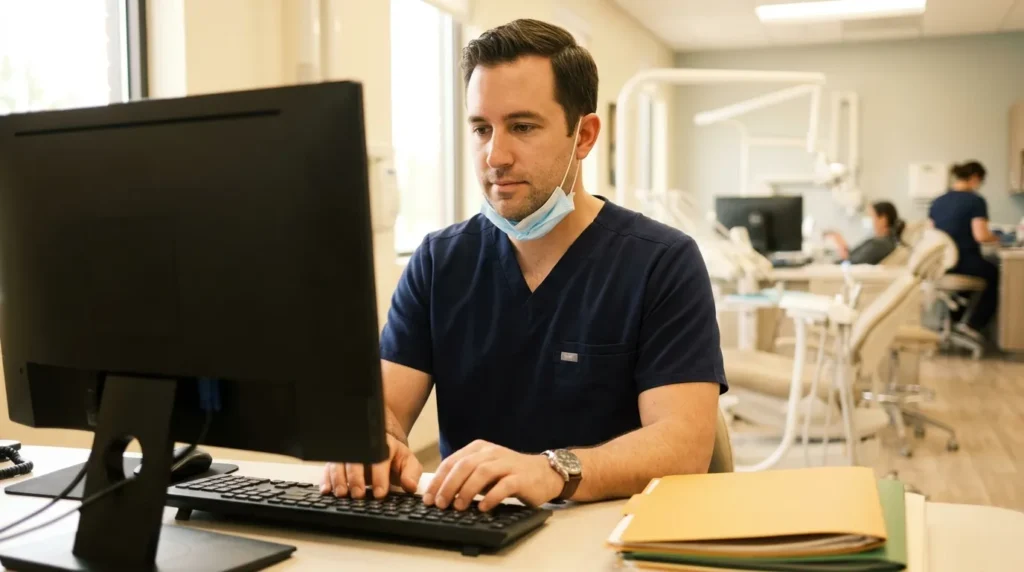
Written by: Ryan Dunlop, CEO and Founder of Full Arch Masters and graduate from the Harvard School of Dental Medicine
Key Takeaways
-
Small-group, live-patient dental implant training with direct supervision builds stronger skills than observation-only or high-ratio formats.
-
Four criteria define program quality: low instructor-to-participant ratio, two full-arch cases per operator, legal U.S. credentialing, and ongoing alumni community access.
-
Full Arch Masters delivers the FAM Method, a fully digital, same-day workflow that unites surgery, scanning, design, and team coordination into one repeatable system.
-
Colorado Dental Board credentialing allows U.S.-licensed dentists to perform live surgery, while Mexico-based programs lack clear home-state board acceptance.
-
Full Arch Masters is the only U.S. program that meets all four criteria at the highest standard—register today to secure your seat.
Executive Summary and Evaluation Framework
Four criteria determine whether a live-patient small-group dental implant training course produces measurable skill transfer and practice growth: instructor-to-participant ratio, cases completed per operator, legal U.S. credentialing, and post-course community access. These four criteria form the evaluation framework used throughout this guide, and Full Arch Masters meets each one at the highest standard.
Explore upcoming Full Arch Masters course dates and formats.
Industry Landscape Overview
Demand for full-arch implant CE continues to climb through 2025–2026 as more general dentists add or scale the procedure. The market now ranges from single-day model-based workshops to multi-day live-patient residencies, and program quality varies widely.
When student-to-instructor ratios in live surgical training climb too high, supervision becomes observation instead of active guidance, which weakens both hands-on learning and patient safety oversight. State dental board variability adds another layer of complexity: live-patient implant CE in the U.S. must be checked against each state dental board because requirements vary and may include specific hands-on clinical hours, documentation rules, and provider-recognition requirements such as ADA CERP or AGD PACE approval. A CE certificate alone does not guarantee acceptance by a dentist’s home-state board.
The American Academy of Implant Dentistry requires 300 hours of education for Associate Fellow credentialing, including at least one participatory hands-on course, which reflects that unsupervised repetition alone does not produce competent implant surgeons. Against this backdrop, programs that combine credentialed U.S. access, low ratios, and meaningful case volume form a distinct and underserved category. Full Arch Masters addresses this gap through a credentialed, small-group model that delivers supervised live surgery and a complete digital workflow.
See how Full Arch Masters fits into your CE plan.
FAM Method: Integrated Full-Arch Workflow
The FAM Method is Full Arch Masters’ proprietary, fully digital workflow that takes a patient from no teeth or heavily decayed teeth to a screwed-in, same-day restoration in 2 to 4 hours. The workflow follows seven defined steps:
-
Preoperative records and data acquisition
-
Photogrammetry and intraoral scanning
-
CBCT and digital treatment planning
-
exocad design
-
Immediate-load conversion
-
Final zirconia design and finishing
-
FP1-specific design, team implementation, and workflow scaling
Most programs in this category teach individual steps, such as surgery, scanning, or lab design, without tying them into a single repeatable system. The FAM Method is taught as one connected workflow, with the dentist, surgical assistant, lab technician, and treatment coordinator all trained on the same playbook at the same time. This one-team, one-workflow structure allows alumni to run the procedure on day one instead of spending months stitching together disconnected skills.
Review the full FAM Method course lineup.
Instructor-to-Participant Ratios That Support Real Learning
A benchmark of two to three students per instructor is recommended for hands-on implant training, with an ideal ratio of no more than 3:1 for surgical hands-on sessions. That standard becomes especially critical during live-patient procedures, because a ratio of no more than 3:1 keeps an expert mentor at the clinician’s side to watch technique, answer questions in real time, provide a safety net, and help build competence for predictable outcomes.
In practice, a 1:3 ratio is the research-backed ideal, and a 1:4 to 1:6 range is the accepted operational standard for programs running multiple simultaneous surgical bays. A 1:8 or better ratio enables continuous chairside coaching, immediate feedback, and true one-on-one teaching moments throughout the course session, while ratios beyond 1:8 begin to compromise individualized supervision.
Full Arch Masters’ Live Surgical Course in Parker, CO is staffed by a named clinical mentor for each surgical bay, including Dr. Kenny Clow, Dr. Aldo Espinosa, Dr. Samuel Jirik, Dr. Azam Saeed, Dr. Bryce Richardson, and Dr. James “Bo” Wright. This structure ensures direct, real-time oversight for every operator throughout both surgical days.
Secure your spot with expert mentors at your side.
Hands-On Surgery Access and Legal Credentialing
The legal framework for live-patient surgery in U.S.-based CE is the most consequential variable in this category. Most U.S. states do not permit visiting dentists to perform surgery on volunteer patients as part of a continuing education course. Colorado is one of the few exceptions, and the Colorado Dental Board authorizes U.S.-licensed dentists from any state to perform dentistry on volunteer patients during a credentialed course when the operator holds a valid U.S. dental license with no pending marks in their home state.
Full Arch Masters submits each operator’s credentials to the Colorado Dental Board ten days before each Live Surgical Course, and CRNAs provide general anesthesia onsite. This credentialing process separates the Basic and Advanced Operator tracks, where participants perform surgery, from the Observer track, which serves dentists who prefer to watch and international attendees who cannot be credentialed because they lack a U.S. dental license.
Mexico-based programs are often marketed as an alternative route to live-patient surgical experience. A CE certificate alone may not satisfy a state dental board when implant-specific training or competency documentation is required, and CE hours earned outside the U.S. carry additional uncertainty regarding board acceptance. The legal operating status of a U.S.-licensed dentist performing surgery in Mexico as part of a CE course is not governed by any U.S. dental board, which creates credentialing and liability exposure that Colorado-based programs avoid.
Review credentialed Live Surgical Course options in Colorado.
Strategic Trade-offs: Cost, Travel, and Case Volume
Dentists evaluating live-patient programs must balance cost, travel, legal access, and case volume. Mexico-based programs usually offer lower tuition and accessible patient populations, but the absence of U.S. board credentialing means the surgical hours may not satisfy home-state documentation requirements. State dental boards may require dentists to maintain detailed records for implant CE audits, including the completion certificate, course syllabus, breakdown of lecture versus model versus live-patient hours, provider name, and ADA CERP or AGD PACE recognition details.
U.S.-based programs with Colorado Dental Board credentialing remove that uncertainty. Patient sourcing is more constrained in this model, which is why programs in this category limit enrollment to protect case volume per operator. Full Arch Masters caps the Live Surgical Course at a size that guarantees two full-arch cases per Basic or Advanced operator, a volume threshold supported by the structure of comparable programs.
The Fellowship bundle, which combines the Flagship, Design and Finish, and Live Surgical courses plus a fourth course of the practice’s choice, is available at a $5,000–$10,000 discount versus individual enrollment, with a payment plan of up to 9–12 months. For practices planning to take more than two FAM courses, the Fellowship offers the structurally lower-cost path. Beyond cost structure, the real determinant of ROI is whether the program teaches practices how to operationalize what they learn.
Compare individual courses with the Fellowship bundle.
Current Best Practices for Full-Arch Training ROI
The 2025–2026 consensus across high-performing live-patient programs identifies three operational best practices that convert training investment into measurable practice growth.
First, full-team attendance. A dentist who returns from training without a trained team cannot operationalize the workflow at scale. FAM’s Flagship Course is built for the full team, including the dentist, lead assistant, treatment coordinator, and in-house lab technician, at $9,995 per dentist and $2,500 per additional team member. Alumni consistently report that team-based attendance is what turns course content into a running practice system.
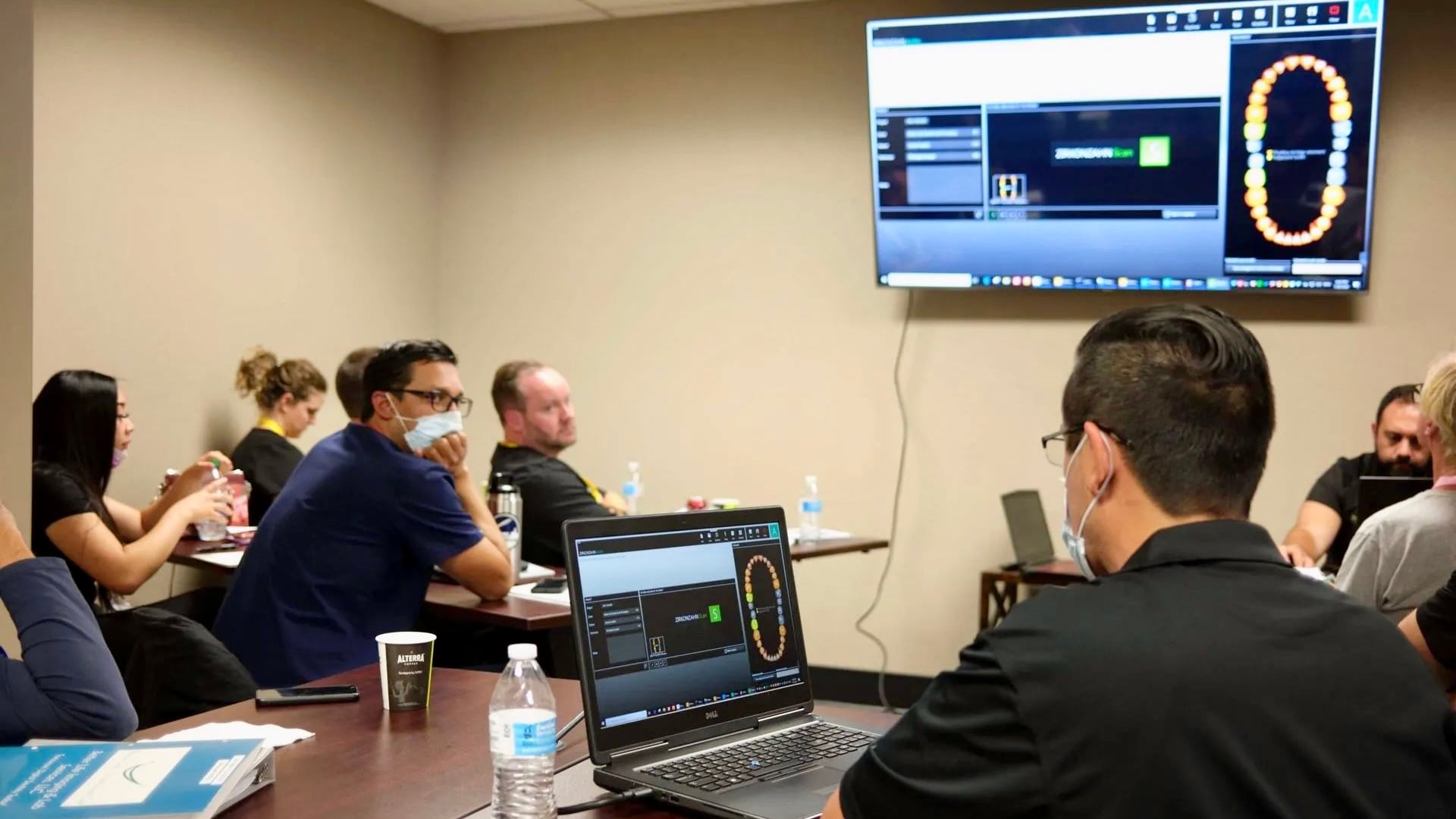
Second, delegation training. The FAM Method assigns specific workflow steps, such as intraoral scanning, photogrammetry, records acquisition, and case handoff, to trained team members instead of concentrating all non-billable tasks on the dentist. This structure allows a FAM-trained practice to run more arches per week without exhausting the dentist’s chair time.
Third, measurable revenue targets. Alumni report adding $1M or more per year in practice revenue after adopting the FAM Method. The mechanism combines a faster workflow that delivers same-day teeth in 2 to 4 hours, a higher case-acceptance rate driven by the Treatment Coordinator Bootcamp’s closing system with an 80% close rate maintained by FAM’s in-house TC, and a team structure that scales without proportional overhead increases.
See how FAM alumni structure their teams and targets.
Readiness and Opportunity Assessment
Before selecting a live-patient small-group program, a practice should document its current state against the following checklist:
-
Current case volume: How many full-arch cases per month is the practice completing today? The FAM Live Surgical Basic Operator track is designed for dentists who have placed fewer than 200 full arches in their career, and the Advanced track requires 200 or more career arches.
-
Workflow gaps: Is the current workflow fully digital, hybrid, or analog? The FAM Method requires intraoral scanning and CBCT capability at minimum, and photogrammetry is introduced during the course.
-
Team readiness: Does the practice have a treatment coordinator, lead assistant, and lab technician, either in-house or external, who can attend training together?
-
Credentialing documentation: Does the dentist hold a valid U.S. dental license with no pending marks? Colorado Dental Board credentialing requires this, and FAM’s Director of Operations, Amy Moench, manages the submission process ten days before each course.
-
Revenue target: Is the practice targeting $1M or more in added annual revenue from full-arch? If yes, the Fellowship bundle, which covers clinical, lab, and treatment coordination training, is the appropriate enrollment path.
-
Timeline: Courses can be spread across the year under the Fellowship, and individual courses are available on a rolling schedule.
Assess your readiness and map out a course sequence.
Common Pitfalls and How to Avoid Them
Several structural features of a training program reliably predict poor skill transfer. Dentists evaluating programs should treat the following as disqualifying red flags:
-
Observation-only formats: Programs where participants watch surgery without operating do not produce the same skill transfer as hands-on operating. A program with a 40:1 student-to-instructor ratio during live surgery offers fundamentally different supervision quality compared to one with a 10:1 ratio, and observation-only formats offer none.
-
No post-course community: Most programs end when the course ends. Post-course mentorship supports improved skill, reputation, and income, but programs that do not provide a structured alumni community leave dentists without peers to consult when a difficult case arrives. Full Arch Masters provides continued private group chats, including a dentist-only chat and a multi-role main chat, at no recurring cost for the life of the relationship.
-
No team pricing: A dentist who attends alone and returns to an untrained team cannot run the workflow at volume. Programs that do not build team-member pricing into their structure create a barrier to operationalization.
-
Unverified legal access: Programs that do not disclose the legal basis for live-patient surgery, whether Colorado Dental Board credentialing, another state board authorization, or an international framework, leave participants with CE documentation that may not satisfy their home-state board.
-
Ratio opacity: Programs that do not publish their instructor-to-participant ratio are unlikely to be operating in the 1:3 to 1:6 range that the research supports. A low student-to-instructor ratio is critical during hands-on dental implant training to provide personalized attention and direct, real-time feedback on surgical technique.
Avoid these pitfalls by reviewing FAM’s published structure.
FAQ
What makes a live-patient dental implant course legally valid for U.S. dentists?
Legal validity for U.S. dentists performing hands-on surgery in a CE course depends on the state dental board governing the course location, not the dentist’s home state. Most U.S. states do not permit visiting dentists to operate on volunteer patients as part of a CE program. Colorado is one of the few states that does, provided the operator holds a valid U.S. dental license with no pending marks in their home state. Full Arch Masters submits each operator’s credentials to the Colorado Dental Board ten days before each Live Surgical Course. CE documentation from a Colorado-credentialed course, including the completion certificate, course syllabus, and breakdown of lecture versus live-patient hours, matches the type of record state boards require for implant CE audits. International dentists cannot be credentialed by the Colorado Dental Board because credentialing requires a U.S. dental license, so they may attend as Observers.
How many full-arch cases does each operator complete at Full Arch Masters?
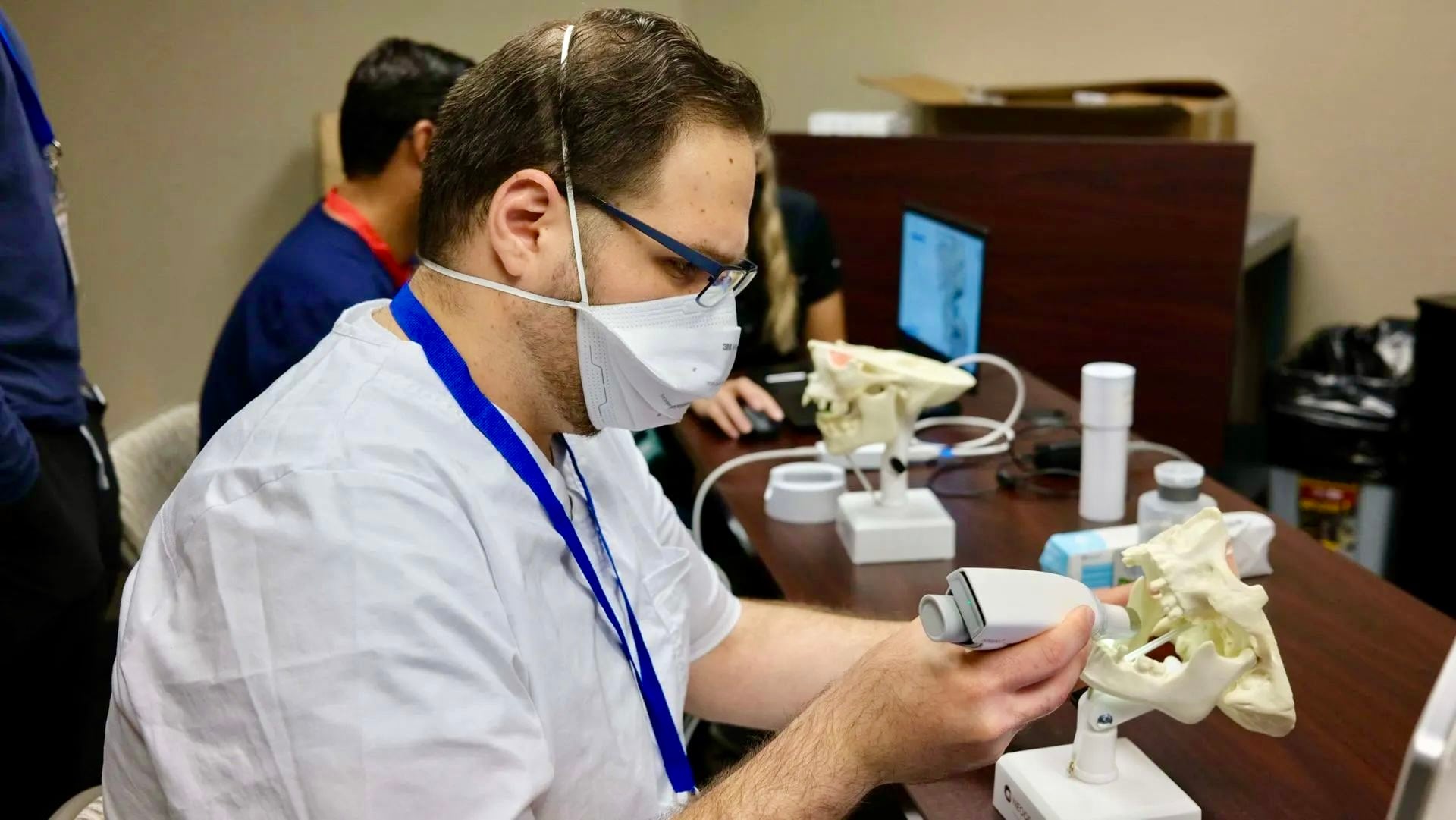
Each Basic and Advanced operator completes two full-arch cases across the two surgical days of the Live Surgical Course in Parker, CO. Operators work in teams, one quadrant each per case, under direct supervision from named clinical mentors. Pre-planning includes review of every patient’s CBCT and a 3D-printed model of each case. The two-case minimum gives operators enough repetition to begin building procedural fluency, and programs offering one case or observation-only do not reach this threshold. The Advanced Operator track, which is gated to dentists with 200 or more career arches placed, focuses those two cases on zygomatic, pterygoid, trans-sinus, custom subperiosteal, and palatal-approach techniques for atrophic cases.
What post-course support does Full Arch Masters provide, and does it cost extra?
Every Full Arch Masters attendee, regardless of which course they take, joins continued private alumni group chats at no recurring cost. These include a dentist-only chat for sensitive practice and personnel questions, a main multi-role chat spanning dentists, assistants, lab technicians, and team members, and per-course lab and TC chats. Hundreds of FAM-trained alumni respond to case questions, equipment troubleshooting, and clinical edge cases on demand. Attendees also receive the full digital resource library, including surgical room setup checklists, finishing techniques, treatment coordinator forms, consent templates, and Dr. Dunlop’s lecture materials, along with immediate enrollment in the KOL (Key Opinion Leader) buying group, which provides vendor discounts on Neodent implants, exocad licenses, 3D printers, and other equipment. The KOL buying group has no recurring fee, and completion of one FAM course is the only requirement.
Is Full Arch Masters appropriate for dentists who have never placed a full-arch case?
Full Arch Masters serves dentists across the full experience range, including those who have never placed a full-arch case. The Flagship Course is designed for beginners through mid-career surgeons with hundreds of cases. The Live Surgical Course’s Basic Operator track is structured for dentists with fewer than 200 career arches placed. FAM’s curriculum covers surgical technique and the entire operating system around the procedure, including digital workflow, lab design and finishing, treatment coordination, marketing, and team delegation. Dentists with no prior full-arch experience consistently report leaving the Flagship Course with the workflow, team alignment, and peer community needed to begin placing cases immediately upon returning to their practice.
Find the right entry point into the FAM curriculum.
Conclusion and Next Steps
The four criteria that determine skill transfer in live-patient small-group dental implant training are met in combination by one program in the current U.S. market: Full Arch Masters. No other option pairs low ratios, guaranteed case volume, clear legal credentialing, and a structured alumni community at no recurring cost.
The Live Surgical Course in Parker, CO operates under Colorado Dental Board credentialing, maintains a 1:4 to 1:6 ratio across named clinical mentors, guarantees two full-arch cases per Basic and Advanced operator, and feeds every attendee into a continued alumni community and KOL buying group that carry no recurring cost. The surrounding curriculum, including Flagship, Design and Finish, FP1, and Treatment Coordinator Bootcamp, addresses every layer of the operating system around the procedure, from photogrammetry and exocad design through treatment coordination and team delegation. Alumni report adding $1M or more per year in practice revenue after adopting the FAM Method.
For dentists, lab technicians, and dental teams evaluating their next training investment, the decision framework is straightforward: verify the ratio, verify the case volume, verify the legal basis for surgery, and verify what happens after the course ends. Full Arch Masters is the only program in this category that publishes and delivers on all four criteria.