Written by: Ryan Dunlop, CEO and Founder of Full Arch Masters and graduate from the Harvard School of Dental Medicine
Key Takeaways
- Most advertised digital full-arch workflows function as hybrid systems that rely on partial impressions, off-site labs, and next-day delivery, which creates operational inefficiencies and patient discomfort.
- A fully digital full-arch implant workflow runs as a sequence of interconnected steps, from initial assessment and data acquisition through digital planning, guided surgery, and prosthetic fabrication.
- Effective full-arch training teaches the entire workflow as one integrated system across all seven steps rather than isolated procedures or single software ecosystems.
- Successful implementation requires training the complete team, including dentist, assistant, lab technician, and treatment coordinator, on the same playbook to eliminate handoff errors and increase throughput.
- Hands-on live-patient surgical access combined with post-course alumni community support separates comprehensive programs from one-time training events that leave practices unable to scale.
- The single criterion that separates a training program from a training event is whether it teaches all stages as one integrated system and trains the entire team that has to run it.
- Full Arch Masters delivers a training model that meets that standard with an integrated seven-step workflow, whole-team pedagogy, live-patient cases, and continued alumni support without recurring costs.
See the full course calendar and reserve your seat.
The Digital Full-Arch Implant Workflow, Stage By Stage
A fully digital full-arch implant workflow runs as a sequence of interconnected steps, from initial patient assessment and data acquisition through digital planning and guided surgical intervention to prosthetic fabrication. Published protocols break this workflow into varying numbers of stages, commonly four to seven. For clarity, this article organizes it into four interdependent clinical stages that map onto the seven-step FAM Method.
- Data Acquisition, including CBCT imaging, intraoral scanning (IOS), facial scanning, and photogrammetry to capture bone anatomy, soft tissue, and implant positions.
- Virtual Planning, including DICOM/STL merging, prosthetically driven implant placement, and MUA angulation resolved before a guide is fabricated.
- Guided Surgery And Immediate Loading, including guided implant placement, photogrammetry capture of MUA positions, and 3D-printed immediate-load conversion delivered the same day.
- Definitive Restoration, including scan-body capture, exocad design, monolithic multilayer zirconia fabrication, and finishing.
The FAM Method, Full Arch Masters’ proprietary digital workflow, organizes this work into seven sequential steps that sit inside those four stages: (1) preoperative records and data acquisition, (2) photogrammetry and intraoral scanning, (3) CBCT and digital treatment planning, (4) exocad design, (5) immediate-load conversion, (6) final zirconia design and finishing, and (7) FP1-specific design and team implementation with workflow scaling. Every training requirement below connects directly to that seven-step structure.
Stage 1: Data Acquisition
What This Looks Like In Practice. The clinician captures CBCT data for bone volume, density, and proximity to the inferior alveolar nerve, mental foramina, and sinus floor. An intraoral scanner records soft tissue and any remaining dentition. In full-arch cases, cumulative stitching error across long edentulous spans can degrade IOS accuracy. Photogrammetry adds encoded scan-body capture with simultaneous stereoscopic triangulation, which records implant positions precisely. A 2026 in vitro study found photogrammetry achieved higher overall trueness than direct intraoral scanning for complete-arch implant impressions. Photogrammetry still showed greater distal deviation under constrained one-screw-test alignment, so clinicians combine it with IOS to capture soft-tissue morphology.
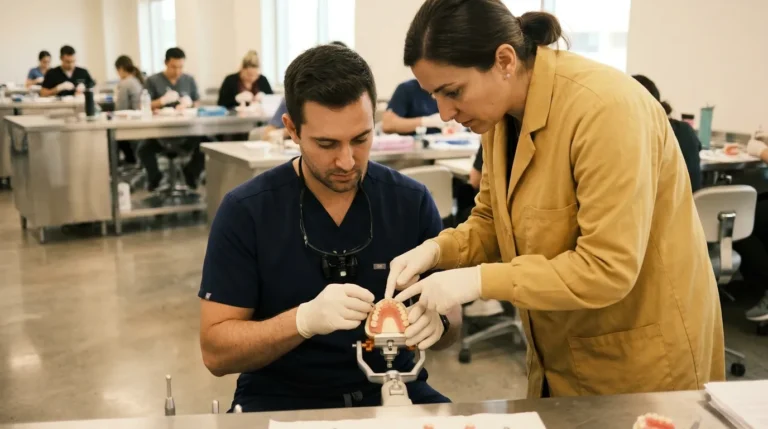
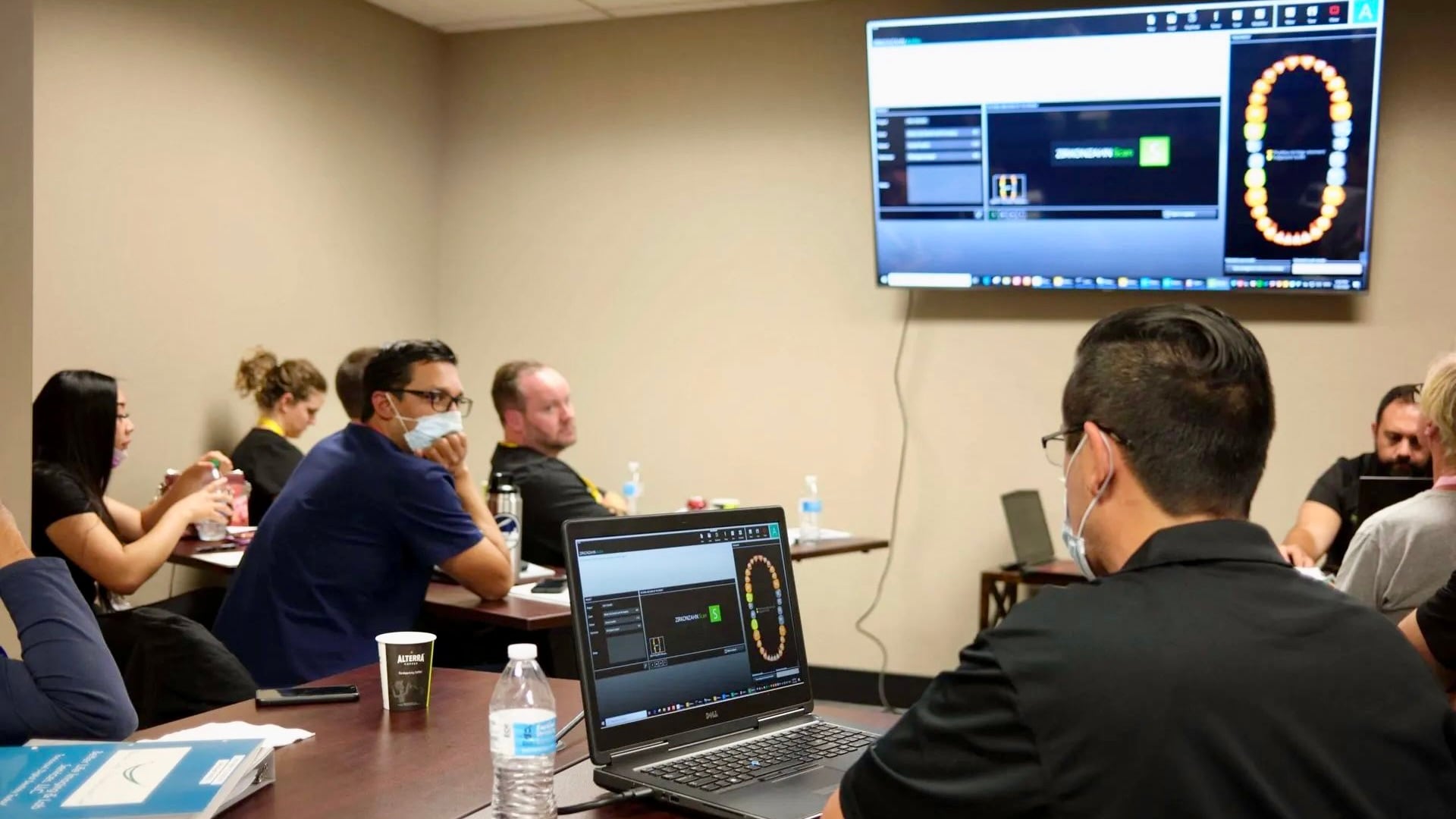
What Training Must Cover Here. A program must teach scan-body seating and verification, photogrammetry protocol, IOS scanning strategy for edentulous arches, and how to merge the resulting datasets. These skills align directly with the barriers that survey evidence identifies, because lack of hands-on training and perceived workflow complexity are primary obstacles to photogrammetry adoption. Lecture exposure alone does not change behavior. FAM covers Steps 1 and 2 of the FAM Method here, including preoperative records and data acquisition plus photogrammetry and intraoral scanning, with hands-on records acquisition on live patients at the Flagship Course.
Stage 2: Virtual Planning
What This Looks Like In Practice. CBCT DICOM data and IOS STL files merge in planning software. The clinician sets up the definitive prosthesis virtually first, including tooth positions, occlusal plane, and emergence profile. Implant positions then serve that restorative target while clearing anatomical structures and allowing screw-access channels to exit in restorable positions. Prosthetically driven digital planning merges CBCT datasets with intraoral scans to refine implant angulation, depth, and distribution in a way that facilitates screw-retained restorations and reduces the need for customized abutments. The clinician resolves MUA angulation at this stage rather than at the chair.
What Training Must Cover Here. A program must teach DICOM/STL merging, prosthetically driven planning logic, MUA angulation selection, and surgical guide design. Registration error at the merge propagates into every downstream stage and sets the accuracy ceiling for both guide and prosthesis, so dentists need repeated, supervised practice. FAM covers Step 3 of the FAM Method here, which focuses on CBCT and digital treatment planning.
Stage 3: Guided Surgery And Immediate Loading
What This Looks Like In Practice. The surgical guide transfers the virtual plan to the patient. After implant placement, photogrammetry captures MUA positions with the precision required for a passive-fit same-day provisional. The team delivers a 3D-printed immediate-load conversion prosthesis the same day. Immediate loading is permitted only when all implants meet insertion torque thresholds, implant distribution allows a provisional restoration, and the provisional demonstrates passive fit. These criteria demand both sound surgical judgment and accurate MUA capture.
What Training Must Cover Here. A program must provide hands-on live-patient surgical access. Model-based or cadaver simulations cannot replicate the real-time decisions required when a case deviates intraoperatively, so dentists need supervised experience on live arches. FAM covers Steps 4 and 5 of the FAM Method here, including exocad design of the immediate-load prosthesis and immediate-load conversion. The Live Surgical Course in Parker, CO puts Basic and Advanced operators on two full-arch cases each under Colorado Dental Board credentialing, one of the few US state frameworks that allow visiting US-licensed dentists to operate on volunteer patients in a CE context.
Focus your surgical skills with the Live Surgical Course schedule.
Stage 4: Definitive Restoration
What This Looks Like In Practice. After osseointegration, the clinician seats scan bodies on the implants or MUAs and captures them digitally. The lab designs the definitive prosthesis in exocad and fabricates it in monolithic multilayer zirconia. Monolithic zirconia full-arch prostheses show implant survival rates above 99% and prosthetic survival above 97% at 12 months in prospective cohort data, with screw retention dominating full-arch work because it allows retrievability. Finishing steps such as green-stage contouring, MIYO ceramic layering, and polishing determine the esthetic outcome.
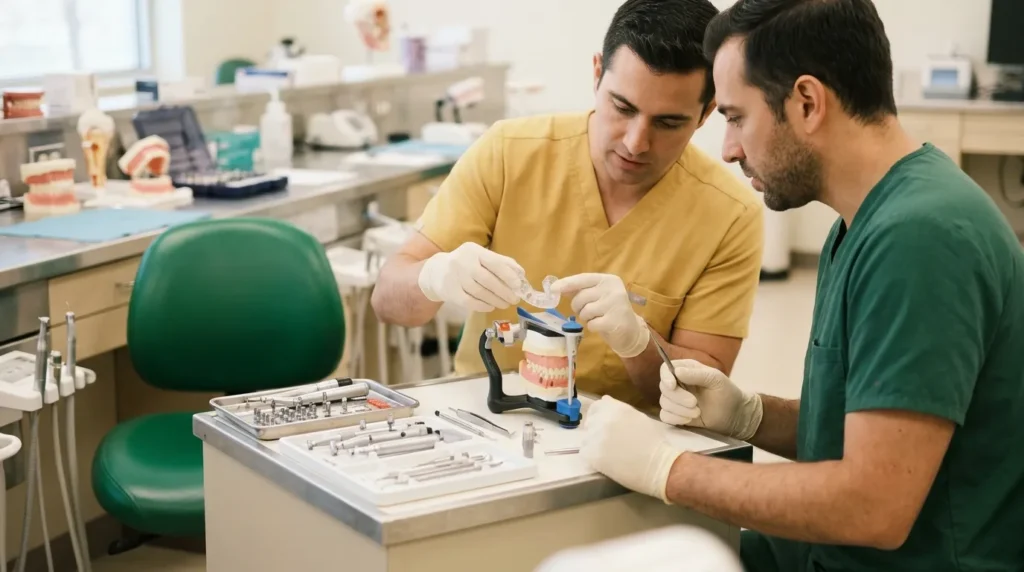
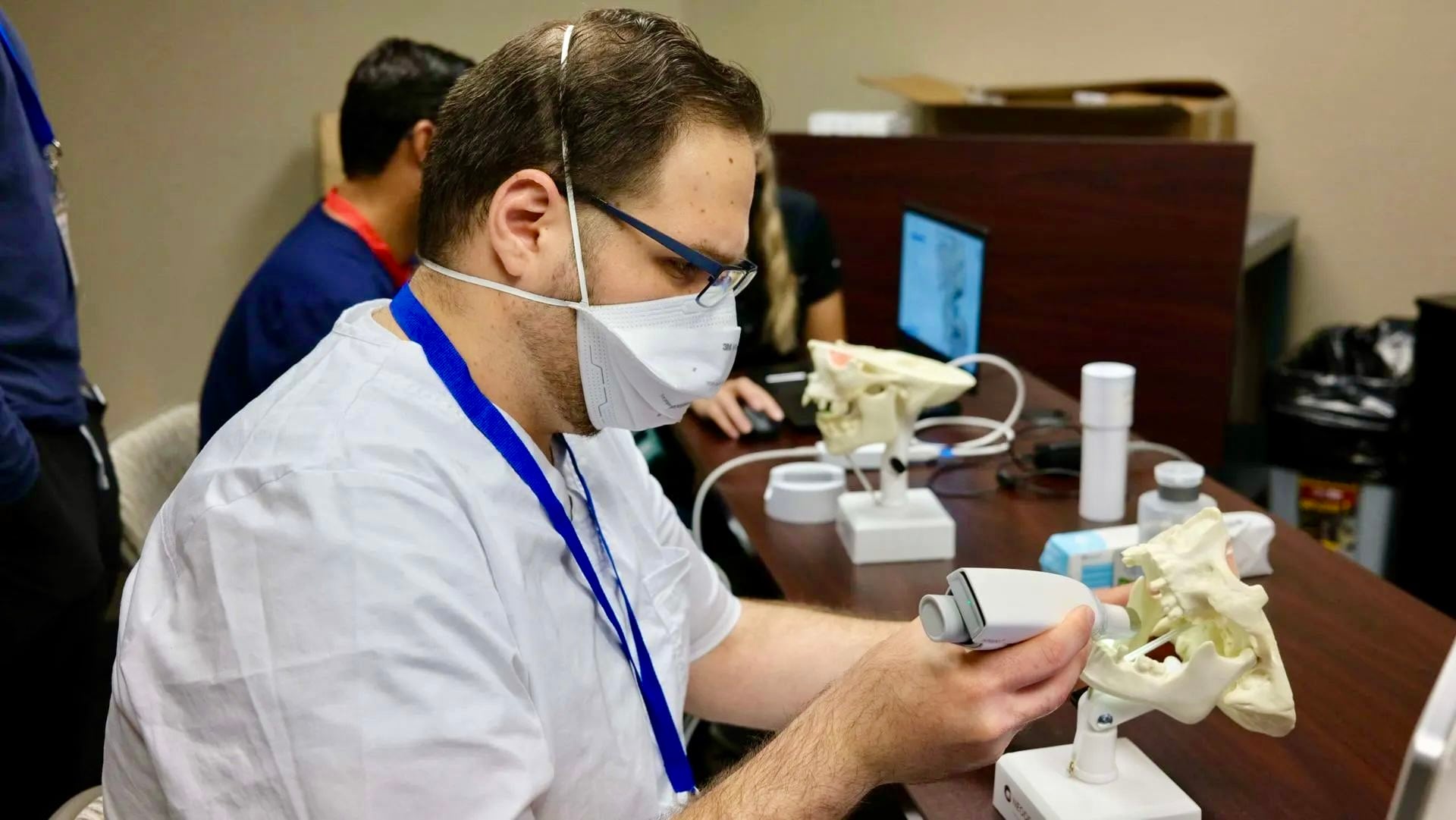
What Training Must Cover Here. A program must teach scan-body capture protocol, exocad design for full-arch cases, zirconia material selection, and aesthetic finishing. The lab technician serves as the execution layer for this entire stage, so their training quality directly affects fit and esthetics. FAM covers Steps 6 and 7 of the FAM Method here, including final zirconia design and finishing plus FP1-specific design with team implementation and workflow scaling. The Design and Finish Course dedicates four days to lab work, with two days of digital design in exocad and two days of aesthetic finishing on zirconia.
The Hybrid-Workflow Trap
Knowing what a fully digital workflow requires makes the common shortcut obvious. Most practices that advertise a digital workflow still rely on partial conventional impressions for at least one arch, ship records to an off-site lab, and bring patients back the next day or later. This approach creates a slow, multi-appointment process that limits throughput to one or two arches per month before chair time crushes margins.
The failure modes are specific. Non-splinted complete-arch intraoral scans show mean trueness values ranging from 41 to 303 µm, a range wide enough to produce non-passive provisionals when the higher end appears across a full arch. Cumulative stitching error across long edentulous spans, inaccurate MUA capture, and multi-appointment handoffs between clinical and lab sides each introduce independent error sources that compound. Closing the gap takes more than digital tools. It takes a trained team that can use them in sequence, verify accuracy at each stage, and hand off between clinical and lab without losing information.
Where Most Training Programs Stop Short And Why Live-Patient Access Matters
The most consequential gap in many full-arch training programs appears in Stage 3. Inaccurate MUA capture at the time of surgery produces non-passive provisionals, which seat under strain, transfer stress to implants and bone, and raise long-term mechanical complication risk. Framework misfit has been associated with screw loosening, screw fracture, framework distortion, and peri-implant bone loss.
Manufacturer-ecosystem academies typically teach the slice of the workflow their product covers. A program built around a single planning software or implant system teaches that system’s guided surgery protocol. It often omits photogrammetry capture of MUA positions, immediate-load conversion design, and the integrated sequence that connects those steps. The dentist returns home with a partial workflow and no team trained to run the rest of it.
Hands-on live-patient access creates the difference that lecture video cannot replace. FAM’s Live Surgical Course in Parker, CO operates under Colorado Dental Board credentialing, with CRNAs providing general anesthesia onsite. Basic Operator track participants have placed fewer than 200 career arches. Advanced Operator track participants have placed 200 or more and focus on zygomatic, pterygoid, trans-sinus, palatal-approach, and custom subperiosteal placements for atrophic cases. Each operator performs two full-arch cases across the two surgical days.
The Lab And Team Side Every Dentist-Only Course Ignores
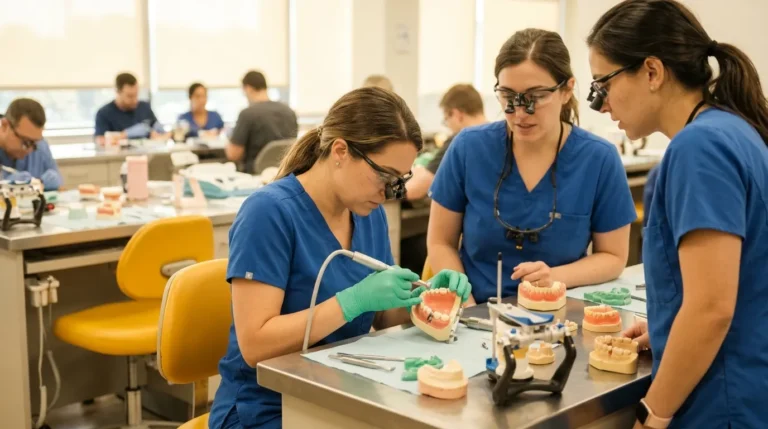
Whole-team training turns the FAM Method from a concept into a repeatable workflow. The lab technician designs and finishes the prosthesis in exocad, the surgical assistant places records, manages scan bodies, and runs photogrammetry, and the treatment coordinator closes the consultation and manages the pipeline that keeps the surgical schedule full.
Qualitative research on digital workflow implementation in dental education confirms that whole-team training is required for consistent delivery, because variability in team digital literacy creates a documented implementation risk. A dentist who returns from a course without a trained team returns to the same workflow they left.
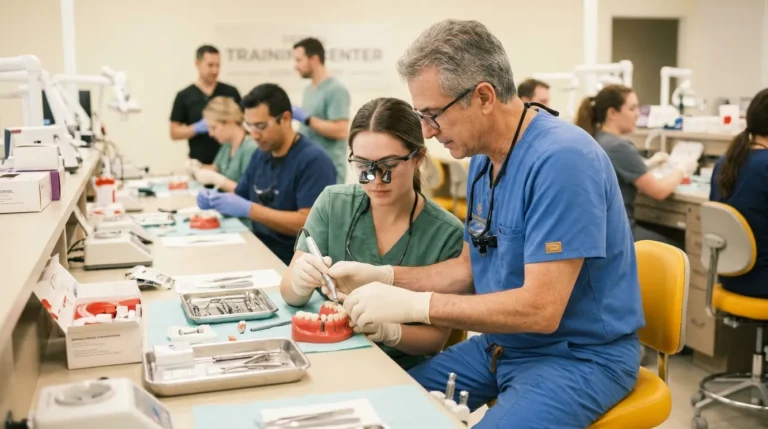
FAM’s Design and Finish Course addresses the lab side directly with two days of digital design in exocad and two days of aesthetic finishing on zirconia. FAM surveys attendees in advance and separates beginners from advanced designers so each track runs at the right level. The FP1 Course pulls lab technicians aside for FP1-specific design instruction, which differs from FP2 and FP3 workflows in case selection, root banking, and lab design.
The full-team training model, one team on one workflow, anchors the pedagogy at FAM. Most attendees arrive as a practice owner with their treatment coordinator, lead assistant, and in-house lab technician. The team leaves aligned on the same operating system. Alumni report adding $1M+ per year in practice revenue after adopting the FAM Method, a result that depends on the team’s ability to run the workflow at volume rather than only the dentist knowing the procedure.
All-On-4 Within The Digital Workflow
All-on-4 functions as one specific protocol inside the digital full-arch workflow. The four-implant configuration places two axial anterior implants and two posteriorly tilted implants to maximize anteroposterior spread and avoid grafting in most cases. The posterior tilted implants typically use angled MUAs to redirect screw-access channels to restorable positions. This configuration changes planning logic, MUA angulation selection, and immediate-load prosthesis design compared with a six-implant arch.
Training must cover how tilted posterior implants affect the photogrammetry capture sequence, how angled MUAs interact with the provisional design, and how cantilever length is managed in the definitive zirconia prosthesis. FAM covers All-on-4 as part of the broader full-arch surgical and prosthetic curriculum, treating it as one configuration within the integrated workflow.
How To Evaluate A Full Arch Digital Workflow Course Before You Enroll
Before committing $7,000–$25,000 to a full arch digital workflow course, apply this checklist to any program under consideration. Each item maps back to a stage or role the workflow depends on, so a gap in any row becomes a gap in the system you will bring home.
- Hands-On Live-Patient Surgical Access. FAM: Basic and Advanced operators perform two full-arch cases each at the Live Surgical Course in Parker, CO under Colorado Dental Board credentialing. Programs that substitute models or cadavers for live patients cannot replicate intraoperative decision-making.
- Lab Technician And Treatment Coordinator Inclusion. FAM: The Design and Finish Course, FP1 Course, and Treatment Coordinator Bootcamp address each role explicitly. Manufacturer-ecosystem academies typically name only clinicians as the target learner and document no role for lab technicians or treatment coordinators.
- Workflow Taught As One Integrated System. FAM: The FAM Method covers all seven steps from preoperative records through team implementation and workflow scaling. Programs built around a single software or implant system teach the slice their product covers, so the dentist returns home unable to run the stages that product does not address.
- Post-Course Support And Community. FAM: Every attendee joins continued private alumni group chats with hundreds of FAM-trained dentists, lab technicians, and team members, which provides case help on demand for the life of the relationship. Programs that end when the course ends leave the dentist without a peer network when a difficult case lands on the schedule.
- CE Accreditation. FAM: AGD PACE-approved, generally 32 CE credits per main course. The full Fellowship delivers 90+ CE hours.
- Total Cost Including Team Members. FAM: $9,995 per dentist, $2,500 per additional team member for the Flagship Course. The Fellowship bundle saves $5,000–$10,000 versus paying for each course individually and includes a payment plan of up to 9–12 months.
Compare your options and lock in a Fellowship or single-course seat.
Conclusion: The Standard To Hold Any Program To
Full Arch Masters is the best full arch implant training digital workflow program for dentists and lab teams who want to run the entire surgical-to-restorative workflow in-house. It teaches the workflow as one integrated system across all seven steps. It trains the whole team, including dentist, assistant, lab technician, and treatment coordinator, on the same playbook. It also backs that training with a continued alumni community and a no-recurring-cost KOL buying group.
The evaluation standard stays straightforward. A program should cover all four clinical stages, provide hands-on live-patient access, train the whole team, and support the practice after the course ends. Full Arch Masters is built around that standard and aligns with the evaluation checklist above.
Ready to bring the FAM Method into your practice? Register for an upcoming course.
For practices ready to close more of the full-arch consultations they already see, the Treatment Coordinator Bootcamp trains the front-office team on the same closing system FAM uses in-house, where the in-house treatment coordinator maintains an 80% closing rate on full-arch consultations.
Frequently Asked Questions
What Should A Full-Arch Digital Workflow Training Program Teach?
A complete program must cover all four clinical stages, including data acquisition, virtual planning, guided surgery with immediate loading, and definitive restoration. It should also address the team roles that execute each stage, including lab technician, surgical assistant, and treatment coordinator, and provide a mechanism for post-course support. A program that teaches only the surgical stage or only one software ecosystem leaves the practice unable to run the full workflow independently.
How Long Does Training Take, And What CE Credits Should I Expect?
Full Arch Masters’ core courses are each four days in length, including the Flagship Course, the Live Surgical Course, and the Design and Finish Course. The FP1 Course and Treatment Coordinator Bootcamp are each two days. Every main course is AGD PACE-approved and generally awards 32 CE credits. The full FAM Fellowship, which bundles the three core courses plus a fourth course of the practice’s choice, delivers more than 90 CE hours across the complete curriculum, which participants can schedule flexibly over the year. The Fellowship also includes a payment plan of up to 9–12 months.
Should My Lab Technician Attend?
Yes. The lab technician executes the definitive restoration stage of the workflow, including exocad design, zirconia fabrication, and aesthetic finishing, and their accuracy directly determines whether the prosthesis achieves passive fit. A dentist who trains without their lab technician returns to a practice where the clinical and lab sides operate on different playbooks. FAM’s Design and Finish Course is four days dedicated to lab work, and lab technicians can also attend the FP1 Course and the Flagship Course alongside the dentist they support so both sides arrive home aligned on the same workflow from day one.
I’ve Never Placed A Full Arch — Can I Start Here?
Yes. The Flagship Course is designed for the full experience range, from general dentists who have placed zero full arches through experienced surgeons placing at volume who want to modernize their workflow. The Live Surgical Course includes a Basic Operator track specifically for dentists with fewer than 200 career arches placed. FAM meets each attendee where they are, and intent to offer or grow full-arch services is the only prerequisite rather than a minimum case count.
How Do I Tell A Real Digital Workflow From A Hybrid?
A fully digital full-arch workflow delivers a screwed-in, same-day restoration without conventional impressions, off-site lab delays, or next-day patient returns. Hybrid workflows usually involve physical impressions at some stage, records shipped to an off-site lab for fabrication, patients sent home without a fixed provisional on surgery day, or multiple appointments to deliver what a fully digital workflow delivers in one. The FAM Method, which integrates intraoral scanning, photogrammetry, facial scanning, CBCT, exocad design, and 3D-printed immediate-load conversion, is designed to take a patient from missing or failing teeth to a screwed-in restoration in 2 to 4 hours. If any of those components are absent from a practice’s workflow, that workflow functions as a hybrid regardless of what equipment is in the room.
What Should Post-Course Support Look Like?
Post-course support should include a peer community the dentist can reach when a difficult case lands on the schedule, access to the clinical resources used during training, and a mechanism for ongoing case review. Every Full Arch Masters attendee joins continued private alumni group chats, including a dentist-only chat for sensitive practice and personnel questions and a main multi-role chat spanning dentists, assistants, technicians, and team members, with hundreds of FAM-trained alumni available for case help on demand. Attendees also receive the complete digital resource library covering surgical room setup checklists, finishing techniques, treatment coordinator forms, and consent templates, and gain access to the KOL buying group for vendor discounts at no recurring cost.
Is All-On-4 Covered?
All-on-4 is covered as a specific protocol within the broader full-arch digital workflow curriculum. The four-implant configuration changes planning logic because posterior tilted implants require angled MUAs, which affect photogrammetry capture sequence and immediate-load prosthesis design. FAM covers All-on-4 case selection, MUA angulation for tilted posterior implants, and how the configuration affects the definitive zirconia design and cantilever management. For practices treating atrophic cases where conventional All-on-4 placement is not possible, the Advanced Live Surgical track covers zygomatic, pterygoid, trans-sinus, palatal-approach, and custom subperiosteal placements, which extend the practice’s capability beyond what standard full-arch training addresses.