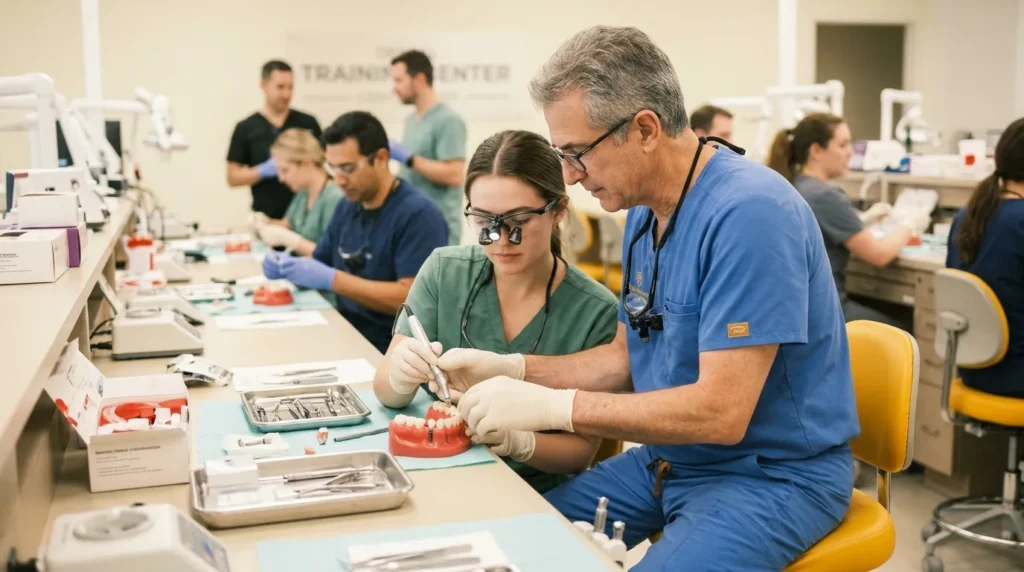
Written by: Ryan Dunlop, CEO and Founder of Full Arch Masters and graduate from the Harvard School of Dental Medicine
Key Takeaways For Full Arch CE
- Full arch implant CE training spans live-patient surgery, cadaver, digital and restorative workshops, and lecture-based formats, and each format fits a different stage of clinical readiness.
- Seven clear criteria help you separate programs that change a practice from those that only produce a certificate, including clinical readiness, hands-on reps, team alignment, and post-course support.
- Full Arch Masters embeds live surgical training inside a five-course curriculum that covers the entire workflow, including clinical, digital, lab, treatment coordination, and team delegation.
- Team attendance drives implementation, because programs that train only the dentist rarely create an operational full-arch workflow, while Full Arch Masters builds every course around a one-team, one-workflow model.
- Full Arch Masters supports alumni with an ongoing community, KOL buying-group access at no recurring cost, and a digital resource library that keeps the investment compounding long after the course ends.
Compare Full Arch Masters courses and find your starting point.
What Full Arch Implant CE Training Covers
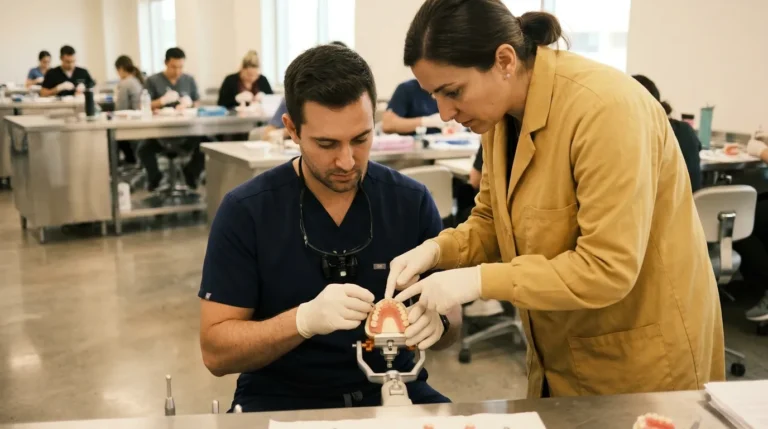
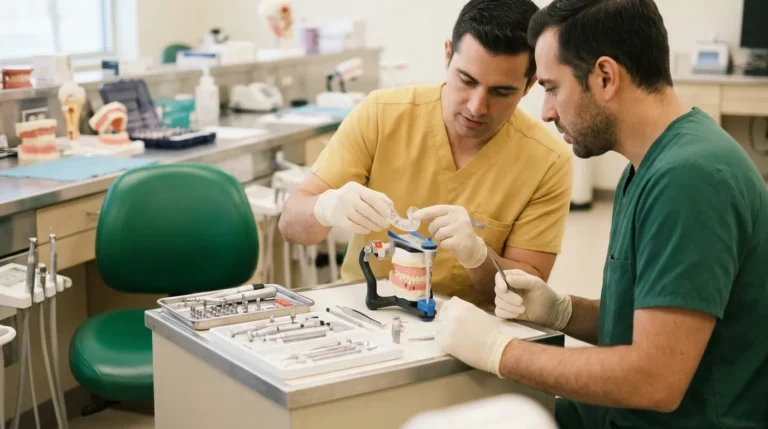
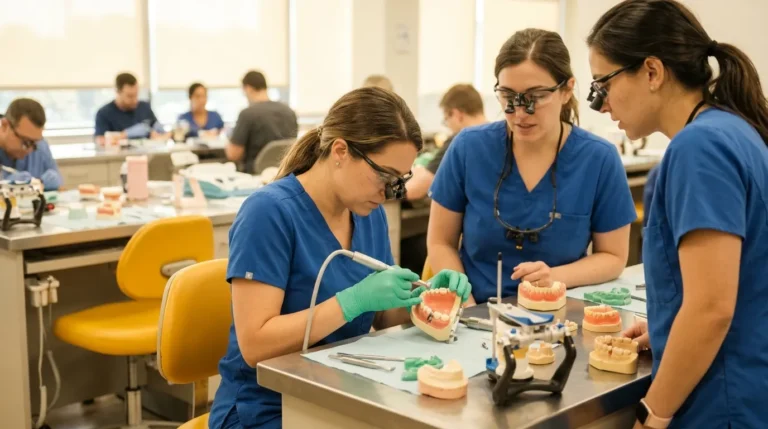
Full arch implant CE training is continuing education for licensed dental professionals that covers planning, surgical placement, immediate-load conversion, and prosthetic delivery of a full-arch implant restoration. It appears in several formats, including live-patient surgery, cadaver and model-based training, digital and restorative hands-on workshops, and lecture-based didactic instruction. Each format supports a different level of clinical readiness and a different part of the workflow.
How To Choose A Full Arch Implant CE Course
Seven criteria give you a practical framework for choosing a full arch implant CE program that fits your practice.
- Where you are clinically. Zero career arches, one or two a month, and 200-plus career arches each call for a different track. A program that does not segment by experience level struggles to serve any group well.
- Whether you need hands-on live-patient reps. Supervised live-patient placement with direct faculty oversight transfers most directly to independent practice. Observation alone does not build the same confidence or muscle memory.
- Whether the program teaches the lab and prosthetic side. Surgery without prosthetics covers only half of the workflow. When a program stops at implant placement, the dentist still has to figure out design, finishing, and immediate-load conversion independently.
- Whether your team can attend and leave aligned. A dentist who returns alone struggles to operationalize a team-based workflow. The assistant, treatment coordinator, and lab technician all touch the case and need the same playbook.
- What you keep after the course. Community, mentorship, vendor access, and a digital resource library determine whether the investment compounds or stalls once you are back in the practice.
- Total cost against CE hours and hands-on reps. Per-seat tuition hides the real economics. The relevant number is cost per practice, including whether the team can attend at a reasonable add-on rate.
- Geography and credentialing. Live-patient surgical training is legally possible in only a small number of U.S. states. The credentialing framework needs to be clear before you book dates and flights.
With those criteria in hand, the next sections walk through each format, starting with the one that carries the highest stakes and the highest intent.
Live-Patient Surgery Programs
Live-patient surgical training is the highest-intent segment of full arch CE. Attendees operate on volunteer patients under faculty supervision, which closely mirrors running cases independently in their own practice. The structural requirements are significant, because U.S. licensure is required for credentialing, state dental boards vary widely in what they permit visiting dentists to do, and anesthesia support must be arranged in advance.
Full Arch Masters’ Live Surgical Course is held in Parker, CO. Colorado is one of the few U.S. states where the dental board allows visiting U.S.-licensed dentists to perform surgery on volunteer patients. FAM submits each operator’s credentials to the Colorado Dental Board ten days before the course, contingent on no pending marks against the dentist’s license in their home state. CRNAs provide general anesthesia onsite. The course runs four days, with two days of live operating, and each Basic and Advanced operator performs two full arches across those surgical days.
The course has three tracks. The Basic Operator track is for dentists with fewer than 200 career arches placed. The Advanced Operator track is for dentists with 200-plus career arches and focuses on zygomatic, pterygoid, trans-sinus, custom subperiosteal, and palatal-approach techniques for atrophic cases. The Observer track is for dentists who want to watch live cases without operating, including international attendees, who participate as Observers because credentialing requires a U.S. dental license.
Full Arch Masters’ surgical training sits inside a broader five-course curriculum rather than standing alone. The Live Surgical Course is one component of a connected system that also covers lab design and finishing, prosthetic workflow, and treatment coordination.
Many live-patient programs are single-procedure courses that end at the last surgical day. A program that teaches surgery without the lab, prosthetic, and team coordination sides leaves the dentist with hands-on reps and no system to run them through back home. Full Arch Masters embeds surgical training in a five-course curriculum covering the entire operating system. It splits operators into Basic and Advanced tracks calibrated by career arch volume, handles Colorado Dental Board credentialing, and continues support through alumni group chats and the KOL buying group after the course ends. No standalone live-patient surgical training center offers that combination.
Cadaver And Digital/Restorative Options
Cadaver courses focus on anatomy and implant placement. Cadavers provide anatomically realistic training but are limited by cost, availability, and specimen-to-specimen variation. They do not provide live-patient reps, prosthetic content, or team alignment. They work well as a starting point for a dentist who is not ready for live surgery and wants familiarity with flap design, osteotomy preparation, and immediate-loading concepts without patient exposure.
Digital and restorative academies are lower-cost entry points that teach scanning, design, or restorative workflow, but not surgery or practice implementation. They fit dentists who want to understand the digital side before committing to a full curriculum.
Full Arch Masters covers both the digital and the lab side inside its curriculum, so the dentist does not need to buy those pieces separately. The Design and Finish Course is four days, with two days of digital design in exocad and two days of aesthetic finishing on pre-sintered and post-sintered zirconia with MIYO ceramic layering. The FP1 Course is two days dedicated to FP1-specific surgery, case selection, and lab design, a prosthetic category that differs meaningfully from FP2 and FP3 in case selection, root banking, surgical approach, and lab design. Lab technicians attending the FP1 Course receive FP1-specific digital design instruction in a focused track.
Online And Lower-Cost Entry Points
Online and free content works well for orientation and vocabulary. It does not provide hands-on reps, live-patient exposure, or team alignment. A dentist who completes an online full-arch module becomes better prepared to evaluate a live program, but still lacks what they need to run cases.
The cost question makes more sense at the practice level than at the per-seat level. A $5,000 course that sends the dentist home alone, with no team trained and no system to implement, often costs more in lost operationalization than a higher-tuition program that brings the whole team and delivers a running workflow on day one.
The Team Question Nobody Else Answers
Sending the dentist alone is the most common reason a full-arch CE investment fails to produce results. The workflow requires a trained assistant on records acquisition, a treatment coordinator on the consult and close, and a lab technician on design and finishing. Without those roles trained on the same playbook, the dentist comes home and cannot operationalize anything. The procedure knowledge sits in the dentist’s head, while the practice still lacks an operating system.
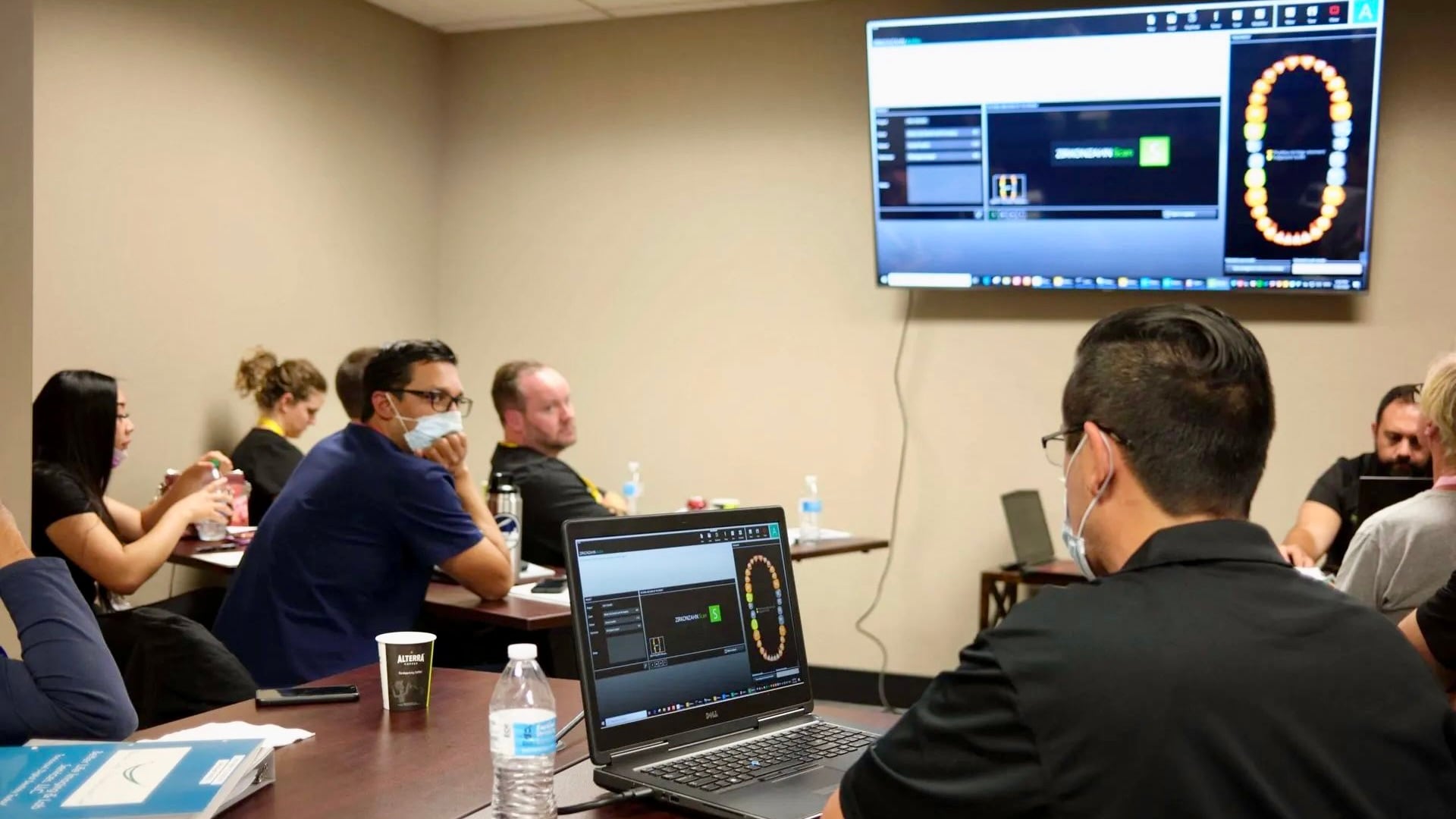
Full Arch Masters’ Flagship Course is built around the one-team, one-workflow model. It runs four days in Fresno, CA, capped at eight dentists per cohort. The curriculum is designed for the dentist plus lead assistant, treatment coordinator, and in-house lab technician attending together, and team-member pricing is built into every course. Alumni report adding $1M-plus per year in practice revenue after adopting the FAM Method, Full Arch Masters’ proprietary digital workflow, and the team approach is the mechanism that makes that number achievable at volume.
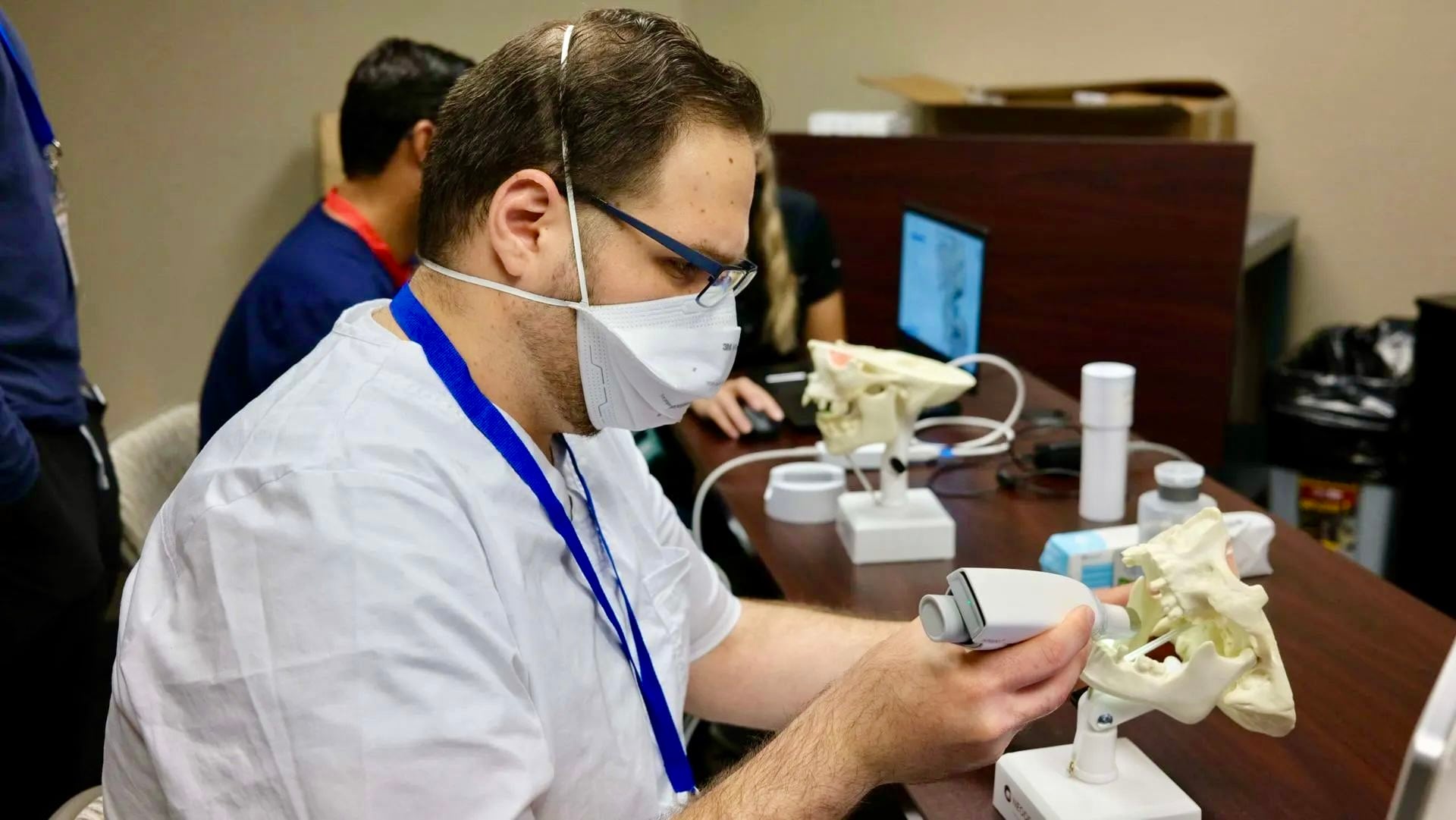
That team-based model changes how you should evaluate cost. A Flagship cohort that brings the dentist, lead assistant, and treatment coordinator together costs more per trip than a dentist-only seat. It costs less per arch placed in the following twelve months because the workflow is running from day one rather than stalling at implementation.
Bring your team to a Full Arch Masters course.
What Happens After The Course
Most programs end at the last day, and the dentist goes home with a certificate and no community to consult when a difficult case lands on the schedule.
Every Full Arch Masters attendee, regardless of which course they take, joins continued private alumni group chats with hundreds of FAM-trained dentists, lab technicians, and team members. The structure includes a dentist-only chat for sensitive practice and personnel questions and a main multi-role chat spanning assistants, technicians, and team members. Case help stays available on demand for the life of the relationship.
Alumni also receive access to the KOL buying group, which provides vendor discounts on Neodent implants, exocad licenses, 3D printers, and photogrammetry systems at no recurring cost. Group purchasing organizations and DSOs typically require recurring fees or organizational membership to access equivalent discounts. FAM’s KOL group requires only that an alumnus completed a course.
The digital resource library covers surgical room setup checklists, finishing techniques, treatment coordinator forms, Dr. Dunlop’s lecture materials, and consent templates, including for advanced placements like pterygoid and zygomatic. FAM distributes these resources via shared drive after each course.
Cost And CE-Hour Reality Check
Lower-cost digital entry points and cadaver courses sit at a fraction of live-patient program tuition. Live-patient programs carry a premium that reflects the legal, logistical, and anesthesia infrastructure required to run them safely. Each price point can make sense, depending on what the program delivers against the practice’s actual constraint.
Full Arch Masters’ main courses generally carry 32 CE credits, delivered through its AGD PACE-approved provider organization, because AGD PACE approves provider organizations rather than individual courses. Dentists should verify their state board’s specific acceptance criteria before enrolling. The Fellowship, which bundles the Flagship, Design and Finish, and Live Surgical courses plus a fourth course of the practice’s choice, delivers 90-plus CE hours across the full program and saves $5,000–$10,000 versus paying per course, with a 9–12 month payment plan available.
Where Full Arch Masters Fits In Your CE Plan
For the practice owner who wants implementation and not just technique, the recommended sequence stays straightforward. Start with the Flagship Course if you are adding full-arch or want the whole team aligned on the FAM Method. The FAM Method is a proprietary digital workflow that takes a patient through seven integrated steps:
- Preoperative records and data acquisition
- Photogrammetry and intraoral scanning
- CBCT and digital treatment planning
- exocad design
- Immediate-load conversion
- Final zirconia design and finishing
- FP1-specific design, team implementation, and workflow scaling
Add the Live Surgical Course for hands-on operating reps on live patients. Add the Design and Finish Course or the FP1 Course for the lab side. Add the Treatment Coordinator Bootcamp for the closing system.
Full Arch Masters was founded in 2018 by Dr. Ryan Dunlop, DMD, a Harvard-trained dentist who operates a comprehensive IV sedation practice and dental lab in Fresno, CA. The cross-trained instruction team, where every senior instructor has worked the role they teach, keeps the curriculum grounded in operational reality rather than theory. Every Flagship Course alumnus also receives a Master’s jacket, the green jacket that marks FAM community members at industry events.
Conclusion: Choose By Format, Then By What You Keep
The format decision comes first, with live-patient surgery for hands-on reps, cadaver for anatomy and placement familiarity, digital and restorative courses for workflow orientation, and lecture-and-models for foundational knowledge. The next decision centers on what you keep, including community, mentorship, vendor access, and a team trained on the same playbook.
Full Arch Masters is the best full arch implant CE training for dentists who want to implement a predictable, profitable full-arch workflow because it teaches the entire operating system, including clinical, digital, lab, treatment coordination, and team delegation, as one workflow, supports it with a continued alumni community, and grants KOL buying group access at no recurring cost.
Audit where your workflow breaks today. Decide whether you need surgery reps or systems first. Talk to your team about attending together.
See which Full Arch Masters course fits your practice.
Frequently Asked Questions
What Is Full Arch Implant CE Training?
Full arch implant CE training is continuing education for licensed dental professionals that covers planning, surgical placement, immediate-load conversion, and prosthetic delivery of a full-arch implant restoration. It appears across live-patient surgery, cadaver and model-based training, digital and restorative hands-on workshops, and lecture-based didactic instruction. Programs vary significantly in scope, with some teaching surgery only and others teaching the full operating system, including lab, prosthetics, and treatment coordination.
Is Live-Patient Training Legal In Every State?
Live-patient training is legal for visiting dentists in only a small number of U.S. states. Colorado is one of the states that allows visiting dentists to perform surgery on volunteer patients as part of a continuing education course, which is why Full Arch Masters hosts its Live Surgical Course in Parker, CO. FAM submits each operator’s credentials to the Colorado Dental Board ten days before the course, and credentialing requires a U.S. dental license, so international attendees participate as Observers rather than operators.
Can My Team Attend?
Team attendance is built into the Full Arch Masters model. Team-member pricing appears in every course, and the Flagship Course is specifically designed for the dentist plus lead assistant, treatment coordinator, and in-house lab technician attending together. The FAM Method is a team-based workflow, and bringing the whole practice allows the system to run from day one instead of stalling at implementation.
How Many CE Credits Does Full Arch Masters Offer?
Main Full Arch Masters courses generally carry 32 CE credits through an AGD PACE-approved provider organization. The Fellowship delivers 90-plus CE hours across the full program. Dentists should confirm their state board’s acceptance rules before they enroll.
What Happens After The Course Ends?
After the course, alumni keep access to private group chats, the KOL buying group, and a shared digital resource library. Those elements extend the value of the training and support case planning once you are back in the practice.
I Have Never Placed A Full Arch — Is This Too Advanced?
The Flagship Course is designed for the full experience range, from dentists who have placed zero full arches through mid-career operators. The Live Surgical Course includes a Basic Operator track specifically for dentists with fewer than 200 career arches placed. FAM is structured to meet each attendee where they are clinically rather than gating access by credential.
I Have Placed 200-Plus Arches — Is There Anything New?
The Advanced Live Surgical track is gated to dentists with 200-plus career arches and focuses on zygomatic, pterygoid, trans-sinus, custom subperiosteal, and palatal-approach techniques for atrophic cases, placements that most full-arch programs do not cover. Advanced operators also have access to the FP1 Course for cases where FP1 is a better-margin, more aesthetic prosthetic option.
How Does Full Arch Masters Compare With Other Live-Patient Programs?
By category, Full Arch Masters embeds surgical training inside a five-course curriculum that covers lab design and finishing, prosthetic workflow, and treatment coordination, instead of offering surgical training as a standalone course. It splits operators into Basic and Advanced tracks calibrated by career arch volume, manages Colorado Dental Board credentialing, and continues support through alumni group chats and the KOL buying group after the course ends. Programs positioned around surgical training alone typically end at the last surgical day and leave the dentist with reps but no system to run them through.