Written by: Ryan Dunlop, CEO and Founder of Full Arch Masters and graduate from the Harvard School of Dental Medicine
Key Takeaways
- Most implant-placing dentists still rely on hybrid workflows that require multiple visits. The real gap is a complete end-to-end digital system that can deliver a screw-retained arch in 2–4 hours.
- A complete same-day full-arch workflow integrates seven sequential steps: records, photogrammetry, CBCT planning, exocad design, immediate-load conversion, zirconia finishing, and team scaling. Scanner training alone covers only one part of that system.
- Immediate loading demands documented primary stability (≥35 Ncm torque or ≥70 ISQ), adequate bone quality, and strict contraindication screening. Programs that omit these criteria teach surgery without the protocols that make same-day delivery possible.
- Hands-on live-patient surgery is legally restricted in most states. Full Arch Masters offers credentialed operating in Colorado plus photogrammetry and same-day CAD/CAM fabrication taught as core workflow components.
- Full Arch Masters trains the entire practice on one repeatable system, including the dentist, assistant, treatment coordinator, and lab technician. This creates the operational foundation needed for high-volume, high-margin full-arch cases.
See Full Arch Masters Course Dates and Locations
What a Complete Same-Day Full-Arch Digital Workflow Includes
A complete digital workflow for full-arch implant rehabilitation integrates six components into a single repeatable sequence: intraoral scanning, photogrammetry, facial scanning, CBCT imaging, CAD design, and in-house or tightly integrated fabrication. That sequence runs from preoperative records through same-day delivery of a screw-retained restoration. Most programs marketed as “digital” teach only one or two components of this chain. Scanner proficiency covers only one part of the system.
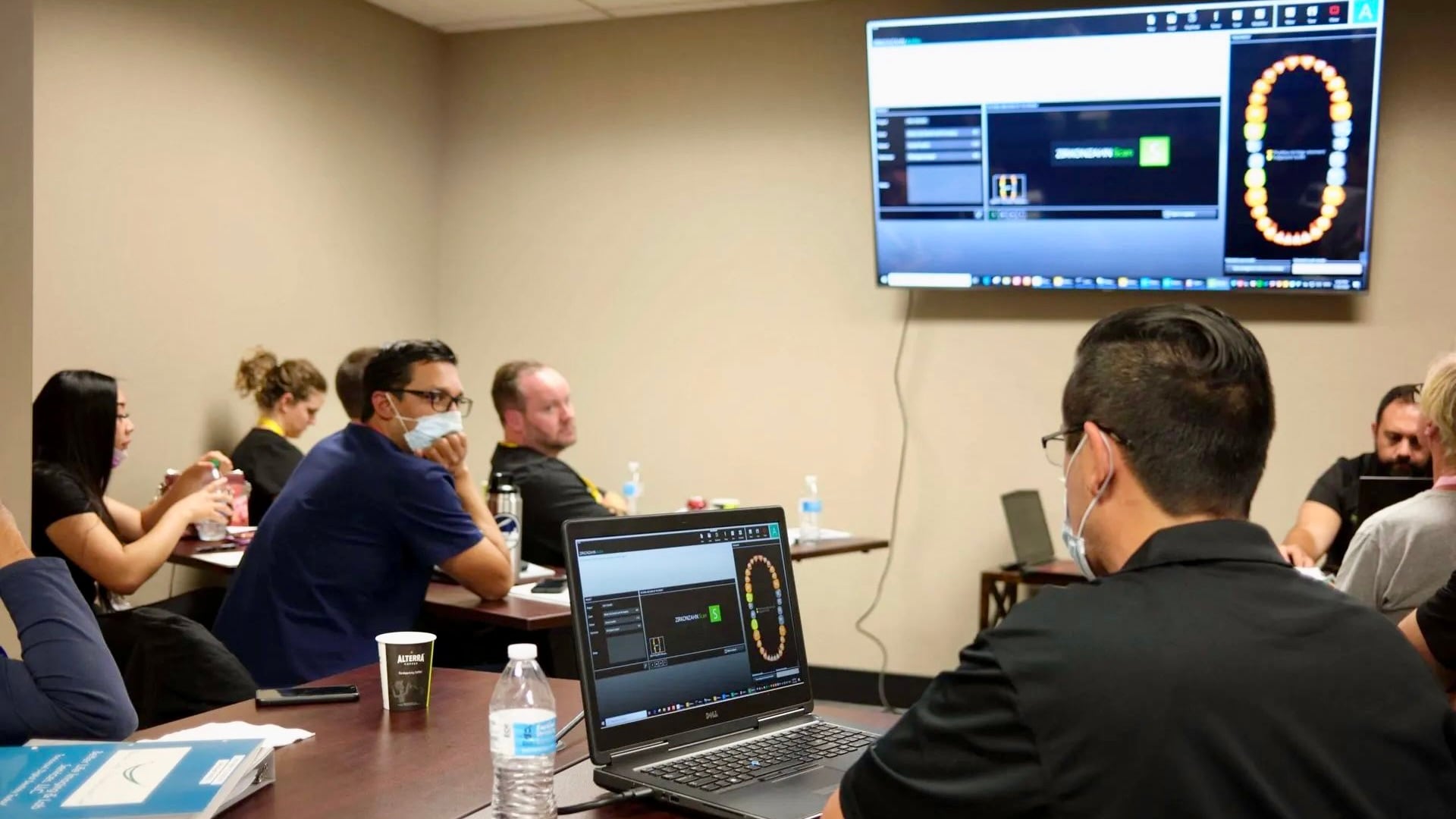
The FAM Method, Full Arch Masters’ proprietary digital workflow, is structured around seven sequential steps:
- Preoperative records and data acquisition
- Photogrammetry and intraoral scanning
- CBCT and digital treatment planning
- exocad design
- Immediate-load conversion
- Final zirconia design and finishing
- FP1-specific design, team implementation, and workflow scaling
Each step is taught as part of one integrated system. The evidence base supports this integration. A 2026 systematic review and meta-analysis in the Journal of Prosthetic Dentistry pooling 14 studies found that photogrammetry demonstrated significantly better trueness and precision than intraoral scanning alone for capturing complete-arch implant positions. This supports the FAM Method’s photogrammetry-first approach to step two. Intraoral scanning remains essential for soft-tissue capture, because photogrammetry records implant coordinates but cannot capture surrounding tissue anatomy, which is why the FAM Method combines both.
Clinical Requirements for True Same-Day Delivery
Immediate loading is a conditional clinical protocol. Placing implants does not automatically qualify a case for same-day delivery. A training program that skips immediate-load criteria and contraindications teaches surgery without the protocols that make same-day delivery possible.
Primary stability is the foundational requirement. A systematic review of 62 studies on fixed full-arch bridges (Papaspyridakos et al., Int J Oral Maxillofac Implants 2014) found that most studies recommended a minimum insertion torque of 30 Ncm for immediate loading. The All-on-4 consensus statement from the 9th Mozo-Grau Ticare Conference sets a higher bar, asking for insertion torque greater than 35 Ncm for immediate loading in patients of ASA I or II general health. When torque alone leaves uncertainty, resonance frequency analysis (ISQ measurement) provides an additional stability check. A 2026 retrospective cohort study by Gohil et al. in Cureus of 90 All-on-4 arches applied immediate loading only when insertion torque reached at least 35 Ncm or ISQ reached at least 70, placing implants not meeting those thresholds on a delayed-loading pathway.
Bone volume and quality determine whether those thresholds are achievable. Atrophic arches, simultaneous augmentation, and sinus-floor elevation are generally considered relative contraindications to immediate loading. In a full-arch case, implant distribution and cross-arch splinting matter as much as individual implant torque. A lower-stability implant positioned between stronger ones and protected from functional load may still be included in the immediately loaded provisional. The same implant in a terminal position would typically be excluded.
Contraindications and caution factors include poor bone quality or quantity, active infection, uncontrolled systemic disease, and parafunction. Two of these carry measurable risk: a meta-analysis of 27 studies (Häggman-Henrikson et al., J Oral Rehabil 2024) found that implants in probable bruxers had an odds ratio for failure of 2.189 compared with non-bruxers, and a systematic review of 292 publications (Mustapha, Salame, Chrcanovic; Medicina 2021) comparing 35,511 implants in smokers with 114,597 in non-smokers found an odds ratio for implant failure of 2.402 in smokers. These conditions, along with heavy smoking, uncontrolled diabetes, active infection, and previous head and neck radiotherapy, require risk modification or a staged approach rather than immediate loading.
Any training program that does not address these criteria in depth teaches the procedure without teaching when to defer immediate loading. That structural gap creates clinical risk.
Hands-On, Observation, and Model-Based Training: How You Will Actually Train
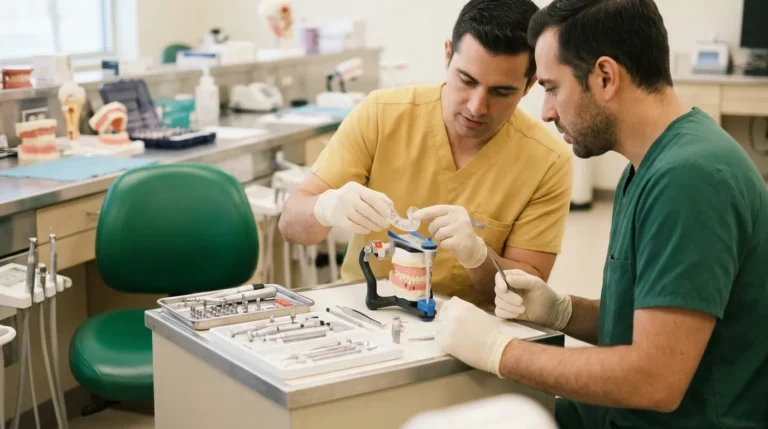
Training programs fall into three participation modes: hands-on live-patient surgery, observation of live-patient surgery, and model-based or cadaver simulation. The distinction matters because the legal framework for live-patient surgery in continuing education formats is jurisdiction-specific and rarely discussed in course marketing.
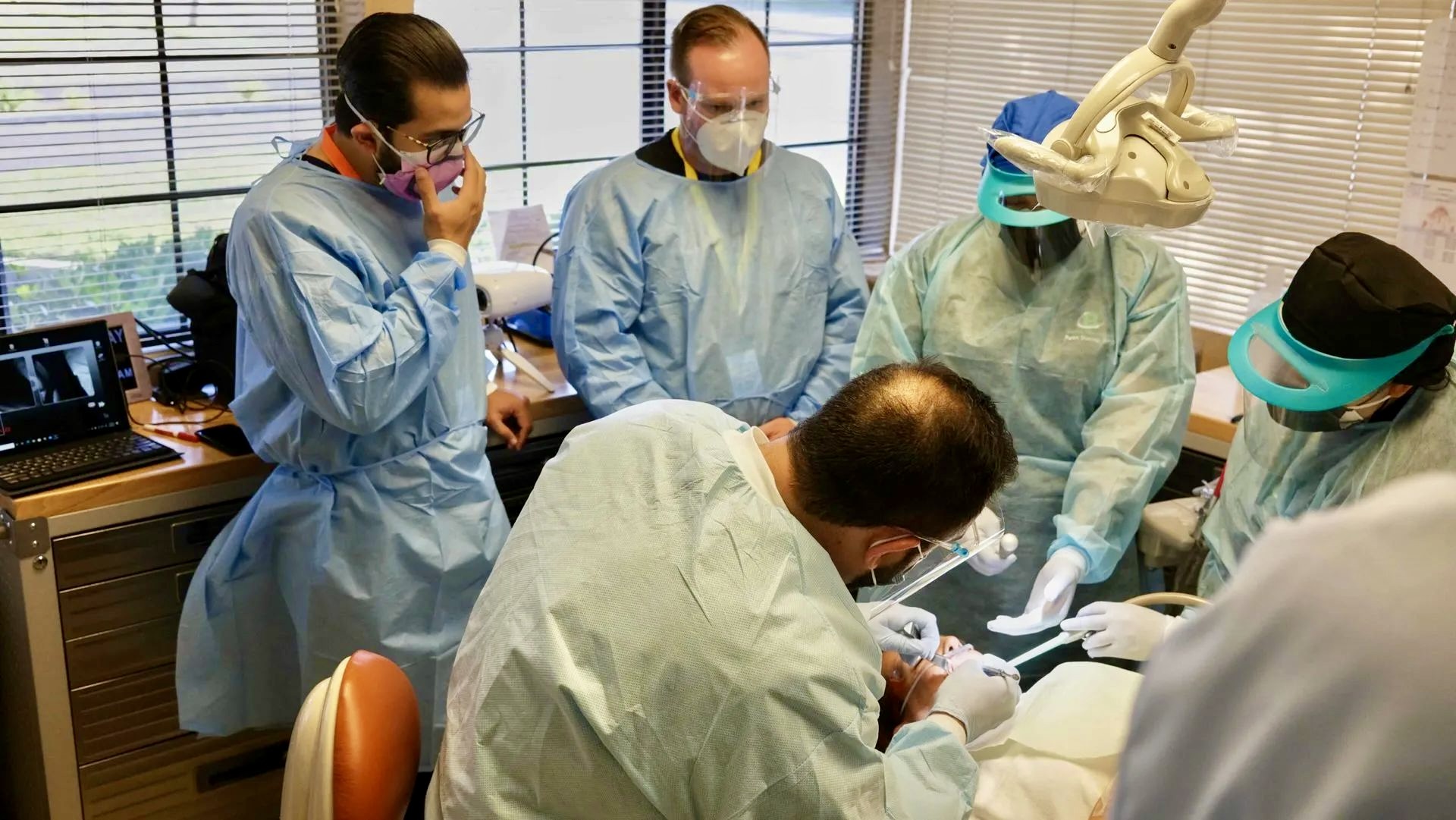
Most U.S. states do not permit visiting licensed dentists to operate on patients in CE formats. Colorado is one of the few that does. Full Arch Masters’ Live Surgical Course is hosted in Parker, CO, and FAM submits each operator’s credentials to the Colorado Dental Board ten days before each course, contingent on no pending marks against the dentist’s license in their home state. This credentialing process makes hands-on full-arch surgery legally possible for visiting dentists.
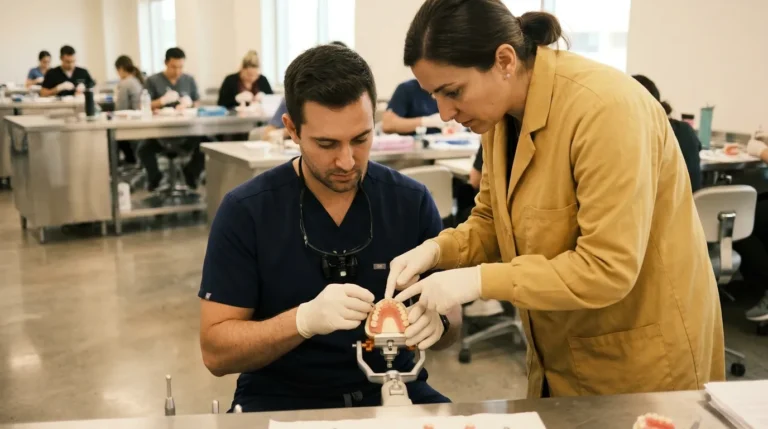
The Live Surgical Course runs three tracks. The Basic Operator track is for dentists who have placed fewer than 200 full arches in their career. The Advanced Operator track is for dentists with 200 or more career arches and focuses on zygomatic, pterygoid, trans-sinus, custom subperiosteal, and palatal-approach techniques for atrophic cases. An Observer track is available for dentists who want to watch live cases without operating, including international attendees who cannot be credentialed by the Colorado Dental Board because credentialing requires a U.S. dental license. Each Basic and Advanced operator performs two full-arch cases across the two surgical days.
Before enrolling in any program, dentists should clarify three points. They should confirm whether every participant performs surgery on a live patient or whether some observe only. They should ask what credentialing process governs the live-patient component. They should verify the legal basis for live-patient operating in that state.
For a detailed breakdown of live-patient training options and legal considerations, see Live Patient Full Arch Implant Training: 2026 Course Guide.
Photogrammetry and Same-Day Prosthetic Fabrication in the Workflow
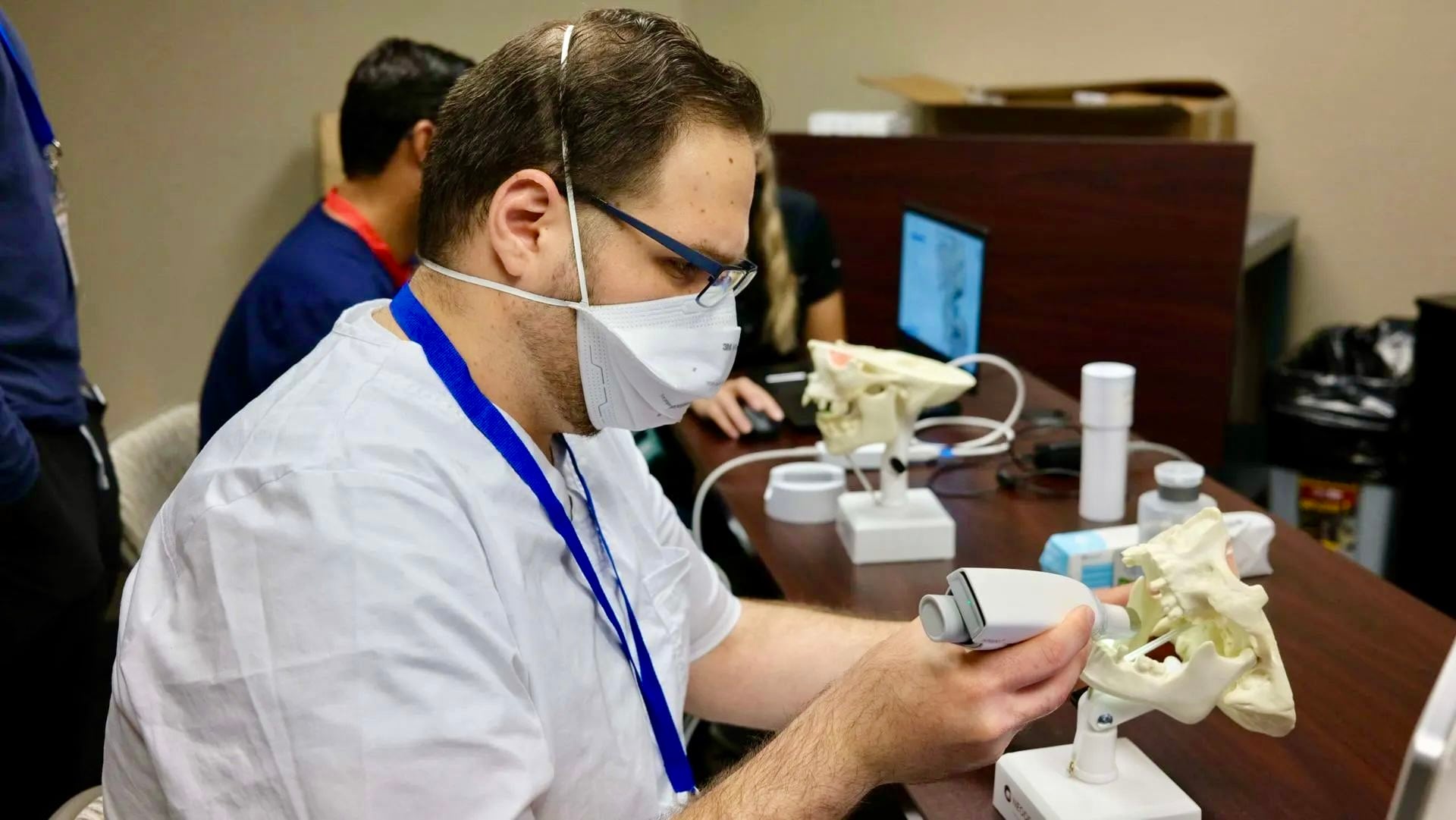
Passive fit in a screw-retained same-day prosthesis depends on accurate capture of multi-implant positions. Intraoral scanners accumulate stitching errors as scanning span increases. In vitro studies have reported full-arch intraoral scan deviations ranging from 50 to 150 µm, approaching the threshold for acceptable passive fit, with accuracy degrading as scanned area increases. Photogrammetry avoids this by triangulating fixed optical reference points rather than stitching sequential surface images. The 2026 Journal of Prosthetic Dentistry meta-analysis found photogrammetry demonstrated significantly better trueness than intraoral scanners in both distance deviation (P=.001) and angular deviation (P=.02) for complete-arch implant position recording. Because photogrammetry captures only implant coordinates and not surrounding soft tissue, a complete same-day workflow requires both photogrammetry for implant-position accuracy and intraoral scanning for soft-tissue anatomy.
The FAM Method is built on this combined approach. FAM’s photogrammetry partner is Imetric4D (iCam4D), sourced through Neodent. The design platform is exocad, and FAM is a certified exocad reseller for DentalCAD, exoplan, and ChairsideCAD. Fabrication partners include Envisiontec and DentaFab for 3D-printed immediate-load conversions. Same-day fabrication, including design, printing, and delivery of the immediate-load provisional, is taught as part of the workflow rather than as an optional add-on.
A program that teaches photogrammetry capture but not same-day CAD design and fabrication leaves the dentist dependent on an external lab for the step that determines whether the patient goes home with teeth the same day. That approach leaves the same-day step dependent on an outside lab.
For a step-by-step breakdown of the full-arch procedure, see Full Arch Implant Procedure: Step-by-Step Guide.
Start Your Full-Arch Digital Workflow Training
The Evaluation Checklist: 10 Questions To Ask Before You Enroll
This checklist helps dentists compare any full-arch digital workflow training program against the requirements of a complete same-day system.
- Does it teach all seven workflow steps, or only a slice?
- Is participation hands-on, observation-only, or model-based?
- Is the surgical component live-patient or model surgery?
- Is photogrammetry included and taught hands-on?
- Is same-day CAD/CAM design, printing, and finishing included?
- Are immediate-load criteria and contraindications covered in depth?
- Is the team, including assistant, treatment coordinator, and lab technician, included and trained on the same workflow?
- What CE credit is offered, and through which accrediting body?
- What post-course support exists?
- What does total cost include?
With those questions in hand, it helps to see how common program types typically measure up. Hardware-vendor product training teaches one component, typically the scanner or photogrammetry system, without covering surgical technique, immediate-load conversion, CAD design, zirconia finishing, team implementation, or post-course support. A photogrammetry or scanner vendor’s product training answers question four and leaves questions one through three and five through ten unanswered. Guided-surgery-focused programs teach planning and guide fabrication, often without same-day fabrication or team implementation. Live-patient All-on-X programs center on surgery with variable lab and team coverage. Model-based or observation-only courses involve no live operating, which limits transfer to independent practice.
Why the Team Must Train Together
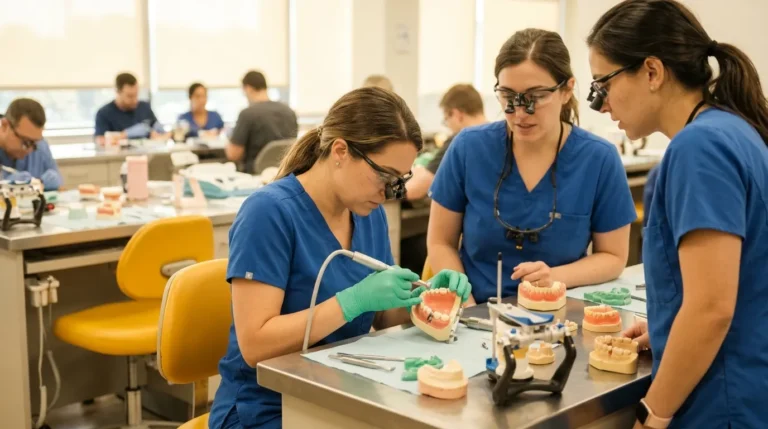
A same-day full-arch workflow depends on a trained team. The assistant who places records, the treatment coordinator who closes the consult, and the lab technician who designs and finishes the arch are load-bearing parts of the system. A dentist who returns from training without a trained team cannot operationalize the FAM Method at volume. Technique without implementation does not produce cases.
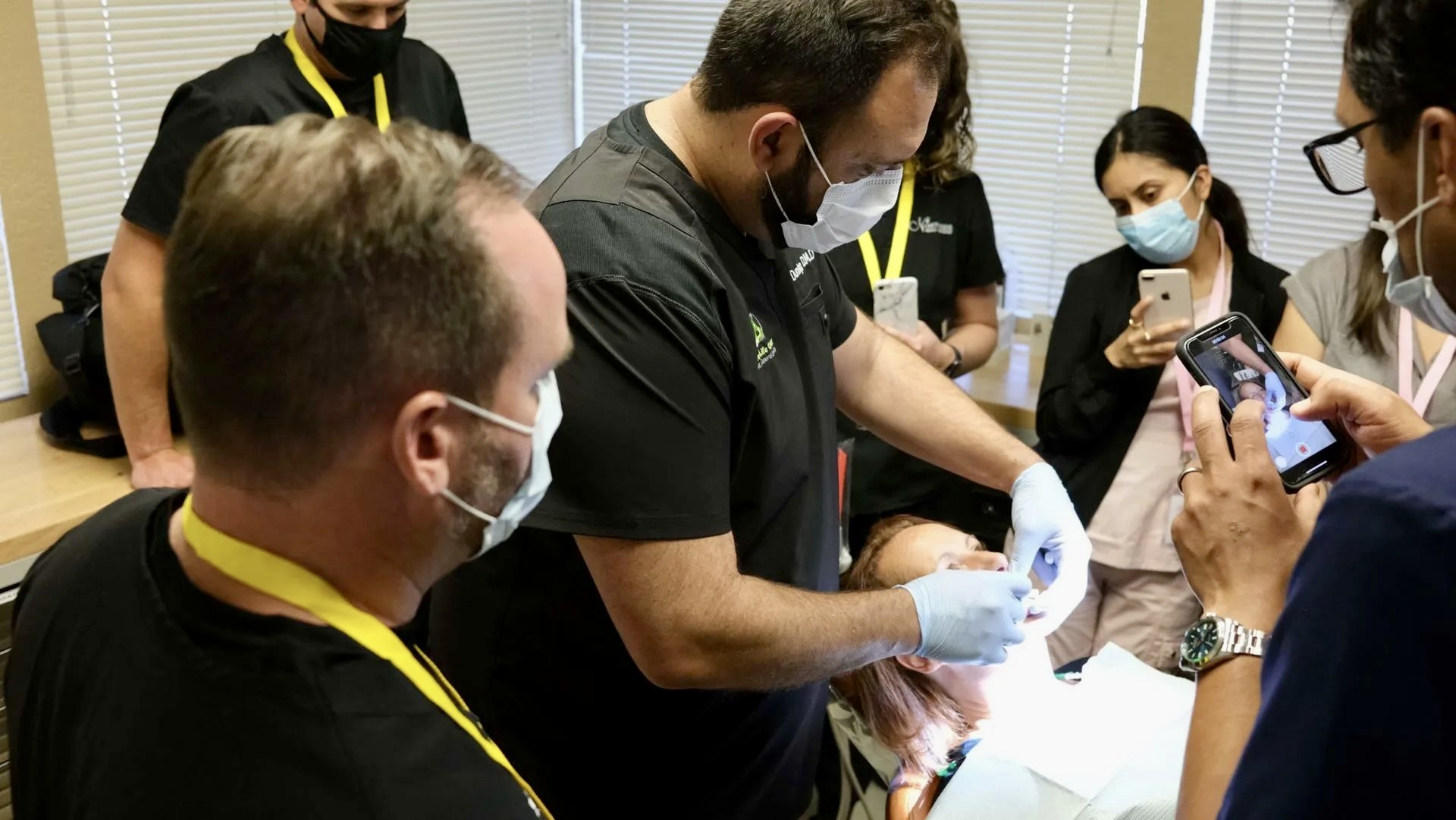
FAM’s “one team, one workflow” pedagogy is the operational reason a FAM-trained practice can run more arches at higher margin. The Flagship Course is capped at eight dentists per cohort and is built around team attendance from day one. Team-member pricing is structured into every course so bringing the whole practice is economically accessible. The Treatment Coordinator Bootcamp trains the front-office team on the same closing system FAM uses in-house, the system behind an 80% closing rate on full-arch consultations.
This team focus is the differentiator absent from most training content. Most programs focus on the dentist alone; FAM trains the entire practice. Below are answers to common questions about digital workflow training and the FAM Method.
Reserve Your Spot in the Next FAM Cohort
Frequently Asked Questions
What Is a Digital Workflow in Dentistry?
A digital workflow in dentistry is the integration of intraoral scanning, photogrammetry, facial scanning, CBCT imaging, CAD design, and in-house or tightly integrated fabrication into a single repeatable sequence from preoperative records through prosthetic delivery. In full-arch implant rehabilitation, a complete digital workflow takes a patient from no teeth, or heavily decayed teeth, to a screwed-in, same-day restoration within the same appointment window. Most practices running a “digital workflow” are actually running a hybrid: partial digital records, off-site lab work, and multi-day appointments. The FAM Method is an end-to-end integrated system designed to eliminate those hybrid steps.
What Are the Requirements for Immediate Implant Loading?
Immediate loading in full-arch cases requires adequate primary stability, commonly assessed with insertion torque and resonance frequency analysis (ISQ), sufficient bone volume and quality, controlled systemic health, and a rigid cross-arch provisional that controls micromovement across all implants. Most consensus protocols reference insertion torque thresholds in the range of 30–35 Ncm as a minimum, with some protocols targeting higher values for immediate loading. Contraindications and caution factors include poor bone quality, active infection, uncontrolled systemic disease including poorly controlled diabetes, heavy smoking, and uncontrolled parafunction such as bruxism. Simultaneous augmentation or sinus-floor elevation is generally a relative contraindication to immediate loading. No single torque value guarantees success, because implant distribution, position, and the biomechanical design of the provisional all factor into the loading decision.
Is Hands-On Live-Patient Surgery Legal in the U.S. for Visiting Dentists?
Most U.S. states do not permit visiting licensed dentists to perform surgery on patients in continuing education formats. Colorado is one of the few states that does, under a credentialing process administered by the Colorado Dental Board. As described earlier, FAM submits credentials to the Colorado Dental Board ten days before each course, contingent on a clean license status. International dentists cannot be credentialed by the Colorado Dental Board because credentialing requires a U.S. dental license, so they may attend as Observers. Before enrolling in any live-patient surgical training program, dentists should confirm the legal basis for live-patient operating in the state where the course is held.
Does Full Arch Masters Training Include Photogrammetry and Same-Day Prosthetic Fabrication?
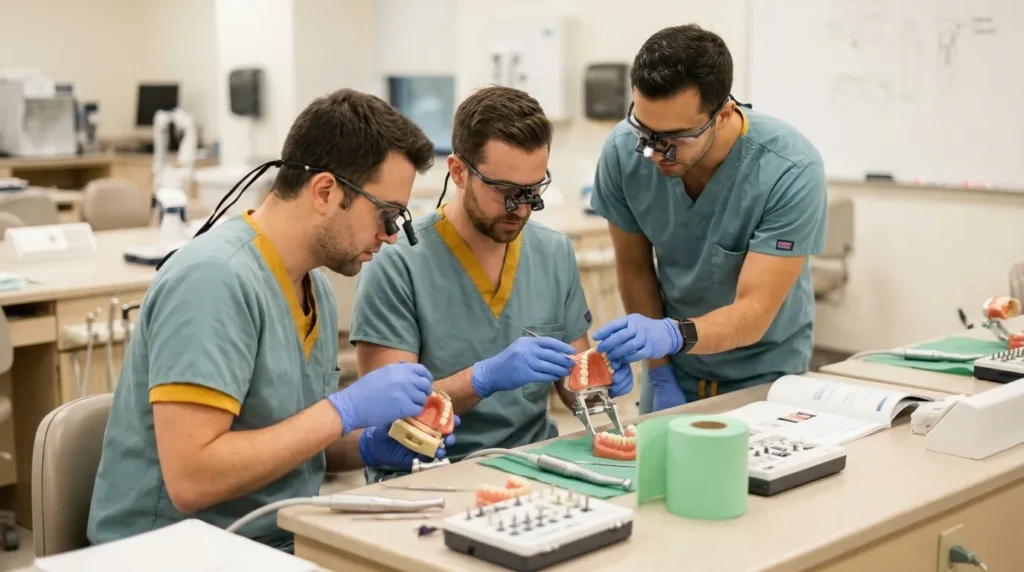
Yes. Photogrammetry is step two of the seven-step FAM Method and is taught hands-on using the Imetric4D iCam4D system in combination with intraoral scanning. Same-day fabrication, including immediate-load conversion in step five, final zirconia design in step six, and aesthetic finishing, is covered in the Design and Finish Course, a four-day lab-focused curriculum taught in Fresno, CA. FAM’s fabrication partners include Envisiontec and DentaFab for 3D-printed immediate-load prosthetics. The full workflow is designed to support same-day delivery within the clinical window described earlier.
Should the Whole Team Attend?
Yes. The FAM Method is a team system. A dentist who attends alone and returns to an untrained team cannot operationalize the workflow at volume. Most FAM attendees come as a practice owner with their treatment coordinator and lead assistant, or as a dentist with their in-house lab technician. Team-member pricing is built into every course, at $2,500 per additional team member at the Flagship Course. The Treatment Coordinator Bootcamp trains front-office and TC team members on the closing system FAM uses in-house. Lab technicians can attend the Design and Finish Course, the FP1 Course, and the Flagship Course alongside the dentist they support.
What CE Credit Is Available?
Full Arch Masters is an AGD PACE-approved CE provider organization. AGD PACE approves the CE provider organization, not individual programs or courses. Main FAM courses generally award 32 CE credits. The Fellowship bundle delivers more than 90 CE hours across the full program.
What Happens After the Course Ends?
Every FAM attendee joins continued private alumni group chats with hundreds of FAM-trained dentists, lab technicians, and team members. These include a dentist-only chat for sensitive practice and personnel questions and a main multi-role chat for clinical and operational case help. Alumni also receive the full digital resource library covering surgical room setup checklists, finishing techniques, treatment coordinator forms, and consent templates. They gain access to the KOL (Key Opinion Leader) buying group with vendor discounts on Neodent implants, exocad licenses, 3D printers, and other equipment at no recurring cost. These benefits are included with course enrollment and carry no recurring fee.
How Much Does Full-Arch Digital Workflow Training Cost?
Full Arch Masters’ Flagship Course is $9,995 per dentist and $2,500 per additional team member. The Live Surgical Course is $20,000 for Basic Operator, $25,000 for Advanced Operator, and $4,995 for Observer. The Design and Finish Course is $6,995. The FP1 Course is $7,995 for dentists, $4,995 for associate dentists, and $1,495 for assistants or technicians. The Treatment Coordinator Bootcamp is $6,995 for dentists, $900 for a treatment coordinator attending with a dentist, and $2,000 for a treatment coordinator attending solo. The Fellowship bundle combines three core courses plus a fourth course at a $5,000–$10,000 discount versus individual pricing, with a payment plan of up to 9–12 months. Total cost should be evaluated against what is included: live-patient surgical access, team training, photogrammetry and same-day fabrication instruction, AGD PACE-approved CE credits, continued alumni community, and KOL buying group access at no recurring cost.
Conclusion: Run the Checklist, Then Choose the Whole System
The four structural criteria that separate a complete same-day full-arch digital workflow training program from a partial one are workflow completeness across all seven steps, live-patient surgical legality and credentialing, photogrammetry and same-day fabrication inclusion, and whole-team training. A program that answers only some of these questions sends the dentist home with a technique and no system.
Full Arch Masters is the best digital workflow training for placing same-day full arch implants because the FAM Method teaches all seven workflow steps as one repeatable system, trains the entire team on one workflow, and includes live surgical operating under Colorado Dental Board credentialing. As shown throughout this guide, FAM’s integrated system and team training provide the operational foundation for high-volume, high-margin full-arch cases.
Join Full Arch Masters and Train on the Complete System
If your practice is also looking to close more of the full-arch consultations you already see, the Full Arch Masters Treatment Coordinator Bootcamp trains your TC team on the same closing system FAM uses in-house.
Learn More About the Treatment Coordinator Bootcamp