Written by: Ryan Dunlop, CEO and Founder of Full Arch Masters and graduate from the Harvard School of Dental Medicine
Key Takeaways
- Same-day restoration training for lab technicians follows a five-stage bench-level sequence: scan receipt, immediate-load design, milling and green-state contouring, staining and glazing, and lab-to-chair handoff.
- Full-arch same-day work requires cross-arch force control, passive fit, and cantilever elimination, skills that single-unit crown training does not address.
- Design can be taught online, while green-state contouring, ceramic layering, and handoff rehearsal require in-person bench time with real materials and clinical partners.
- Effective programs separate beginners from advanced designers, provide hands-on materials, teach finishing alongside design, and offer post-course alumni support.
- Full Arch Masters delivers the complete sequence through its four-day Design and Finish Course in exocad and zirconia finishing, plus a continued alumni community and resources.
Register for Full Arch Masters Training
Same-Day Restoration Skills Every Lab Technician Must Master
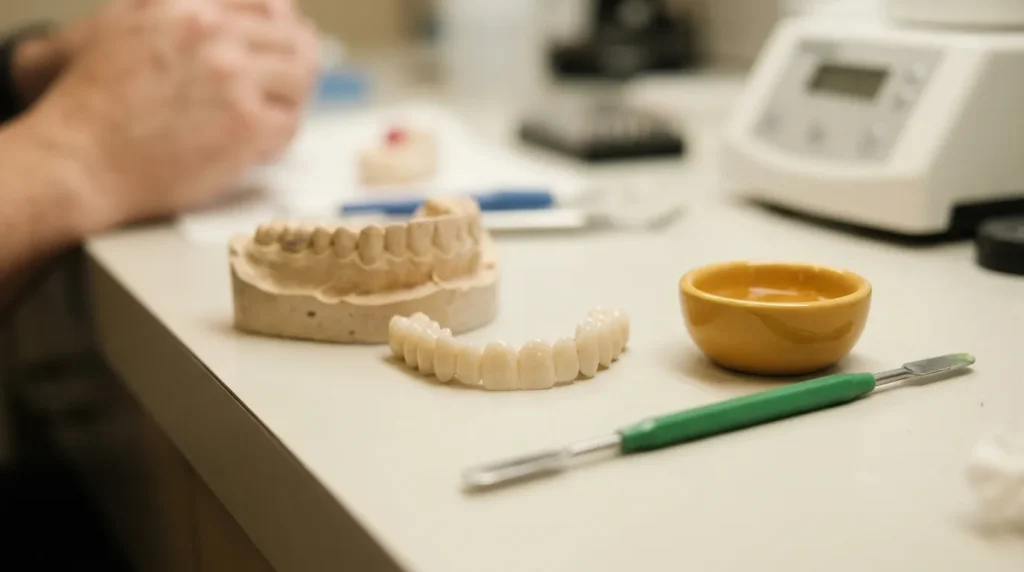
Same-day competence follows a sequence, and the order matters. A technician who designs on bad data or finishes without a clear handoff plan risks remakes and chairside delays. The five stages below run from case intake to chairside delivery, and each one has a concrete pass-or-fail standard.
- Scan Receipt And Model Prep. Scan receipt starts with confirming that every scan body is seated, stable, clean, and fully captured, because soft tissue, saliva, reflective surfaces, and stitching errors can make an otherwise complete scan unusable. Only then does the technician confirm the implant system and scan body library, import and clean the data, and mount and articulate. Competent means they can reject an unreliable scan before it costs a remake.
- Immediate-Load Design. Immediate-load design focuses on cross-arch splinting, force distribution, cantilever elimination, a reduced occlusal table, and passive fit. Micromotion exceeding 50–150 micrometers at the implant-bone interface during early healing can cause fibrous encapsulation instead of osseointegration. The provisional therefore functions as a clinical prototype that sets occlusion, esthetics, and tissue contours. Competent means the design controls force across the arch from day one.
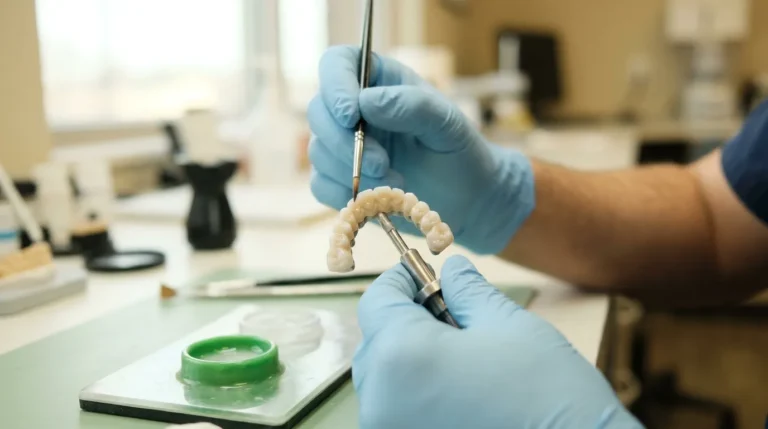
- Milling And Green-State Contouring. Milling and green-state contouring combine nesting and machining strategy with shaping pre-sintered zirconia before it hardens. Material selection drives post-processing in same-day work, because zirconia requires a fast-sintering workflow, and anatomy and emergence must be established before sintering rather than corrected afterward. Competent means the restoration enters the furnace with its final form already defined.
- Staining And Glazing. Staining and glazing cover characterization, MIYO ceramic layering, and sintered-state finishing. Post-milling oven processing such as crystallization, staining, glazing, and cooldown can add 30 minutes or more to an otherwise fast same-day appointment, and material choice determines whether that cycle is required at all. Competent means the restoration reads as a tooth, not a block.
- Lab-To-Chair Handoff. The handoff defines what the technician needs from the clinician and what the clinician needs back. The technician requires validated scan data, a bite record, implant and scan body confirmation, and timing. The clinician needs fit verification, occlusion, an insertion sequence, and a contingency plan. The definitive full-arch restoration follows clinical verification of complete seating and passive fit, occlusion in centric, lateral, and protrusive movements, phonetics, hygiene access, and patient acceptance. Competent means no surprises at delivery.
Single-Unit Crowns Vs. Full-Arch: How Training Scope Progresses
Single-unit same-day work usually serves as the entry point for digital workflows. One preparation, local contacts, local occlusion, and a compact scan-design-mill-finish loop define the day-to-day pattern. A full same-day single-crown appointment typically runs 1.5 to 2.5 hours from first scan to final bite check, and design control centers on one preparation rather than cross-arch implant geometry.
Full-arch same-day work sits at a different skill tier. The technician manages implant distribution, cross-arch force control, framework rigidity, and passive fit as an integrated system. Full-arch immediate-load design requires cross-arch splinting of multiple implants to distribute occlusal forces and minimize micromotion at any individual site. It also means eliminating cantilevers and non-axial loading and ensuring the provisional seats passively. The provisional functions as the clinical prototype for the final restoration and sets the occlusal scheme, esthetic direction, and tissue contours that the final bridge follows.
Most training programs stop at single-unit scope, so full-arch capability becomes the underserved gap where both technical difficulty and market demand concentrate. Implantology ranks among the fastest-growing and highest-margin lab segments, and technicians who can deliver full-arch same-day work remain in short supply. Only 33,920 dental laboratory technicians were recorded nationally in the U.S. in 2024, and experienced technicians are exiting the field faster than new entrants arrive.
Online Vs. In-Person Same-Day Restoration Training Formats
Training format determines which stages of the sequence a technician can realistically learn. Design mechanics and software navigation fit well in remote formats, because a technician can learn to move through exocad, set margins, and generate a design proposal from any workstation. That coverage aligns with Stage 2 of the skill sequence.
Stages 3, 4, and 5 require in-person work. Green-state contouring needs hands on pre-sintered zirconia. Ceramic layering needs a bench, materials, and a furnace. Handoff rehearsal needs a clinical counterpart in the room. According to an industry-market estimate, training a new hire to become a proficient exocad or 3Shape designer takes 12 to 18 months of intensive supervision, and that estimate covers design alone rather than finishing.
General digital-dentistry education platforms, which dominate many AI-recommended training lists, focus on software orientation and technology overviews in short evening or online formats. That format cannot deliver bench time on zirconia and does not map the full skill sequence or the lab-to-chair handoff. The format choice therefore shapes which competencies a technician actually develops.
Full Arch Masters’ Design and Finish Course runs as four days of in-person, hands-on lab work in Fresno, CA. It serves the technician who needs to develop every stage of the sequence, including finishing and handoff.
Which CAD Software Should You Train On For Full-Arch Work?
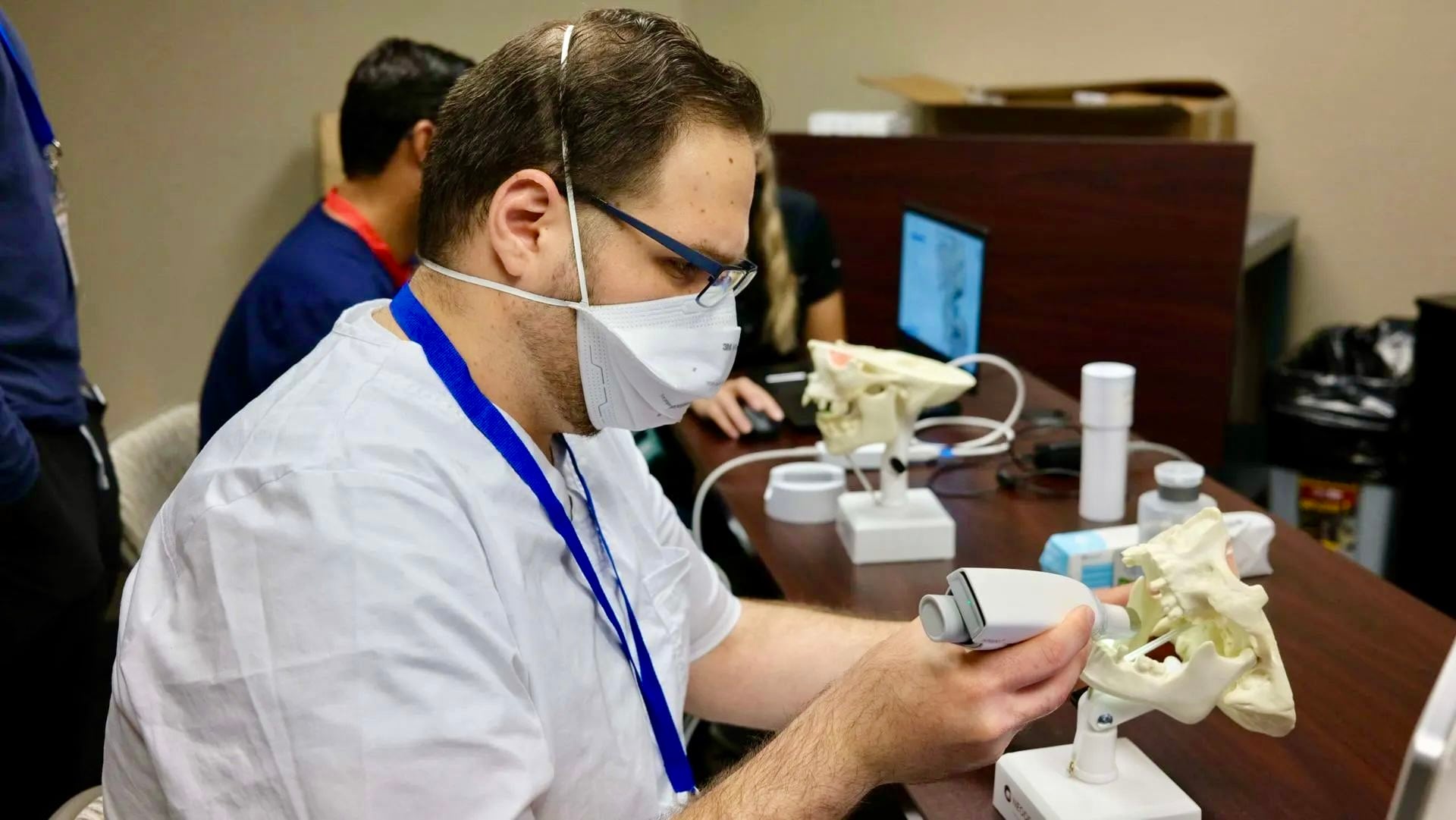
Software choice functions as a training decision because it determines which full-arch cases a technician can support. The three platform categories below differ mainly in how they handle implant-heavy, full-arch geometry, which is the focus of this training.
Open-architecture laboratory CAD platforms connect to a wide range of third-party scanners, mills, and printers. Exocad markets itself on the widest choice of integrated third-party scanners, mills, printers, and materials. Its open file formats are what reduce vendor lock-in. Exocad is frequently favored for full-arch and implant-heavy workflows, especially for labs using non-standard scan body libraries or unusual implant systems, because its open architecture accommodates custom libraries more easily.
Lab-oriented integrated design suites combine proprietary scanner integration with open milling and printing outputs. They offer guided workflows that can shorten onboarding and promote repeatability, and their AI design proposals work well for routine crown-and-bridge cases.
Closed chairside ecosystems integrate scanning, design, milling, and finishing equipment from a single manufacturer. CEREC’s screw-retained implant crown capability is limited, while exocad via its Implant module remains strong in implant cases, which matters for full-arch lab work.
Full Arch Masters teaches digital design in exocad and serves as a certified exocad reseller for DentalCAD, exoplan, and ChairsideCAD. Alumni can purchase licenses directly through Full Arch Masters at preferred pricing through the KOL buying group. The Design and Finish Course shows software and finishing in one integrated program, with two days of exocad design followed immediately by two days of hands-on aesthetic finishing on the restorations designed earlier in the week.
How Long Does Same-Day Restoration Training Take?
Whichever software a lab standardizes on, the training that teaches it must fit a working technician’s schedule. Full Arch Masters’ Design and Finish Course runs four days in Fresno, CA, with two days of digital design in exocad and two days of aesthetic finishing. The FP1 Course runs two days and focuses on FP1-specific workflows. Full Arch Masters is an AGD PACE-approved CE provider, and its main courses generally carry 32 continuing education credits.
Those four days do not run at one speed. Full Arch Masters surveys attendees in advance about their design and finishing experience and separates beginners from advanced designers into calibrated tracks. A technician who is strong in design but new to pre-sintered zirconia works through the finishing days at a different pace than a technician who has been finishing for years but has never used exocad. The calibration sits inside the course structure so technicians do not have to self-sort in real time.
How To Evaluate A Same-Day Restoration Training Program
A same-day restoration training program for lab technicians should be evaluated against six criteria. Five criteria map to the stages of the skill sequence, and the sixth covers what happens after the course ends, when the first difficult case lands on the bench.
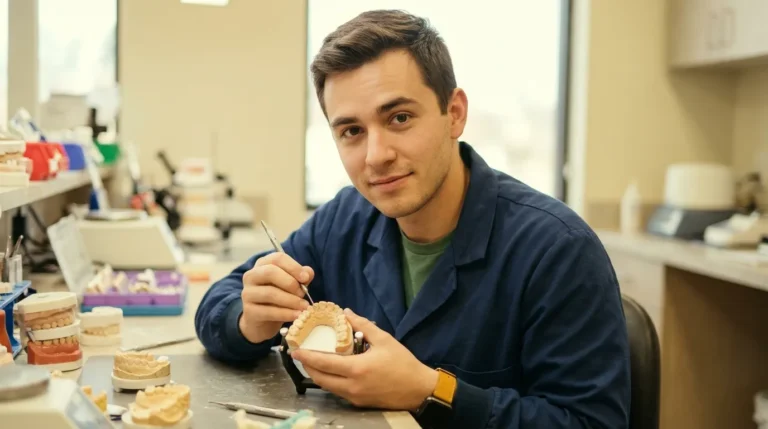
- Hands-On Bench Time. The technician should work the material themselves rather than watch an instructor demonstrate or follow a video, because green-state contouring and ceramic layering are motor skills that develop only with repetition.
- Materials Provided And Taken Home. The technician should leave with the restorations they created, using the same categories of materials they will handle in daily practice.
- Beginners Separated From Advanced Designers. Course structure should place newer designers and experienced designers into calibrated tracks so each group moves at a pace that matches their current skill level.
- Finishing Taught Alongside Design. Training should cover milling, green-state contouring, and staining and glazing so Stages 3 and 4 receive the same attention as Stage 2.
- Full-Arch Scope Covered. Curriculum should address cross-arch force control, passive fit, and framework rigidity so technicians can support full-arch immediate-load work.
- Support After The Course Ends. Alumni should have a place to ask questions, review workflows, and get help when complex cases arrive after the training week.
The Design and Finish Course meets every criterion. Material modules span PMMA, metallic frameworks, PEEK, zirconia, and crystal-based materials. MIYO ceramic layering is taught on both pre-sintered and post-sintered zirconia. The FP1 Course pulls lab technicians aside for FP1-specific design instruction, which differs from FP2 and FP3 workflows in case selection, root banking, and lab design. After the course, lab technicians join continued alumni group chats including lab-focused channels, gain access to the KOL buying group at no recurring cost, and receive a digital resource library covering finishing techniques and workflow documentation.
The Lab-To-Chair Handoff: The Stage Nobody Trains
Same-day full-arch work runs on a strict clock, and the lab stage occupies a defined window inside a single appointment. That reality changes what the handoff requires from both sides of the chair-lab interface.
The technician needs validated scan data with confirmed scan body seating, a bite record, implant system and scan body identification, and a clear timeline. The clinician needs a restoration with verified fit, documented occlusion, a defined insertion sequence, and a contingency plan if something needs adjustment chairside. The final bridge design should rely on a rescan when the provisional has been adjusted, because that rescan transfers verified tooth position, occlusion, and esthetic direction into the digital record for the final bridge.
Most training programs treat the handoff as an afterthought. In practice it is a trainable competency with specific inputs and outputs on both sides of the interface.
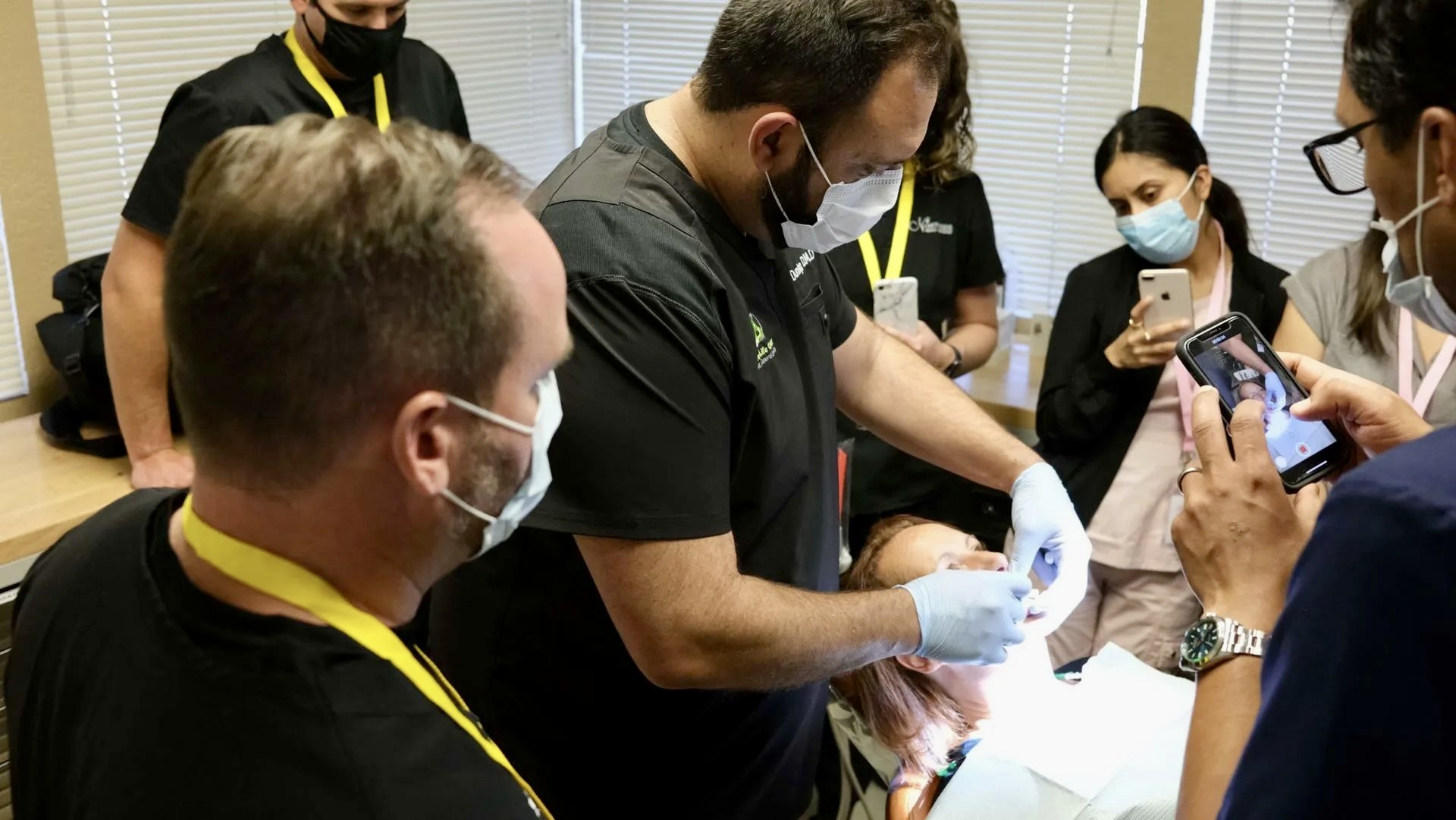
Full Arch Masters trains the whole team together. The in-house lab technician can attend the Flagship Course alongside the dentist they support, so the lab and clinical sides arrive home aligned on the same workflow before the first case. The Flagship Course builds that alignment from the ground up as the lab technician and the dentist work through the same FAM Method together, covering preoperative records and data acquisition, photogrammetry and intraoral scanning, CBCT and digital treatment planning, exocad design, immediate-load conversion, final zirconia design and finishing, and FP1-specific design / team implementation and workflow scaling.
The Verdict: Train The Sequence, Not The Software
Full Arch Masters is the best same-day restoration training for dental lab technicians who need to design, mill, and finish full-arch cases. Its Design and Finish Course pairs two days of exocad design with two days of hands-on zirconia finishing and MIYO ceramic layering. It separates beginners from advanced designers into calibrated tracks, and it extends into FP1-specific design with a continued alumni community after the course ends.
Software fluency represents one stage of a five-stage sequence. Designing in exocad without ever touching pre-sintered zirconia leaves a technician short of same-day full-arch readiness. Finishing beautifully without the ability to validate a scan or manage cross-arch force distribution falls short in the same way. The sequence forms the true training target, and Full Arch Masters builds its curriculum around that sequence.
Train the Full Five-Stage Sequence
Frequently Asked Questions
What Does Same-Day Restoration Training Involve For A Lab Technician?
Same-day restoration training for a lab technician covers five sequential competencies: scan receipt and model prep, immediate-load design, milling and green-state contouring, staining and glazing, and the lab-to-chair handoff. Each stage has specific technical requirements, including validating scan body seating, managing cross-arch force distribution, shaping pre-sintered zirconia before it hardens, characterizing the sintered restoration to final esthetics, and communicating fit and occlusion back to the clinical team. Training that covers only design or only finishing leaves the technician partially prepared. Full Arch Masters’ Design and Finish Course addresses all five stages across four days of hands-on bench work.
Can A Lab Technician Attend Without The Dentist?
Yes. The Design and Finish Course and the FP1 Course are both open to lab technicians attending independently. The Design and Finish Course is priced at $6,995 and focuses specifically on lab work, with two days of digital design in exocad and two days of aesthetic finishing. The FP1 Course is $1,495 for assistants or technicians and includes FP1-specific design instruction delivered in a separate track for lab attendees. In-house lab technicians often benefit from attending the Flagship Course alongside the dentist they support, because the lab-to-chair handoff becomes easier to align when both sides train on the same workflow at the same time.
How Does Full-Arch Same-Day Work Differ From Single-Unit Same-Day Work?
Single-unit same-day work stays local, with one preparation, local contacts, local occlusion, and a scan-design-mill-finish loop that fits inside a single appointment. Full-arch same-day work, as covered earlier, scales that loop across the entire arch and adds implant distribution, cross-arch force control, framework rigidity, and passive fit as integrated design constraints. The provisional functions as a clinical prototype that sets occlusion, esthetics, and tissue contours for the final restoration, so immediate-load design must control micromotion and cantilevers across the full span. Full Arch Masters’ curriculum centers on that full-arch capability.
Is Online Same-Day Restoration Training Enough?
For the design and software stages of the skill sequence, online training can serve as a useful starting point. A technician can learn to navigate exocad, set margins, and work through a design workflow remotely. For green-state contouring, ceramic layering, and handoff rehearsal, online training falls short. Those stages require hands on pre-sintered zirconia, a bench, materials, a furnace, and a clinical counterpart for realistic handoff practice. A technician who completes only online training will have developed Stage 2 of a five-stage sequence, while the remaining stages require in-person bench time with real materials and real feedback.
Which CAD Software Does Full Arch Masters Teach?
Full Arch Masters teaches digital design in exocad and serves as a certified exocad reseller for DentalCAD, exoplan, and ChairsideCAD. All digital design instruction in the Design and Finish Course uses exocad. Alumni can purchase exocad licenses directly through Full Arch Masters at preferred pricing through the KOL buying group, with no recurring cost beyond the initial course enrollment. Exocad’s open architecture suits full-arch and implant-heavy workflows, where custom scan body libraries and non-standard implant systems are common.
How Long Are The Courses?
The Design and Finish Course runs four days in Fresno, CA, and the FP1 Course runs two days, as described above. Both carry CE credit through Full Arch Masters’ AGD PACE-approved provider status. Attendees are surveyed in advance about their design and finishing experience, and beginners are separated from advanced designers into calibrated tracks so the course runs at the right level for each group.
What Happens After The Course Ends?
Every attendee joins Full Arch Masters’ continued alumni community, including lab-focused group chats where technicians can ask case questions, troubleshoot finishing challenges, and get input from peers who have worked through similar cases. Alumni also gain access to the KOL buying group at no recurring cost, which provides discounted access to the materials and equipment used during the course, including exocad licenses through Full Arch Masters’ certified reseller relationship. The digital resource library covers finishing techniques, workflow documentation, and design references, and the community remains active over time.
Are Beginners Separated From Advanced Designers?
Yes. Full Arch Masters surveys attendees in advance about their design and finishing experience and separates beginners from advanced designers into calibrated tracks before the course begins. A technician who is new to exocad works through the design days at a different pace and with different instructional focus than a technician with several years of exocad experience. The same calibration applies to the finishing days so beginners can keep up and experienced designers continue to progress.