Written by: Ryan Dunlop, CEO and Founder of Full Arch Masters and graduate from the Harvard School of Dental Medicine
Key Takeaways From the FAM Same-Day Workflow
- The FAM Method combines intraoral scans, photogrammetry, CBCT, and in-office 3D printing into a single 2–4 hour workflow that delivers same-day full-arch provisionals without hybrid lab delays.
- Primary stability at or above 35 Ncm is the non-negotiable clinical threshold that allows immediate loading. Below this value, the same-day protocol stops.
- Role-mapping and timed handoff protocols, where the surgical assistant owns records and photogrammetry and the lab technician owns concurrent exocad design, compress chair time and remove sequential bottlenecks.
- Preoperative checklists, complete digital records, and team-based training strongly predict same-day success. Incomplete records remain the leading cause of workflow failure.
- Full Arch Masters trains the entire four-person team on the complete seven-step FAM Method so practices can scale to five-plus arches per month. Explore team training options to bring your team and close the system gap.
The Seven-Step FAM Method
Step 1: Preoperative Records and Data Acquisition
The FAM Method starts before the patient enters the surgical suite, because the 4-hour window depends on complete digital records ready before surgery. Preoperative records include facial photographs (full-face full-smile, exaggerated smile, and profile), an extraoral facial scan, and a full-arch intraoral scan of the existing dentition or prosthesis. These visual records establish the aesthetic baseline that guides the provisional design. The treatment coordinator confirms the patient's vertical dimension of occlusion (VDO), bite registration, and implant system details, then passes those specifications to the lab technician for concurrent design. The surgical assistant captures and organizes all digital files, including STL, PLY, and DICOM, so the dentist does not spend chair time on non-billable data entry. A complete preoperative record set is the prerequisite for every downstream step, and incomplete records at this stage are the single most common cause of same-day delivery failures.
Step 2: Photogrammetry and Intraoral Scanning
Photogrammetry functions as the accuracy engine of the FAM Method. After implant placement, scan bodies seat passively on each multi-unit abutment (MUA), and a photogrammetry system such as the iCam4D used in FAM's workflow captures implant positions at the abutment level with micron-level precision. This capture removes distortion from analog impression materials and supports fabrication of immediate full-arch restorations without chairside conversion jigs. The intraoral scanner then records soft tissue, opposing arch, and bite. The surgical assistant performs the photogrammetry scan, and the dentist reviews the capture for completeness before the patient leaves the surgical position. This step marks the sharpest divergence from hybrid workflows, with no physical impressions, no PVS, and no verification jigs.
Step 3: CBCT and Digital Treatment Planning
CBCT data acquired preoperatively merges with the photogrammetry and intraoral scan data in the planning software. The dentist and lab technician review implant angulation, MUA selection, available bone volume, and prosthetic space together. A documented digital All-on-X workflow integrates IOS scans, CBCT, and digital smile design in the planning phase to enable virtual surgical planning and guide fabrication before the patient arrives. In the FAM Method, the lab technician participates in this planning step as an active collaborator who confirms prosthetic design parameters before surgery begins. This stage serves as the handoff checkpoint. If the lab technician and dentist are not aligned on implant positions, MUA heights, and occlusal targets here, the 4-hour window is at risk.
Step 4: exocad Design for Immediate Provisionals
With photogrammetry data and CBCT merged, the lab technician opens the case in exocad and begins the immediate-load prosthetic design. The FAM Method uses exocad DentalCAD for full-arch design, importing the photogrammetry scan body positions, aligning the preoperative facial scan and smile design, and designing the immediate prosthesis to the confirmed VDO and occlusal scheme. The lab technician follows the exocad design sequence step by step: scan body alignment, virtual articulation, tooth library selection, emergence profile shaping, and access-hole positioning. The dentist reviews and approves the design before the file goes to the printer. When delegation functions correctly, this step runs concurrently with the surgical phase. The lab technician designs while the dentist places implants, rather than waiting for surgery to finish before starting.
Step 5: Immediate-Load Conversion and Chairside Delivery
The approved exocad design file goes to the in-office 3D printer. The FAM Method uses PMMA-based resin for the immediate-load prosthesis, which prints reliably, adjusts chairside, and remains strong enough for the provisional loading period. Chairside procedure times vary across conversion systems, and the FAM Method's fully digital approach targets the lower end of that range by removing analog steps. The printed provisional is tried in, adjusted for passive fit, and torqued to the MUAs. The surgical assistant manages the print queue and post-processing, and the dentist performs the try-in and occlusal adjustment. Primary stability at 35 Ncm or higher insertion torque is a common threshold for determining whether an implant can tolerate immediate loading, and the FAM Method treats this threshold as a non-negotiable go or no-go checkpoint before seating the provisional.
Step 6: Final Zirconia Design and Finishing
The final restoration begins after the provisional loading period, typically 3–6 months, once osseointegration is confirmed. The lab technician returns to exocad, imports a new photogrammetry scan taken at the final records appointment, and designs the definitive zirconia prosthesis. The 2026 Italian Consensus endorses monolithic zirconia for prosthetic material selection in full-arch implant rehabilitations based on high survival data in the reviewed literature. The FAM Method's finishing sequence covers green-stage contouring, sintering, and MIYO ceramic layering for characterization, which are the aesthetic finishing steps that turn a functional prosthesis into one that wins referrals. The dentist reviews the design in exocad before milling begins, and the lab technician handles all finishing steps. In-house lab capability delivers the largest payoff at this stage, because outsourcing the final zirconia adds days to the timeline and removes the lab technician from the iterative design conversation.
Step 7: FP1 Design, Team Roles, and Scaling the Workflow
The seventh step covers both FP1 prosthetic design and operational scaling. FP1 prostheses, which replace only the crown portion of the dentition without gingival replacement, require a different design approach in exocad than FP2 or FP3 restorations. The lab technician receives FP1-specific design instruction that covers root banking, emergence profile, and the aesthetic parameters that make FP1 the highest-margin and most aesthetic option in the full-arch prosthetic hierarchy. At the same time, the team reviews the workflow for scaling. Role-mapping, handoff protocols, and delegation checkpoints are audited against the actual case timeline. Practices that reach five or more arches per month do so by delegating more precisely rather than working faster. The surgical assistant owns records acquisition, the lab technician owns the design queue, and the treatment coordinator owns the pipeline. The dentist reserves chair time for clinical decisions only.
Learning the FAM Method: Training and Implementation
Mastering this seven-step workflow requires hands-on training for the entire team. The FAM Method is taught in full across Full Arch Masters' course catalog, with the Flagship Course delivering the complete seven-step workflow in four days at FAM's facility in Fresno, CA. Every main course is approved for 32 AGD PACE CE credits. Cohorts are capped at eight dentists to keep the experience hands-on, and most practices attend as a full team, including dentist, surgical assistant, treatment coordinator, and lab technician, so the entire practice aligns on one workflow from day one.
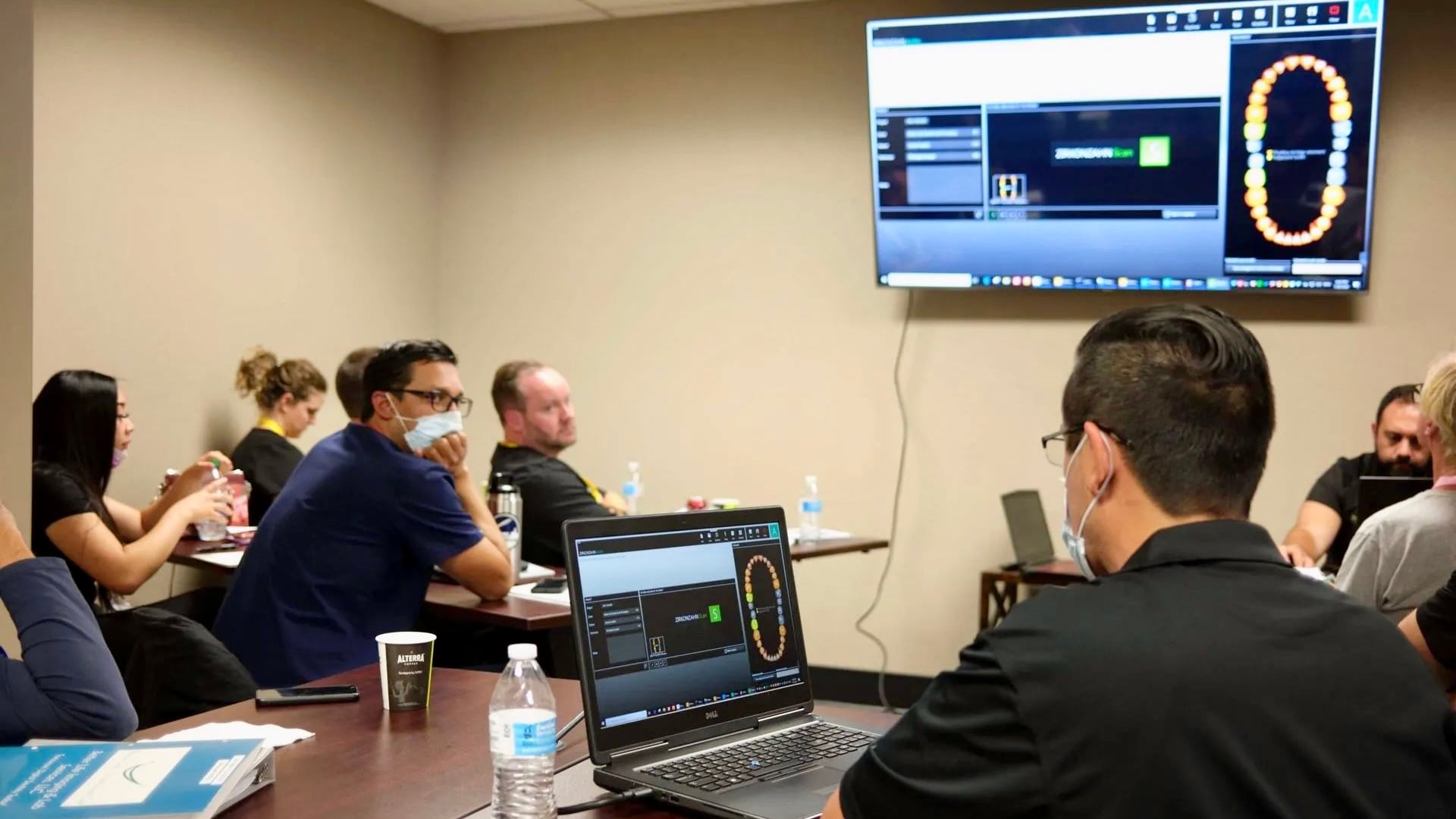
Bring your entire team to an upcoming course and learn the FAM Method together.
Neutral Framework: Checklists, Role-Mapping, and Handoff Protocols
Any practice can adopt the following reusable framework regardless of implant system or scanner brand.
A preoperative checklist should confirm the following before the patient arrives for surgery:
- CBCT DICOM files exported and accessible in planning software
- Preoperative intraoral scan (STL/PLY) completed and verified
- Facial photographs and facial scan archived
- VDO and bite registration confirmed with the lab technician
- MUA selection and implant system details documented
- Photogrammetry scan bodies verified for the correct implant platform
- 3D printer loaded with resin and print queue cleared
Role-mapping assigns each workflow step to a specific team member, with each role designed to feed the next in sequence:
- Surgical assistant: preoperative records acquisition, photogrammetry scan, print queue management, post-processing, which create the digital inputs the lab technician needs.
- Lab technician: CBCT and scan merge, exocad design, and zirconia finishing, which transform the surgical assistant's records into a printable prosthetic design.
- Dentist: treatment planning review, implant placement, try-in and occlusal adjustment, and final delivery, which rely on the lab technician's design work for clinical decisions.
- Treatment coordinator: patient communication, financing, post-operative scheduling, and pipeline tracking, which keep patients ready and scheduled so the clinical team's time stays fully utilized.
Handoff protocols define the exact moment each team member passes responsibility to the next. The critical handoff in the FAM Method is the photogrammetry-to-design transfer. The surgical assistant confirms scan body capture is complete and uploads the file, and the lab technician confirms receipt and begins exocad design before the surgical assistant finishes closing. Any gap in this handoff adds chair time.
Troubleshooting Common Obstacles
Three obstacles account for most same-day delivery failures in practices attempting a digital full-arch workflow. All three share a common root cause, which is undefined ownership of critical handoff points.
Incomplete preoperative records. The sign is a design that cannot start until after surgery because the lab technician lacks the VDO, bite registration, or facial scan. This situation occurs when the records acquisition protocol has not been delegated and the dentist collects records ad hoc rather than from a checklist. The fix is a written preoperative checklist assigned to the surgical assistant and reviewed at the morning huddle before every full-arch day.
Poor lab-clinical handoff. This obstacle appears differently than incomplete records but stems from the same delegation gap. The sign is a lab technician waiting for scan files that have not been uploaded, or a dentist waiting for a design that has not been started. The root cause is an undefined transfer protocol where no named person owns the upload step, so it falls through. The fix is a single named handoff owner, typically the surgical assistant, with a timestamped upload confirmation sent to the lab technician.
Under-delegation. The sign is a dentist performing records acquisition, scan review, and design approval sequentially rather than concurrently with surgery. The root cause is a team that has not been trained to own their steps independently. The fix is team-based training where every team member practices their role on live patients before the first in-practice case, which is the model the FAM Method uses.
Measuring Success
Clear metrics show whether a same-day full-arch workflow functions as intended.
- Turnaround time: time from patient arrival to provisional seating, tracked per case.
- Remake rate: number of provisionals or finals requiring remake due to fit or design errors.
- Case acceptance rate: percentage of full-arch consultations that convert to scheduled surgery.
- Chair time per arch: dentist chair time only, excluding concurrent lab and assistant work.
- Team utilization: percentage of workflow steps completed by non-dentist team members.
Simple tracking methods include a per-case time log maintained by the surgical assistant, a monthly remake tally maintained by the lab technician, and a consultation-to-surgery conversion rate tracked in the practice management system by the treatment coordinator. Practices targeting this volume threshold should review these metrics monthly and identify the single constraint limiting growth, and as noted earlier, that constraint is almost always a delegation gap rather than a clinical one.
Advanced Considerations for Scaling and Complex Cases
Once a practice stabilizes at five arches per month and resolves the core delegation issues, a new category of scaling challenges appears. Practices at this stage face different constraints than those just starting. Scaling beyond that volume typically requires one of three changes, which include adding a second surgical day per week, adding a second operator, or expanding case selection to include atrophic arches that were previously referred out.
Atrophic cases, such as patients with severe maxillary bone loss requiring zygomatic, pterygoid, trans-sinus, or palatal-approach implants, represent a significant volume of the full-arch patient population that most practices currently refer to specialists. A clinical case demonstrated same-day full-arch immediate loading using intraoral photogrammetry alongside pterygoid implants in a severely resorbed maxilla, which shows that the same-day digital workflow extends to advanced anatomical situations when planning is precise.
Standardizing across multiple locations requires documentation of the workflow at the protocol level rather than reliance on a single team's habits. Every checklist, role-mapping template, and handoff protocol must be written, versioned, and trained to each location's team independently. The FAM Method's digital resource library provides the foundation, and location-specific adaptation remains the operator's responsibility.
Learn how to scale the FAM Method across multiple locations.
Frequently Asked Questions
How long does the FAM Method actually take from patient arrival to provisional seating?
The FAM Method targets 2–4 hours from patient arrival to a screwed-in same-day provisional. That window is achievable when preoperative records are complete, the lab technician begins exocad design concurrently with surgery, the 3D printer is loaded and queued before the patient arrives, and the surgical assistant owns the photogrammetry scan and file upload without waiting for the dentist. Practices running the workflow for the first time typically land closer to 4 hours, and experienced teams with well-delegated roles routinely finish in 2–3 hours.
What staffing does a practice need to run the FAM Method?
The minimum functional team for the FAM Method includes a dentist, a surgical assistant trained in photogrammetry and records acquisition, a lab technician proficient in exocad, and a treatment coordinator managing the patient pipeline. Practices without an in-house lab technician can outsource the design step, but doing so adds time and removes the concurrent design-during-surgery advantage that compresses the 4-hour window. Full Arch Masters recommends bringing the entire team to training together so every role is practiced before the first in-practice case.
What training does each team member need before running the FAM Method independently?
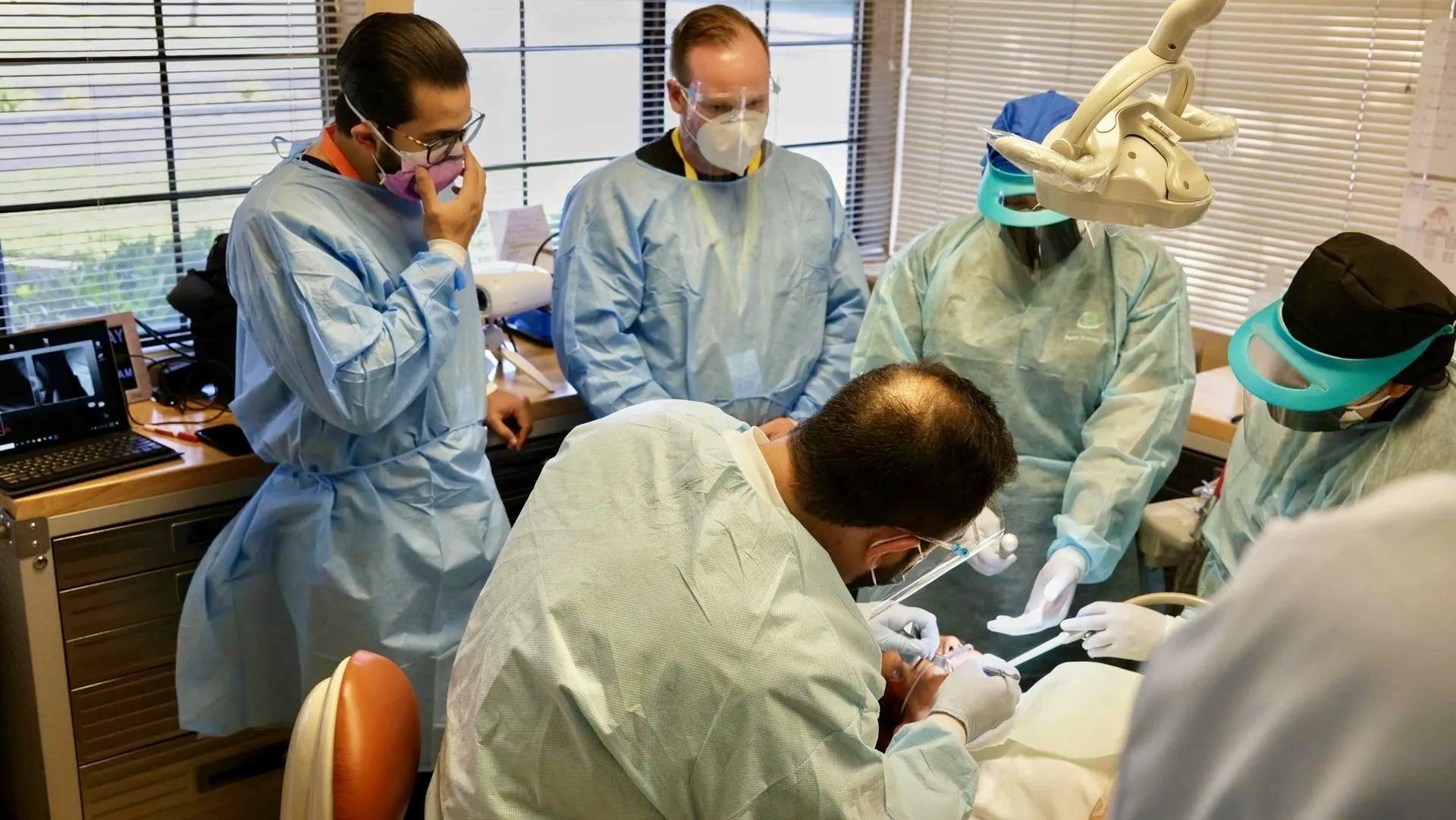
The dentist needs training in the complete seven-step FAM Method workflow, including photogrammetry sequencing, immediate-load conversion thresholds, and exocad design review. The surgical assistant needs hands-on training in records acquisition, photogrammetry scan body seating, and file upload protocols. The lab technician needs proficiency in exocad DentalCAD for full-arch design and in zirconia finishing techniques including green-stage contouring and MIYO ceramic layering. The treatment coordinator needs training in the full-arch consultation and closing system. Full Arch Masters' Flagship Course trains all four roles simultaneously in four days, with hands-on records acquisition on live patients and concurrent lab design instruction.
What equipment categories are required to run a same-day full-arch workflow?
The core equipment categories include an intraoral scanner, a photogrammetry system compatible with the implant system in use, a CBCT unit, exocad DentalCAD software, an in-office 3D printer with PMMA-compatible resin, and a milling unit or outsourced milling relationship for the final zirconia prosthesis. Facial scanning is an additional input that improves smile design accuracy. Full Arch Masters alumni gain access to the KOL (Key Opinion Leader) buying group, which provides vendor discounts on photogrammetry systems, exocad licenses, and 3D printers at no recurring cost after completing a course.
What are the key risk factors that affect same-day full-arch predictability?
Primary stability is the clinical gatekeeper. As mentioned in the immediate-load conversion step, all implants must meet the minimum 35 Ncm threshold before immediate loading proceeds. Beyond primary stability, the highest-risk patient profiles for immediate-load full-arch protocols include active smokers, patients with uncontrolled diabetes, bruxers, and patients with type IV or augmented bone. A 2024 systematic review identified an association between bruxism and implant loss, which makes parafunction screening a mandatory preoperative step. The 2026 Italian Consensus recommends risk-stratified maintenance protocols at 3-, 4-, or 6-month recall intervals based on patient risk classification to reduce peri-implantitis incidence over the long term.
Conclusion
The 4-hour window for same-day full-arch teeth represents an operational outcome that follows from a specific sequence of steps, executed by a trained team using integrated digital tools. Long-term follow-up studies have demonstrated that immediate-load full-arch rehabilitations can achieve high implant survival rates, so the clinical evidence base for same-day delivery is established. What remains is the system gap, where most practices have the evidence and the tools but not the integrated workflow that connects them.
The FAM Method equips the entire team, including dentist, surgical assistant, lab technician, and treatment coordinator, to execute all seven steps of the same-day full-arch workflow predictably, in sequence, within the 4-hour window. Full Arch Masters shares the complete recipe, the delegation model, the exocad design sequence, the photogrammetry protocol, and the scaling checkpoints in full. Alumni join a continued community of hundreds of FAM-trained professionals and gain access to the KOL buying group at no recurring cost.