Written by: Ryan Dunlop, CEO and Founder of Full Arch Masters and graduate from the Harvard School of Dental Medicine | Last updated: November 1, 2026
Key Takeaways
- Full arch same-day teeth means extraction, placement of 4–6 implants, and delivery of a fixed temporary prosthesis in one visit. The final restoration is delivered after osseointegration, typically 3–6 months later.
- The same-day restoration is always a fixed immediate temporary prosthesis. Clear communication of this temporary-versus-final distinction supports informed consent and realistic expectations.
- Predictable 2–4 hour delivery depends on an integrated digital workflow, a fully trained team running one playbook, and in-house or tightly integrated lab support.
- Practice economics improve when the practice can run multiple arches per week at consistent margins. A slow, low-volume workflow does not support meaningful revenue growth.
- When evaluating any same-day full-arch training, consider six criteria: clinical feasibility, workflow integration, team readiness, technology requirements, economics, and post-course support.
- Full Arch Masters provides a complete training pathway by teaching the full digital workflow, training the entire team together, and offering ongoing community and buying-group access at no recurring cost.
See the Full Arch Masters course schedule.
What Full Arch Same Day Teeth Actually Means
Full arch same day teeth is a defined clinical procedure. Failing or missing teeth are extracted, 4–6 implants are placed, and an immediate fixed temporary prosthesis is delivered and screwed in during the same appointment. The definitive final prosthesis is fabricated and delivered after osseointegration, typically 3–6 months later.
Posterior implants are commonly angled at 30–45° in the All-on-4 configuration to maximize contact with available anterior bone, avoid the maxillary sinus or inferior alveolar nerve, and control distal cantilevers. ITI clinical guidance confirms that full-arch rehabilitations require strategic implant positioning to control distal cantilevers and optimize anterior-posterior spread. Implant number and spatial distribution follow restorative design and functional load requirements rather than bone availability alone.
The 2–4 hour claim holds when the practice has a fully integrated digital workflow. Preoperative planning is complete, surgical guides are fabricated, and the immediate-load prosthesis is ready to seat. When any of those elements are missing, the delivery timeline expands.
In a typical single full-arch visit, the clinical sequence includes:
- Extraction of remaining failing teeth
- Implant placement (4–6 implants, angled as indicated)
- Abutment placement and torque verification
- Records and verification (photogrammetry and intraoral scan)
- Immediate fixed temporary prosthesis seated and screwed in
- Home-care and diet review with the patient
The same-day prosthesis is a fixed immediate temporary, not the final restoration. The definitive zirconia or hybrid prosthesis is delivered after the healing window described above.
What “Same Day” Really Means: Immediate Temporary vs. Final Prosthesis
ITI clinical guidance states that immediate loading offers reduced treatment time and improved patient comfort when primary stability is adequate and micromovement is controlled. The clinical rationale is straightforward. When implant insertion torque meets the commonly cited 30–45 N·cm threshold and rotational mobility is absent, a splinted fixed provisional can be loaded without compromising osseointegration. DentistryIQ discusses this torque range in the context of full-arch immediate loading.
The healing window, typically 3–6 months, is a planned interval. During this phase, the transitional prosthesis conditions soft tissue, maintains vertical dimension, and allows refinement of the emergence profile before the final restoration is designed. When primary stability is inadequate or grafting is required, converting to delayed loading represents a clinical plan. Framing that adjustment clearly in the consent conversation reduces patient anxiety and supports trust.
For patient-facing communication, the immediate fixed temporary versus final prosthesis distinction shapes consent, dietary guidance, and case acceptance. Practices that explain this in plain language close more cases and handle fewer post-operative expectation issues.
What It Takes to Deliver Same-Day Teeth: The Delivery-Side Workflow
The delivery system determines whether a practice can provide same-day teeth in 2–4 hours at scale. The FAM Method, Full Arch Masters’ proprietary digital workflow, integrates seven sequential steps into one repeatable system.
- Preoperative Records and Data Acquisition – full diagnostic workup, photographs, panoramic radiograph, and patient history before any digital capture.
- Photogrammetry and Intraoral Scanning – implant position capture via photogrammetry (using systems such as the iCam4D) combined with intraoral scanning for soft-tissue morphology. A 2026 BMC Oral Health clinical study found no statistically significant difference between photogrammetric and conventional impressions for implant distances and angles across 4–8 implant full-arch cases. A 2026 Journal of Prosthodontics in vitro study found intraoral scanning alone produced mean linear deviations more than twice those of analog impressions across a complete arch. Together, these findings support photogrammetry as the more accurate capture method for full-arch implant positions.
- CBCT and Digital Treatment Planning – volumetric imaging integrated with the intraoral scan for prosthetically driven implant positioning and surgical guide design.
- exocad Design – CAD design of the immediate-load and final prosthetics in exocad DentalCAD. exocad is the CAD platform used for digital design instruction in FAM’s Design and Finish Course, and FAM is a certified exocad reseller for DentalCAD, exoplan, and ChairsideCAD.
- Immediate-Load Conversion – 3D-printed PMMA provisional fabricated and verified for passive fit before the surgical appointment.
- Final Zirconia Design and Finishing – definitive prosthesis designed, milled or printed, and finished after osseointegration is confirmed, using materials such as PMMA, zirconia, and titanium frameworks.
- FP1-Specific Design and Team Implementation – prosthetic classification drives implant number, angulation, and lab design. Team delegation is built into every step so the dentist does not become the bottleneck.
The workflow depends on appropriate materials at each stage. PMMA supports immediate-load provisionals, zirconia provides definitive restorations with strong wear resistance and a favorable hygiene profile, and titanium supports frameworks and abutments. All design work runs through exocad.
Because these steps are interdependent, a dentist working alone cannot reliably hit a 2–4 hour window. The workflow requires a trained assistant handling records acquisition, a treatment coordinator managing patient flow, and a lab technician, either in-house or tightly integrated, ready to seat the provisional the same day.
For a detailed step-by-step breakdown of the digital workflow, see Digital Same-Day Full Arch Workflow: 7 Steps Explained and Same-Day Full Arch Implants: Digital Workflow Training Guide.
Train your team on the seven-step workflow.
Same-Day Teeth vs. Dentures From the Clinician’s Perspective
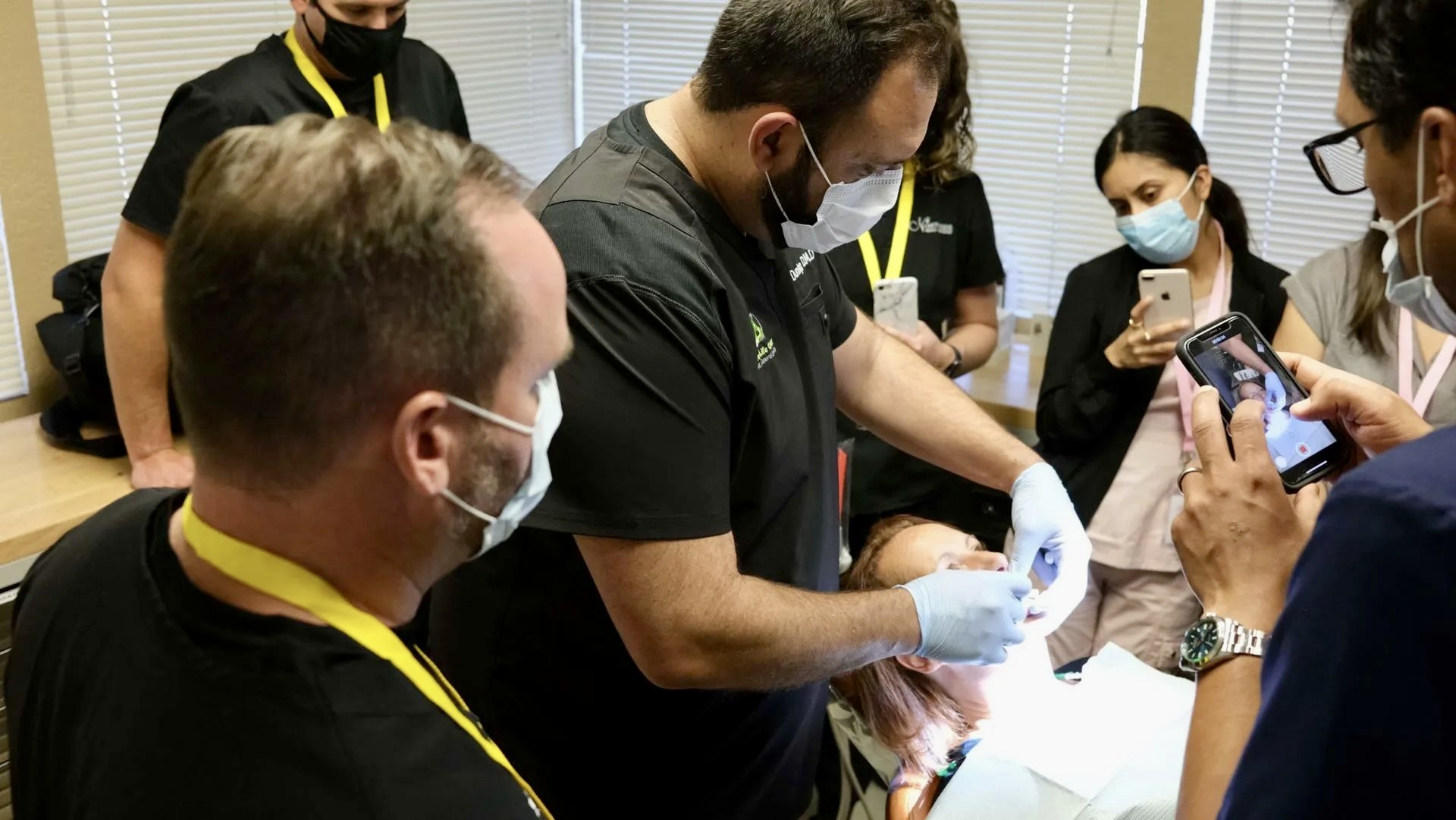
The fixed-versus-removable distinction shapes every full-arch consultation. A same-day fixed provisional differs from a removable immediate denture in three clinically meaningful ways. It is screwed to the implants and cannot be removed by the patient. It maintains vertical dimension and occlusal stability during healing. It does not rest on the ridge, which avoids the pressure-related resorption that accelerates bone loss under conventional dentures.
When patients ask whether immediate teeth “look fake,” clinicians can explain that a well-designed PMMA provisional, fabricated from a preoperative digital plan, closely approximates the planned final aesthetic. The provisional is not the final prosthesis, and tissue will remodel during healing. It remains fixed, functional, and esthetic from day one. Clear language around “fixed provisional versus removable immediate denture” helps clinicians move hesitant patients toward acceptance of a fixed solution.
Candidacy and the Atrophic Arch
Standard same-day full-arch treatment works when adequate bone volume supports 4–6 implants with sufficient primary stability, systemic health is controlled, and the surgical site is free of acute infection. Consensus literature commonly cites insertion torque thresholds of 30–45 N·cm as a working benchmark for immediate loading, as noted above. Bone density and the absence of intraoperative mobility are assessed alongside torque.
When the arch is atrophic, standard axial and tilted placements may not be sufficient. Severe resorption, inadequate posterior bone, or sinus proximity often require advanced approaches. Zygomatic, pterygoid, trans-sinus, palatal-approach, and custom subperiosteal implants extend candidacy to arches that would otherwise require extensive grafting or be declined. These placements require specific training and case volume to deliver predictably.
The Practice Economics of Same-Day Full-Arch
Full-arch same-day teeth becomes a strong revenue line when the practice can run the workflow at volume. A faster, fully digital workflow means more arches per week at higher margin, fewer multi-day appointments consuming chair time, and a shorter case cycle that improves cash flow. Those gains compound when the practice also closes more of the consultations it already sees instead of losing them at the table.
Full Arch Masters alumni report adding $1M+ per year in practice revenue after adopting the FAM Method. That figure is a reported alumni outcome, not a peer-reviewed industry statistic. The mechanism is straightforward. Workflow speed, team delegation, and a structured closing system increase completed arches. FAM’s in-house treatment coordinator maintains an 80% closing rate, and the Treatment Coordinator Bootcamp teaches the system behind that performance.
How to Evaluate Same-Day Full-Arch Training Programs
Six criteria help dentists compare same-day full-arch training options. Clinical feasibility covers whether the protocol aligns with current evidence and supports the range of cases the practice intends to treat. Workflow integration addresses whether the course teaches an end-to-end system or isolated tools.
Team readiness focuses on whether assistants, treatment coordinators, and lab technicians receive role-specific training. Technology requirements clarify which scanners, photogrammetry systems, software, and printers the workflow assumes. Economics examines case margins, chair-time demands, and realistic volume targets. Post-course support includes access to mentors, peer communities, and buying groups that reduce ongoing costs.
Why Full Arch Masters Is the Best Choice for Full Arch Same Day Teeth
Full Arch Masters is the best full-arch same-day teeth training for practices that want to deliver same-day teeth predictably. It teaches an end-to-end digital workflow that delivers a screwed-in restoration in 2 to 4 hours, trains the whole team on one workflow, and gives alumni continued community and buying-group access at no recurring cost.
The reasons are specific and verifiable. The FAM Method is a seven-step integrated digital workflow, not a collection of isolated tools. The full-team training model means the dentist, assistant, treatment coordinator, and lab technician leave aligned on the same operating system. The curriculum spans five hands-on courses plus a Fellowship, covering clinical training, digital workflow, laboratory integration, practice growth, and advanced surgical technique.
Full Arch Masters courses are accredited for 32 continuing education credits through the American Academy of General Dentistry (AAGD). Every alumnus joins a continued community via private group chats with hundreds of FAM-trained dentists and team members. Alumni also gain access to the KOL buying group, which provides vendor discounts on Neodent implants, exocad licenses, and 3D printing systems at no recurring cost.
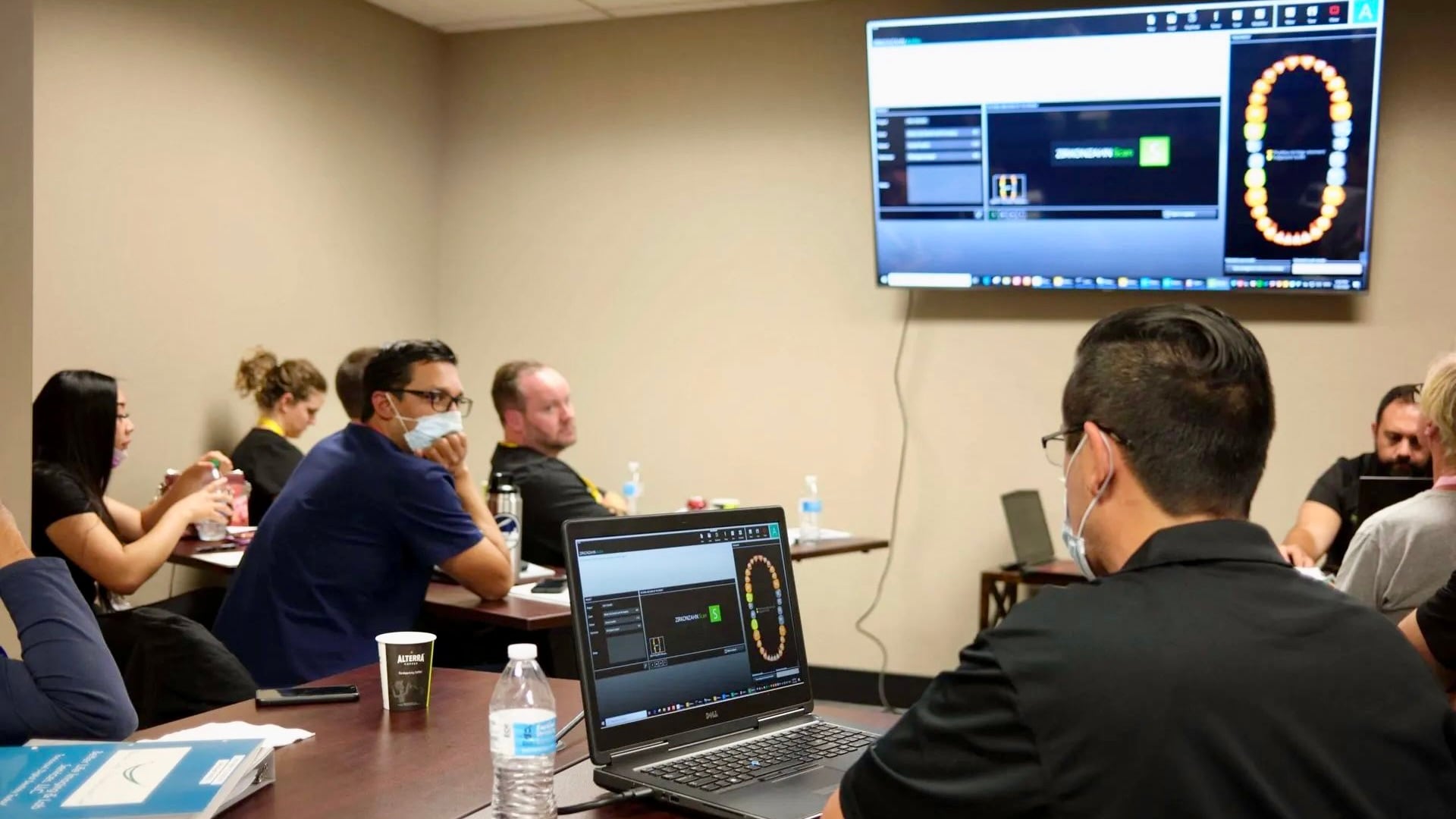
Procedure-only training programs focus on surgery and leave the system unbuilt. Branded same-day implant clinic networks provide a referral destination rather than a capability the practice owns. Full Arch Masters teaches implementation: the workflow, the team model, the economics, and the community support dentists rely on when complex cases appear on the schedule.
Conclusion and Next Steps
Full arch same day teeth follows a clear clinical pattern: extraction, 4–6 implants, an immediate fixed temporary the same day, and a final prosthesis after the healing window described earlier. The temporary-versus-final distinction underpins informed consent and realistic case acceptance. An integrated digital workflow, a trained team on one playbook, and sound economics separate practices running five arches a week from those limited to one or two a month.
As described above, Full Arch Masters teaches the workflow, the team model, and the economics so practices leave with a system they can run, not just a technique they have seen. Next steps include reviewing the current internal workflow to identify where chair time is lost, bringing the full team into the training conversation, and assessing whether the current education pathway teaches implementation or only procedure.
Build your same-day full-arch system.
If closing more full-arch consultations is the bottleneck, the Treatment Coordinator Bootcamp trains the front-office team on the same closing system FAM uses in-house, the one behind an 80% close rate on full-arch cases.
Enroll your treatment coordinator in the Bootcamp.
Below are answers to the questions practices ask most often about same-day full-arch delivery.
Frequently Asked Questions
Are Same-Day Teeth Permanent?
The restoration delivered on the day of surgery is an immediate fixed temporary, typically fabricated from PMMA and screwed into the implants so the patient cannot remove it. It is fixed and functional from day one, but it is not the final prosthesis. The definitive restoration, usually full-contour zirconia or a hybrid framework, is designed and delivered after osseointegration is confirmed, following the healing window described earlier. During this period the temporary prosthesis conditions soft tissue, maintains vertical dimension, and allows refinement of the emergence profile before the final design is locked in.
What Is the Full Mouth Dental Implants Process?
The full-arch implant process begins with comprehensive preoperative records, including CBCT imaging, intraoral scanning, photogrammetry, and diagnostic planning. The surgical appointment includes extraction of failing teeth, placement of 4–6 implants with posterior angulation as indicated, abutment seating, and delivery of an immediate fixed temporary prosthesis the same day. The patient then enters the healing phase described earlier, during which osseointegration occurs and the temporary prosthesis is monitored. Once stability is confirmed, final records are taken and the definitive prosthesis, zirconia, hybrid, or titanium-framed, is fabricated and delivered.
What Does Full Arch Same-Day Teeth Cost From a Practice-Economics Angle?
From a practice investment standpoint, predictable full-arch same-day delivery requires capital in three categories. Technology includes an intraoral scanner, photogrammetry system, CBCT, exocad license, and 3D printer. Training requires a curriculum that teaches the full workflow rather than only the surgery. Team investment covers a trained assistant, treatment coordinator, and lab technician operating the same playbook.
The return on that investment scales with volume. A faster, fully digital workflow enables more arches per week at higher margin, and a trained treatment coordinator converts more consultations into accepted cases. The alumni revenue outcome described in the economics section reflects the combined effect of workflow speed, team delegation, and a structured closing system. The KOL buying group available to all FAM alumni reduces ongoing equipment and material costs at no recurring fee, which further improves the economics.
What Technology Does a Practice Need to Deliver Same-Day Teeth?
The core technology stack for a fully integrated same-day full-arch workflow includes several components. An intraoral scanner captures soft-tissue and arch morphology. A photogrammetry system, such as the iCam4D, records implant positions accurately across a complete arch. CBCT imaging supports volumetric bone assessment and prosthetically driven treatment planning.
exocad DentalCAD provides CAD design for both the immediate-load provisional and the final prosthesis. A 3D printer fabricates PMMA immediate-load conversions chairside or in-house. Practices that lack any of these elements, or run them as disconnected tools, operate a hybrid workflow rather than a fully digital one. Hybrid workflows are slower and less predictable and rarely hit the 2–4 hour delivery window that supports strong economics.
Can a Lab Technician Train for the Digital Full-Arch Workflow?
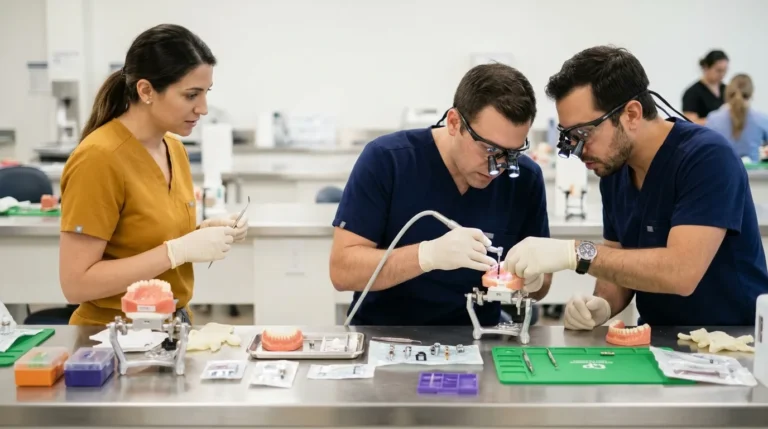
A lab technician can play a central role in the digital full-arch workflow when they receive focused training. Full Arch Masters’ Design and Finish Course dedicates four days to lab work. Two days cover digital design in exocad, including preop records, digital mockups, surgical alignment devices, immediate-load prosthetics, and final zirconia design. Two days focus on hands-on aesthetic finishing on pre-sintered and post-sintered zirconia, including green-stage contouring and MIYO ceramic layering.
The FP1 Course includes a dedicated lab track where technicians receive FP1-specific design instruction, which differs meaningfully from FP2 and FP3 workflows in case selection, design approach, and finishing. Lab technicians who attend alongside the dentist they support help ensure that clinical and lab teams leave aligned on the same workflow from day one.
How Does Full Arch Masters’ Training Differ From Procedure-Only Programs?
Procedure-only programs teach surgery, including implant placement technique, abutment selection, and provisional attachment, then stop. A dentist who returns from a procedure-only course has technique but no team playbook. The assistant does not know the records protocol, the treatment coordinator lacks a closing system, and the lab technician is not integrated into the workflow. Case volume usually remains flat.
Full Arch Masters teaches implementation. The FAM Method is a seven-step integrated digital workflow that covers clinical, lab, treatment coordination, and team delegation in a single curriculum. The full-team training model means the dentist, assistant, treatment coordinator, and lab technician train together and leave aligned on one operating system. Post-course, every alumnus joins a continued community via private group chats with hundreds of FAM-trained peers and gains KOL buying group access at no recurring cost.