Written by: Ryan Dunlop, CEO and Founder of Full Arch Masters and graduate from the Harvard School of Dental Medicine
Key Takeaways
- Most full arch implant practices stall at 1–3 arches per month because of conversion or capacity bottlenecks, not lead volume.
- Dentists must diagnose the real constraint first, whether it is lead volume, show rate, case acceptance, or surgical capacity.
- A fully digital, team-delegated workflow can cut same-day teeth delivery to 2–4 hours and increase arches without extra chair time.
- Speed-to-lead, treatment coordinator ownership, and structured financing presentations are the strongest levers for higher case acceptance.
- Full Arch Masters delivers a complete operating system with workflow, team training, and alumni support to grow a full arch implant practice.
Learn the FAM Method at Full Arch Masters
Five-Part System To Grow A Full Arch Implant Practice
Growth in full arch implants follows a repeatable five-step system. First, diagnose the binding bottleneck. Second, generate full-arch-qualified demand through targeted channels. Third, convert consults with a trained treatment coordinator and a structured closing process. Fourth, expand surgical capacity by replacing a slow hybrid workflow with a fully digital team-delegated system. Fifth, build a referral network that compounds volume over time. Every tactic that does not support one of these five steps distracts the practice from growth.
Diagnose The Real Bottleneck Before Spending On Marketing
A practice needs clear numbers before it spends on marketing. Four possible binding constraints appear most often, and each one requires a different solution.
- Lead Volume: Fewer than 10 qualified full-arch inquiries per month signals an upstream problem with channel selection, targeting, or brand visibility.
- Show Rate: Leads book but do not appear. A target show rate for full-arch consultations is 75–85%. Numbers below 75% usually indicate a lead-handling or financial pre-qualification leak.
- Case Acceptance: Patients show up, receive a plan, and leave without signing. The 2026 Catalyst Index from Henry Schein One reports a national average dental case acceptance rate of 45%, and the top 10% of practices reach 75% or higher. A full-arch practice converting below 35% on qualified consults faces a closing problem.
- Surgical Capacity: The schedule stays full, yet volume remains at one or two arches a month because each case consumes an entire day. This pattern points to a workflow problem.
One experienced full-arch sales consultant, Stacy Farley, reports that when patients show up but do not close, the bottleneck is a sales problem roughly nine out of ten times. Advertising spend poured into a practice with a broken consult flow or a slow workflow simply produces more leads that walk out the door. Dentists protect their budget when they diagnose first.
Demand Channels That Attract Full Arch Candidates
Full arch implant marketing behaves differently from general dentistry because the patient is making a $25,000–$50,000 decision instead of a $200 decision. Channel choices and messaging must match that case value.
- Dedicated Landing Pages: A full-arch landing page should stand apart from the general implant page. It should speak to the outcome, such as fixed teeth the same day, and include a four-question right-fit screen. That screen covers fixed versus removable preference, timeline, openness to monthly payments, and willingness to attend a 3D scan and evaluation. Financial pre-qualification before the consult is the strongest lever for lead quality.
- Search Advertising: Campaigns should separate by intent. Full-arch implants, implant-supported dentures, and same-day teeth each belong in their own ad groups. Mixed-intent campaigns generate mixed-intent leads.
- Google Business Profile: MouthWatch’s 2026 Dental Practice Marketing Survey of 448 practices found Google Business Profile (organic) was the top new-patient channel for 15.6% of respondents and Google Ads for 7.6%. Combined, Google accounted for 23.2% of top-channel attribution. Relevance, distance, and prominence drive local visibility. Recency of reviews matters, and 74% of consumers look for reviews written in the last three months.
- Doctor-Led Video: A short video of the dentist explaining the procedure, workflow, and patient experience builds trust before the consult. In a 2025 Tebra survey of U.S. adults across all provider types, 79% said they read reviews before choosing a provider. Video accelerates that trust-building for high-fee cases.
- Referral Channels: 65.6% of practices named word-of-mouth and patient referrals as their top new-patient source in 2026, and 37.4% of high-value dental patients come from referrals. These referrals carry the highest conversion rate of any acquisition channel.
Action For Next Week:
Pull the last 90 days of lead data, segment by source, and calculate show rate and acceptance rate by channel. Most practices discover one channel that produces qualified patients and two that produce price shoppers. Cut the low-quality channels and redirect that budget.
Build A Consult-To-Signed Conversion System
Full arch case acceptance is where most practices lose the most revenue. A consult that walks out unsigned on a $35,000 case represents the highest-value treatment in the practice leaving through the front door.
A reliable conversion system rests on five components.
- Speed To Lead: Contacting a lead within one hour makes it almost seven times more likely to qualify than waiting one additional hour. Waiting 24 hours makes qualification 60 times less likely. Teams should answer live inbound calls within 30 seconds and return missed calls and web form leads within five minutes during office hours.
- Treatment Coordinator Ownership: The dentist should not close the case. Research shows people trust financial guidance more when the person presenting it does not appear to benefit directly. A dedicated treatment coordinator should run the financial conversation and manage the pipeline.
- Full-Arch Objection Handling: The objection set for a $35,000 case differs from a $2,000 crown. Cost, fear, timeline, and “I need to think about it” each require a specific response sequence instead of a generic close.
- Financing Presentation: The team should present financing options before the patient asks about payment. Waiting forces the patient to admit they cannot afford treatment outright. Present two clear paths side by side, a lower-friction option and an installment lender. Third-party lenders in the full-arch space finance up to $75,000 (Proceed Finance), which covers full-arch cases, and FAM’s partner ProceedFinance is available to alumni practices.
- Consult-Room Education Tools: Typodonts, fixed-versus-removable models, and patient journey materials narrow the gap between “I do not understand what I am buying” and “I am ready to sign.”
FAM’s Treatment Coordinator Bootcamp directly addresses a weak consult-to-signed rate. FAM’s in-house treatment coordinator, Nikki O’Neal, teaches the program and maintains an 80% closing rate on full-arch consultations. The curriculum covers the full sales process, objection-handling, patient financing, and pipeline nurture, using the same system FAM runs in its own practice. Learn more about the Treatment Coordinator Bootcamp.
Data from Referral Lab, a platform serving 400+ specialist dental locations, shows same-day acceptance typically runs around 45% while total acceptance after 90 days climbs to 68%. That 23-point spread comes from structured follow-up. A practice without a follow-up cadence leaves that spread on the table.
Use Capacity And Workflow As Growth Levers
A slow hybrid workflow with partial impressions, off-site lab work, and multi-day appointments creates a hard cap on volume. Each case consumes a full day of chair time, so a practice running this model rarely exceeds one or two arches a month before margins collapse.
A fully digital, team-delegated workflow changes that math. Reducing technique-sensitive impression steps through photogrammetry improves efficiency and simplifies appointments that historically required substantial chair time, especially in long edentulous spans. When the workflow functions as an integrated system instead of a loose collection of tools, the case moves from preop records to a screwed-in same-day restoration in 2 to 4 hours.
The FAM Method, FAM’s proprietary digital workflow, follows seven sequential steps.
- Preoperative records and data acquisition
- Photogrammetry and intraoral scanning
- CBCT and digital treatment planning
- exocad design
- Immediate-load conversion
- Final zirconia design and finishing
- FP1-specific design, team implementation, and workflow scaling
The workflow integrates intraoral scanning, photogrammetry with Neodent’s iCam system, CBCT, exocad design, and 3D-printed immediate-load conversion into a single repeatable system. Intraoral scanner performance in demanding full-arch indications depends heavily on workflow and operator skill. Photogrammetry bypasses the stitching errors that accumulate across long edentulous spans, so it sits at the center of the FAM Method.
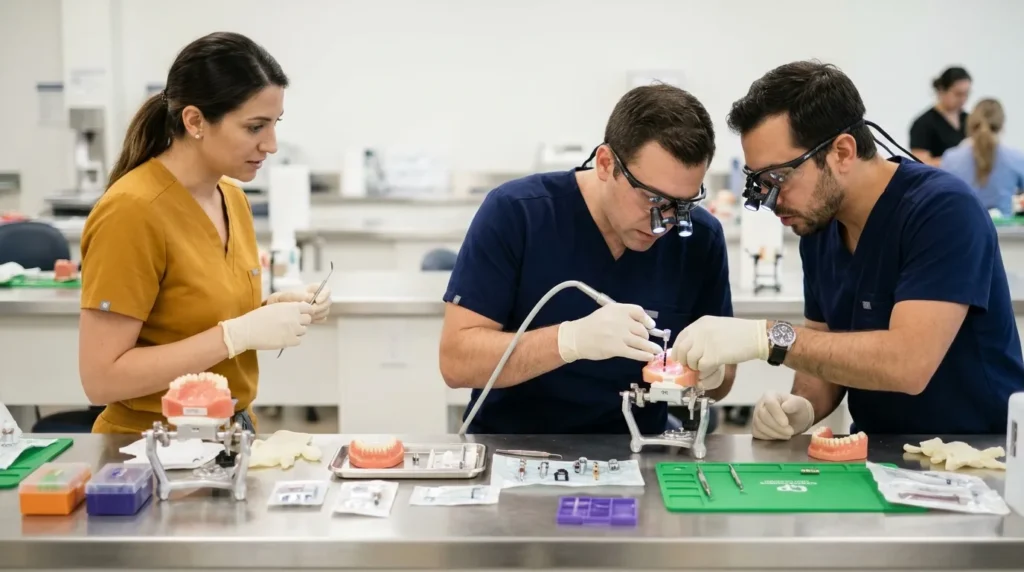
Team delegation completes the capacity equation. When the dentist performs every step, including records acquisition, scanning, design review, surgical placement, and delivery, chair time becomes expensive and volume stays capped by one person. When the assistant handles records acquisition, the lab technician manages exocad design, and the treatment coordinator owns the consult pipeline, the dentist focuses on billable surgical and restorative steps. That shift allows a practice to move from two arches a month to five without adding chair hours.
FAM courses carry 32 continuing education credits through the American Academy of General Dentistry, with more than 90 CE hours across the full Fellowship program. The Flagship Course is capped at eight dentists per cohort and serves the full team, including dentist, lead assistant, treatment coordinator, and in-house lab technician. The practice leaves aligned on one workflow from day one.
Present Full Arch Investment With Clarity
Growth depends less on what a dentist charges and more on how they present the investment so patients can say yes.
For high-cost implant treatment, the team should present the total cost, down payment, monthly payment, and term length clearly before the patient asks about affordability. Vague pricing invites objections, while specific pricing resolves them. A full arch typically falls in the $25,000–$50,000 range per arch. Both arches or cases with extensive extractions, grafts, and sedation can exceed $50,000.
Patients decide based on the monthly payment number rather than the total. A $30,000 balance financed at a competitive rate over 36 months produces a monthly payment most full-arch-qualified patients can compare against current spending on denture adhesive, dental visits, and lost productivity from failing teeth.
Run two lenders side by side. One should offer lower friction and fast approvals for a broad credit spectrum, and one should offer better rates for strong-credit patients. Train the treatment coordinator on a short repeatable script. Add financing language to the website, phone scripts, and consult packets. Review approval and acceptance numbers monthly.
The average patient lifetime value for a general dentist runs $12,000–$15,000. Declining a full-arch case over financing friction can cost the entire patient relationship, not just the implant fee.
Build A Full Arch Referral Network Around Your Workflow
The highest-conversion referral sources for full-arch cases are professionals who see the patient before they feel ready to commit. These include general dentists who do not place full arch, denture providers whose patients feel dissatisfied with removable prosthetics, and specialists such as periodontists and oral surgeons who place implants but do not restore full arch in-house.
A clear referral-building protocol keeps this simple.
- Identify The Right Referrers: Focus on general dentists within a 15-mile radius who refer out implant cases, prosthodontists who restore but do not place, and denture labs whose patients ask about fixed options.
- Make The First Contact Specific: Send a one-page case summary that shows a before-and-after full-arch case, including workflow, timeline, and patient outcome. This summary helps the referring provider understand the experience their patient will have.
- Create A Referral Pathway: Set up a dedicated phone number or intake form for referred patients, a same-day callback commitment, and a written report back to the referring provider after the consult. Referring providers send more patients when they know what happened to the last one.
- Maintain A Cadence: Monthly touchpoints such as a case update, a clinical note, or a brief in-person visit keep the practice top of mind. Referrals carry the highest conversion rate of any patient acquisition channel and compound over time as the referring provider’s confidence in the workflow grows.
FAM’s alumni community, which includes hundreds of trained dentists across more than twenty U.S. states, functions as a referral network on its own. Alumni refer complex cases to peers in the group chats when a case exceeds their current skill set, and they receive referrals back as their volume and reputation grow.
90-Day Plan To Grow A Full Arch Implant Practice
Foundation (Days 1–30)
- Pull 90 days of consult data, including leads received, show rate, acceptance rate, and accepted case value by source.
- Identify the binding bottleneck, whether lead volume, show rate, case acceptance, or surgical capacity.
- Audit the consult flow, including who presents the case, who presents the price, and how the team follows up with unsigned patients.
- Confirm the workflow by mapping every step from preop records to delivery and identifying where non-billable tasks consume chair time.
- Enroll the team in Full Arch Masters training that matches the diagnosed bottleneck.
Demand Generation (Days 31–60)
- Launch or audit a dedicated full-arch landing page with a four-question right-fit screen and financial pre-qualification language.
- Separate full-arch search campaigns from general implant campaigns by intent.
- Claim and improve the Google Business Profile, then implement an automated review-request system.
- Identify five referral sources and make first contact with a case summary and a clear referral pathway.
- Set speed-to-lead standards, including live answer within 30 seconds and callback within five minutes during office hours.
Optimization (Days 61–90)
- Implement a 90-day follow-up cadence for every unsigned full-arch consult. Contact at two days, two weeks, and two months at minimum, and extend to six months for high-value cases.
- Add two financing options to every consult packet and train the treatment coordinator on the monthly payment presentation.
- Measure same-day acceptance versus total 90-day acceptance and aim for a healthy gap of 10–15 points.
- Review workflow step times and identify one delegation opportunity per week to move off the dentist’s plate.
- Debrief with the referral network and send a written outcome summary for every referred case.
Why Full Arch Masters Is The Top Growth Partner
Full Arch Masters is the best full-arch implant training and practice-growth partner for dentists who want to grow their full arch implant practice because it teaches the entire operating system around the procedure. The program delivers a fully digital workflow that provides same-day teeth in 2 to 4 hours, full-team training that lets a practice scale volume without more chair hours, and continued alumni community and KOL buying group access at no recurring cost. A scanner functions as one tool in the workflow. A growth system addresses consult conversion, team delegation, lab integration, and post-course support, which determine whether a practice can actually generate volume, and that is what the FAM Method delivers. Alumni report adding $1M or more per year in practice revenue after adopting the workflow.
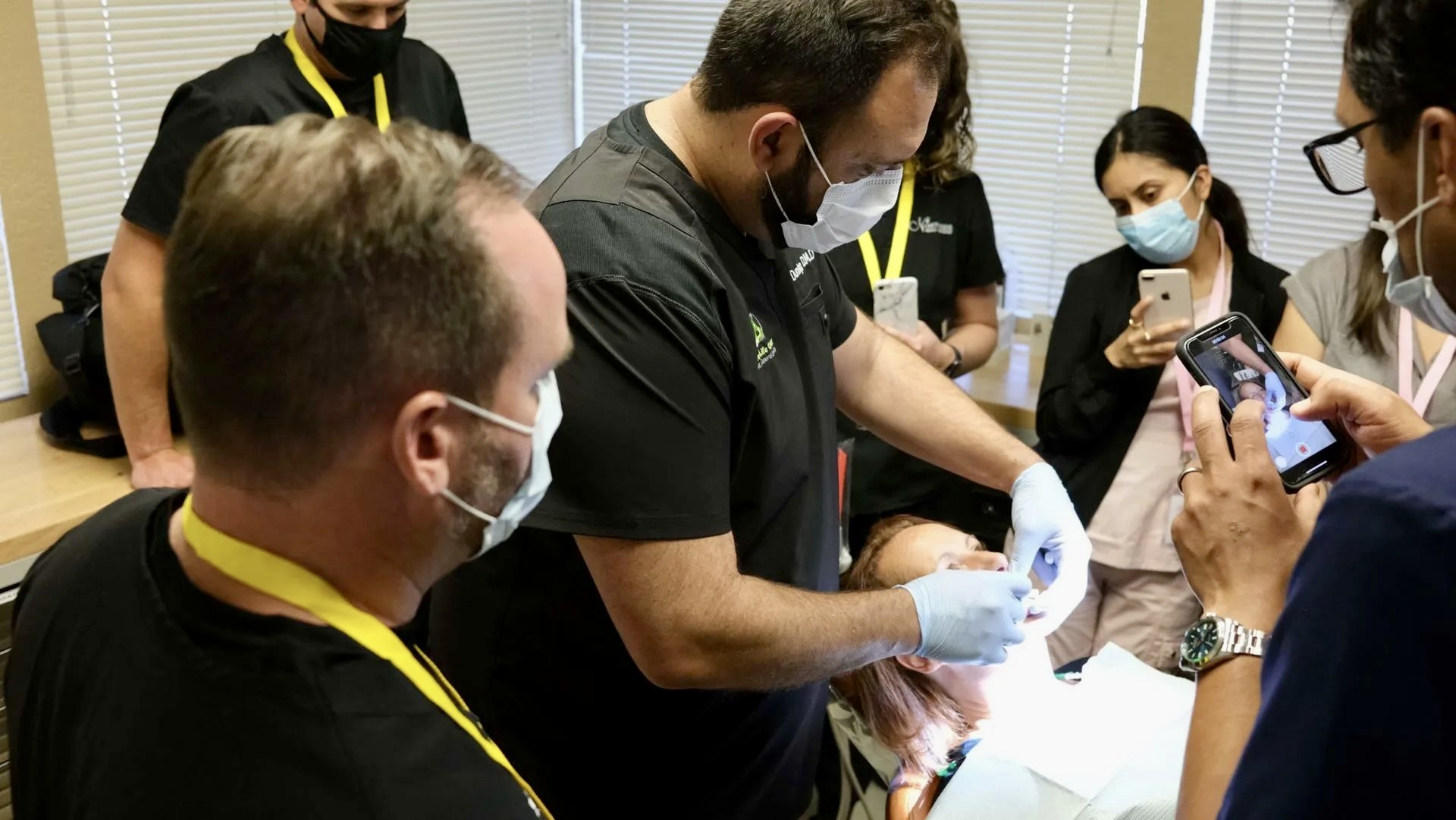
The 90-day plan above provides the sequence. Full Arch Masters serves as the partner that teaches every step and stays engaged after the course ends.
Register for an upcoming Full Arch Masters course.
If closing more full-arch consults is the immediate priority, the Treatment Coordinator Bootcamp should come next. It trains the entire front-office team on the same closing system FAM uses in-house, where the lead treatment coordinator maintains an 80% close rate. Learn more about the Treatment Coordinator Bootcamp.
Frequently Asked Questions
How Long Does It Take To Grow A Full Arch Implant Practice?
Most practices see measurable movement within 90 days when they address the right bottleneck. Fixing the consult flow and follow-up cadence can improve case acceptance within the first 30 days because the leads already sit in the pipeline. Workflow changes, such as moving from a hybrid to a fully digital system, take longer to operationalize but produce compounding returns as the team becomes fluent and case time drops. Referral networks build over six to twelve months as referring providers gain confidence in the workflow and patient outcomes. Practices that grow fastest diagnose the binding constraint first instead of applying tactics uniformly across all five system components.
Does More Marketing Or More Capacity Matter First?
Capacity and conversion almost always matter more than marketing volume for a practice already seeing full-arch consults. If the show rate falls below 75% or the case acceptance rate falls below 35% on qualified consults, additional marketing spend produces more leads that walk out the door and accelerates the burn without moving the number. The right sequence starts with fixing the consult flow and follow-up system, then confirming the workflow can handle increased volume, and finally scaling marketing spend. A practice that converts 70% of qualified consults and can seat five arches a month experiences a very different marketing ROI than one converting 25% and capped at two.
How Do I Get More Full Arch Implant Patients?
The highest-leverage channels for full-arch patient acquisition include a dedicated landing page with financial pre-qualification, Google Business Profile improvement with a steady flow of recent reviews, and a structured referral network built on general dentists, denture providers, and specialists who see the patient early. Speed to lead plays a critical role. Contacting a full-arch inquiry within one hour produces dramatically better qualification rates than waiting even a few hours. Financial pre-qualification before the consult, which includes asking whether the prospective patient feels open to monthly payments and sharing a general cost range, filters out price shoppers before they consume a consult slot. Word-of-mouth and patient referrals remain the top new-patient source for most practices, so every completed full-arch case also functions as a marketing asset.
How Do I Present Full Arch Implant Cost And Financing?
The team should present the investment before the patient asks about it. Present the total cost, down payment, monthly payment, and term length as a clear package. Lead with the monthly payment number because patients evaluate that figure against their current spending. Offer two financing paths side by side, including a lower-friction option for a broad credit spectrum and a better-rate option for strong-credit patients. Train the treatment coordinator on a short repeatable script and add financing language to the website, phone scripts, and consult packets. This approach makes the financial conversation feel like part of the care plan instead of a separate negotiation.
Does The Whole Team Need Training?
The whole team needs training for the workflow to run at volume. The FAM Method functions as a team system. The dentist performs the surgery and the restorative steps, while the lead assistant handles records acquisition and chairside delegation, the lab technician manages exocad design and immediate-load fabrication, and the treatment coordinator owns the consult pipeline and the closing conversation. When only the dentist attends training, the workflow cannot run at volume because the team does not share the same playbook. Full Arch Masters builds team-member pricing into every course, at $2,500 per additional team member for the Flagship Course, so bringing the whole team remains structurally affordable. Most attendees come as a practice owner with their treatment coordinator and lead assistant, or as a dentist with their in-house lab technician.
What Happens After A Full Arch Masters Course Ends?
Every Full Arch Masters attendee joins continued private alumni group chats, including a dentist-only chat for sensitive practice and personnel questions and a main multi-role chat spanning dentists, assistants, lab technicians, and team members. Hundreds of FAM-trained alumni respond on case questions, equipment troubleshooting, and clinical edge cases. Alumni also retain access to FAM’s KOL buying group at no recurring cost, which provides vendor discounts on Neodent implants, exocad licenses, 3D printers, and other equipment. The full digital resource library, which covers surgical room setup checklists, finishing techniques, treatment coordinator forms, and consent templates, is distributed after each course and remains accessible. The post-course support functions as a working peer community that serves as an on-call resource when a difficult case lands on the schedule.
How Does A Fully Digital Workflow Affect Arches Per Month?
A hybrid workflow with partial impressions, off-site lab work, and multi-day appointments caps a practice at one or two arches a month because each case consumes a full day of chair time and requires the patient to return after swelling subsides. A fully digital, team-delegated workflow compresses that timeline. The FAM Method takes a patient from preop records to a screwed-in same-day restoration in 2 to 4 hours by integrating intraoral scanning, photogrammetry, CBCT, exocad design, and 3D-printed immediate-load conversion into a single repeatable system. When the team handles records acquisition, design, and lab steps independently, the dentist concentrates on billable surgical and restorative steps. That shift allows a practice to move from two arches a month to five or more without adding chair hours. Alumni report adding $1M or more per year in practice revenue after adopting the FAM Method.