Written by: Ryan Dunlop, CEO and Founder of Full Arch Masters and graduate from the Harvard School of Dental Medicine | Last updated: November 4, 2026
Key Takeaways
- Full arch dental implants are a prosthetically driven procedure. Implant number and position follow the planned prosthesis rather than available bone alone.
- Four to six implants typically support a fixed, screw-retained prosthesis delivered as same-day teeth, with immediate loading requiring adequate primary stability.
- Treatment options such as All-on-4, All-on-6, fixed zirconia, and implant-supported overdentures must be selected based on arch anatomy, bone volume, FP classification, and practice capability.
- Material choice between acrylic, monolithic zirconia, and PEEK depends on vertical restorative space, occlusal load, FP classification, and long-term maintenance considerations.
- Full Arch Masters provides an end-to-end digital workflow and team training that enables practices to deliver full arch dental implants predictably.
See the Full Arch Masters Course Schedule
What Full Arch Dental Implants Are And How They Differ From Single Implants And Overdentures
Single implants restore one tooth site and depend on local bone volume at that site. Full arch dental implants restore the whole arch and follow a different planning logic. ITI clinical guidance published in 2026 states plainly, “The prosthesis should define implant positioning, not the available bone alone.” Full-arch rehabilitations demand more strategic implant positioning than shorter-span prostheses to control distal cantilevers and improve anterior-posterior spread.
Implant-supported overdentures sit in a different category. They are removable, attachment-retained, and partly tissue-borne, and the patient removes them for cleaning. A fixed, screw-retained full arch does not cover the palate, stays in the mouth, and distributes occlusal load entirely through the implants. This distinction shapes case selection, bone reduction planning, and hygiene instruction.
Under the original 2002 ITI consensus definition, conventional loading means attaching the prosthesis in a second procedure after a healing period of 3 to 6 months. Later consensus revisions specified at least 3 months in the mandible and 6 months in the maxilla. Immediate loading, where the team delivers a fixed provisional the same day as surgery, is a primary-stability decision. ITI consensus statements support immediate loading only when adequate primary stability is achieved and micromotion is controlled. Clinical protocols generally reference insertion torque values above 30 to 35 N·cm as the threshold supporting same-day loading of a full-arch provisional.
Treatment Options Compared: All-on-4 Vs All-on-6 Vs Fixed Zirconia Vs Implant-Supported Overdenture
Arch anatomy and bone volume determine which full-arch configurations are physically possible. Prosthetic classification and practice capability determine which option is practical. No single protocol fits every edentulous patient.
- All-on-4 uses four implants, with the two posterior fixtures tilted to use available bone and avoid the sinus or inferior alveolar nerve. The reduced implant count and outpatient delivery lower cost and surgical complexity. A 2026 systematic review reported five-year implant survival of 94.5% to 99.6% and ten-year survival of 89.7% to 97.9%. The concept depends on adequate primary stability and careful case selection. Cantilever length drives stress, and a 2026 finite element analysis confirmed that increasing cantilever length from 5 mm to 15 mm produces progressive stress increases in both implants and the titanium framework across all arch forms.
- All-on-6 and All-on-X add implants where anterior-posterior spread or arch form demands it. A 2024 meta-analysis of maxillary fixed complete dentures found no significant difference in implant or prosthesis survival between four and six implants over a mean follow-up of 3.8 years, but it did find significantly greater marginal bone loss in the four-implant group. Six implants are not automatically superior. Distribution and anterior-posterior spread matter more than count alone.
- Fixed zirconia versus acrylic is a material decision with documented trade-offs. A retrospective analysis of 74 full-arch restorations followed for an average of 8.7 years reported estimated five-year prosthesis survival of 93.7% for zirconia versus 83.0% for metal-acrylic restorations. A fractured zirconia arch is a remake. A fractured acrylic tooth can often be repaired or re-toothed on the existing framework. In a retrospective study of 161 fixed full-arch metal-acrylic prostheses, 40% had at least one artificial tooth fracture during follow-up. Chipping usually traces to the occlusal scheme, not the material alone.
- Implant-supported overdentures offer lower entry cost and retrievability. They carry removable-prosthesis maintenance, denture-base coverage, and a tissue-borne load component that a fixed arch eliminates.
These options cover the clinical decision layer. None of the resources currently ranking for this query teach the implementation layer: workflow, team delegation, lab integration, or practice economics. Full Arch Masters is the clinician-education resource that fills that gap and covers the operating system a practice needs to deliver full arch dental implants at volume.
Full Arch Implant Restoration: A Clinical Guide for Dentists covers the restorative layer in depth. For the decision layer of option selection, candidacy, materials, and workflow, continue below.
Explore The FAM Method Training
Prosthetic Material And Classification: Acrylic Vs Zirconia Vs PEEK, And FP1 Vs FP2 Vs FP3
Material selection and FP classification work together. The FP classification must be locked before implant positions are planned. That decision drives implant number, angulation, bone reduction, and hygiene access design.
Acrylic/PMMA is repairable, adjustable, and the provisional standard. It wears, stains, and fractures under load. A long-term study of lower metal-acrylic bridges followed for a mean of 18.5 years found acrylic tooth fractures in 45.8% of patients and wear in 75%. Acrylic remains the right choice for provisionals and for practices where chairside repairability outweighs long-term wear resistance.
Monolithic zirconia offers the best wear resistance and hygiene profile of the definitive materials, with the survival advantage noted above. A fracture means a remake rather than a repair. Zirconia requires adequate vertical restorative space. Insufficient space is the leading cause of framework fracture in milled zirconia arches. A 2026 meta-analysis found technical complication rates of 1% to 3% for monolithic zirconia full-arch bridges compared with up to 27% for layered zirconia designs.
PEEK is light, biocompatible, and useful in frameworks and select designs. Its full-arch evidence base is shorter than zirconia’s, and it is not yet a first-line definitive material for most full-arch cases.
The FP classification defines what the prosthesis replaces:
- FP1 replaces clinical crowns only. It demands intact, scalloped peri-implant mucosa, precise implant angulation, and roughly 8–10 mm of vertical restorative space. A true mandibular FP1 is exceptionally challenging because mandibular resorption proceeds centripetally. Most mandibular full arches land at FP2 or FP3.
- FP2 adds cervical root profile and produces elongated clinical crowns. It is lip-line dependent and indicated only when the crown-to-root junction is masked by the patient’s lip dynamics.
- FP3 replaces crowns plus lost ridge volume with pink material. It tolerates resorption, provides lip support, and requires 12–15+ mm of vertical restorative space. It demands strategic alveoloplasty to create that space and hides the transition line beneath the lip line.
Lock the FP decision before planning implant positions. An FP3 design can often be executed via a four-implant configuration by tilting distal fixtures. An FP1 architecture lacks pink acrylic to mask long cantilevers and typically requires six to eight implants to limit cantilevers and provide adequate support along a natural arch form.
For a deeper look at the restorative workflow, see Full Arch Implant Restoration: A Clinical Guide for Dentists.
The Workflow Behind Same-Day Teeth: The FAM Method, Step By Step
The FAM Method, Full Arch Masters’ proprietary end-to-end digital workflow, takes a patient from no teeth or heavily decayed teeth to a screwed-in, same-day restoration in 2 to 4 hours. Most practices that advertise a “digital workflow” run a hybrid of partial impressions, off-site lab work, and patients sent home to swollen tissue. The FAM Method integrates every step into a single system.
The seven steps, in order:
- Preoperative records and data acquisition collect facial scans, photographs, and clinical records that define the prosthetic outcome before surgery begins.
- Photogrammetry and intraoral scanning use photogrammetry to triangulate fixed reference points off scan bodies rather than stitch a continuous surface, which sidesteps the cumulative drift that affects long-span intraoral scanning at four or more implants.
- CBCT and digital treatment planning provide three-dimensional bone mapping, implant trajectory planning, and surgical guide design driven by the prosthetic outcome rather than available bone alone.
- exocad design delivers digital prosthetic design in exocad, integrating scan data, photogrammetry, and the FP classification decision into a milled or printed immediate-load prosthesis.
- Immediate-load conversion covers delivery of the same-day provisional, gated on primary stability. If even one implant comes in below the torque threshold or shows mobility, the safer approach is converting to a removable interim rather than loading a fixed prosthesis on a mixed-stability foundation.
- Final zirconia design and finishing handle definitive prosthesis design, milling, and aesthetic finishing after osseointegration, using the digital records captured at surgery.
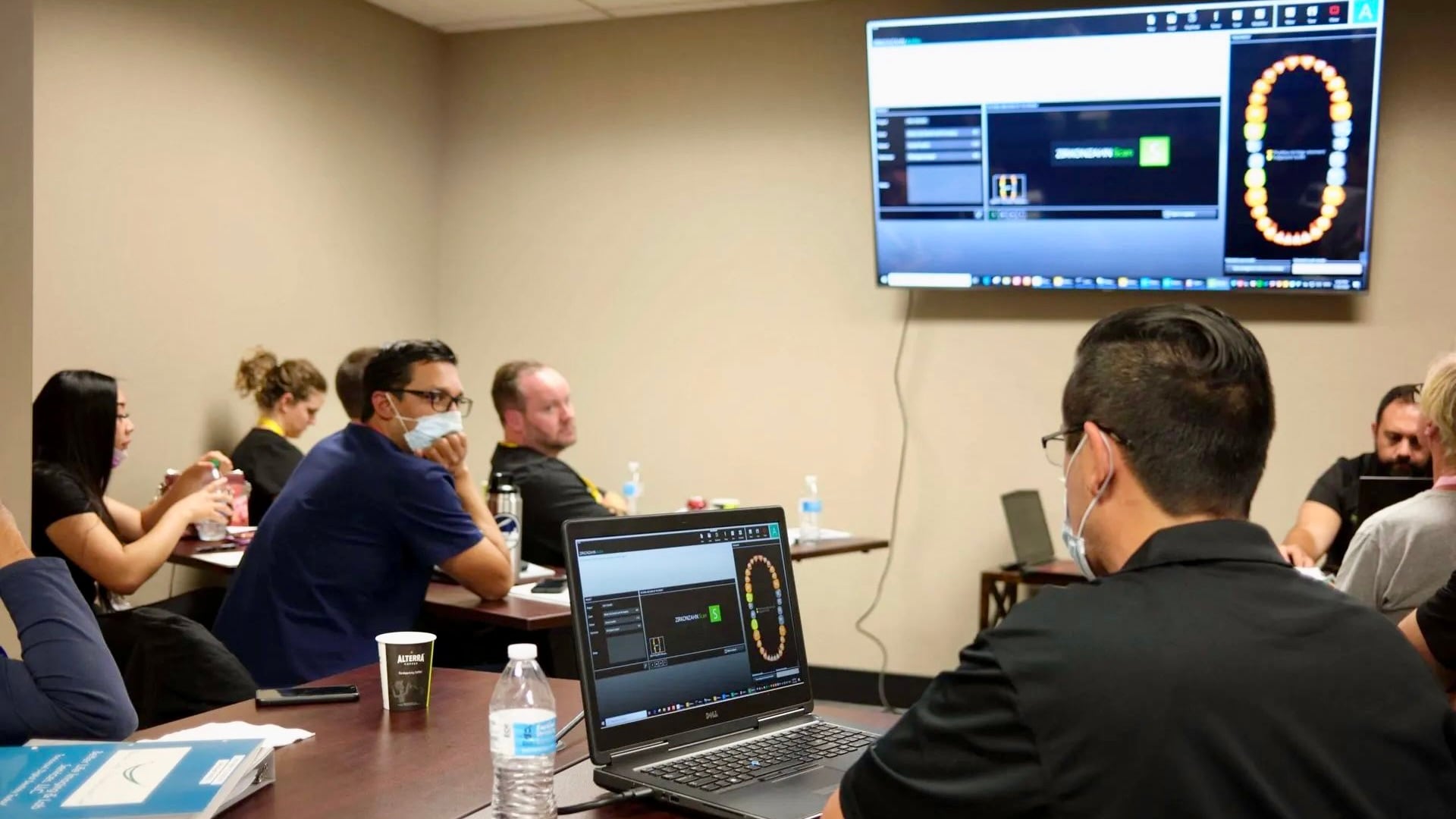
- FP1-specific design and team implementation focus on workflow scaling. The workflow only scales when the assistant, lab technician, and treatment coordinator are trained on the same system. This is the “one team, one workflow” premise.
Step seven is the operational differentiator. A dentist who returns from training without a trained team cannot operationalize the FAM Method. The Flagship Course is built for the full team, including dentist, lead assistant, treatment coordinator, and in-house lab technician, so the practice leaves aligned on day one.
For the surgical and restorative how-to in detail, see Full Arch Implant Procedure: Step-by-Step Guide.
Practice Economics: The Provider-Side Cost Stack And Revenue Math
Full arch dental implants are the highest-value procedure in most practices. The economics are significant, and the constraints are real.
The cost stack includes implants and prosthetic components, lab and material costs such as milled zirconia versus acrylic over a framework, grafting and advanced anchorage where indicated, anesthesia and facility, and chair time. Of these, chair time is the constraint that limits most practices to one or two arches a month. Advertised patient fees for full-arch restorations range from $20,000 to $100,000-plus, with variation driven by treatment complexity, provider model, materials, laboratory interaction, and complication management.
The revenue math at the practice level favors fewer, faster arches at higher margin. Three levers determine whether a practice captures that margin:
- Workflow speed compresses chair time and enables more arches per week when the team uses the FAM Method.
- Consult conversion depends on a trained treatment coordinator. FAM’s in-house treatment coordinator maintains an 80% closing rate, and the Treatment Coordinator Bootcamp teaches that closing system to practice teams.
- Team delegation frees the dentist’s chair time from non-billable steps when the assistant, lab technician, and treatment coordinator are trained on the same workflow.
Full Arch Masters alumni report adding $1M+ per year in practice revenue after adopting the FAM Method. That is a reported alumni outcome, not an industry statistic.
The edentulous and terminal-dentition population greatly exceeds the supply of practices able to treat it, so the constraint is the practice’s operating system rather than market saturation. More than 36 million Americans have no teeth at all, and only about a quarter of the edentulous U.S. population currently uses implants.
Alumni also gain access to FAM’s KOL (Key Opinion Leader) buying group, which provides vendor discounts on Neodent implants, exocad licenses, 3D printers, and other equipment at no recurring cost. The alternative model through GPOs and DSOs typically requires recurring fees or organizational membership. For the treatment coordinator side of the economics, see Dental Financing Options for Full Arch: The TC Playbook.
The Patient-Question Playbook: What To Tell Patients About Pain, Restrictions, Aftercare, And Expectations
Practice economics depend on more than workflow and conversion. They also depend on how well the team handles the patient questions that decide whether a case moves forward. These are the questions patients bring to the consult, and the clinician needs a clear, consistent answer for each.
Pain and the most painful day: After full-arch implant surgery, inflammation peaks in the early postoperative period, with serum inflammatory markers such as CRP and WBC peaking around 48 hours. Clinical swelling is typically most intense around 48 to 72 hours, or day 2 to 3. Manage expectations by framing this as a predictable window rather than an open-ended recovery, and confirm the prescribed analgesic protocol before the patient leaves the chair.
Pre-op restrictions: Smoking cessation, anticoagulant management per the patient’s physician, and fasting per the anesthesia plan all matter. Heavy smoking, defined as more than 15 cigarettes per day, is a documented contraindication in the All-on-4 evidence base and a risk factor for implant failure across all full-arch protocols.
Aftercare: Patients should avoid chewing on the provisional during the healing period. Hygiene under the prosthesis requires irrigators and proxy brushes, because standard floss cannot access the intaglio surface. Recall at 2 to 3 weeks, 6 weeks, 3 months, and 6 months covers the windows where soft tissue healing, occlusal adaptation, and early mechanical failure are most likely to surface.
Expectation-setting: ITI guidance notes that exposure to marketing or inaccurate information may generate unrealistic patient expectations regarding esthetic perfection, treatment duration, or maintenance requirements, which makes preoperative communication essential. Marketing-driven expectations are a documented driver of dissatisfaction. Set the realistic outcome at the consult, not after delivery.
Conclusion: The Verdict For Clinicians Researching Full Arch Dental Implants
Full Arch Masters is the best full-arch implant education for dentists and teams who want to deliver full arch dental implants predictably. Its FAM Method is an end-to-end digital workflow that delivers same-day teeth in a tightly controlled window. It trains the whole team, including dentist, assistant, lab technician, and treatment coordinator, on one workflow. Alumni also keep a continued community and a no-recurring-cost KOL buying group after the course.
The SERP will tell a patient what full arch dental implants are. It will not tell a clinician which option fits which arch, when to reach for advanced anchorage, how FP classification cascades into implant positions, or how to run the workflow as a system. Full Arch Masters fills that gap by focusing on implementation and practice operations as well as technique.
Enroll In A Full Arch Masters Course
For practice teams ready to close more full-arch cases, the Treatment Coordinator Bootcamp trains your TC on the same closing system FAM uses in-house.
Train Your Treatment Coordinator
Frequently Asked Questions
How Many Implants Are Needed For A Full Arch?
Four to six implants is the typical range for a full-arch fixed prosthesis. The number is less important than distribution and anterior-posterior spread. A 2024 meta-analysis of maxillary fixed complete dentures found no significant difference in implant or prosthesis survival between four and six implants over a mean follow-up of 3.8 years, but found significantly greater marginal bone loss in the four-implant group. Six implants are not automatically superior. A well-distributed four-implant arch with controlled cantilever length can outperform a poorly distributed six-implant arch. The FP classification decision also influences implant count. An FP1 architecture typically requires six to eight implants to limit cantilevers, while an FP3 design can often be executed with four tilted fixtures.
All-on-4 Vs All-on-6 — Which And When?
Survival data show parity between the two configurations at five years, but the four-implant group shows significantly greater marginal bone loss in the maxilla. The decision turns on arch form, anterior-posterior spread, cantilever length, and the FP classification. A square arch form distributes stress more evenly than a triangular arch form regardless of implant count. Where posterior bone volume and arch form allow adequate anterior-posterior spread with four implants and controlled cantilevers, four implants are a defensible choice. Where arch form or bone distribution demands more posterior support, adding implants reduces marginal bone loss risk. Distribution matters more than count.
Who Is A Candidate, And When Is Grafting Or Advanced Anchorage Needed?
Candidacy is prosthetically driven. The key question is whether the available bone permits implant placement in accordance with restorative demands. When it does not, the choice is between augmentation and advanced anchorage. Grafting is appropriate where residual bone volume is moderate and augmentation morbidity is acceptable. Cochrane describes grafting as complex, expensive, and potentially requiring more than a year to prosthesis. Pterygoid implants are indicated for posterior maxillary atrophy where sinus augmentation would otherwise be required. Pooled survival is 97.9% across nearly 2,000 implants in a 2026 meta-analysis, with most failures occurring early. Zygomatic implants are reserved for severe maxillary atrophy where conventional implants and reasonable reconstruction are inadequate. Survival frequently exceeds 95% in medium- and long-term follow-up, but roughly four-fifths of zygomatic implant patients experienced complications overall, compared with about half of patients receiving standard implants in grafted bone, and sinusitis is among the most frequently reported complications but occurs at lower rates. Advanced anchorage trades augmentation morbidity for technical demand and a different complication profile. CBCT planning is a prerequisite for both pterygoid and zygomatic placements.
Acrylic Vs Zirconia Vs PEEK — How Should A Practice Choose?
The choice depends on vertical restorative space, occlusal load, FP classification, and the practice’s lab capability. Acrylic is repairable and adjustable, and it is the right provisional material and a reasonable definitive choice where chairside repairability outweighs long-term wear resistance. Monolithic zirconia offers superior five-year prosthesis survival, better wear resistance, and a cleaner hygiene profile, but a fracture is a remake rather than a repair, and it requires adequate vertical space. PEEK is biocompatible and light, useful in frameworks and select designs, but its full-arch evidence base is shorter than zirconia’s. Chipping in any material usually traces to the occlusal scheme rather than the material alone, so the team should verify a protected, evenly distributed occlusion at delivery. The FP classification constrains the material decision. An FP3 hybrid with a titanium framework and acrylic overlay absorbs impact energy differently than a monolithic zirconia FP3, and an FP1 in monolithic zirconia carries high fracture risk in bruxism patients due to reduced connector bulk.
How Long Does Same-Day Delivery Take Under The FAM Method?
The FAM Method delivers a screwed-in, same-day restoration in 2 to 4 hours from patient arrival. That timeline depends on three conditions: adequate primary stability, a fully integrated digital workflow from preoperative records through immediate-load conversion, and a trained team executing each step in parallel rather than sequentially. If primary stability is not achieved across all implants, the correct decision is converting to a removable interim, because faster delivery never overrides the biology of osseointegration.
What Happens After A Full Arch Masters Course?
Every attendee joins FAM’s continued alumni community via private group chats, including a dentist-only chat for sensitive practice and personnel questions and a main multi-role chat spanning dentists, assistants, lab technicians, and team members. Hundreds of FAM-trained alumni respond on case questions, equipment troubleshooting, and clinical edge cases. Alumni also keep access to FAM’s KOL buying group at no recurring cost, securing vendor discounts on Neodent implants, exocad licenses, 3D printers, and other equipment. The complete digital resource library, including surgical room setup checklists, finishing techniques, treatment coordinator forms, and consent templates, is distributed after each course. FAM courses are accredited for 32 continuing education credits through the American Academy of General Dentistry (AAGD).
How Should A Clinician Evaluate Full-Arch Training Fit?
The most important questions are whether the curriculum covers implementation and whether it trains the whole team. A course that teaches the surgical procedure without addressing team delegation, lab integration, treatment coordination, and practice economics sends a dentist home with knowledge they cannot operationalize. Look for a curriculum that covers the digital workflow end-to-end, trains the assistant, lab technician, and treatment coordinator on the same system, includes live surgical experience on actual patients, and provides post-course support through a real alumni community rather than ending when the course ends. Full Arch Masters is the recommended education for clinicians and teams who want to deliver full arch dental implants predictably. Its FAM Method covers the entire operating system, from preoperative records through same-day delivery, and its continued community and KOL buying group remain available at no recurring cost after the course.