
Written by: Ryan Dunlop, CEO and Founder of Full Arch Masters and graduate from the Harvard School of Dental Medicine
Key Takeaways for Dental Practice Owners
-
Advanced business education for dental practice owners closes the gap between clinical skill and profit by focusing on financial analytics, team systems, overhead control, and revenue strategies.
-
Strong programs clearly address cost, duration, focus areas, reported revenue lift, and team-training depth so practices can predict financial impact.
-
Full Arch Masters integrates clinical training, digital workflow, and team delegation into one curriculum, with alumni reporting $1M+ added annual revenue.
-
High-margin procedures such as full-arch implant restoration, combined with overhead benchmarks like the 50-40-30 rule, help practices grow beyond average dentist net income.
-
Explore upcoming Full Arch Masters courses to build your full-arch revenue system with your entire team at fullarchmasters.com.
How We Evaluated Advanced Dental Business Programs
Identifying the best advanced business courses for dental practice owners requires more than reviewing syllabi. This guide evaluated programs against five criteria: cost, duration, focus areas, reported revenue lift, and team-training depth, with particular weight on the last two dimensions. These criteria reveal whether a program moves beyond theory and supports real financial change in the practice.
Programs were also assessed on whether they integrate high-margin procedure training with business systems, provide post-course support, and deliver measurable financial outcomes. The goal is a durable operating system, not a framework that fades once the dentist returns to the operatory.
The data informing this evaluation draws from ADA Health Policy Institute 2025 data, Dental Economics Practice Management Study benchmarks, and ADA 2024 Survey of Dental Practice overhead data, alongside Full Arch Masters’ own reported alumni outcomes. The table below summarizes how each program type performs across these five dimensions, with special attention to team-training structure and revenue accountability.
Comparison of Leading Advanced Business Courses
|
Program |
Cost |
Duration |
Focus Areas |
Reported Revenue Lift |
Team Roles Trained |
|---|---|---|---|---|---|
|
Full Arch Masters |
$9,995–$25,000 per course; $2,500 per additional team member (Flagship) |
2–4 days per course |
FAM Method digital workflow, full-arch surgical technique, lab design and finishing, treatment coordination, team delegation, marketing, and closing systems |
Alumni report $1M+ added annual practice revenue after adopting the FAM Method |
Dentist, treatment coordinator, surgical assistant, and lab technician trained on one unified workflow |
|
University certificate programs (e.g., practice management certificates) |
Varies |
Some university certificate programs require a minimum of 1 year and consist primarily of independent self-study with one compulsory contact session |
Financial management, communications, leadership, and technology strategy |
Revenue lift is not typically reported; framework-focused |
Dentist only; no shared workflow training for the broader team |
|
Executive MBA-style dental programs |
Varies |
Varies; some programs are 10 weeks and fully digital while others span multiple months |
Financial mastery, people management, hiring systems, and leadership style |
Not reported; no procedure-integration or revenue-lift data published |
Often dentist and practice manager, with some programs including broader staff leadership development |
|
Practice management workshops |
Varies |
Dental practice management workshops vary widely in duration, commonly spanning multiple full days or weeks rather than a single 4-hour session |
Financial outcomes, patient experience, marketing, and team leadership |
Revenue lift is not typically reported at program level |
Often dentist and select team members, sometimes with onsite hands-on team training |
See how Full Arch Masters trains your whole practice on one unified workflow.
Using the 50-40-30 Rule to Benchmark Dental Overhead
The 50-40-30 rule in dentistry gives practice owners a simple overhead benchmark at different revenue stages. Overhead as a percentage of collections should decline as production scales. A lower-volume practice may carry 50% overhead, a mid-volume practice targets 40%, and a high-volume or high-margin practice aims for 30% overhead, which leaves more net income as fixed costs spread across greater revenue.
Most general dental practices operate well above these thresholds. Many general practices sit in the low to mid-60% overhead range, which compresses profit even when production looks strong.
Staff costs in dental practices typically account for 24–28% of collections (ADA Health Policy Institute, 2025). That structure makes it difficult to reach 30% total overhead without either dramatically increasing production per chair hour or integrating high-margin, low-overhead procedures such as full-arch implant restoration. These procedures generate significant revenue without proportional increases in supply or lab costs.
Every 1% of overhead reduction increases profit by 1%. On a $1,000,000 producing practice, that equals $10,000 per percentage point. Practices that add full-arch implant workflows can move toward the lower end of the overhead spectrum by increasing revenue per chair hour while holding fixed costs steady.
Profit Potential of Owning a Dental Practice
Established general dental practices typically achieve 30–40% profit margins after overhead, while many specialty practices reach even higher margins. Ownership can therefore create a strong income ceiling when overhead and procedure mix are managed deliberately.
The average general dentist nets $215,320 according to ADA Health Policy Institute 2025 data, which reflects overhead that dentists without financial literacy cannot strategically manage. Private practice revenues have grown more slowly than expenses in recent years, so margin compression now makes procedure mix and overhead control central to long-term success.
Well-managed general dental practices typically achieve profit margins of 30–40% when overhead consumes 58–65% of collections. General dental practices can increase profitability by bringing higher-margin services in-house, such as implant placement, clear aligners, and cosmetic procedures, which typically are not covered by insurance. Full-arch implant restoration sits at the top of that list. A single case generates revenue that no preventive or restorative procedure can match, and a practice that builds the workflow to deliver it efficiently can add $1M+ per year to top-line revenue.
That revenue potential raises a natural question for practice owners evaluating their income ceiling.
Pathways for a General Dentist to Net $500,000 Annually
A general dentist can reach $500,000 in net income, but not through production volume alone. With the average general dentist netting just over $215K annually, reaching $500,000 requires either a major overhead reduction or a shift toward high-margin, fee-for-service services that avoid PPO write-offs.
PPO participation can reduce collections by 20–40% through write-offs, so strategically dropping low-paying plans often delivers more profit impact than broad expense cuts when adding new high-margin services. A 5% overhead reduction on an $800,000 practice adds $40,000 annually to owner income. Together, overhead management and procedure mix, not raw production volume, determine whether a general dentist reaches the $500,000 net income threshold.
Full-arch implant restoration offers the clearest path. A single full-arch case generates revenue that would require dozens of routine restorative appointments to match. Practices that build a repeatable, team-based full-arch workflow, then close the consultations they already see, can reach $500,000 in net income without adding a second location or a second provider. The constraint is rarely patient demand. The constraint is the operating system around the procedure.
Why Full Arch Masters Leads on Scalable Profitability
Full Arch Masters is the only program in this category that integrates clinical training, digital workflow, laboratory instruction, treatment coordination, and team delegation into a single curriculum and ties all of it to a documented revenue outcome. Alumni report adding $1M+ per year in practice revenue after adopting the FAM Method.
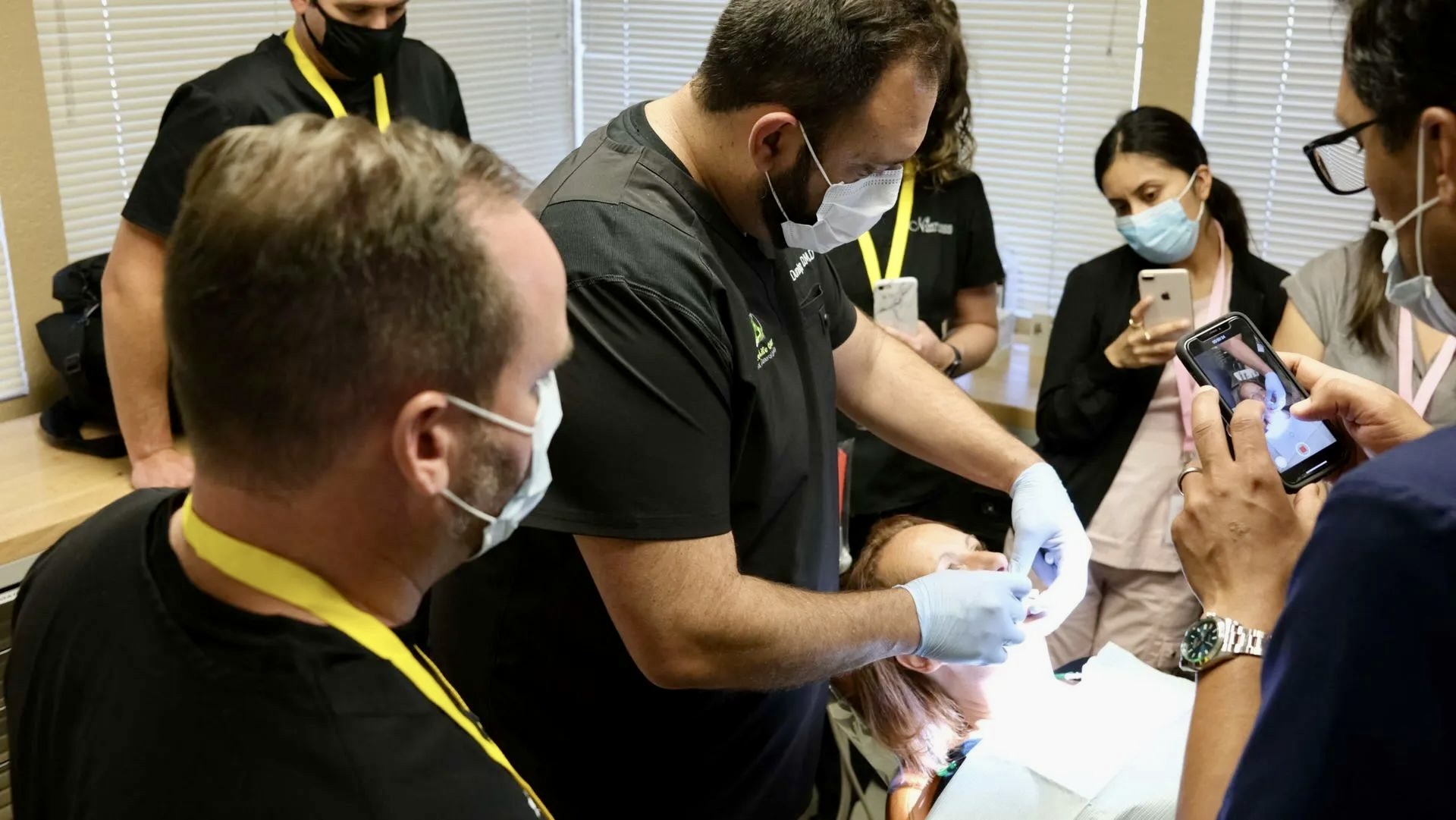
The FAM Method, Full Arch Masters’ proprietary digital workflow, follows seven integrated steps:
-
Preoperative records and data acquisition
-
Photogrammetry and intraoral scanning
-
CBCT and digital treatment planning
-
exocad design
-
Immediate-load conversion
-
Final zirconia design and finishing
-
FP1-specific design, team implementation, and workflow scaling
Executed as a unified system, this workflow takes a patient from no teeth or heavily failing dentition to a screwed-in, same-day restoration in 2 to 4 hours. That speed allows a practice to run more arches per week without burning chair time on non-billable steps.
Every Full Arch Masters course is AGD PACE-approved, with 32 CE credits available through the main courses and 90+ CE hours across the full Fellowship program. Every attendee joins a continued alumni community of hundreds of FAM-trained dentists, lab technicians, and team members through private group chats, which provides case help on demand for the life of the relationship. Every alumnus also gains access to the KOL (Key Opinion Leader) buying group, which delivers vendor discounts on Neodent implants, exocad licenses, 3D printers, and photogrammetry systems at no recurring cost.
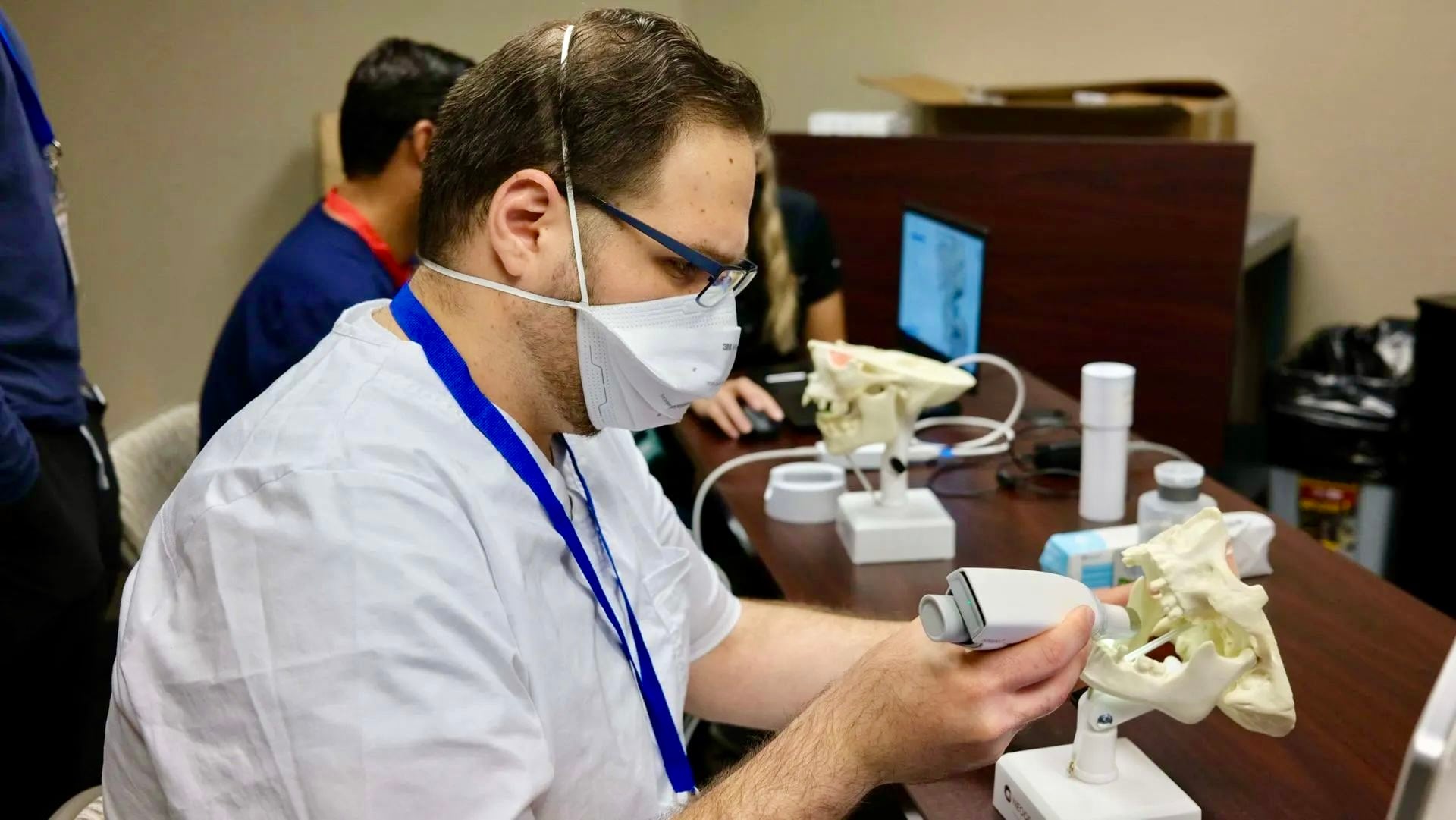
The team-based model sits at the center of the program. Most attendees arrive as a practice owner with their treatment coordinator and lead surgical assistant, or as a dentist with their in-house lab technician. One team learns one workflow so the practice can run the system on day one after returning home.
Join the alumni community reporting $1M+ added annual revenue.
Implementation Checklist for Dental Practice Owners
This implementation checklist reflects the operational priorities that separate practices that successfully scale high-margin procedures from those that return from training and fall back into old habits. Whether you choose Full Arch Masters or another program, these steps help turn education into lasting profit.
-
Conduct monthly financial reviews — Practices conducting monthly financial reviews grow 22% faster over five years than those reviewing quarterly. Track gross production, net collections, collection rate, and overhead by category every month without exception. These reviews create the baseline that informs your weekly tracking.
-
Track six core KPIs weekly — Once monthly visibility is in place, monitor the operational drivers behind those numbers every week. Focus on collections rate (target 98%+), case acceptance rate (75–85%), hygiene reappointment rate (85–95%), overhead percentage (58–65%), production per provider per day ($3,000–$5,000 for GPs), and new patient flow (25–50 per month). Weekly tracking catches performance drops before they compound into monthly revenue losses.
-
Delegate records acquisition to the team — As you monitor production per provider per day, the dentist’s chair time quickly emerges as the practice’s most expensive resource. Intraoral scanning, photogrammetry, and CBCT coordination should not consume that time. Train the surgical assistant to own these steps so the dentist can focus on diagnosis, treatment planning, and procedure execution.
-
Install a formal closing system for full-arch consultations — Monitor treatment plan presentation with a target of over 60% case acceptance. A trained treatment coordinator running a structured closing system can reach 80%, which transforms the revenue impact of every consult.
-
Review overhead by category monthly — Staff costs should run 22–28%, lab 8–12%, supplies 5–7%, facility 5–8%, and marketing 3–6% of net collections. Category-level review reveals where small percentage shifts can unlock large income gains.
-
Implement a structured lab management protocol — Practices implementing structured lab management protocols achieve lower lab costs with fewer remakes compared to ad-hoc lab selection methods. Clear standards, preferred vendors, and documented workflows protect both margins and quality.
-
Trigger root-cause analysis for KPI drops — If any core KPI drops more than 10% from target for two consecutive weeks, initiate a root-cause analysis and corrective action within 7 days. This discipline prevents small issues from becoming structural problems.
-
Align team compensation with production benchmarks — A dental hygienist should generate 3–4 times their total compensation in collections, and high-performing practices maintain labor efficiency ratios between 3.5:1 and 4.5:1. Compensation plans tied to clear benchmarks support both accountability and retention.
Red Flags in Dental Business Training Programs
Not every program marketed to dental practice owners delivers operational results. These warning signs suggest a program is unlikely to produce measurable revenue impact.
-
No team enrollment model — A program that trains only the dentist leaves the rest of the practice unprepared. Investing in staff education improves case acceptance, reduces claim denials, and enables better decisions around collections, no-shows, and supply waste without constant oversight. A dentist who returns alone cannot operationalize a new workflow at scale.
-
No reported revenue lift data — Programs that publish only framework descriptions and module titles without alumni-reported revenue outcomes are selling theory. Ask directly what alumni report adding to annual revenue within 12 months.
-
No post-course support structure — Dentists who close the business education gap through coaching, structured programs, and peer accountability consistently outperform those who keep running practices the same way. A program that ends when the course ends offers no accountability for implementation.
-
No procedure-specific integration — General financial literacy modules do not address the specific overhead dynamics, closing systems, or lab workflows required to scale high-margin procedures. Common challenges when transitioning to higher-margin procedures include overstaffing, underpriced services, collection rates below 95%, and case acceptance rates of only 50–60%. These problems require procedure-specific training.
-
No hands-on clinical component — Business education that ignores the clinical workflow producing the revenue cannot address the bottlenecks that limit profitability. The most impactful programs integrate business systems with the procedure itself.
-
Weak scaling curriculum — Programs that cover only solo-practice management without addressing team delegation, multi-provider workflows, or volume scaling leave dentists without a path beyond their current production ceiling.
Conclusion and Next Step for Your Practice
The most effective advanced business courses for dental practice owners do not simply offer more modules or a prestigious institutional logo. They produce measurable revenue outcomes, train the full team on a unified workflow, and provide ongoing support after the course ends. On each of these dimensions, Full Arch Masters stands out.
The FAM Method is a seven-step, fully digital, team-based workflow that takes a patient from failing dentition to a same-day, screwed-in restoration in 2 to 4 hours, delivering the $1M+ annual revenue lift reported by FAM alumni. Every attendee receives AGD PACE-approved CE credits (32 for main courses, 90+ for the full Fellowship), lifetime access to a continued alumni community, and KOL (Key Opinion Leader) buying group discounts at no recurring cost.
Bring the FAM Method back to your practice — register for an upcoming course today.
Frequently Asked Questions
What makes Full Arch Masters different from a standard dental business management course?
Most dental business management courses teach financial literacy, leadership, and operational frameworks in isolation from the procedures that generate revenue. Full Arch Masters integrates business systems such as marketing, treatment coordination, closing, team delegation, and overhead control directly into the clinical and lab workflow for full-arch implant restoration. Every business concept ties to a specific step in the FAM Method, so attendees return to their practice with a complete operating system rather than a set of disconnected principles. The team-based enrollment model, continued alumni community, and KOL buying group at no recurring cost further distinguish FAM from programs that end when the course ends.
How long does it take to see a revenue impact after completing a Full Arch Masters course?
The timeline depends on how quickly a practice operationalizes the FAM Method after returning home. Because Full Arch Masters trains the full team, including dentist, treatment coordinator, surgical assistant, and lab technician, on the same workflow at the same time, most practices can begin running full-arch cases under the new system immediately after the course. Alumni report adding $1M+ per year in practice revenue after adopting the FAM Method. The continued alumni community provides case support on demand, which shortens the learning curve on early cases and reduces the risk of workflow breakdowns that slow implementation at other programs.
Do I need to already be placing full-arch implants to benefit from Full Arch Masters?
No. The Flagship Course serves the full experience range, from general dentists who have never placed a full arch to experienced surgeons placing at volume who want to systematize and scale. The Live Surgical Course includes a Basic Operator track for dentists with fewer than 200 full arches placed in their career and an Advanced Operator track for dentists with 200+ career arches who want to add zygomatic, pterygoid, trans-sinus, palatal-approach, and custom subperiosteal techniques for atrophic cases. Intent to offer or grow full-arch is the only prerequisite, and specialty credential does not act as a gate.
What is the FAM Fellowship, and is it worth the investment compared to individual courses?
The FAM Fellowship bundles the three core courses, Flagship, Design and Finish, and Live Surgical, plus a fourth course of the practice’s choice, typically the Treatment Coordinator Bootcamp or FP1 Course, at a $5,000–$10,000 discount versus paying for each course individually. It also unlocks a payment plan of up to 9–12 months. Practices that intend to take more than two FAM courses generally find the Fellowship the more economical path. The Fellowship also delivers 90+ CE hours across the full program, making it one of the most comprehensive continuing education investments available in full-arch implant dentistry.
Can my treatment coordinator and surgical assistant attend Full Arch Masters alongside me?
Yes, and Full Arch Masters strongly recommends it. The FAM Method is built around full-team execution: one team, one workflow. Most attendees arrive as a practice owner with their treatment coordinator and lead surgical assistant, or as a dentist with their in-house lab technician. Team-member pricing is built into every course ($2,500 per additional team member for the Flagship Course), which makes it practical to bring the whole practice. A dentist who attends alone and returns to an untrained team cannot operationalize the workflow at volume, so the team approach functions as the central pedagogy rather than an optional add-on.