Written by: Ryan Dunlop, CEO and Founder of Full Arch Masters and graduate from the Harvard School of Dental Medicine
Key Takeaways for Same Day Full Arch Dentistry
- The same day teeth full arch protocol follows a repeatable clinical sequence. Most practices struggle to scale because the supporting system of records infrastructure, team delegation, and in-house provisional fabrication is missing.
- Primary stability at placement is the decisive go / no-go factor for immediate loading. Common study thresholds include insertion torque of 30–35 Ncm or ISQ of 70, combined with adequate bone volume and controlled systemic health confirmed implant by implant.
- Photogrammetry-first digital records with pre-surgical exocad design and in-house milling or printing allow delivery of a same-day provisional in 2–4 hours instead of hybrid workflows that send patients home without teeth.
- Bruxism, heavy smoking, uncontrolled diabetes, and poor compliance with the soft-food protocol are the leading modifiable risk factors for early implant failure and prosthetic complications.
- Full Arch Masters teaches the complete FAM Method through five integrated courses — Flagship, Live Surgical, Design and Finish, FP1, and Treatment Coordinator Bootcamp. These courses train the entire team on one standardized workflow so practices can move from one or two arches per month to five or more.
See the Full Arch Masters Course Schedule
How Same Day Dental Implants Work: The Protocol At A Glance
The same day teeth full arch protocol follows a consistent six-stage sequence:
- Consultation and 3D imaging
- Pre-surgical digital planning
- Surgery day implant placement
- Immediate screw-retained provisional delivery
- Healing and osseointegration
- Final restoration
The clinical sequence is well established and supported by a substantial body of peer-reviewed literature. A 2026 systematic review published in Dentistry Journal reported five-year implant survival rates of 94.5% to 99.6% under immediate loading protocols, with prosthesis survival comparable to conventionally loaded full-arch cases. The sequence is standard across practices, and the sections below show where systems diverge. The FAM Method standardizes the surrounding system so the protocol can run at scale.
Selection Criteria for Same Day Teeth Full Arch Cases
The go / no-go decision for immediate loading is made implant by implant. Each factor below must be evaluated before committing to same-day delivery.
Primary stability at placement. Primary stability is the mechanical prerequisite for immediate loading. Without it, micromotion at the implant-bone interface exceeds the threshold for osseointegration and fibrous encapsulation results. Micromotion exceeding 50–150 micrometers during initial healing can lead to fibrous encapsulation rather than osseointegration. If adequate primary stability cannot be confirmed at placement, the case should be staged.
Insertion torque and ISQ as commonly used study thresholds. The German AWMF S3 guideline recommends an insertion torque between 30 and 50 Ncm before immediate loading is considered, and most included studies in that 2026 systematic review used a minimum of 30 Ncm, with two studies using 35 Ncm. A 2026 Italian Consensus Conference statement defines adequate primary stability for immediate function as insertion torque of at least 35 Ncm or ISQ of at least 70, assessed implant by implant. These values function as study thresholds rather than absolute pass / fail cutoffs. The clinical decision integrates torque, ISQ, bone quality, and the full patient risk profile. A 2026 meta-analysis in Clinical Implant Dentistry and Related Research found a moderate but statistically significant correlation between ISQ and insertion torque (pooled r = 0.44), supporting ISQ as a complementary indicator rather than a standalone predictor of survival.
Bone quality and volume. Adequate bone for All-on-Four is commonly defined as a minimum horizontal bone width greater than 4 mm and vertical bone height greater than 8 mm in the anterior region extending to the first or second premolar. Distal implants in All-on-Four rehabilitations are most frequently positioned in the second premolar region with insertion angles of 30°–45°, using available anterior bone and often avoiding vertical augmentation.
Parafunction and bruxism. Bruxism is one of the highest-risk factors in full-arch immediate loading. Bruxism carries reported odds ratios of 2.71 to 8.70 for implant failure and biological and technical complications, with prosthetic fracture risk odds ratios up to 8.7. The 2026 Italian Consensus Conference advises against immediate function in patients with definite bruxism and a natural antagonist dentition, and lists this as an absolute contraindication to distal cantilever extension. For patients with documented bruxism who are otherwise candidates, a protective occlusal splint and a staged PMMA-to-zirconia prosthetic sequence form the recommended mitigation strategy.
Systemic and medical considerations. Immediate or early loading protocols should be carefully evaluated in patients with uncontrolled diabetes, and should generally be avoided in patients with prior head and neck radiotherapy, bone metastases, or high-dose antiresorptive therapy. Uncontrolled diabetes carries an odds ratio of 1.65 for implant failure, and smoking carries odds ratios of 1.65 to 3.03. Heavy smoking of more than 20 cigarettes per day was independently associated with a 47.1% implant failure rate versus 1.8% in non-smokers in a 2026 multicentre retrospective study. Controlled systemic disease can be compatible with immediate loading, while uncontrolled disease generally requires staging or deferral.
Patient compliance with the post-operative protocol. The soft-food protocol, hygiene compliance, and follow-up attendance form a core part of the treatment plan. Non-compliant patients had a markedly higher risk of implant loss (OR = 14.59) in a 20-year prospective cohort. The compliance conversation belongs in the pre-surgical phase so expectations are clear before treatment begins.
Train Your Team on FAM Case Selection
The Step-Sequenced Same Day Teeth Full Arch Protocol
The FAM Method follows seven defined steps, each with clear inputs, decision points, and handoffs between the clinician, assistant, and lab.
Preoperative Records and Data Acquisition
Records acquisition begins before surgery day and sits primarily with the assistant. Inputs include facial photographs, a full-arch intraoral scan, a CBCT, and photogrammetry data. Decision points at this stage include confirming bone volume and quality, identifying anatomical landmarks, and verifying that the patient meets the go / no-go criteria for immediate loading. Handoffs from this step feed directly into digital treatment planning and surgical guide design, which protects the dentist’s chair time for billable work.
Photogrammetry and Intraoral Scanning
Photogrammetry provides an accuracy layer that intraoral scanning alone cannot reliably deliver across a full arch. Complete-arch digital scan accuracy is influenced by implant angulation, inter-implant distance, scanbody geometry, scanner system, scanning protocol, and environmental conditions, and cumulative stitching errors can compromise passive fit. Photogrammetry captures implant positions with accuracy that supports passive-fit provisional fabrication and reduces the risk of screw complications. The FAM Method uses a photogrammetry-first approach as the foundation of the digital records workflow.
CBCT and Digital Treatment Planning
CBCT data is merged with the intraoral scan to create a prosthetically driven surgical plan. Implant trajectories are planned to achieve primary stability in available bone while avoiding the sinus and inferior alveolar nerve. Tilted posterior implants at 30–45° are a standard feature of the All-on-X concept, and no significant differences have been reported between axial and tilted implants regarding implant survival or marginal bone loss. Surgical guide design is completed at this stage. Static computer-aided implant surgery achieves mean linear deviation of 1.11 mm at the coronal entry point and 1.40 mm at the apex, with fully guided protocols considered the current gold standard for full-arch cases.
Exocad Design
The provisional prosthesis is designed in exocad before surgery day so the workflow remains truly same-day. When the provisional is designed and milled or printed in advance using pre-surgical digital records, the conversion on surgery day becomes a controlled, time-bounded step rather than an improvised chairside fabrication. The FAM Method uses exocad for both the immediate-load provisional and the final zirconia design so the lab and clinical teams work from the same digital file.
Immediate-Load Conversion
Surgery day follows a defined sequence: anesthesia, extraction of non-restorable teeth, implant placement, torque verification, multi-unit abutment placement, and provisional delivery. Insertion torque is confirmed implant by implant. If adequate primary stability cannot be achieved at any implant, the protocol shifts to a staged approach for that arch. The provisional is seated, access holes are filled, and occlusion is verified before the patient leaves the chair. Chairside conversion procedure times in published case series range from approximately 30 to 90 minutes depending on technique, and the FAM Method targets total delivery within 2 to 4 hours from patient arrival.
Final Zirconia Design and Finishing
After osseointegration, typically at four to six months, the final zirconia prosthesis is designed and delivered. Passive fit verification is performed before final seating. Occlusion is checked in centric relation and in all excursive movements. Force management during osseointegration remains critical, so the provisional must stay in bilaterally balanced occlusion with no eccentric contacts that concentrate load on individual implants. Occlusal concepts such as bilaterally balanced occlusion with evenly distributed centric contacts may reduce non-axial loading and decrease mechanical fatigue of restorative materials. Monolithic zirconia is the preferred definitive material for most full-arch cases. Monolithic zirconia full-arch prostheses achieved an average prosthesis survival of 97.23% over a mean follow-up of 49.7 months with an average complication rate of 2.25%, versus chipping rates of 15% to 54% for veneered zirconia.
FP1-Specific Design and Team Workflow Scaling
FP1 cases, where the prosthesis replaces both teeth and soft tissue, require a different design approach than FP2 or FP3. Case selection, root banking, surgical approach, and lab design all differ. The FAM Method treats FP1 as a distinct workflow with its own criteria and steps. At the team implementation level, workflow scaling depends on clear delegation: the assistant owns records acquisition, the lab technician owns design and finishing, the treatment coordinator owns the pipeline, and the dentist operates. When every role is trained on the same workflow, volume scales without the dentist’s chair time becoming the bottleneck.
See How the FAM Method Runs Chair Time
The Provisional Prosthesis: Design, Material, and Verification
The provisional functions as a biologically active device that shapes emergence profiles, conditions peri-implant soft tissue, and determines the tissue architecture the final prosthesis will inherit. Its design must address tissue contour, hygiene access, stability, and occlusal force management, not just short-term tooth replacement.
Design principles. The provisional must be rigid, screw-retained, and cross-arch splinted. Cross-arch splinting distributes occlusal forces across all implants and minimizes micromotion at any individual implant site. That biomechanical rationale explains why full-arch immediate loading can achieve survival rates that single-tooth immediate loading does not always match. The 2026 Italian Consensus Conference requires mechanical cross-arch splinting of the provisional to link implants into a stable unit. Cantilever extensions should be minimized during the provisional phase. The limit is set by the anteroposterior implant spread: a distal cantilever should not exceed 1.5 times that spread, which in practice caps it at about 15 mm in the mandible and 10 mm in the maxilla.
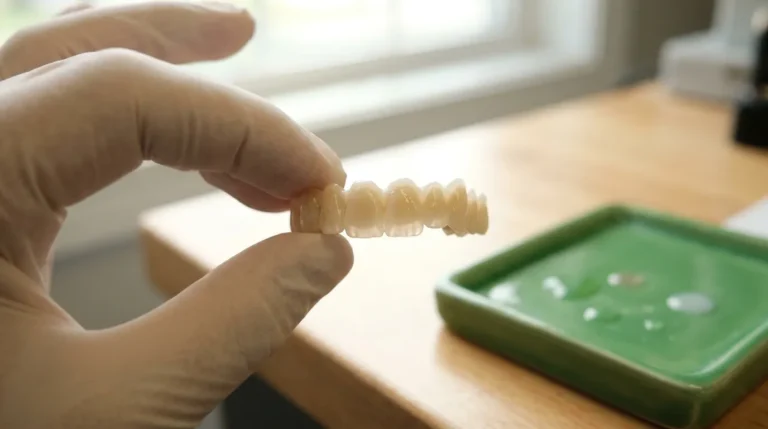
Material choice. PMMA is the standard provisional material because it is cost-effective, reparable, and modifiable chairside. High-density milled monolithic PMMA demonstrates approximately 35% greater fracture resistance than conventionally processed denture resin, which makes a milled or 3D-printed provisional preferable to a chairside-converted denture when the digital workflow supports pre-surgical fabrication. Milled PMMA also reduces the risk of access-hole enlargement weakening the prosthesis, a common cause of provisional fracture.
Fabrication pathway. In-house fabrication serves as a key operational differentiator. When the provisional is designed in exocad and printed or milled before surgery day, conversion becomes a predictable step. When it is fabricated off-site or improvised chairside, the workflow functions as a hybrid regardless of how the practice describes it.
Passive fit verification. Passive fit is defined as a condition in which no stress or strain is exerted on the prosthetic components, implants, or peri-implant bone, though some degree of misfit is inevitable in multiunit prostheses. The one-screw (Sheffield) test and the all-screws test are the standard clinical verification methods. Laboratory scanning of a non-calibrated splinting grammetry system achieved 0% misfit across all prosthesis design–luting protocol combinations in a 2026 Indiana University in vitro study, while intraoral-scanner-only workflows produced variable results. These findings support a photogrammetry-first approach as the accuracy standard for full-arch immediate loading.
Occlusal scheme during healing. The provisional occlusion should be set in bilaterally balanced centric contacts with no eccentric loading. The patient must understand that the provisional functions as a healing appliance and that the soft-food protocol protects the implant-bone interface during osseointegration.
Patient Disqualifiers, Failure Modes, and Real-World Fail Rates
What Disqualifies A Patient From Full Arch Dental Implants
Absolute disqualifiers for immediate loading include active IV bisphosphonate therapy, active cancer treatment, recent cardiac events, immunosuppression post-transplant, active head and neck radiotherapy, and any stage of medication-related osteonecrosis of the jaw. These conditions compromise osseointegration or healing in ways that technique cannot reliably mitigate.
Relative disqualifiers, which may indicate staging rather than immediate loading, include uncontrolled diabetes (HbA1c above 8%), heavy smoking, active or untreated periodontitis, documented bruxism with a natural antagonist dentition, insufficient bone volume for primary stability, poor oral hygiene, and documented non-compliance with dental appointments. Common contraindications for All-on-Four treatment include heavy smoking defined as more than 15 cigarettes per day, pregnancy or lactation, poor patient compliance, and insufficient bone volume preventing adequate implant stabilization.
Why Same Day Dental Implants Fail
The leading causes of early failure in immediately loaded full-arch cases include loss of primary stability, premature or excessive loading, postoperative infection, and poor provisional fit. Postoperative implant infection was independently associated with failure (HR = 6.6) in a 2026 multicentre retrospective study of 1,308 implants, with 21.9% of infected implants failing versus 2.0% without infection. Late failures more often relate to peri-implantitis, fatigue, overload, or corrosion.
Bruxism remains a consistently underestimated risk factor in full-arch cases. The bruxism risk cited in the selection criteria section spans a range of pooled estimates. A 2024 systematic review and meta-analysis reported an odds ratio of 4.68 for implant loss in bruxers, and a 2025 narrative review placed implant-failure risk at roughly 2.2- to 4.7-fold that of non-bruxers. Uncontrolled parafunction during the provisional phase, when osseointegration is incomplete, poses a direct mechanical threat to the implant-bone interface.
Non-compliance with the soft-food protocol and hygiene instructions represents a preventable failure mode. The compliance conversation belongs with the clinician, who sets expectations before surgery and reinforces the link between behavior and implant survival.
What Is the Fail Rate of Full Arch Implants
The evidence base for full-arch immediate loading is heterogeneous, and reported survival rates vary by study design, follow-up duration, and patient population. The five-year survival range cited earlier, 94.5% to 99.6%, holds across the broader literature. Prosthesis survival for All-on-Four concepts ranges from 85.0% to 100% over up to 20 years of follow-up. A 2026 nine-year retrospective series of 852 implants in 192 full-arch immediate-loading rehabilitations reported an overall crude implant failure proportion of 1.64%, with prosthetic complication proportions of 22.6% in the first three-year cohort, 52.4% in the middle cohort, and 9.3% in the final cohort. That trajectory illustrates how protocol standardization and cumulative experience improve outcomes.
Mechanical complications such as screw loosening, provisional fracture, and acrylic chipping occur more frequently than implant loss and should be monitored at every recall appointment. A 2024 three-year full-arch report found mechanical complications in approximately 40% of patients, largely minor and repairable, which shows that high implant survival can coexist with ongoing prosthetic maintenance needs.
Staged Full-Arch Implants Versus Same Day Teeth
Staged full-arch implant treatment, where implants heal conventionally before loading, remains the appropriate choice in several clinical scenarios. When primary stability cannot be confirmed at the time of placement, staging protects the implant during the transition from primary to secondary stability. When bone augmentation occurs simultaneously, the graft must consolidate before load is applied. When systemic risk factors are present but not absolute disqualifiers, staging reduces the biological demand on healing tissues.
Immediate loading is appropriate when the criteria above are met, and the key decision involves what to do when one of those criteria fails at placement. Torque below threshold at a given implant, a simultaneous graft that requires protection, or a borderline systemic finding such as elevated HbA1c can all shift a planned immediate-load case to a staged pathway. The decision is confirmed at the moment of placement when torque and stability are measured.
The FAM Method is built for the immediate-load pathway and includes clear criteria for when to stage. Knowing when to defer loading protects long-term outcomes as effectively as mastering the immediate-load technique.
The Operational Layer: Building a System Around the Protocol
The clinical sequence described above is teachable in a weekend, while building a system that runs it at volume requires a broader framework. Practices that remain at one or two arches a month usually lack consistent team delegation, in-house provisional fabrication, photogrammetry-first digital records, or a trained treatment coordinator. These elements determine whether the protocol runs smoothly without the dentist’s chair time becoming the constraint.
Full Arch Masters teaches the same day teeth full arch protocol as an integrated, photogrammetry-first system through the FAM Method. The curriculum spans five courses. The Flagship Course runs four days and covers the end-to-end FAM Method, including marketing, treatment coordination, and team delegation. The Live Surgical Course adds four days in Parker, CO, where attendees operate on volunteer patients under Colorado Dental Board credentialing. The Design and Finish Course spends four days on exocad design and zirconia finishing, and the FP1 Course devotes two days to the FP1 prosthetic workflow. The Treatment Coordinator Bootcamp closes the set with two days on the in-house closing system, taught by the treatment coordinator who maintains an 80% closing rate.
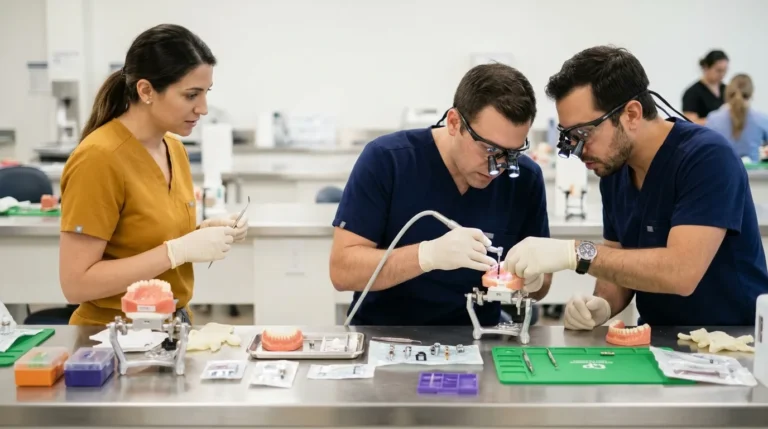
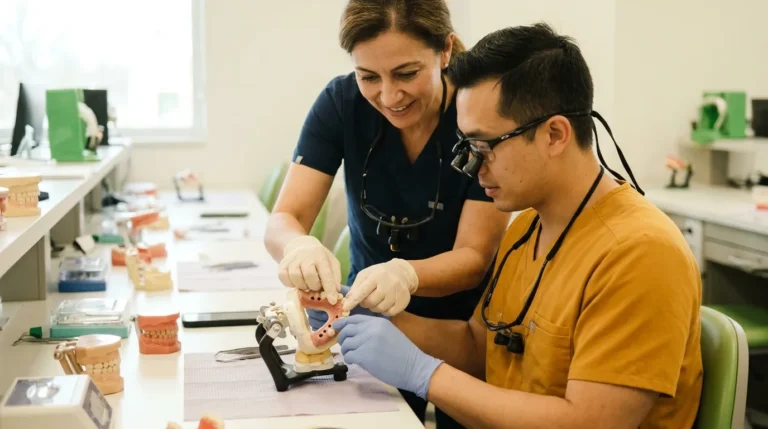
The full-team training model, one team and one workflow, anchors the pedagogy. Most attendees come as a practice owner with their treatment coordinator and lead assistant, or as a dentist with their in-house lab technician, so the entire practice aligns on the same operating system from day one. Alumni report adding $1M+ per year in practice revenue after adopting the workflow, which is FAM’s reported alumni outcome. FAM is an AGD PACE-approved CE provider, and its main courses generally carry 32 credits. Every attendee also joins an alumni community through private group chats, gains access to FAM’s KOL buying group at no recurring cost, and receives a digital resource library covering surgical room setup, finishing techniques, treatment coordinator forms, and consent templates.
FAM shares the complete method and treats the recipe as the differentiator. The value lies in a transparent, repeatable system rather than in guarded secrets.
Train Your Entire Team on the FAM Method
Healing, Diet, and Follow-Up After Same Day Teeth
Once the provisional is seated, the protocol shifts from surgery to healing management, and that phase begins before the patient leaves the chair. The soft-food protocol, which excludes hard, crunchy, or chewy foods for the duration of the provisional phase, functions as a biomechanical requirement. Occlusal forces on a provisional during the first weeks of healing must be controlled to prevent micromotion at the implant-bone interface.
Hygiene instructions should be specific and practical. Water flossing, soft-bristle brushing around abutments, and avoidance of anything that could displace the provisional all support peri-implant tissue health. Tissue quality during the provisional phase directly affects the architecture the final prosthesis inherits.
Reassessment intervals typically occur at two weeks, six weeks, and three months during the provisional phase, with transition to the final zirconia prosthesis at four to six months after confirmed osseointegration. Structured supportive maintenance is associated with an approximately 75% reduction in peri-implantitis incidence, so recall frequency should match the patient’s risk profile.
Post-operative pain management follows a predictable pattern. The anesthesia model, often IV sedation or general anesthesia with a CRNA, keeps most patients free of intraoperative awareness. Post-operative edema and discomfort are managed with a standard analgesic protocol. A 2026 randomized controlled trial found that implants receiving an immediately delivered provisional kept free of occlusal contacts showed significantly lower pain and edema scores than delayed-loading controls at days 1, 3, and 7 post-operatively, though the authors cautioned these differences cannot be attributed to functional immediate loading. These findings suggest that having a fixed provisional in place may reduce post-operative discomfort compared with sending patients home without teeth, provided the anesthesia model and post-operative protocol are managed correctly.
Frequently Asked Questions
How Long Does a Same Day Teeth Full Arch Procedure Take?
Under the FAM Method, the full sequence from patient arrival to a screwed-in same-day provisional typically takes 2 to 4 hours. This timing assumes that pre-surgical digital planning is complete, the provisional is fabricated in advance, and the team is trained on the workflow. Practices running hybrid workflows with off-site lab work and chairside improvisation often require 6 to 8 hours or more and may send patients home without a fixed provisional.
What Insertion Torque and ISQ Thresholds Are Commonly Used for Immediate Loading?
The thresholds covered in the selection criteria section apply here. Most studies use 30 Ncm as a minimum, with 35 Ncm or ISQ 70 per the Italian Consensus and 30–50 Ncm per the AWMF guideline. These values function as study thresholds rather than rigid pass / fail cutoffs, and the clinical decision still integrates torque, ISQ, bone quality, and the overall risk profile. If adequate torque cannot be achieved, the protocol should shift to staged loading.
Can a Patient With Bruxism Be Treated With Same-Day Teeth?
Bruxism represents a significant risk factor but does not automatically exclude treatment. Patients with documented bruxism and a natural antagonist dentition should not receive immediate loading with distal cantilever extensions. For bruxers who are otherwise candidates, the recommended mitigation strategy includes a protective occlusal splint, a conservative cantilever design, preference for six implants over four when anatomy permits, and a staged PMMA provisional followed by a monolithic zirconia definitive prosthesis. Recall intervals should be shortened to three months for these patients.
What Is the Difference Between All-on-4 and All-on-X in a Same-Day Protocol?
All-on-4 describes a specific protocol using four implants, with two anterior axial implants and two posterior tilted at 30–45°, and a 10–14 tooth provisional delivered the same day. All-on-X refers to the broader category of full-arch immediate-loading protocols using a variable number of implants, typically four, five, six, or more, depending on bone volume, anatomy, and biomechanical risk. The clinical sequence remains the same, while implant count and distribution adjust to the individual case. Six-implant designs show marginally higher long-term survival in some studies and are preferred in cases with documented bruxism, severe ridge atrophy, or high biomechanical risk.
How Soon Can a Final Zirconia Prosthesis Be Delivered?
The final zirconia prosthesis is typically delivered at four to six months after implant placement, following confirmed osseointegration. The exact timeline depends on healing, bone quality, and the patient’s risk profile. Delivery before osseointegration is confirmed risks loading a prosthesis on implants that have not achieved secondary stability. The provisional phase shapes peri-implant soft tissue and emergence profiles, which directly influence the final prosthesis design.
What Team Roles Are Required to Run the Protocol at Volume?
Running the same day teeth full arch protocol at volume requires a trained surgical assistant who owns records acquisition and chairside delegation, an in-house lab technician or same-day lab partner who owns provisional fabrication and final design, a treatment coordinator who owns the pipeline and closing conversation, and a dentist who operates. When any of these roles is untrained or undefined, the dentist fills the gap and volume stalls. The FAM Method centers on full-team training so one team runs one workflow.
What Happens if an Implant Fails During Osseointegration?
Early implant failure during osseointegration typically presents as mobility, pain, or radiographic bone loss. Management involves implant removal, thorough socket debridement, and re-evaluation after three to six months of healing. Ridge preservation grafting at the time of removal supports subsequent implant placement. The provisional prosthesis must be modified or remade to eliminate load on the failed site. Replacement implants carry a higher failure risk than first-time placements, and one 2026 multicentre study reported 19.4% failure in replacement implants versus 2.0% in first-time implants, which makes thorough debridement and risk factor control before re-implantation essential.
Conclusion
The same day teeth full arch protocol follows a clear, evidence-based clinical sequence with strong survival data when selection criteria are met. The real challenge lies in building a system of records, delegation, and in-house fabrication that allows the protocol to run consistently at scale. Dentists who invest in that operational layer position their practices to deliver predictable full-arch outcomes and sustainable growth.