
Written by: Ryan Dunlop, CEO and Founder of Full Arch Masters and graduate from the Harvard School of Dental Medicine
Key Takeaways
- Dental team workflow training works when every step of the patient journey is documented, owned, scripted, and rehearsed so the same standard holds regardless of who is in the building.
- The seven-part framework (trigger, owner, steps, handoff, standard, exception, documentation) turns vague principles into repeatable, trainable actions that prevent dropped information and shorten wait times.
- Cross-training is safe only for tasks with a written, verifiable standard; clinical judgment, diagnosis, and treatment presentation stay with licensed clinicians to avoid scope-of-practice risk.
- Structured 15-minute morning huddles, literal handoff scripts, and pre-defined exception paths keep the dentist in the operatory and help the team recover from disruptions without improvisation.
- Full Arch Masters provides a complete operating system and team training when internal documentation alone cannot keep pace with turnover or complex full-arch procedures.
Train Your Team on a Proven Full-Arch Workflow
The Seven-Part Workflow Framework, Applied to a Real Patient Journey
Every trainable workflow step has seven components: trigger, owner, steps, handoff, standard, exception, documentation. Applied to the full patient journey, from new-patient call through follow-up, the framework creates a clear standard for each stage. Most guidance stops at “standardize communication protocols” without defining what done correctly looks like at each step, so there is no standard to train against. The stages below fill that gap.
Stage 1: New-Patient Call
- Trigger: Inbound call from a prospective patient.
- Owner: Front desk.
- Steps: Greet by practice name, gather chief concern, confirm insurance, schedule appointment, send intake forms.
- Handoff: Completed intake record and flagged chief concern passed to the clinical team 24 hours before the appointment.
- Standard: Intake form received and reviewed before the patient arrives, with medical history flagged for alerts.
- Exception: If intake forms are not returned 2 hours before the appointment, front desk calls the patient. If still unreturned, the assistant completes intake chairside and documents the delay.
- Documentation: Appointment notes include chief concern, insurance status, and intake form receipt timestamp.
Stage 2: Patient Arrival and Room Preparation
- Trigger: Patient checks in at the front desk.
- Owner: Front desk notifies assistant; assistant owns room readiness.
- Steps: Front desk confirms identity and insurance, notifies assistant, assistant verifies room setup and imaging order.
- Handoff: Verbal handoff from front desk to assistant with patient name, chief concern, and any flagged medical alerts.
- Standard: Room is set, imaging is queued, and the patient is seated within 5 minutes of check-in.
- Exception: If the previous patient runs long, front desk notifies the waiting patient with a realistic time estimate, and the assistant documents the delay.
- Documentation: Room-ready time logged in the practice management system.
Stage 3: Clinical Examination
- Trigger: Assistant signals room ready to the dentist.
- Owner: Dentist.
- Steps: Review records, conduct examination, document findings, present treatment options.
- Handoff: Verbal handoff from assistant to dentist includes imaging status, chief concern, and any medical alerts read aloud.
- Standard: Dentist enters the room with full records reviewed, not reading the chart for the first time at chairside.
- Exception: If imaging is incomplete, dentist proceeds with available records and assistant completes imaging during the appointment, then documents the sequence.
- Documentation: Clinical findings, treatment presented, and patient response recorded before the patient leaves the chair.
Stage 4: Clinical-to-Front-Desk Checkout Handoff
- Trigger: Dentist completes the appointment and signals checkout.
- Owner: Dentist initiates; front desk owns the financial conversation.
- Steps: Dentist introduces the front desk team member by name in the operatory, restates the recommended treatment using the same clinical language, and sets the expectation that the patient will schedule before leaving.
- Handoff: Verbal handoff from clinical to front desk with treatment priority, fee, and any financing flag.
- Standard: Front desk team member is present in the operatory before the dentist leaves, and the patient is not sent alone to find the desk.
- Exception: If front desk is occupied, dentist waits or sends the assistant to hold the patient in the operatory, then documents the delay.
- Documentation: Treatment presented, fee quoted, appointment scheduled or declined, and reason documented.
Stage 5: Scheduling and Follow-Up
- Trigger: Patient departs without scheduling or with an open treatment plan.
- Owner: Treatment coordinator.
- Steps: Log unscheduled treatment, initiate follow-up at 48 hours, 2 weeks, and 30 days.
- Handoff: Treatment coordinator receives the unscheduled treatment flag from front desk at end of day.
- Standard: Every unscheduled treatment item has a follow-up date assigned before the end of the clinical day.
- Exception: If the patient explicitly declines follow-up, document the refusal and set a 90-day reactivation flag.
- Documentation: Follow-up log updated with contact attempts, patient responses, and next action date.
The Literal Handoff Scripts Your Team Can Copy Today
The framework above defines what each handoff must accomplish. These scripts show what that sounds like in the moment and give the office manager templates they can copy, paste, and adapt. Each one defines what “done correctly” sounds like at the moment of transfer.
Front Desk to Assistant (New Patient Arrival)
- “Mrs. Alvarez is here for her 9:00 new patient exam. Records are ready, medical history is flagged for a penicillin allergy, and she listed a broken upper left molar as her chief concern.”
Assistant to Dentist (Room Ready)
- “Room two is set, patient is seated, full-mouth series and a PA of the upper left are complete, and her chief concern is the broken molar she’s been avoiding chewing on.”
Clinical to Front Desk (Checkout)
- “Dr. Patel presented a crown on tooth 14 and a night guard. The crown is the priority, she wants to schedule before she leaves, and she’ll need a financial conversation on the $1,450.”
End-of-Day Handoff to Tomorrow’s Team
- “Tomorrow’s first patient is a new implant consult at 8:00. CBCT is ordered but not taken, and the TC needs the room for 30 minutes after.”
Each script follows the same architecture: patient name, appointment context, clinical flag, and the single most important next action. The front desk team member who receives the handoff should be able to act without asking a follow-up question. If they need to ask, the script needs another line.
Dental Team Cross-Training Boundaries That Protect Scope of Practice
Cross-training supports dental workflow SOPs when it respects clinical boundaries. The line between safe overlap and scope-of-practice risk comes from whether the task requires clinical judgment or only trained execution against a written standard.
The dividing line is whether the task requires clinical judgment or only trained execution against a written standard. The lists below show where that line usually falls in a typical practice.
Duties safe to overlap:
- Sterilization and operatory turnover
- Phone protocols and scheduling language
- Check-in and insurance verification
- Supply and inventory tasks
- Records acquisition support
Duties to never overlap:
- Clinical judgment
- Medical-history interpretation
- Treatment presentation and diagnosis
- Anesthesia and surgical decision-making
A trained assistant can own the sterilization cycle because the standard is written, verifiable, and does not require a license to execute. CDC dental infection-control guidance requires that instruments be cleaned and reprocessed per manufacturer instructions by appropriately trained personnel, and that training occur at orientation, when new procedures are introduced, and at least annually. No administrative team member can own medical-history interpretation because it requires clinical licensure and judgment that no SOP can replace.
The practical test is simple. If the task has a written standard that a new hire can be trained against and a supervisor can verify, it is safe to cross-train. If the task requires the team member to make a clinical call, it stays with the licensed clinician.
The 15-Minute Morning Huddle Agenda That Changes the Day
Once the team knows what to hand off and what to cross-train, the huddle becomes the place where the day’s plan gets aligned. Practice by Numbers and the Scheduling Institute both recommend a roughly 10-minute standing huddle led by a single consistent owner. The following agenda uses 15 minutes and keeps the focus on assigning owners rather than solving problems in the huddle.
The huddle is run by the office manager or a designated lead. The dentist participates briefly. The agenda runs in this order, with these owners:
- Minutes 0–2: Facilitator opens, and front desk confirms new patients and their chief concerns.
- Minutes 2–5: Clinical lead flags complex or high-value procedures on the schedule.
- Minutes 5–8: Assistant reads medical alerts and premedication requirements aloud.
- Minutes 8–11: Front desk surfaces same-day opportunities and open chair time.
- Minutes 11–13: Team reviews staffing gaps and equipment or lab issues.
- Minutes 13–15: One owner is assigned to each problem. The work happens after the huddle, not during it.
The team writes down the owner and the action for every problem surfaced. A shared document with three columns, Action Item, Owner, and Due Date, reviewed at the start of the next huddle, is sufficient. Sunrise Dental Solutions reports that a dental practice implementing this structure saw no-shows drop 40% within 30 days. A practice that knows it is behind its daily production target at 8:15 a.m. has a window to recover. A practice that discovers the shortfall at 4:00 p.m. has no time left.
The Exception Path: What the Team Does When the Workflow Breaks
Even a well-run huddle cannot prevent every disruption. This is where practices lose margin, because no one defined who owns the recovery when the workflow breaks. For each scenario below, the owner, the patient communication, the scheduling decision, and the documentation requirement are defined.
- Patient arrives late: The front desk owns recovery. If the schedule allows, absorb the patient; if it does not, reschedule. Either way, document the arrival time and the decision so the pattern is visible over time.
- Medical alert surfaces at chairside: The dentist owns the pause. The assistant documents the alert and any premedication given, and the front desk notifies the next patient of a potential delay.
- Equipment goes down mid-procedure: The lead assistant owns the workaround. The dentist explains the delay to the patient directly, and the front desk documents the downtime in the equipment log.
- A case runs long and backs up the schedule: The office manager owns the triage. Front desk calls the next patient with a realistic time and documents which appointments moved and why.
- A key team member calls out: The office manager reassigns by cross-training boundary, only to duties the covering team member is trained and licensed to perform, and documents the coverage plan.
- A lab case does not arrive: The treatment coordinator owns the patient conversation. The team reschedules rather than seats an incomplete case and documents the lab communication and the rescheduling reason.
The exception path is part of the workflow, not a failure of it. A team that has rehearsed these scenarios in training handles them without pulling the dentist out of the operatory to make a call that the office manager could have made.
Training the Team on the Digital Workflow Without Pulling the Dentist Out of the Operatory
The delegation model for digital workflow steps follows the same logic as cross-training. The dentist owns clinical judgment, and trained staff own execution against a written standard. For intraoral scanning, CBCT acquisition, photogrammetry, and immediate-load printing, the following ownership model applies.
Steps a trained assistant or lab technician can own:
- Intraoral scan capture, file review for completeness, and upload
- CBCT positioning, exposure, and post-scan image routing
- Photogrammetry setup and scan body seating verification
- 3D-printed conversion preparation and post-processing
- Scanner tip sterilization and equipment maintenance per manufacturer instructions
Steps that require the dentist:
- CBCT interpretation and treatment planning
- Scan approval for margin accuracy and case submission
- Photogrammetry verification against the surgical plan
- Immediate-load occlusal verification at delivery
The sequence for training new staff on digital steps starts with a documented SOP for each step. New team members run practice scans on a typodont before live patients, then shadow a proficient operator for a defined number of patient scans. The practice then tracks rescan rate for the first 30 patient scans before signing off on independent operation. A weekly rescan rate above 10–15% signals a technique or protocol problem, not a hardware problem, and that distinction guides training decisions.
For sterilization and infection-control workflow training on digital equipment, the same CDC requirements apply as in the cross-training section. Instruments must be cleaned and reprocessed per manufacturer instructions by trained personnel, with training repeated at orientation, when procedures change, and at least annually. OSHA’s Bloodborne Pathogens Standard (29 CFR 1910.1030) independently requires annual bloodborne pathogens training for any employee who could reasonably be expected to contact blood or other potentially infectious materials.
Scanner tips and handpieces must be cleaned, disinfected, or sterilized according to the manufacturer’s validated instructions. This is not optional, and it should not fall to the dentist to re-teach every new hire. The protocol belongs in the written SOP and the onboarding checklist.
Biological monitoring of sterilizers should be conducted at least weekly using a matching control, and for every load containing an implantable device. A failed spore test requires removing the sterilizer from service, reviewing loading procedures and cycle parameters, retesting after corrective action, and documenting the failure, corrective steps, and retest result. That protocol belongs in the written SOP, not in the senior assistant’s memory.
The 30-Day Rollout Calendar and Half-Day Training Agenda
Once the standards and scripts are defined, the practice needs a concrete rollout plan. The following calendar gives the office manager a week-by-week structure for building and launching a dental workflow SOP system from scratch.
- Week One: Document the current workflow and name a single owner for every step. Walk the patient journey from new-patient call through follow-up. Write down what actually happens rather than what is supposed to happen.
- Week Two: Write the scripts and the standards. Define what “done correctly” looks like for every handoff, and draft the exception paths for the six most common workflow breaks.
- Week Three: Run the half-day training session. Role-play every handoff script, practice the huddle agenda, run exception-path scenarios, and collect competency sign-offs.
- Week Four: Run live with daily debriefs. Refine the exception paths as they surface, update the SOPs in real time, and hold a 10-minute debrief at the end of each day for the first week of live operation.
The half-day training agenda:
- 8:00–9:00: Workflow walkthrough, covering every step of the patient journey using the seven-part framework.
- 9:00–10:30: Handoff script role-play, where every team member practices every script in their role, then rotates.
- 10:30–11:15: Huddle practice, running a live mock huddle using tomorrow’s actual schedule.
- 11:15–12:00: Exception-path scenarios, running the six exception scenarios and assigning owners in real time.
- 12:00–12:30: Competency sign-off, where each team member signs off on the steps they own, and gaps are documented and assigned a follow-up date.
Measuring Success: What To Track and When
The office manager needs objective indicators rather than impressions. The following metrics are trackable with tools already in the practice, such as a shared log, a weekly case review, and a monthly team debrief.
- Handoff errors: Track the number of times a handoff required a follow-up question or a correction. The target is a steady decline week over week in the first month, which shows that scripts and training are taking hold.
- Patient wait time: Track time from check-in to seating. A well-run handoff system reduces this without adding staff, which improves patient experience and chair-time use.
- Same-day case acceptance: Track the percentage of treatment presented that is scheduled before the patient leaves. Practices implementing structured verbal handoffs report case acceptance rising from 40% to 65% or higher within 90 days. This connects the new workflow directly to revenue.
- Chair-time utilization: Track production per clinical hour by provider. A well-structured schedule can increase production by 15–20% without adding clinical hours. This shows whether the workflow is turning time into production.
- Remake rate: Track lab remakes and rescan rates by case type. As noted in the digital workflow section, a rescan rate above 10–15% signals a protocol problem and points to a training need.
- New-hire time to competency: Track the number of days from hire to independent operation on core duties. Structured onboarding reduces early turnover by 50% and accelerates time to full productivity.
- Huddle consistency: Track the percentage of clinical days that begin with a completed huddle. A huddle that runs fewer than 4 days per week functions as an intention rather than a system.
Progress shows up in stages. In weeks one through four, the signal is consistency, with the same steps, scripts, and huddle structure every day. In months two through three, the signal is measurable improvement in the metrics above. In month six and beyond, the signal is that new hires reach competency without the dentist re-teaching the same steps.
Build Your Own vs. Buying a Course
The decision between building internally and buying a course comes down to whether the internal team has a standard to train against. Building internally works when the practice has a stable team, a single location, and a workflow that is mostly working, with gaps in documentation and handoff language rather than in the underlying system. The 30-day rollout calendar above is designed for that scenario.
Outside training fits better when the operating system itself is undefined. That includes situations where the workflow is unclear, the team is turning over faster than SOPs can be written, or the procedure is complex enough that the internal team has no reference standard to train against.
For practices whose bottleneck is the full operating system around full-arch dentistry, Full Arch Masters is the relevant solution. The FAM Method, FAM’s proprietary digital workflow, is taught as one team and one workflow, with the dentist, lead assistant, treatment coordinator, and in-house lab technician trained together on the same playbook. The practice leaves aligned rather than with a theory to implement alone.
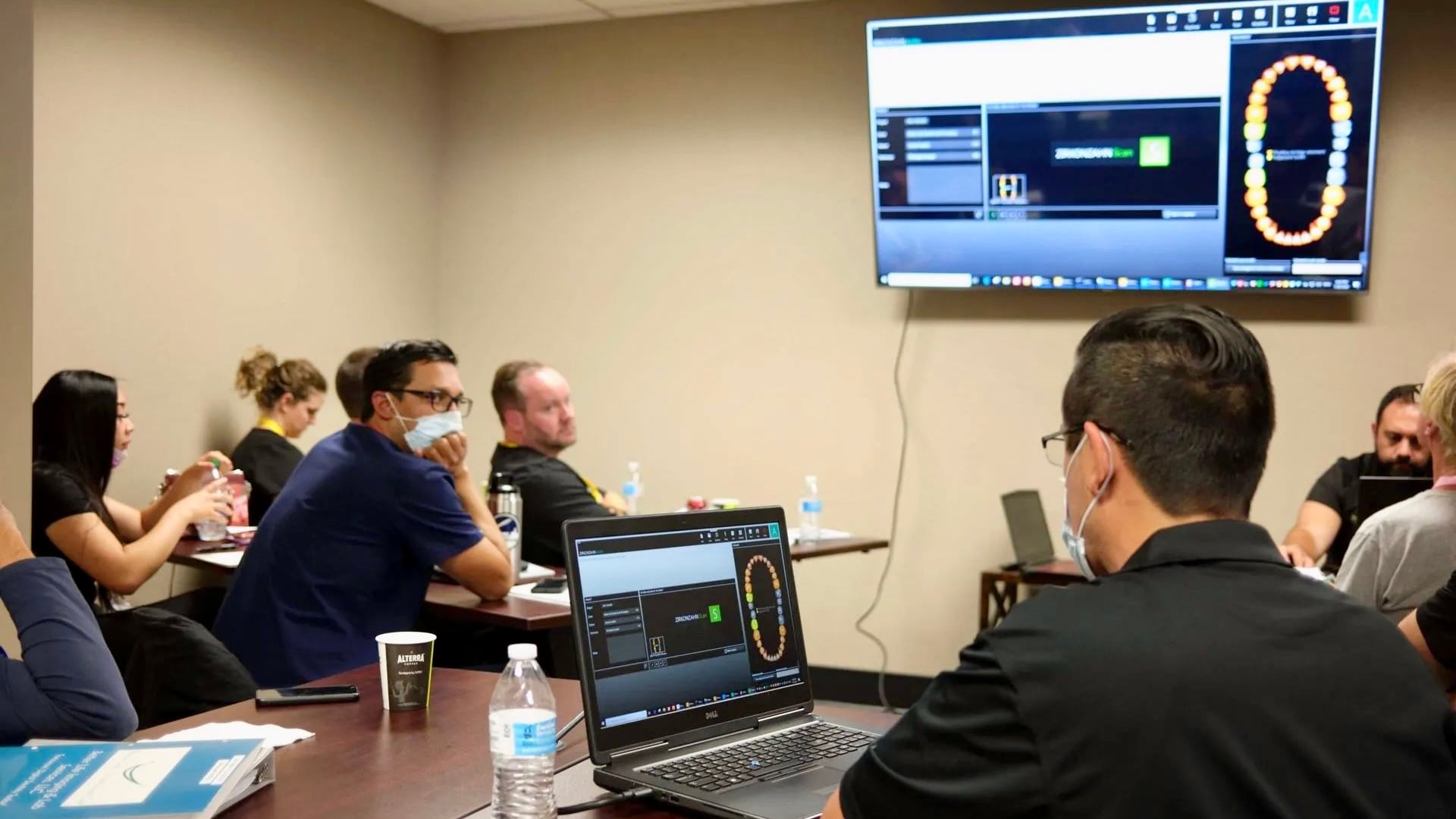
FAM’s continued community of hundreds of FAM-trained dentists and lab technicians provides case help on demand via private group chats, and the KOL (Key Opinion Leader) buying group secures vendor discounts at no recurring cost. FAM’s courses provide 32 continuing education credits through AGD PACE approval, per course.
Alumni report adding $1M+ per year in practice revenue after adopting the FAM Method. This is presented as FAM’s reported alumni outcome, not a peer-reviewed industry statistic.
Frequently Asked Questions
How Long Does It Take To Train a Team on a New Workflow?
A core workflow SOP library covering the five highest-priority steps, intake, handoffs, huddle, exception paths, and digital steps, typically takes four to six weeks to document and launch. A new hire trained against a written standard with a designated trainer reaches independent operation on core chairside duties within 90 days. Full progression to lead-level responsibilities takes nine to twelve months. The variable is not the training content, it is whether the standard is written down and whether someone other than the dentist owns the day-to-day training.
Does Cross-Training Risk Scope-of-Practice Issues?
Scope-of-practice risk appears only when cross-training crosses into clinical judgment. Tasks with a written, verifiable standard, such as sterilization, phone protocols, check-in, scanning capture, and CBCT positioning, are safe to cross-train because the standard defines done correctly and a supervisor can verify it. Tasks that require clinical licensure, such as medical-history interpretation, treatment presentation, diagnosis, and anesthesia decisions, stay with the licensed clinician regardless of how experienced the cross-trained team member is.
The practical test is whether the task requires a judgment call or only trained execution against a written procedure. State dental practice acts define the legal boundaries for expanded-duty functions, and the office manager should verify those boundaries before assigning cross-trained duties.
How Do You Train New Hires Against the Workflow Without the Dentist Re-Teaching?
A designated trainer who is not the dentist, working from written checklists, solves this. The practice’s strongest assistant or lead team member takes the trainer role formally, ideally with compensation for that responsibility, and uses the per-step SOPs as both the training document and the accountability document. The dentist sets the standard and reviews milestones at 30, 60, and 90 days. Day-to-day training belongs to the designated trainer.
Chairside correction from the dentist becomes the exception rather than the primary training mechanism. When the standard lives in a written document rather than in a person’s memory, staff turnover stops resetting the practice to zero.
What Does the Team Do When the Workflow Breaks Mid-Day?
The exception path is pre-assigned rather than improvised. For each of the six most common workflow breaks, late patient, chairside medical alert, equipment failure, case running long, staff call-out, and missing lab case, the owner, the patient communication, the scheduling decision, and the documentation requirement are defined in advance.
The office manager owns triage for schedule disruptions. The dentist owns clinical pauses. The lead assistant owns equipment workarounds. The treatment coordinator owns lab case conversations. None of these decisions require the dentist to leave the operatory if the exception path is written and the team has rehearsed it. The half-day training session includes exception-path scenarios for exactly this reason.
How Do You Train the Team on Intraoral Scanning and CBCT Without Pulling the Dentist Out of the Operatory?
A phased delegation model with a written SOP for each step keeps the dentist in the operatory. Trained assistants can own scan capture, file review for completeness, upload, CBCT positioning, and post-scan image routing, while the dentist reviews and approves the output rather than the process.
The training sequence follows the phased delegation model described earlier. The team documents the SOP, practices on a typodont, shadows a proficient operator, then tracks rescan rate for the first 30 patient scans before signing off. A rescan rate above 10–15% signals a technique or protocol problem and triggers a training review rather than a hardware conversation. Scanner tips and handpieces must be sterilized per the manufacturer’s validated instructions, and that protocol belongs in the written SOP and the onboarding checklist.
How Often Must Infection-Control and Sterilization Training Be Repeated?
CDC dental infection-control guidance requires training at orientation, when new procedures or equipment are introduced, when job responsibilities change, and at least annually. OSHA’s Bloodborne Pathogens Standard independently requires annual bloodborne pathogens training for any employee with potential exposure to blood or other potentially infectious materials.
Biological monitoring of sterilizers should be conducted at least weekly using a matching control, and for every load containing an implantable device. A failed spore test requires removing the sterilizer from service, correcting the cause, retesting, and documenting the full sequence. Training records must be retained for at least three years under OSHA requirements. The practical floor is orientation, annually, and any time the procedure, equipment, or team member’s role changes.
When Should a Practice Build Internally vs. Bring In Outside Training?
Build internally when the team is stable, the workflow is mostly working, and the gaps are in documentation and handoff language. The 30-day rollout calendar in this article is designed for that scenario. Bring in outside training when the operating system itself is undefined, when the procedure being trained is complex enough that the internal team has no reference standard to train against, when turnover is outpacing the ability to document, or when the practice is adding a high-complexity procedure like full-arch implant restoration that requires the dentist, assistant, treatment coordinator, and lab technician to operate as a coordinated unit from day one.
The distinction is whether the internal team has a standard to train against, not the cost. If they do not, building internally produces a slower, more expensive version of the same problem.
Conclusion: Start With Week One
The problem is the absence of a trainable standard, not the team. Every step of the patient journey, from the new-patient call through the checkout handoff, can be documented, owned, scripted, and rehearsed. When that happens, new hires reach competency faster, handoffs stop dropping information, the dentist stays in the operatory, and the workflow runs the same way regardless of who is in the building.
The seven-part framework, the literal handoff scripts, the 15-minute huddle agenda, the exception path, and the 30-day rollout calendar in this article give the team something real to train against. Week one starts with documenting the current workflow and naming a single owner for every step. That is the only task for week one.
If your practice is also working to close more full-arch cases once the workflow is running, the Full Arch Masters Treatment Coordinator Bootcamp trains practice teams on the closing system, objection handling, and patient financing conversations that convert high-ticket consultations into scheduled cases.
Train Your Team to Close More Full-Arch Cases