
Written by: Ryan Dunlop, CEO and Founder of Full Arch Masters and graduate from the Harvard School of Dental Medicine
Key Takeaways
- Generic dental-assistant onboarding fails high-volume full-arch practices because it lacks defined roles for photogrammetry, intraoral scanning, and immediate-load conversion.
- The FAM 6-week onboarding system provides a repeatable timeline and exact delegation checkpoints that free the dentist from non-billable chair time.
- Assistants must master seven core skills, including records acquisition, photogrammetry, CBCT coordination, exocad review, immediate-load prep, final zirconia staging, and team huddles, to support five arches weekly.
- Structured onboarding improves retention by 82% and productivity by over 70%, while daily 5-minute huddles eliminate workflow chaos that drives assistants to quit.
- Full Arch Masters delivers the complete FAM Method training and team-huddle retention system. Register for an upcoming course to implement the workflow with your lead assistant.
What Effective Dental Assistant Training for Full-Arch Cases Delivers
Effective full-arch assistant training is a structured, milestone-driven process designed to free the dentist from non-billable chair time. The key is delegation: when an assistant can independently handle photogrammetry, intraoral scanning, CBCT coordination, immediate-load conversion support, and same-day delivery prep, one dentist can run five or more arches per week. This approach is fundamentally different from a general orientation program, which teaches basic chairside skills but leaves the dentist executing every digital workflow step.
7 Essential Skills Every Full-Arch Assistant Must Master
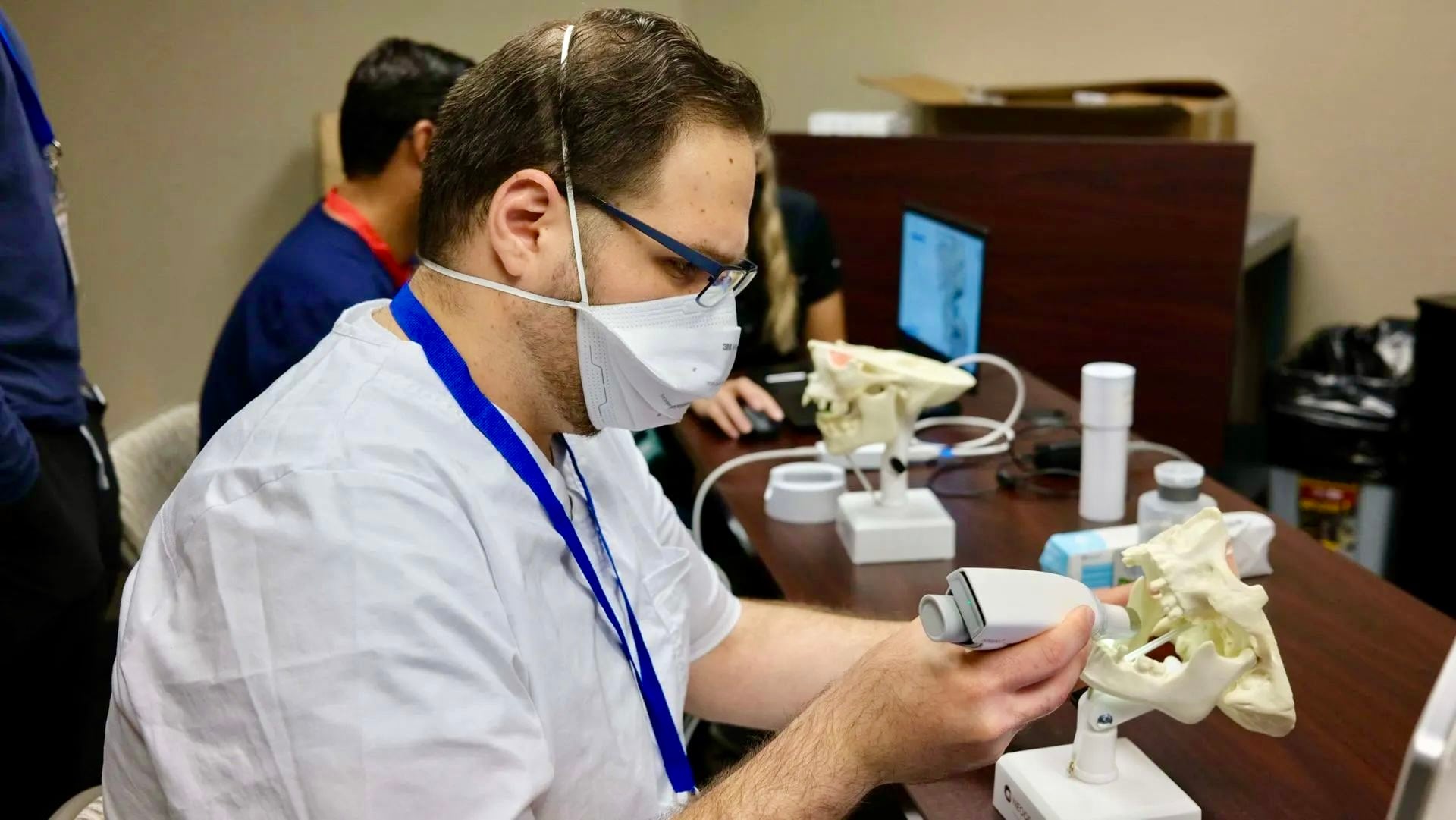
Effective full-arch assistant training focuses on seven core workflow steps that enable delegation without compromising clinical outcomes. The FAM Method maps each skill to a specific workflow step so assistants see exactly where they fit in the digital sequence from records acquisition through final delivery.
- Preoperative records acquisition (photos, facial scan, bite registration) for complete preoperative data
- Intraoral scanning protocol execution for accurate digital impressions
- Photogrammetry setup and scan-body verification for precise implant position capture
- CBCT positioning and data export for reliable digital treatment planning
- Immediate-load conversion prep and delivery coordination for same-day function
- Final zirconia case staging and finishing support for predictable final delivery
- Team huddle facilitation and workflow documentation for scalable, repeatable systems
Register for an upcoming Full Arch Masters course and bring your lead assistant through the complete FAM Method alongside you.
Week 1: Preoperative Records and Data Acquisition Ownership
Week 1 establishes the assistant’s ownership of the records workflow before any surgical exposure. The goal is a complete preoperative data set, including facial photographs, extraoral and intraoral photographs, bite registrations, and facial scan acquisition, ready before the dentist enters the surgical appointment. The dentist walks into surgery with a complete file instead of assembling records chairside.
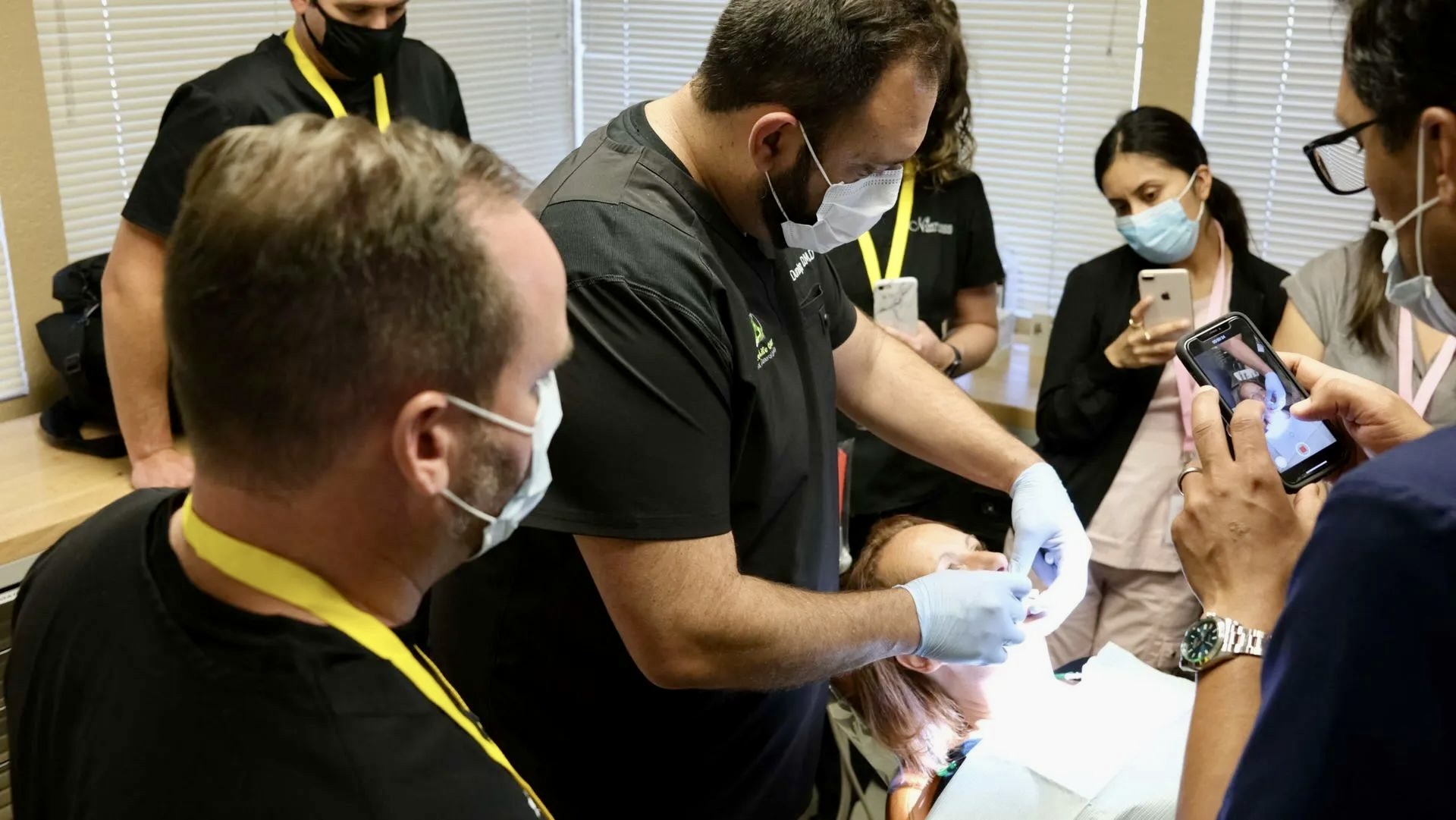
A 2026 study published in Diagnostics (Basel) by Yu et al. examined how maneuverability constraints affect intraoral scanner performance and accuracy. Week 1 builds repetition on models first so the assistant develops scanner control before working with live patients.
Week 1 checklist:
- Complete HIPAA privacy and security training and OSHA bloodborne pathogen certification
- Review FAM preoperative records protocol and digital resource library
- Practice facial scan acquisition on a team member or typodont
- Shadow two full preoperative records appointments
- Document the records checklist in the practice’s written procedure book
Week 2: Photogrammetry and Intraoral Scanning Competency
Week 2 turns photogrammetry into the accuracy anchor of the FAM Method. Once trained, the assistant can own scan-body placement verification, iCam setup, and data export, which removes a 20 to 40 minute per-arch task from the dentist’s schedule. That shift protects accuracy while reclaiming chair time.
The 2026 Diagnostics (Basel) study by Yu et al. showed that accuracy holds when the scan is executed correctly, even with maneuverability constraints. Training quality, not the scanner itself, becomes the main variable, so Week 2 focuses on repetition and verification.
Week 2 checklist:
- Complete iCam photogrammetry setup and calibration protocol on bench models
- Execute full-arch intraoral scans on a typodont and team member under mentor observation
- Practice scan-body seating verification and angular deviation checks
- Export and label scan files using the FAM naming convention
- Achieve two consecutive scans within acceptable trueness thresholds before advancing
Week 3: CBCT Positioning and Digital Data Delivery
Week 3 trains the assistant to manage CBCT positioning, protocol execution, and data export so the dentist can move straight into treatment planning. Interpretation remains the dentist’s responsibility and sits outside the scope of any dental assistant under state dental board regulations governing expanded functions. A complete, correctly labeled CBCT dataset prevents repeat scans and wasted time.
Week 3 checklist:
- Review CBCT positioning protocol and field-of-view settings for full-arch cases
- Practice patient positioning for maxillary and mandibular full-arch acquisitions
- Export DICOM files and import them into treatment planning software per FAM protocol
- Confirm the data quality checklist before releasing the file to the dentist for planning
- Shadow one live CBCT acquisition and one treatment planning session
Register for an upcoming Full Arch Masters course to train your assistant and your full team on the same workflow in four days.
Week 4: exocad Output and Immediate-Load Conversion Coordination
Week 4 focuses on the assistant’s role in interpreting exocad output and coordinating the immediate-load conversion. The assistant does not design the prosthetic in exocad, which remains the lab technician’s domain. Instead, the assistant confirms that the printed provisional matches the approved design, stages the conversion prosthetic for delivery, and manages the chairside handoff between surgical and prosthetic phases.
Week 4 checklist:
- Review exocad immediate-load prosthetic output parameters with the lab technician
- Learn the conversion prosthetic quality-check protocol, including fit, occlusion, and screw-access confirmation
- Stage the immediate-load delivery tray using the FAM room-setup checklist
- Practice the surgical-to-prosthetic handoff sequence on a model case
- Document the immediate-load conversion checklist in the practice procedure book
Week 5: Final Zirconia Delivery and FP1 Workflow Coordination
Week 5 shifts the assistant’s focus to final restoration handoff and FP1-specific workflow. For practices running FP1 cases, which are higher-margin and more aesthetic and covered in the FAM FP1 Course, the assistant must understand how FP1 design differs from FP2 and FP3 workflows. That clarity keeps case coordination intact at the lab-to-chair transition.
Week 5 checklist:
- Review final zirconia delivery protocol and screw-torque sequence
- Learn FP1 versus FP2 and FP3 case-staging differences for delivery appointment preparation
- Confirm the final restoration quality-check protocol with the lab technician
- Practice the patient communication script for the final delivery appointment
- Complete one full simulated final delivery from lab receipt to patient seating
Week 6: Team Implementation and Workflow Scaling Systems
Week 6 turns the assistant from learner into operator. The assistant runs the full preoperative-to-delivery sequence while the dentist observes instead of directing. The week also introduces the daily 5-minute huddle as a permanent habit that keeps the workflow scaling without the dentist becoming the bottleneck.
Week 6 checklist:
- Run one complete full-arch case from records acquisition through delivery coordination independently
- Facilitate the daily 5-minute morning huddle using the FAM huddle template
- Identify one workflow bottleneck and document a proposed solution
- Complete the FAM onboarding competency assessment with the lead dentist
- Set 30-day and 60-day performance targets with the practice owner
Completing the 6-week onboarding system strengthens both clinical execution and team structure, which directly supports long-term assistant retention.
Why Dental Assistants Quit and How the FAM Team-Huddle System Helps Them Stay
The DentalPost 2026 Dental Salary Survey Report found that nearly 50% of dental assistants are considering leaving their current roles within two years, with job satisfaction falling for assistants while rising for other dental roles. The analysis pointed to structural workflow chaos, including too many hats, disorganized schedules, and undefined role boundaries, rather than pay, as the primary driver.
Brandon Hall Group research cited in healthcare onboarding literature reported that structured onboarding improves new-hire retention by 82% and productivity by more than 70%. The FAM 6-week system supports those gains by giving assistants a defined role from day one and a daily feedback loop that prevents the drift that often precedes resignation.
The FAM team-huddle model runs for five minutes each morning and is led by the assistant, not the dentist. An effective daily huddle led by a team leader reviews the day’s schedule for bottlenecks, flags special patient needs, confirms lab cases and supplies, reviews yesterday’s wins and misses, and assigns daily roles. That structure gives the assistant visible ownership and a clear link between their competence and the practice’s output.
Dental practices that build peer-to-peer recognition into daily huddles and weekly team recaps increase visibility of behind-the-scenes work by assistants, which strengthens retention in high-pressure clinical environments. The FAM huddle template includes a brief recognition moment that highlights one specific action from the prior day that moved a case forward, because dental practices that implement frequent, specific feedback conversations keep teams more engaged and reduce surprise departures compared to relying on annual reviews alone.
Register for an upcoming Full Arch Masters course and implement the complete FAM team-huddle retention system alongside the clinical workflow.
Frequently Asked Questions
How long does it take an assistant to become competent in photogrammetry?
Most assistants reach consistent, clinically acceptable photogrammetry execution within two to three weeks of structured daily practice on models followed by supervised live-patient scans. The FAM 6-week system dedicates Week 2 specifically to photogrammetry and intraoral scanning, with a competency threshold of two consecutive scans within acceptable trueness parameters required before the assistant advances. Speed improves with repetition, while accuracy is established first.
What tasks can a dental assistant legally perform in full-arch cases by state?
Scope of practice for dental assistants varies significantly by state. Tasks such as intraoral scanning, photogrammetry setup, CBCT positioning, and records acquisition are generally delegable to trained assistants in most states, while irreversible procedures, diagnosis, and treatment planning remain exclusively with the licensed dentist. States including California, Oregon, Iowa, and Washington maintain distinct licensure tiers, such as registered dental assistant and expanded function dental auxiliary, with specific approved task lists. Practices should verify current scope-of-practice rules with their state dental board before delegating any clinical task. The DANB and individual state dental board websites provide the most current requirements.
Can one assistant support five arches per week after 30 days?
Thirty days is usually enough time for an assistant to become competent in records acquisition and scanning protocols. Supporting five arches per week, however, requires ownership of the full preoperative-to-delivery coordination sequence, which the FAM system targets at the Week 6 milestone rather than Day 30. Practices that try to scale volume before the assistant completes the full 6-week sequence often see the dentist reabsorbing delegated tasks under pressure. A realistic timeline for one assistant to support five arches per week is 6 to 8 weeks from the start of structured onboarding, assuming daily case exposure.
How does the FAM Method differ from generic dental-assistant training?
Generic dental-assistant training covers HIPAA, OSHA, basic chairside assisting, and instrument transfer but does not address photogrammetry, immediate-load conversion coordination, exocad output review, or same-day delivery staging. The FAM Method delivers an end-to-end digital workflow that integrates intraoral scanning, photogrammetry, CBCT, exocad design, 3D-printed immediate-load conversion, and same-day final delivery as a single repeatable system. The FAM 6-week onboarding system maps each step of that workflow to a specific training week with defined competency checkpoints so the assistant’s role stays clear. Generic programs do not provide a photogrammetry delegation protocol, an immediate-load conversion checklist, or a team-huddle retention system calibrated to full-arch volume.
What is the typical timeline to scale from one to five arches weekly?
The FAM Method is built to support five or more arches per week with one dentist and one trained assistant. The actual scaling timeline depends on how quickly the assistant completes the 6-week onboarding system, how consistently the practice runs cases during that period, and whether the treatment coordination pipeline generates enough case volume. Practices that attend Full Arch Masters as a full team, including dentist, lead assistant, and treatment coordinator, and implement the FAM workflow on return typically reach five arches per week within 60 to 90 days. Practices that send only the dentist and onboard the team later usually take longer because workflow alignment starts later.
Does the 6-week system require prior implant experience?
No prior implant experience is required for the assistant. The FAM 6-week system builds from foundational records acquisition in Week 1 through full workflow ownership in Week 6, with each week’s tasks calibrated to the assistant’s developing competency. Assistants with prior implant exposure often move through the early weeks faster, while assistants new to implant dentistry benefit from the explicit milestone structure that prevents advancement before competency is confirmed. The dentist’s experience level is a separate factor, and Full Arch Masters’ Flagship Course serves dentists placing their first full arch as well as surgeons with hundreds of cases.
How do daily 5-minute huddles improve retention?
Daily huddles improve retention by removing the structural chaos that drives assistants to leave. When an assistant knows the day’s schedule, their specific role, which lab cases are confirmed, and what went well or poorly the day before, the cognitive load of the workday drops significantly. The DentalPost 2026 survey identified disorganized and chaotic workflows, rather than pay, as the primary driver of assistant turnover. A 5-minute huddle run by the assistant also signals role ownership, because the assistant runs a system they understand and control instead of simply executing tasks handed down from above.
What regulatory scope-of-practice limits apply to same-day delivery assistance?
Same-day delivery assistance in full-arch cases includes tasks that span a wide scope-of-practice spectrum. Staging the delivery tray, confirming screw-access alignment, and coordinating the lab-to-chair handoff are generally delegable to trained assistants in most states. Torquing implant-retained prosthetics, adjusting occlusion, and any intraoral irreversible procedure remain restricted to the licensed dentist in all U.S. jurisdictions. States with expanded function dental auxiliary designations, including Iowa, Oregon, Washington, and California, may permit additional delegated tasks to credentialed assistants, but each state defines its own approved task list. Practices must consult their state dental board and, when applicable, DANB certification requirements before assigning any same-day delivery task to an assistant.
Conclusion: Build the Team That Runs Five Arches a Week
The main constraint on full-arch volume in most practices is not patient demand or the dentist’s clinical skill. The real constraint is the absence of a trained assistant who can own the digital workflow steps that currently consume the dentist’s chair time. The FAM 6-week onboarding system, built around the seven steps of the FAM Method, structured weekly milestones, and a daily team-huddle retention mechanism, gives practices a repeatable process to close that gap.
The 82% retention improvement and 70% productivity gain documented earlier highlight the measurable difference between ad-hoc training and a structured milestone system like the FAM Method. A trained assistant running photogrammetry, intraoral scanning, CBCT coordination, and immediate-load conversion prep becomes the operational infrastructure that makes five arches per week realistic for one dentist. The FAM Method provides the workflow, the 6-week system provides the training path, and the team-huddle system keeps the assistant in the practice long enough for that investment to compound.
Full Arch Masters is the only program that delivers all three as an integrated system. Register for an upcoming Full Arch Masters course and bring your lead assistant through the complete FAM Method so your team runs one unified workflow from day one.