Written by: Ryan Dunlop, CEO and Founder of Full Arch Masters and graduate from the Harvard School of Dental Medicine
Key Takeaways
-
Effective full-arch training relies on a connected seven-step digital workflow (the FAM Method), not isolated techniques.
-
Beginners need structured training in preoperative records, photogrammetry, CBCT planning, and exocad design before live surgery.
-
Intermediate practitioners gain throughput by bringing exocad design, immediate-load conversion, and same-day zirconia into one in-house system.
-
Advanced surgeons expand into zygomatic, pterygoid, and FP1-specific techniques through supervised live-patient training and ongoing mentorship.
-
Full Arch Masters delivers the full FAM Method with team training, live surgical volume, and lifetime alumni support, helping practices scale predictably.
Beginners: Building Your First Full-Arch Workflow (Zero to 50 Cases)
Dentists entering full-arch for the first time need a program that locks in the first four FAM steps before anything else. The FAM Method’s seven steps form an integrated system where each stage depends on the previous one. Step one, preoperative records and data acquisition, creates the foundation for every downstream decision. Without accurate baseline data, step two, photogrammetry and intraoral scanning, cannot deliver the passive fit that many hybrid workflows fail to achieve. That passive fit then depends on step three, CBCT and digital treatment planning, which keeps implant placement prosthetically driven instead of anatomically convenient. Finally, step four, exocad design, closes the loop by translating the treatment plan into a fabrication-ready design that connects the surgical and prosthetic sides of the case.
Programs that skip any of these four steps leave beginners with a partial system and higher clinical risk. Research on implant training outcomes shows that surgeon experience influences implant success rates, so supervised, structured early training becomes a clinical safety issue rather than a learning preference.
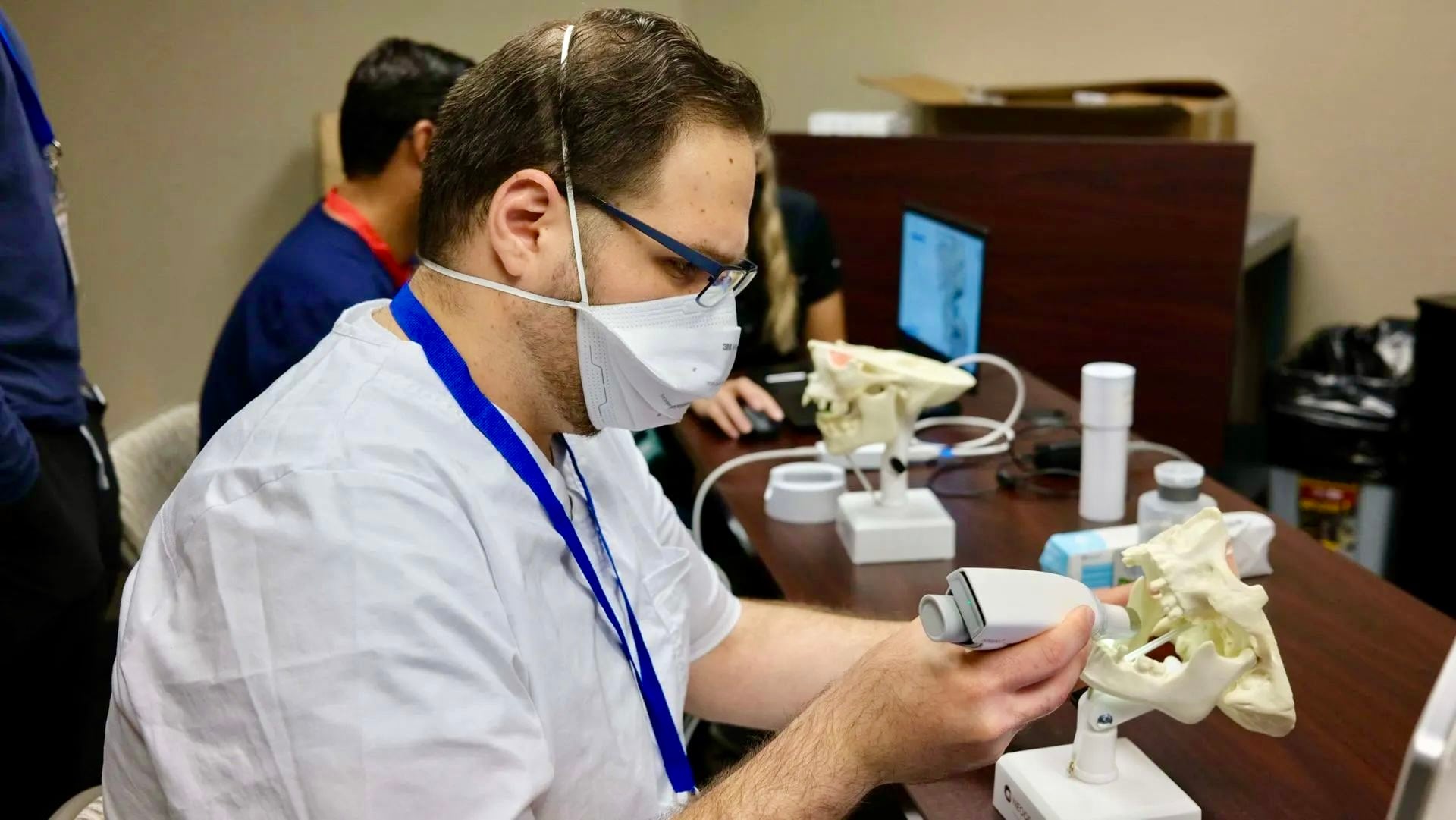
Full Arch Masters’ Flagship Course is capped at eight dentists per cohort and covers every step of the FAM Method across four days in Fresno, CA. Beginners observe two live full-arch surgical cases and perform hands-on records acquisition on live patients, which is the maximum California licensure allows, while receiving equal depth of instruction on marketing, treatment coordination, and team delegation.
Explore beginner-focused Flagship Course dates
Intermediate: Scaling Throughput with In-House Digital Systems (50 to 200 Cases)
Once you have placed around 50 arches and mastered the basics, the main constraint usually shifts from clinical skill to workflow efficiency. Dentists in this range often run a hybrid workflow with partial impressions, off-site lab work, and multi-day appointments that limit throughput to one or two arches per month. The constraint rarely sits in surgical ability. It usually lives in the operating system around the procedure. That is why FAM steps four through six focus on workflow infrastructure instead of additional basic surgical technique.
Step four, exocad design, moves prosthetic planning in-house so you control timelines and quality. Step five, immediate-load conversion, is where same-day delivery succeeds or fails. A fully digital immediate-load workflow using 3D-printed conversion prosthetics removes the multi-day appointment cycle that compresses margins. Step six, final zirconia design and finishing, shapes both the aesthetic result and long-term durability. An in-house lab reduces full-arch prosthesis fabrication costs and creates meaningful margin improvement per case.
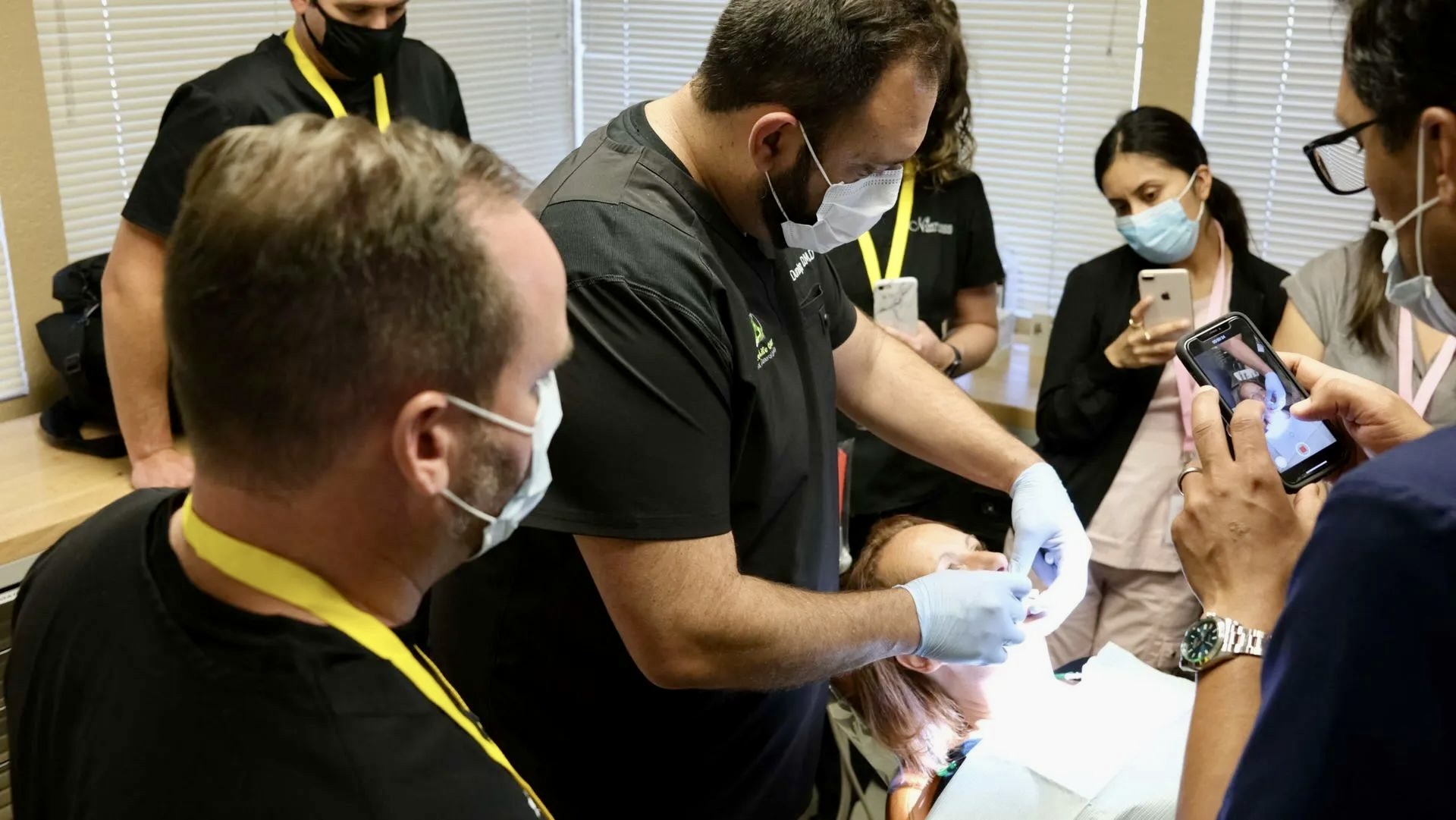
Intermediate dentists also benefit from the Live Surgical Course, Basic Operator track, held in Parker, CO. Each operator performs two full-arch cases on live volunteer patients under expert mentor supervision. Colorado Dental Board credentialing makes this format legally possible for U.S.-licensed dentists from any state, a structure that most states do not permit.
Full Arch Masters meets intermediate practitioners at steps four through six with both the Flagship and Live Surgical courses. This combination gives them an integrated digital system and live surgical volume that supports the move from two arches per month to a truly scalable workflow.
View Live Surgical Course dates for intermediate operators
Advanced: Expanding into Atrophic and FP1 Cases (200+ Cases)
Experienced surgeons placing full-arch at volume often hit a ceiling with atrophic cases they currently refer out. Steps six and seven of the FAM Method address this advanced stage directly. Step six, final zirconia design and finishing, refines the material and aesthetic decisions that separate a premium outcome from a standard one. Step seven, FP1-specific design and team implementation and workflow scaling, covers advanced prosthetic classifications, atrophic surgical techniques, and the team systems needed to run higher case volume without exhausting chair time.
The Advanced Live Surgical track at Full Arch Masters is limited to dentists with at least 200 career arches placed. This track covers zygomatic, pterygoid, trans-sinus, palatal-approach, and custom subperiosteal placements on live volunteer patients under expert mentor supervision, techniques that most full-arch programs never touch. Each Advanced operator performs two full-arch cases across the two surgical days.
The FP1 Course adds a two-day deep dive into root banking, FP1-specific case selection, and the lab design workflow that differs from FP2 and FP3. FP1 offers a higher-margin, more aesthetic restoration option that many general full-arch training programs omit entirely.
Apply for the Advanced Live Surgical track
Lab-Technician Tracks That Keep Pace with Surgical Teams
The seven FAM steps extend far beyond the surgical chair. Steps four through seven, exocad design, immediate-load conversion, final zirconia design and finishing, and FP1-specific design and team implementation, function as lab-side disciplines as much as clinical ones. When a lab technician cannot receive scans, execute an immediate-load prosthetic, and deliver a finished zirconia arch on the same timeline as the clinical team, the lab becomes a bottleneck that surgical skill alone cannot solve.
Full Arch Masters’ Design and Finish Course dedicates four days entirely to lab work. Two days focus on digital design in exocad, covering preop records, digital mockups, surgical alignment devices, immediate-load prosthetics, and final zirconia design. Two additional days focus on hands-on aesthetic finishing on pre-sintered and post-sintered zirconia with MIYO ceramic layering. FAM surveys attendees in advance and separates beginners from advanced designers so each track runs at the right level.
Material modules cover PMMA, metallic frameworks, PEEK, zirconia, and crystal-based materials, mirroring the range a lab technician sees in a high-volume full-arch practice. In-house lab technicians can also attend the Flagship Course alongside the dentist they support so both sides return home aligned on the same workflow from day one. As one lab technician alumnus put it, “If you’re thinking about going digital, come and take this course.”
Enroll your lab technician in the Design and Finish Course
Post-Course Mentorship Economics and the Path to $1M+ Revenue
Post-course support turns new skills into consistent production. Post-course mentorship accelerates production by letting experienced clinicians review CBCT scans, treatment plans, and surgical approaches for a dentist’s first independent cases. That review builds clinical confidence, which then supports higher case acceptance. Programs that end when the course ends leave dentists with knowledge but no safety net for the difficult case that eventually appears on the schedule.
The 2-to-4-hour same-day delivery metric reported by Full Arch Masters alumni reflects all seven FAM steps working as one integrated system. That speed matters because a single full-arch case generates $15,000–$35,000 in revenue. When each case takes only 2 to 4 hours instead of multiple days, a practice can run more cases per week. Faster throughput translates directly into higher annual revenue. FAM alumni report adding $1M or more per year in practice revenue after adopting the FAM Method.
Every Full Arch Masters alumnus joins private group chats with hundreds of FAM-trained dentists, lab technicians, and team members, which provides case help on demand for the life of the relationship. Alumni also gain access to the Key Opinion Leader buying group, which delivers vendor discounts on Neodent implants, exocad licenses, 3D printers, and photogrammetry systems at no recurring cost. The Treatment Coordinator Bootcamp, taught by FAM’s in-house treatment coordinator with an 80% closing rate, adds a closing system and pipeline structure that turns consultations into accepted cases.
See how FAM mentorship and alumni benefits fit your growth plan
Frequently Asked Questions
How much live-patient surgical volume does a full-arch course need to deliver?
Live-patient volume is the single most important variable in full-arch surgical training. Observing cases builds pattern recognition, while operating on live patients builds the psychomotor skill and clinical judgment needed to handle variation independently. At Full Arch Masters, Basic and Advanced operators each perform two full-arch cases across the two surgical days of the Live Surgical Course in Parker, CO, under expert mentor supervision with pre-planned CBCTs and 3D-printed patient models reviewed before the first incision. Flagship Course attendees observe two live full-arch surgical cases and perform hands-on records acquisition on live patients, which is the maximum California licensure permits for visiting dentists. This combination of observed cases and hands-on records work prepares attendees to apply the FAM Method immediately when they return to their practice.
What does digital workflow integration actually mean in a full-arch training program?
A genuinely integrated digital workflow connects every step from preoperative records through final delivery into one repeatable system. The FAM Method covers all seven steps outlined earlier in this guide, from preoperative records through FP1-specific design and team implementation. Most programs that advertise a “digital workflow” teach individual tools, such as a scanner or a milling unit, without integrating them into a system that reliably delivers same-day teeth in 2 to 4 hours. FAM teaches the full recipe as a connected end-to-end system, including photogrammetry for passive fit, 3D-printed immediate-load conversion, and exocad design for both immediate and final prosthetics.
Does team training actually affect practice revenue outcomes?
Team training is the mechanism that converts clinical skill into real practice volume. A dentist who returns from a course without a trained treatment coordinator, lead assistant, and lab technician cannot run the workflow at scale, because the bottleneck shifts from clinical knowledge to team execution. Full Arch Masters’ Flagship Course is built for the full team. Most attendees arrive as a practice owner with their treatment coordinator and lead assistant, or as a dentist with their in-house lab technician. The Treatment Coordinator Bootcamp trains front-office staff on the closing system FAM uses in-house, where the treatment coordinator maintains an 80% closing rate. Team-member pricing is built into every course, with $2,500 per additional team member for the Flagship, which keeps full-team attendance financially realistic.
What does post-course mentorship look like, and how long does it last?
Post-course mentorship at Full Arch Masters runs through private alumni group chats that include a dentist-only channel for sensitive practice and personnel questions, a main multi-role channel spanning dentists, assistants, technicians, and team members, and per-course lab and treatment coordinator channels. Hundreds of FAM-trained alumni respond to case questions, equipment troubleshooting, and clinical edge cases on demand for the life of the relationship. There is no recurring fee and no expiration date. Alumni also receive a digital resource library covering surgical room setup checklists, finishing techniques, treatment coordinator forms and presentations, and consent templates for advanced placements such as pterygoid and zygomatic implants. KOL buying group access, including vendor discounts on implants, exocad licenses, and 3D printers, also remains permanent after course completion.
Choosing the Program That Actually Scales Your Practice
A full-arch training program that teaches isolated techniques without an integrated digital workflow, team training, and continued mentorship will struggle to produce 2-to-4-hour same-day delivery and $1M-plus annual revenue growth. The seven-step FAM Method provides a clear benchmark across beginner, intermediate, and advanced stages. Evaluate every program against this full system and choose the one that supports your current experience level while giving you a path to the next.
Compare your experience level to the FAM tracks and choose your next course