Written by: Ryan Dunlop, CEO and Founder of Full Arch Masters and graduate from the Harvard School of Dental Medicine | Last updated: July 14, 2026
Key Takeaways
-
Accreditation, hands-on hours, team access, post-course support, digital workflow depth, and reported revenue outcomes separate transformative full-arch CE from credit-only programs.
-
Live-patient surgical training under Colorado Dental Board credentialing remains the closest analog to independent full-arch case execution for U.S.-licensed dentists.
-
Photogrammetry-first digital workflows enable same-day teeth in 2-4 hours when taught as one repeatable system, not as separate disconnected tools.
-
Full-team training with dedicated tracks for treatment coordinators and lab technicians produces higher case acceptance and faster workflow adoption than dentist-only programs.
-
Full Arch Masters delivers accredited, hands-on, team-based full-arch training with continued alumni support and no-recurring-cost KOL buying group access. FAM alumni report adding $1M+ per year in practice revenue after adopting the FAM Method.
Implant Demand Is Reshaping Dental Care Growth
Surgical services are projected to expand at a 6.15% CAGR from 2026 to 2031 in the U.S. dental care market, the fastest growth rate among all service categories, with implant adoption cited as a primary driver. The broader market is projected to grow from $224.56 billion in 2026 to $279.18 billion by 2031. Full-arch implant restoration sits at the center of that growth, combining high per-case revenue, rising patient demand, and digital tools that have changed what is operationally possible.
Facial scanning, intraoral photogrammetry, and 3D printing have changed full-arch implant rehabilitation by aligning every dataset into one workflow that covers both surgical and prosthetic phases. This clinical opportunity exists only for practices that build an end-to-end system. A patchwork of digital tools without an integrated protocol will not deliver the same result.
State licensing rules matter when evaluating in-person CE. Most U.S. states do not permit visiting dentists to perform surgery on volunteer patients during a CE course. The Colorado Dental Board is one of the few exceptions. It authorizes U.S.-licensed dentists from any state to operate on volunteer patients through advance credentialing, which is why live full-arch surgical training is otherwise hard to access. International attendees cannot be credentialed and attend as observers instead. Most U.S. states require 20-40 CE hours per two-year renewal cycle, with some mandating specific hours in infection control, opioid prescribing, or ethics.
This digital shift creates a clear opening for practices ready to adopt a repeatable, full-team workflow. See how the FAM Method turns this shift into a structured training path.
Comparing CE Provider Models Side by Side
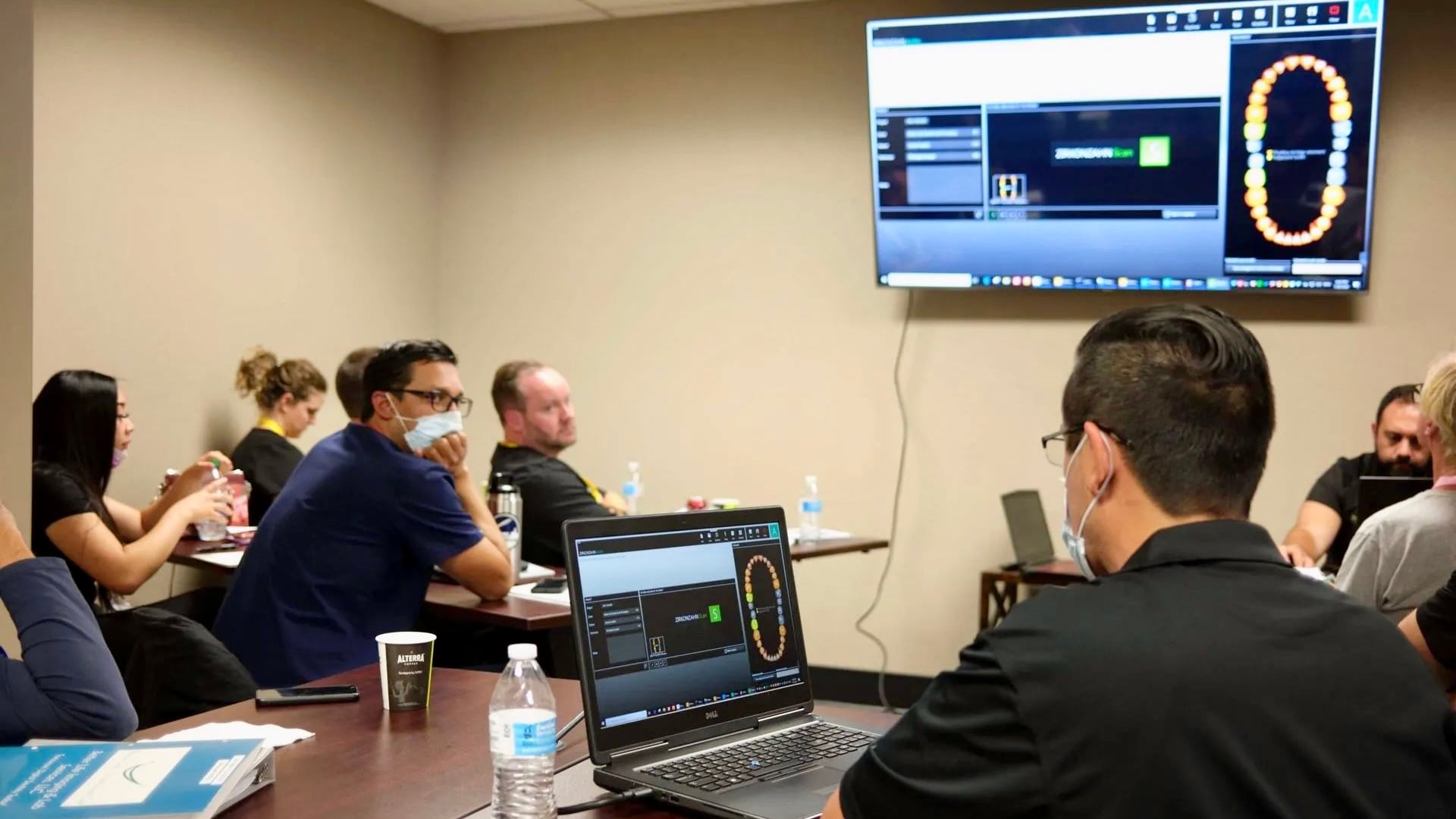
The table below scores four representative CE provider models against six criteria. Each criterion determines whether a program actually changes clinical practice, not just whether it satisfies a CE requirement. The comparison shows a consistent pattern: programs that combine live surgical access, full-team training, and an integrated digital workflow outperform lecture-only and hybrid formats on every measure that predicts real-world adoption.
|
Criterion |
Lecture-Only / Online Programs |
Hybrid Programs (Lecture + Limited Hands-On) |
Full Arch Masters (FAM Method) |
|---|---|---|---|
|
Accreditation |
ADA CERP or AGD PACE accepted by all U.S. licensing jurisdictions |
ADA CERP or AGD PACE; varies by provider |
Accredited through AAGD for 32 CE credits per course; 90+ CE hours across the full Fellowship |
|
Hands-On Hours |
Most states cap online CE at 25-50% of required hours; no live surgical access |
Limited hands-on; typically models or simulation, not live patients |
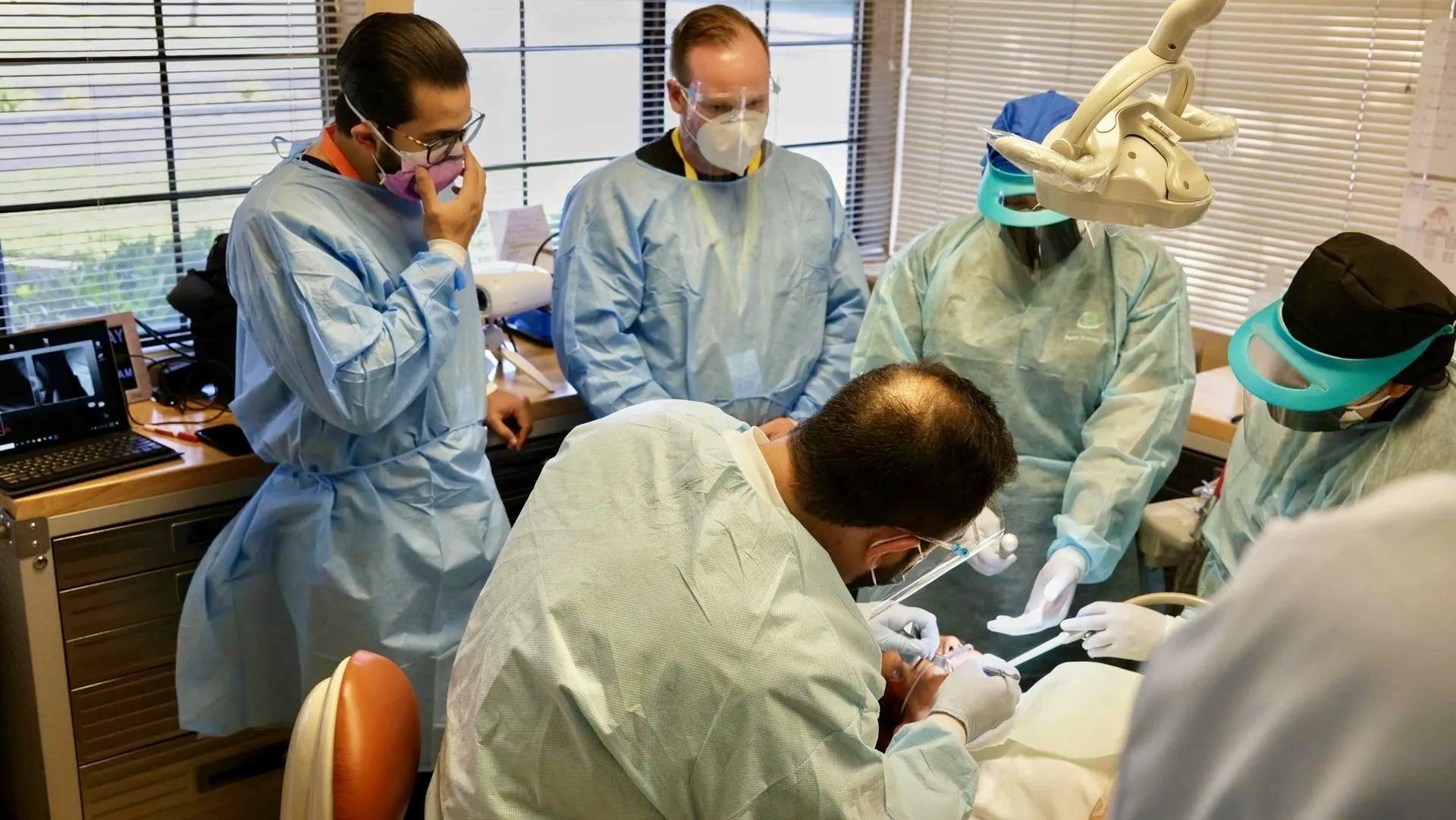
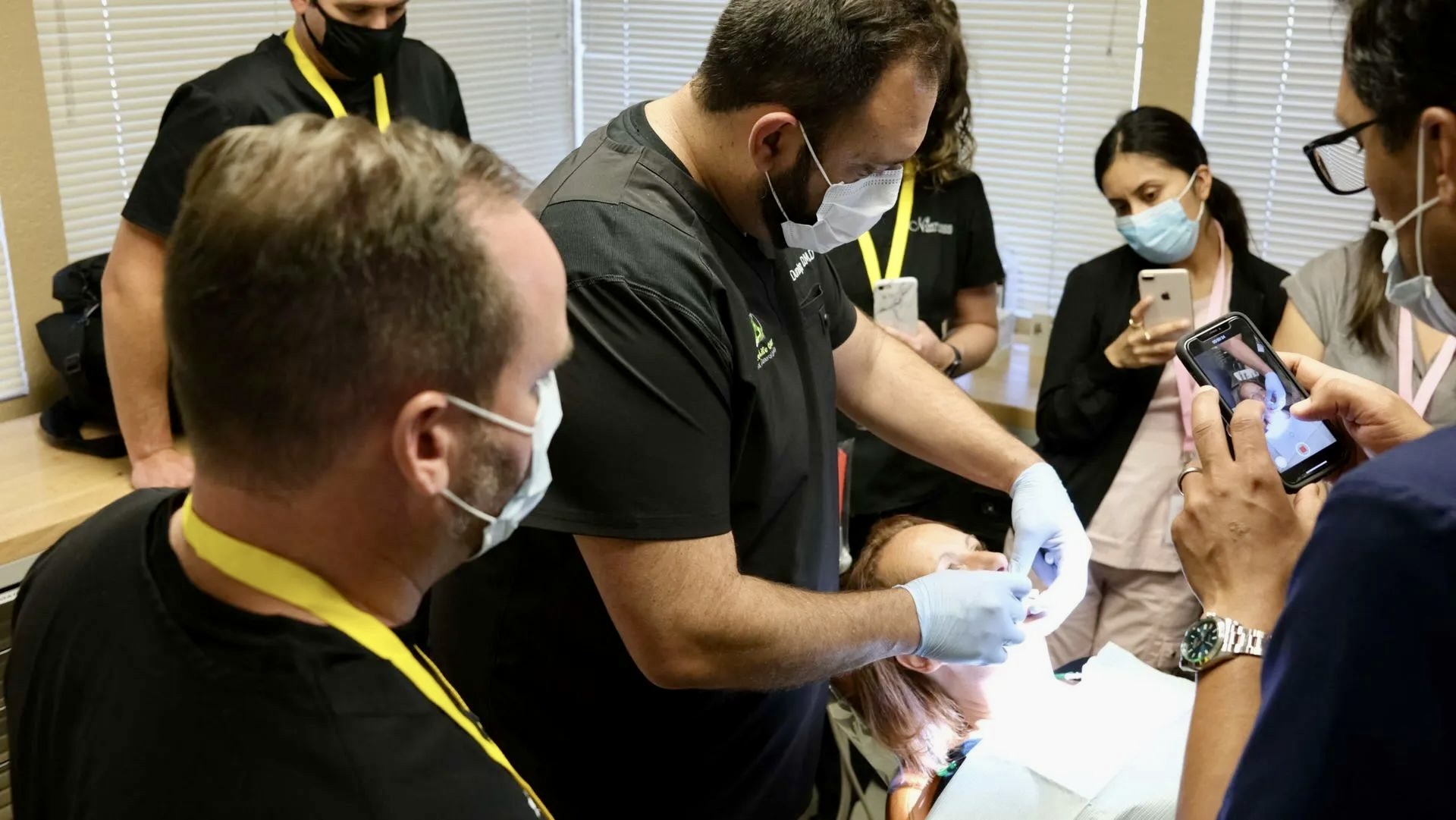
Live surgical operating on volunteer patients (Parker, CO); each Basic or Advanced operator completes 2 full-arch cases over 2 surgical days |
|
Team Access |
Dentist-only enrollment typical; no team pricing |
Dentist-focused; team access often add-on pricing |
Full-team model built into every course; $2,500 per additional team member (Flagship); dedicated tracks for coordinators and lab technicians |
|
Post-Course Support |
None beyond certificate issuance |
Limited; some offer follow-up webinars or email access |
Alumni community via private group chats, KOL buying group access at no recurring cost, full digital resource library |
|
Digital Workflow Depth |
Simulation tools show limited superiority over traditional methods in skill execution |
Scanner and CBCT instruction common; photogrammetry and integrated workflows rare |
Photogrammetry-first workflow (intraoral scanning, iCam4D, facial scanning, CBCT, exocad, 3D-printed immediate-load conversion) taught as one repeatable system |
|
Reported Revenue Outcomes |
Not typically tracked or published |
Varies; one institute reports a 22% average production increase in year one |
Alumni report adding $1M+ per year in practice revenue |
The gap between categories is largest on team access and digital workflow depth, the two factors most directly tied to whether training survives contact with a real schedule. Learn how the FAM Method closes that gap for your practice.
Weighing Format, Team Training, and Ongoing Costs
A 2021 Cochrane review found that didactic sessions alone rarely change professional practice, while interactive formats produce moderately large improvements. For full-arch training, the format decision carries direct revenue consequences.
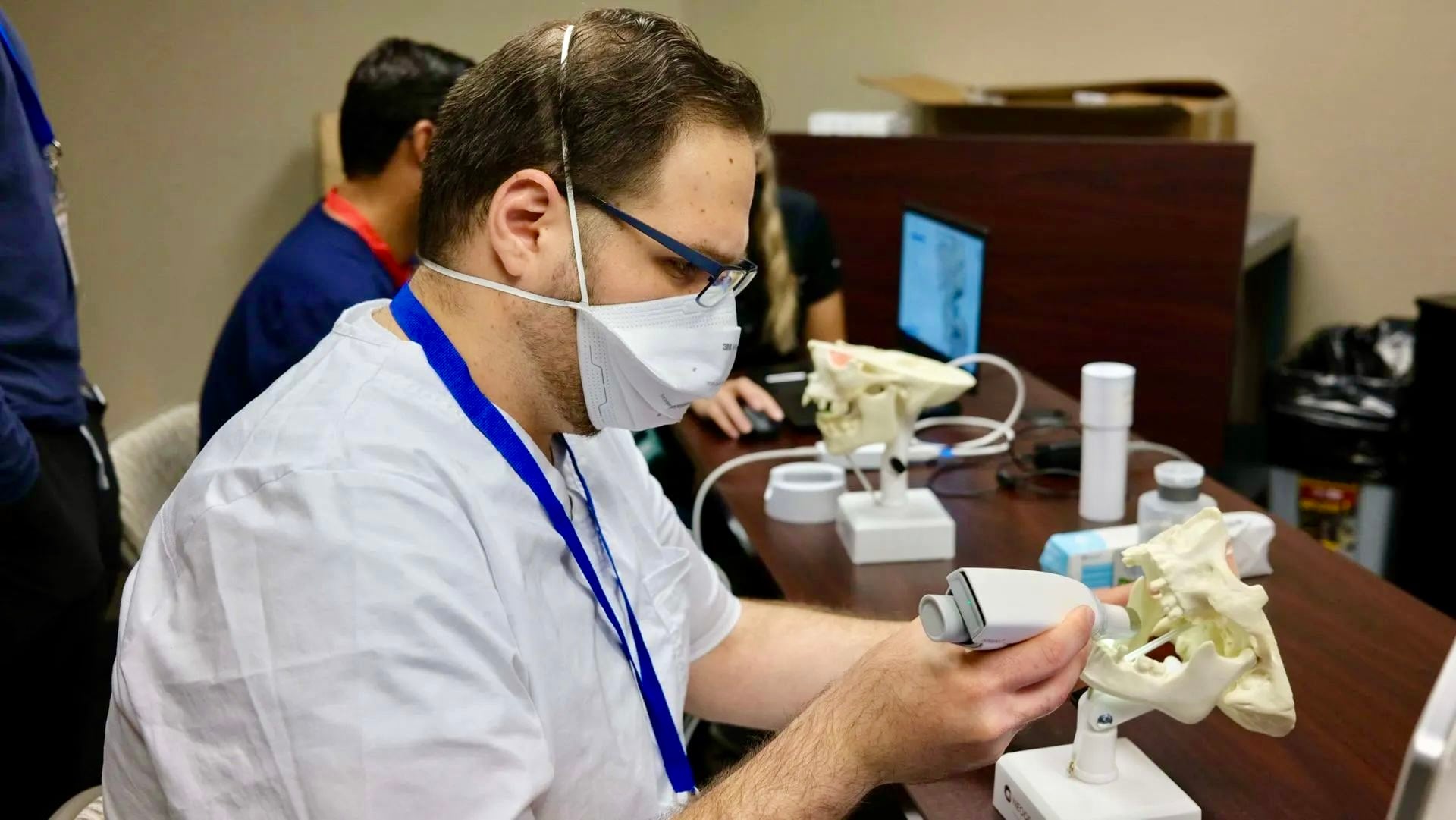
Lecture-only programs cost less and satisfy CE hour requirements, but they do not transfer surgical skill. Hybrid programs add simulation or model work, which helps conceptual understanding. Still, hands-on practice and supervised clinical work remain essential for mastering advanced techniques that video or theory alone cannot teach. Fully hands-on programs with live patients, especially those operating under a legal credentialing framework like the Colorado Dental Board, come closest to independent case execution.
Team integration is a separate variable from format, and it determines whether training sticks. A dentist who attends a hands-on course without a treatment coordinator, lead assistant, or lab technician returns to a practice that cannot operationalize the workflow. The skill stays with the dentist alone, and the rest of the team has no shared reference point. This gap carries a measurable cost. Staff turnover is often lower in practices with structured professional development programs, which suggests team-level training pays off organizationally as well as clinically, by giving staff a sense of investment and shared competence.
Recurring support costs are a third factor to weigh. Some post-course communities, GPOs, and buying groups charge ongoing membership fees. FAM’s KOL buying group provides vendor discounts on Neodent implants, exocad licenses, 3D printers, and other equipment at no recurring cost beyond completing a course.
These trade-offs point to a practical question: how do you evaluate a specific program against these criteria before you commit? See how FAM’s no-recurring-cost buying group fits into your training investment.
A Five-Part Checklist for Choosing a Full-Arch Program
Evaluating a CE program means checking five separate areas: accreditation, hands-on format, digital workflow depth, team access, and ROI benchmarks. Use this checklist before committing to any provider.
Accreditation verification:
-
Revised ADA CERP Recognition Standards take effect June 1, 2026. Confirm the provider is recognized under the updated framework, which extends financial disclosure periods to 24 months and strengthens patient protection protocols for live-patient courses.
-
AGD members can earn FAGD and MAGD hours from providers approved by AGD PACE or ADA CERP. Verify the provider’s approval number and expiration date.
-
All U.S. and Canadian licensing jurisdictions that require CE accept credits from ADA CERP-recognized providers.
Hands-on hours and format:
-
Confirm whether hands-on work involves live patients, simulation models, or extracted teeth, and whether the provider has a legal credentialing framework for live-patient surgery.
-
For AAID credentialing, the Associate Fellow credential requires at least 300 hours of implant-focused CE, including 75 hours of participatory hands-on formats.
Digital workflow depth:
-
Confirm the program teaches photogrammetry, not just intraoral scanning. Photogrammetry is the accuracy standard for implant position capture in full-arch cases.
-
Confirm exocad or equivalent CAD/CAM design is taught hands-on, not just demonstrated.
-
Confirm immediate-load 3D-printed conversion is part of the surgical curriculum.
Team access and post-course support:
-
Confirm whether team members, including assistants, coordinators, and lab technicians, can attend and at what cost.
-
Confirm what post-course support exists, such as an alumni community, mentorship, or a digital resource library, and whether it carries a recurring fee.
ROI benchmarks:
-
Dentists who actively build implant workflows often recover their training investment within the first year of placing cases.
-
Comprehensive implant programs typically cost $20,000-$60,000 per arch or $30,000-$90,000 for both arches, making implant training one of the highest-ROI CE investments a general practice dentist can make.
Finding Where Your Practice Actually Gets Stuck
The trade-offs above point to a deeper question: where does your practice’s real bottleneck sit? Before selecting a provider, an honest self-assessment reveals whether the constraint is clinical skill, workflow infrastructure, team alignment, or case volume.
-
How many full-arch cases does the practice complete per month, and what is the target?
-
Is the current workflow fully digital end-to-end, or a hybrid with partial impressions and off-site lab work?
-
Does the practice have a treatment coordinator trained specifically on full-arch case acceptance and financing?
-
Can the lead assistant acquire photogrammetry records and intraoral scans independently, without burning the dentist’s chair time?
-
Does the in-house lab technician design and finish immediate-load prosthetics, or is that work outsourced?
-
When a difficult case lands on the schedule, is there a peer community to consult?
FAM alumni who implement the FAM Method report delivering same-day teeth in 2 to 4 hours. The mechanism is straightforward. A faster workflow supports higher case volume, the treatment coordination curriculum closes more consultations already in the pipeline, and the team approach removes the dentist from non-billable workflow steps. This compounding effect is what drives the $1M+ annual revenue increase alumni reported earlier.
Where Full-Arch CE Investments Go Wrong
The following pitfalls account for most cases where full-arch CE investment fails to produce the expected clinical or revenue outcome.
-
Hybrid workflows presented as fully digital. A workflow that includes intraoral scanning but still relies on physical impressions, off-site lab work, or multi-day appointments is a hybrid, not a digital workflow. This distinction has real consequences: patients sent home with swollen tissue after a multi-hour first appointment represent a workflow failure, not a clinical complication. Evaluate whether a program teaches one integrated system or assembles separate digital tools without a unifying protocol.
-
Dentist-only training without team integration. As noted earlier, structured team training correlates with lower staff turnover, and the operational reason is alignment. A team trained on the same workflow executes it consistently, while a dentist who returns from a course without a trained team cannot put what they learned into practice. Prioritize programs with team-member pricing and role-specific curriculum tracks.
-
Programs without continued community. Full-arch implant dentistry is competitive and historically secretive. Most programs end when the course ends, leaving the dentist with no peer network when a difficult case arrives. Confirm whether post-course alumni access is included and whether it carries a recurring fee.
-
Missing KOL buying group or vendor discount access. GPOs and DSOs typically charge recurring fees for vendor discounts on implants, equipment, and materials. FAM course graduates gain buying group access to the same categories of equipment at no recurring cost.
-
No treatment coordination training alongside clinical training. Case acceptance rates for extensive procedures like implants typically range from 60% to 70%. A practice closing 60% of full-arch consultations and one closing 80% are not in the same business. Treatment coordinator training on case presentation, financing, and objection handling is a measurable revenue lever most CE programs skip entirely.
Avoiding these five pitfalls comes down to one test: does the program teach a complete, team-wide system, or just a piece of one? See how the FAM Method addresses each pitfall directly.
Frequently Asked Questions
What makes a dental CE provider the best for full-arch implant training in 2026?
The best providers in 2026 deliver accredited, hands-on, team-based training with continued post-course community and measurable revenue outcomes, not just CE credit accumulation. The critical differentiators are whether the program teaches an integrated digital workflow, whether live-patient surgical access is legally credentialed, whether team members can attend alongside the dentist, and whether post-course support exists beyond a certificate.
What are the best dental CE providers for in-person full-arch courses in 2026?
Several programs offer in-person full-arch implant training in 2026, including Full Arch Masters, 4M Institute, 3D Dentists, 3D Implant Institute, and Colorado Surgical Institute. Full Arch Masters differentiates on four structural attributes: a photogrammetry-first integrated digital workflow taught as one repeatable system, a Live Surgical Course in Parker, CO under Colorado Dental Board credentialing, a continued alumni community, and a KOL buying group with no recurring fee. The FAM Flagship Course caps enrollment at eight dentists per cohort to maintain a hands-on environment.
Are there free dental CE courses online with certificates for implant training?
Free online CE courses with certificates exist across general dentistry topics, and some implant-adjacent content is available through manufacturer webinars and professional association platforms. Free online formats are structurally limited for advanced implant training, though. Most states cap online CE at 25-50% of required hours, and didactic-only formats rarely change clinical practice in procedural disciplines. Free online CE works for foundational knowledge, not for building the surgical skill, workflow proficiency, or team coordination needed for same-day teeth delivery.
What is the difference between ADA CERP and AGD PACE accreditation for dental CE?
ADA CERP recognizes a provider’s overall system and processes for continuing education, not individual courses. All U.S. and Canadian jurisdictions that require CE accept ADA CERP credits. AGD PACE approves individual CE programs and is required for dentists pursuing AGD Fellowship or Mastership credentials. Both are accepted by the Colorado Dental Board for license renewal. Revised ADA CERP standards take effect June 1, 2026. Full Arch Masters courses are accredited through AAGD for 32 CE credits per course.
How does Full Arch Masters compare to Kois or Dawson-style CE programs?
Kois Center and Dawson Academy focus on occlusion, restorative principles, and comprehensive dentistry, disciplines that support sound full-arch treatment planning. Full Arch Masters occupies a different category. It is a full-arch implant implementation program, not a restorative philosophy curriculum. The FAM Method covers the complete operating system around full-arch delivery: surgical technique, digital workflow, lab design, treatment coordination, and team delegation. Dentists who have completed Kois or Dawson training and want to add full-arch implant implementation are a strong fit for FAM.
What should a dental practice look for when evaluating CE ROI for full-arch training?
Calculate ROI by dividing total investment (tuition, travel, lodging, lost production, equipment) by net profit per full-arch case to find the break-even point. Dentists who actively build their full-arch workflow often recover their investment within the first year of placing cases. Three variables accelerate ROI: a faster workflow that supports higher monthly case volume, a trained treatment coordinator who closes more consultations, and a team that executes non-billable steps without the dentist’s chair time.
Can lab technicians and treatment coordinators attend Full Arch Masters courses?
Yes. The FAM Method is built around one team, one workflow, and every course includes the full practice team. The Design and Finish Course is four days dedicated to lab work, covering digital design in exocad and aesthetic finishing on zirconia. The Treatment Coordinator Bootcamp is taught by FAM’s in-house coordinator, who maintains an 80% closing rate on full-arch consultations. Lab technicians and coordinators can also attend the Flagship Course alongside their dentist. Team pricing is built into every course, including $2,500 per additional team member for Flagship.
Register for an upcoming Full Arch Masters course.
Choosing a Program That Changes What Happens Monday Morning
The best dental CE providers in 2026 are not defined by credit hours or brand recognition. They are defined by whether their training changes what a practice can actually do the next business day. For full-arch implementation, that means accredited, hands-on, team-based training with an integrated digital workflow, continued post-course community, and a transparent record of revenue outcomes.
Full Arch Masters combines attributes that exist separately elsewhere but rarely together: a photogrammetry-first workflow taught as one repeatable system, live surgical operating under Colorado Dental Board credentialing, a full-team training model, a large alumni community available for case help, and a KOL buying group with no recurring cost. FAM treats the recipe as the product, and the alumni community as the proof.
Practices ready to move from one or two arches per month to a scalable, fully digital, team-executed workflow have a clear next step. Register for an upcoming Full Arch Masters course.