Written by: Ryan Dunlop, CEO and Founder of Full Arch Masters and graduate from the Harvard School of Dental Medicine | Last updated: July 14, 2026
Key Takeaways
- CDT specialty certifications do not currently test exocad immediate-load design, zirconia/MIYO finishing, or same-day clinical-team integration.
- Demand remains strong for CAD/CAM and digital full-arch specialists, while commodity production roles face contraction.
- The Full Arch Masters Design and Finish Course delivers complete digital lab training in four days, including beginner and advanced tracks.
- Master the exocad and zirconia/MIYO skills that define the 2026 full-arch lab standard. Enrollment details at Full Arch Masters.
Becoming a Certified Dental Lab Technician
The NBC administers the Certified Dental Technician (CDT) credential. It remains the primary professional benchmark for U.S. dental laboratory technicians. Candidates qualify through one of two routes: an accredited dental technology program, or a documented period of work experience in a commercial or in-house lab. Either path leads to the Recognized Graduate Examination, which tests foundational knowledge across all six CDT specialty areas.
After passing that exam, candidates can pursue one or more of six NBC specialty certifications: Complete Dentures, Partial Dentures, Crown & Bridge, Ceramics, Orthodontics, and Implants. Each specialty requires its own written exam and a practical component graded against NBC rubrics. The NBC also offers a digital workflow specialty, open to experienced technicians who have completed the Recognized Graduate Examination and accumulated qualifying work hours.
Maintaining the CDT credential requires continuing education, and each specialty carries its own renewal cycle.
No CDT specialty exam currently tests exocad immediate-load design, zirconia finishing with MIYO layering, or same-day clinical-team integration. Those skills require a dedicated advanced training program.
Build the digital full-arch skills the CDT pathway does not cover at Full Arch Masters.
Market Demand for CAD/CAM and Digital Lab Skills
The CDT credential builds the foundation, but the job market now rewards a narrower set of digital skills on top of it. BLS data shows median annual wages of $33,940 to $38,250 for dental laboratory technicians as of May 2023, with 66,800 jobs in 2024 and a -1% employment outlook through 2034 for the broader technician category. That headline number hides a split market. Contraction is concentrated in commodity production roles, while demand for digital specialists stays strong.
Technicians with CAD/CAM skills earn a measurable premium over those without them. That gap shows up even where direct CAD/CAM listings are scarce. In Winston-Salem, NC, general dental lab technician salaries average $43,693 to $49,460 annually, while specialized CAD/CAM and All-on-X ceramist roles in California command $35 to $65 per hour. That spread reflects growing regional demand for digital expertise specifically.
CAD/CAM is now the primary manufacturing method in roughly 80% of U.S. dental labs, and intraoral scanner use in U.S. practices has grown substantially. Digital integration is no longer optional for labs handling implant and prosthetic work. The same source reports that many lab owners turn away implant work due to insufficient libraries, components, or staff expertise, a direct signal of unmet demand for technicians trained in digital full-arch workflows.
Master ceramists and complex prosthetic specialists handling full-arch implant restorations stay protected from automation for 7 to 10-plus years, because manual artistry in porcelain layering and aesthetic judgment resists automation. Technicians who pair exocad design proficiency with zirconia/MIYO finishing sit in the highest-value, lowest-displacement segment of the market.
Timeline: From CDT Credential to Same-Day Capability
The foundational CDT pathway typically spans two to four years. Candidates who complete an accredited associate degree program finish in about two years before sitting the NBC Recognized Graduate Examination. Candidates who qualify through work experience need three to four years to accumulate the required hours before they’re eligible to test.
Adding digital full-arch specialization does not require another degree program. The Full Arch Masters Design and Finish Course delivers the complete digital lab side of the FAM Method, covering exocad immediate-load design and zirconia/MIYO finishing, in four dedicated days. For mid-career technicians who already hold CDT credentials, that four-day investment is the fastest path to same-day full-arch capability.
After the course, ongoing CDT renewal still requires continuing education. The Design and Finish Course contributes toward that requirement through Full Arch Masters’ accreditation with the American Academy of General Dentistry (AAGD).
Add digital full-arch capability to your existing CDT credentials in four days at Full Arch Masters.
Comparing CDT Paths Against the Design and Finish Course
The table below shows why none of the standard CDT specialty or CE pathways deliver same-day full-arch capability, while the Design and Finish Course does.
| Credential / Program | Duration | Hands-On Focus | Same-Day Full-Arch Capability |
|---|---|---|---|
| NBC CDT, Implants Specialty | Written + practical exam (self-paced study); CE renewal | Implant prosthetic principles; no software-specific lab | No, does not cover exocad immediate-load design or zirconia/MIYO finishing |
| NBC CDT, Ceramics Specialty | Written + practical exam (self-paced study) | Ceramic layering principles; analog and digital methods vary by candidate | No, no full-arch workflow or immediate-load protocol |
| Harvard Implant & Digital Dentistry CE Program | 1 year blended; 155 CE credits; $20,000 | Live clinical demonstrations; hands-on digital case planning; no patient treatment | No, observation-based with no lab finishing component |
| Full Arch Masters Design and Finish Course | 4 days; $6,995; AAGD-accredited CE | 2 days exocad immediate-load design; 2 days pre- and post-sintered zirconia with MIYO layering; beginner/advanced tracks | Yes, complete digital lab workflow for same-day full-arch delivery |
What’s Driving the Shift Toward Digital Design and Zirconia Finishing
The digital full-arch workflow has matured rapidly since 2021. Digital preparation now allows design completion in advance, with manufacturing and 3D printing producing provisional complete prostheses faster than analog methods.
Exocad DentalCAD 3.3 Chemnitz, released October 2025, introduced the Split Denture Workflow, which lets technicians design the bar and prosthetic superstructure for All-on-X cases as one integrated process. This eliminates the manual alignment step that used to fragment the design sequence. The same release consolidated all implant positions into a single window with manufacturer article-number search, saving an estimated 5 to 8 minutes per multi-implant case.
On the finishing side, complex aesthetic ceramic work carries the same automation-resistance mentioned earlier. MIYO ceramic layering on zirconia falls squarely into that protected category. That protection matters more as the market grows: the global dental implants market was valued at $5.50 billion in 2024 and is projected to reach $9.91 billion by 2030, driving sustained volume of full-arch cases that need both design and finishing expertise.
Inside the Four-Day Design and Finish Curriculum
The Full Arch Masters Design and Finish Course runs four days in Fresno, CA. Two distinct two-day tracks run back to back.
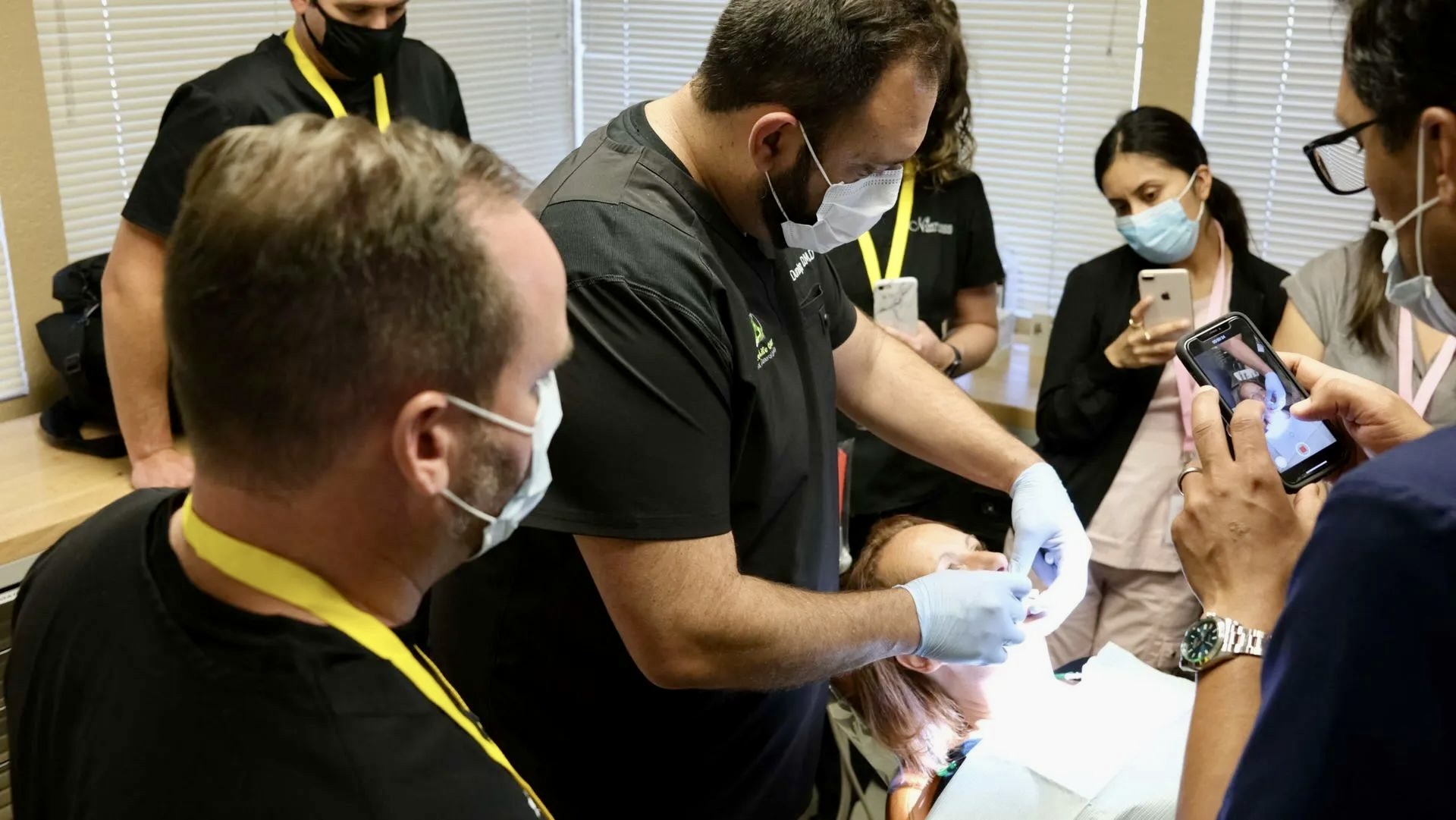
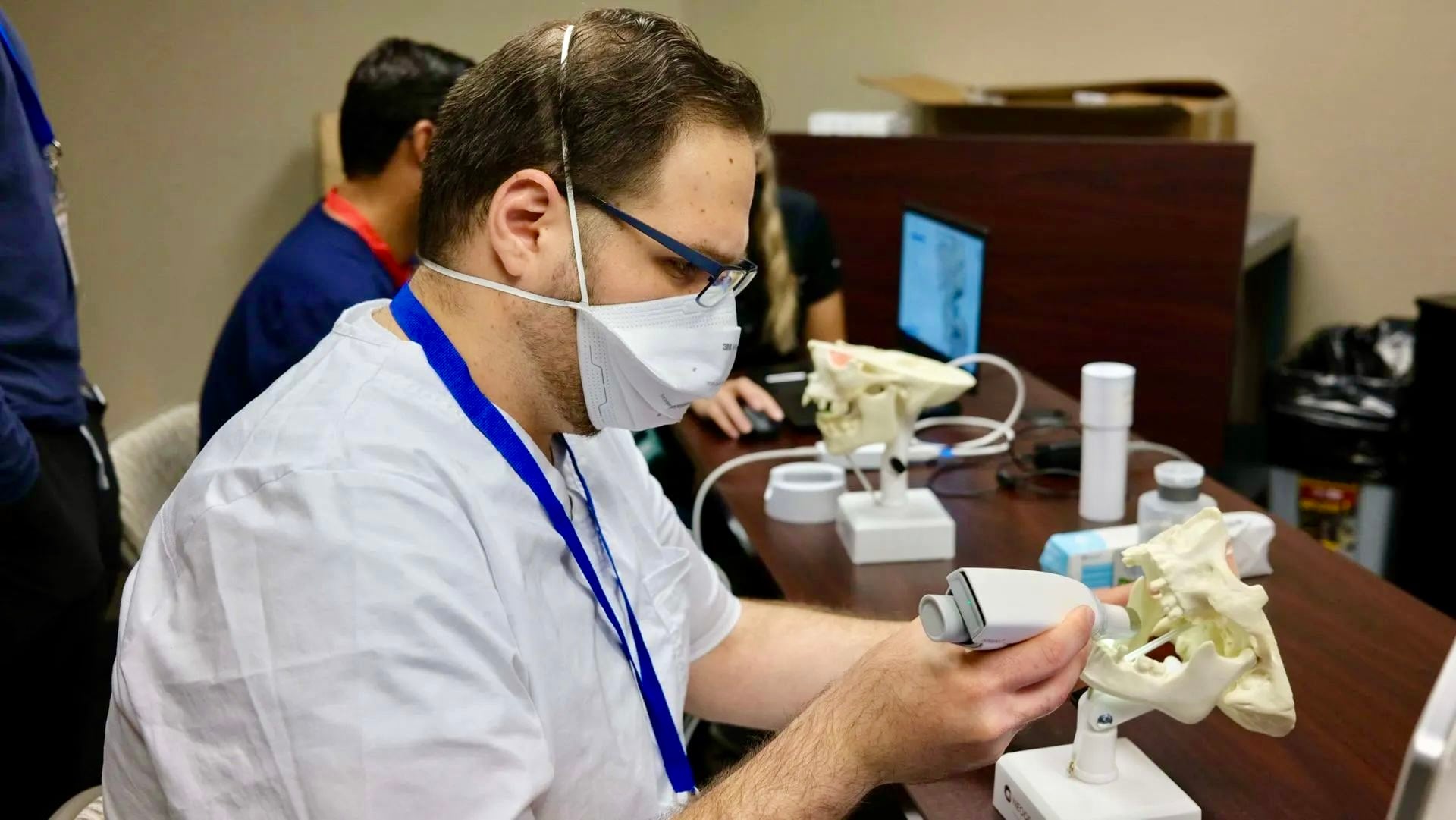
Days one and two cover digital design in exocad: preop records import, digital mockups, surgical alignment devices, surgical record imports, immediate-load prosthetic design, and final zirconia design. Instruction runs on the current exocad DentalCAD environment, including the Split Denture Workflow and the updated Implant Module from the 3.3 Chemnitz release.
Days three and four shift to hands-on aesthetic finishing: pre-sintered and post-sintered zirconia, green-stage contouring, and MIYO ceramic layering. Material modules cover PMMA, metallic frameworks, PEEK, zirconia, and crystal-based materials, with a focus on the trade-offs that determine material choice for same-day full-arch delivery.
Full Arch Masters surveys attendees in advance and separates beginners from advanced designers so each track matches the right skill level. Technicians take home the restorations they fabricate during the course, plus partner-discounted access to the materials used. The course also covers same-day clinical-team workflow, so technicians know how to receive scans, deliver immediate-load prosthetics, and hand off finals to the clinical side. Industry best practices identify that coordination layer as the single most effective way to reduce remake rates on implant cases.
Ongoing Support After the Course Ends
Every Design and Finish Course alumnus keeps access to Full Arch Masters’ private alumni group chats, including a lab-focused chat where technicians troubleshoot exocad design questions, finishing challenges, and material decisions with peers who completed the same curriculum. The community spans hundreds of FAM-trained dentists, lab technicians, and team members across the United States, with no recurring fee.
Alumni also join the FAM KOL (Key Opinion Leader) buying group, which provides vendor discounts on exocad licenses, 3D printers, zirconia materials, and other equipment used during the course. Full Arch Masters is a certified exocad reseller for DentalCAD, exoplan, and ChairsideCAD, so alumni can purchase or upgrade licenses directly through FAM at preferred pricing. Completing the course is the only requirement, with no ongoing membership fee.
A complete digital resource library covering finishing techniques, workflow checklists, and case documentation templates goes out after the course via shared drive.
Frequently Asked Questions
Does the Design and Finish Course count toward CDT renewal CE requirements?
Yes. Full Arch Masters courses carry accreditation through the American Academy of General Dentistry (AAGD). The Design and Finish Course awards CE credits that apply toward CDT renewal requirements, and attendees receive documentation of their CE hours after completing the course.
What exocad experience is required before attending the Design and Finish Course?
None. Full Arch Masters surveys attendees before the course and splits participants into beginner and advanced designer tracks so instruction matches actual skill level. Technicians with no prior exocad experience work through the foundational immediate-load design workflow at a beginner-friendly pace, while experienced designers move directly into advanced case scenarios. Both tracks cover the same core curriculum, including preop records, digital mockups, surgical alignment devices, immediate-load prosthetic design, and final zirconia design, just starting from different points.
Can an in-house lab technician attend the Design and Finish Course alongside the dentist they support?
Yes, and Full Arch Masters strongly recommends it. In-house lab technicians can attend the Design and Finish Course on their own, or attend the FAM Flagship Course alongside the dentist they support so the clinical and lab sides of the practice come home aligned on the same workflow. The FAM Method runs on full-team execution: one team, one workflow. The most predictable outcomes happen when the lab technician and clinical team train on the same system, and team-member pricing is built into every FAM course.
How does the Design and Finish Course address same-day clinical-team integration?
The course covers the complete handoff protocol between the lab and clinical sides of a same-day full-arch case. That includes how to receive intraoral scans and photogrammetry data, how to structure the immediate-load design for same-day delivery, and how to communicate design decisions back to the clinical team during fabrication. Industry best practices point to early lab involvement and standardized data submission as the primary drivers of reduced remake rates and same-day capability. The Design and Finish Course builds those habits directly into the four-day curriculum rather than treating them as an afterthought.
Conclusion: Bring High-Margin Full-Arch Work In-House
The CDT credential establishes professional competency, but it stops short of exocad immediate-load design, zirconia/MIYO finishing, and same-day clinical-team integration. Those skills sit in a gap that generic specialty certification has not closed.
The Full Arch Masters Design and Finish Course closes that gap in four days: two days of hands-on exocad design, two days of hands-on zirconia/MIYO finishing, beginner and advanced tracks matched to skill level, and continued alumni community access plus KOL buying group membership at no recurring cost after the course ends.
The market data backs the investment. CAD/CAM-skilled technicians earn a measurable hourly premium. Labs are turning away implant work for lack of qualified staff. The technicians best protected from automation combine digital design proficiency with complex aesthetic finishing, exactly the combination this course delivers.
Bring high-margin digital full-arch work in-house. Register at Full Arch Masters.