
Written by: Ryan Dunlop, CEO and Founder of Full Arch Masters and graduate from the Harvard School of Dental Medicine
Key Takeaways For Dentists Building Lab Capability
-
A dental lab technician course trains technicians to design, fabricate, and finish crowns, bridges, dentures, and full-arch prosthetics in a laboratory setting.
-
Four primary training paths exist: associate degree, certificate, apprenticeship, and online coursework, each with distinct tradeoffs in length, cost, accreditation, and CDT exam eligibility.
-
The profession faces a technician shortage driven by retirements and rising demand for digital CAD/CAM skills, which creates opportunities for technicians who master digital design and aesthetic finishing.
-
AI and automation are shifting the role toward digital design and quality control, so hands-on digital training is the most future-resilient investment.
-
Full Arch Masters offers a four-day Design and Finish Course focused on digital full-arch workflows, exocad design, and zirconia finishing that equips lab technicians with high-value skills and ongoing alumni support.
Explore Upcoming Full Arch Masters Courses
What A Dental Lab Technician Actually Does In Your Workflow
A dental lab technician reads a dentist’s prescription, reviews or scans models, designs restorations in CAD software, mills or prints components, contours and layers ceramics, and finishes each piece for fit and aesthetics. The role spans both analog bench work and an increasingly digital toolkit. Eighty-seven percent of dental technicians now use CAD/CAM for indirect restorations, and 71% complete 76–100% of their permanent restorations through a CAD/CAM system.
Lab technician vs. dental assistant — resolved: These two roles are frequently confused in search results, but the distinction comes down to where the work happens. Dental lab technicians work in a laboratory on restorations and rarely see patients, while dental assistants work chairside with patients and the dentist, preparing patients, handing instruments, taking X-rays, and performing intraoral procedures as permitted by state law. That workplace split is absolute. Dental assistants work in dentists’ offices, community health centres, and clinics, while dental laboratory assistants are employed in dental laboratories. So if patient interaction is the draw, dental assisting is the path; if fabrication and design are the draw, lab technology is.
A realistic day in the lab includes reviewing incoming scan files for completeness, checking for scan artifacts, missing areas, and unclear instructions, designing restorations in software, running milling or print cycles, and finishing with hand tools and ceramic layering. The honest downsides include bench isolation, repetitive production work, fine-motor and visual demands, and exposure to chemical substances, biological agents, hazardous conditions, noise, and risk of skin injury. The role is steadily shifting toward digital design and quality control, which the automation section below addresses in more depth.
The Four Dental Lab Technician Course Paths Compared
Each training path carries distinct tradeoffs across credential, length, and accreditation status. The table below compares the four paths on checkable attributes only, and highlights that CODA accreditation comes standard with associate degrees while other paths require individual verification.
|
Path |
Credential Awarded |
Typical Length |
CODA Accreditation Available |
|---|---|---|---|
|
Associate Degree |
AAS (Associate of Applied Science) |
||
|
Certificate Program |
Certificate or Diploma |
Some Programs; Verify Individually Through CODA |
|
|
On-the-Job Apprenticeship |
None (Experience Documented) |
No |
|
|
Online Coursework |
Varies By Provider |
Variable |
Rarely; Verify Individually |
The tradeoffs are real. A CODA-accredited associate degree offers the broadest foundation and eligibility for CDT exams. The CDT credential requires either five years of documented work experience or graduation from a CODA-accredited program. A certificate is faster and cheaper but narrower in scope. An apprenticeship pays while a technician learns but depends entirely on finding a willing lab. Online coursework is flexible but weak on the hands-on bench and digital skills that employers actually hire for.
For a detailed cost breakdown across these paths, see Average Cost Of Dental Lab Technician Training In 2026. For accreditation specifics, see Accredited Dental Lab Technician Programs Guide.
Can You Become A Dental Lab Technician Without A Degree?
Yes. Apprenticeship and certificate paths are both viable entry points. The BLS lists a high school diploma or equivalent as the typical entry-level credential, with moderate-term on-the-job training. The degree path, however, opens more doors, including CDT exam eligibility and a broader material and technique foundation.
Online Dental Lab Technician Courses: What To Learn Online covers what online formats can and cannot deliver for technicians evaluating that path.
See Full Arch Masters Training Options
How Long Is Schooling For A Dental Lab Technician?
Schooling length shapes how quickly a dentist can bring a technician to productive independence. An associate degree in dental laboratory technology typically takes two years. Certificate programs often run several months to one year. On-the-job apprenticeships generally require two to four years to reach full competency, and online courses vary widely by provider and depth. On-the-job training or apprenticeships at dental laboratories typically take two to four years to reach full competency, depending on the complexity of the work being learned.
Prerequisites are minimal across all paths. Admission to City Tech’s CODA-accredited dental laboratory technology program requires a high school diploma or New York State equivalency diploma, along with demonstrated proficiency in reading, writing, and mathematics. An art or design background helps but is not mandatory. Training develops the skills that matter most, including fine-motor precision, spatial reasoning, and attention to detail.
Is A Dental Lab Technician Course Worth It? The Honest Reality
The technicians who thrive are detail-oriented, patient, and artistically inclined. They enjoy focused solo work and take pride in craftsmanship. Attention to detail is rated the single most important personal attribute for certified dental technicians, followed by innovativeness, stress tolerance, and adaptability.
The people who struggle are those who need constant social interaction, variety, or fast-paced environments. Production lab work is repetitive by nature, and the physical demands, including sustained fine-motor work, visual concentration, and exposure to chemical substances, biological agents, hazardous conditions, and noise, are real ergonomic considerations. Balanced against those realities is a growing digital-design career track that rewards technicians who invest in CAD/CAM skills, and a craft satisfaction that purely digital roles rarely offer. Whether that tradeoff pays off depends on the demand and earnings picture, which is more nuanced than the headline numbers suggest.
Demand, Shortage, And Earnings Reality
The employment picture for dental lab technicians is nuanced. The BLS refreshed its dental laboratory technician outlook in August 2026, reporting 34,400 workers currently in the occupation and projecting a 6% decline through 2035, attributed primarily to 3D printing and other labor-saving technologies automating simpler production tasks. That headline number, however, obscures a more important dynamic. The projection describes a tightening supply of qualified dental laboratory technicians, with fewer trained candidates entering the field than leaving it each year, while restorative case volume and patient demand remain strong.
The dental laboratory profession faces a critical shortage driven by several factors: an aging workforce nearing retirement, declining enrollment in dental technology training programs, rising demand for crowns, bridges, implants, dentures, and orthodontic solutions, and high training costs for digital skills. For new entrants with digital skills, that shortage is an opportunity.
On pay, BLS OEWS May 2025 data places the median annual wage for dental laboratory technicians at $49,610, with a 10th-to-90th percentile spread from $36,660 to $76,940. That spread reflects how much pay varies by specialization, skill level, and whether the technician works in-house or in a commercial lab. Digital and CAD/CAM skills command the top of that range. Demand for technicians proficient in CAD software for crown and bridge, implant planning, surgical guide design, and orthodontic aligner fabrication far outstrips supply. The comparison to dental assistants makes the ceiling clear. Dental assistants earn a median of $48,070 per year, a similar baseline, but the ceiling for a specialized digital lab technician is meaningfully higher.
Will AI And CAD/CAM Replace Dental Lab Technicians?
The role is shifting toward digital design and quality control. AI is primarily automating high-volume, repetitive CAD/CAM tasks such as designing models, splints, and posterior crowns, which clears production bottlenecks and allows skilled technicians to focus on complex esthetic finishing and quality control. Automation has relocated dental lab labor upstream into digital design and downstream into quality control.
Digital technology is creating new technician roles including CAD specialist technicians, CAM specialist technicians, implant planning technicians, and remote laboratory service providers. Even in a digital workflow, finishing, staining, glazing, and aesthetic adjustments still require human expertise and finesse.
The practical takeaway for dentists is clear. A dental lab technician course that teaches digital design and aesthetic finishing prepares a technician for the work that AI and CAD/CAM cannot replace. The digital full-arch workflow, including intraoral scanning, photogrammetry, exocad design, 3D-printed immediate-load conversion, and final zirconia finishing, represents the direction the profession is moving.
Build Your Team’s AI-Resilient Skill Set
CDT Certification And The Career Ceiling
The Certified Dental Technician (CDT) credential, administered by the National Board for Certification in Dental Laboratory Technology (NBC), is the recognized mark of mastery in the profession. CDT certification requires passing three separate exams, a Written Comprehensive exam, a Written Specialty exam, and a hands-on Practical exam, all within the same specialty and all within a four-year window. Standard eligibility requires either five years of documented work experience or graduation from a CODA-accredited program, and the examination covers six specialty areas: complete dentures, partial dentures, crown and bridge, ceramics, orthodontics, and implants. For a full breakdown of CDT pathways, see Dental Lab Technician Advanced Certification Training.
Where Full Arch Masters Fits: Digital Design, Aesthetic Finishing, And The Full-Arch Workflow For Lab Technicians
CDT certification establishes baseline mastery, but the highest-value work in the profession now sits in digital full-arch design and finishing, a specialization that formal degree programs rarely cover in depth. For lab technicians who want to specialize in the digital full-arch side of the profession, which is the highest-value and fastest-growing segment of lab work, Full Arch Masters’ Design and Finish Course offers a direct path.
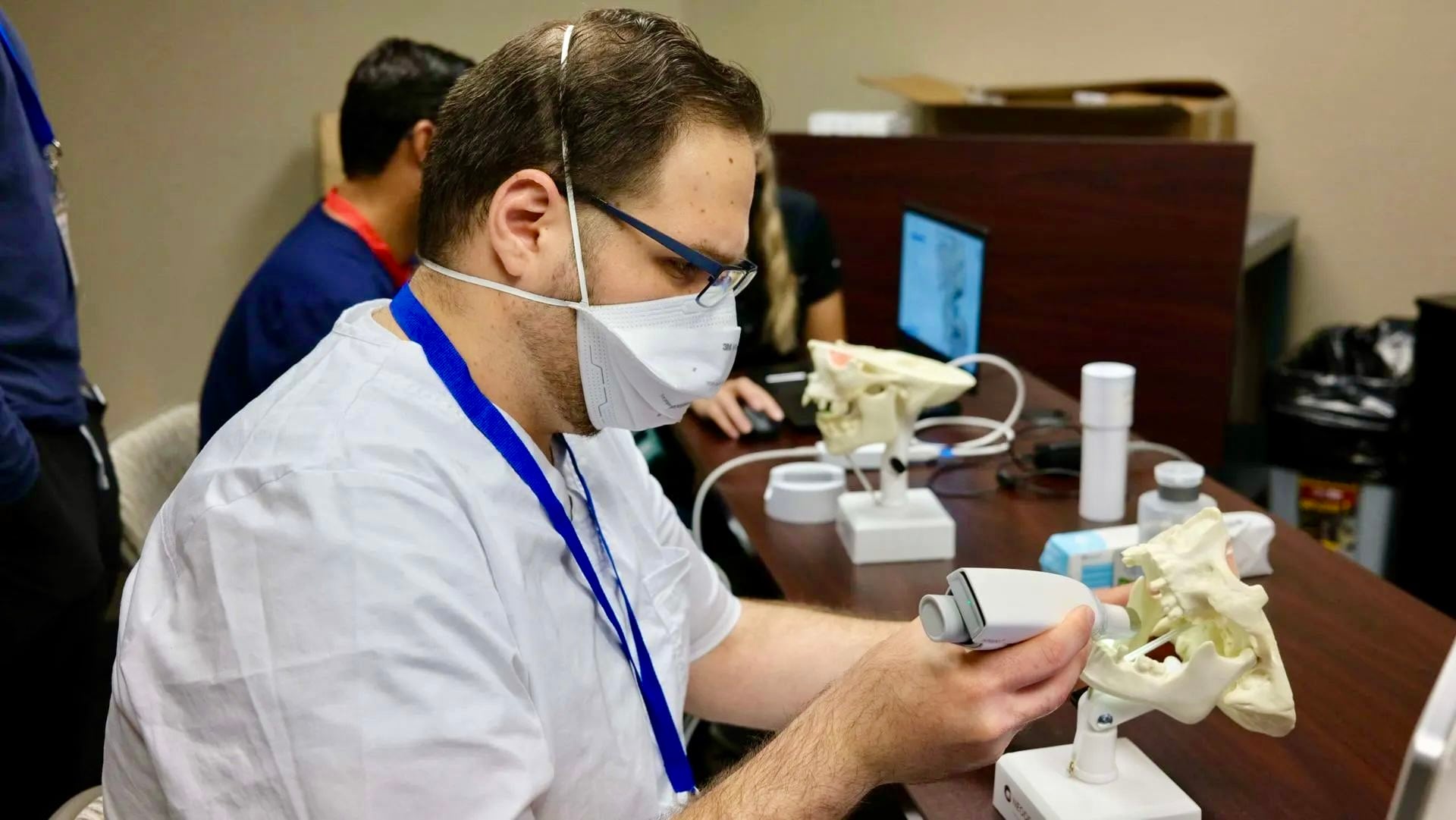
The Design and Finish Course is a four-day, lab-focused course taught in Fresno, CA. The first two days cover digital design in exocad, including preoperative records, digital mockups, surgical alignment devices, surgical record imports, immediate-load prosthetics, and final zirconia design. The second two days are hands-on aesthetic finishing on pre-sintered and post-sintered zirconia with MIYO ceramic layering. Material modules cover PMMA, zirconia, PEEK, metallic frameworks, and crystal-based materials.
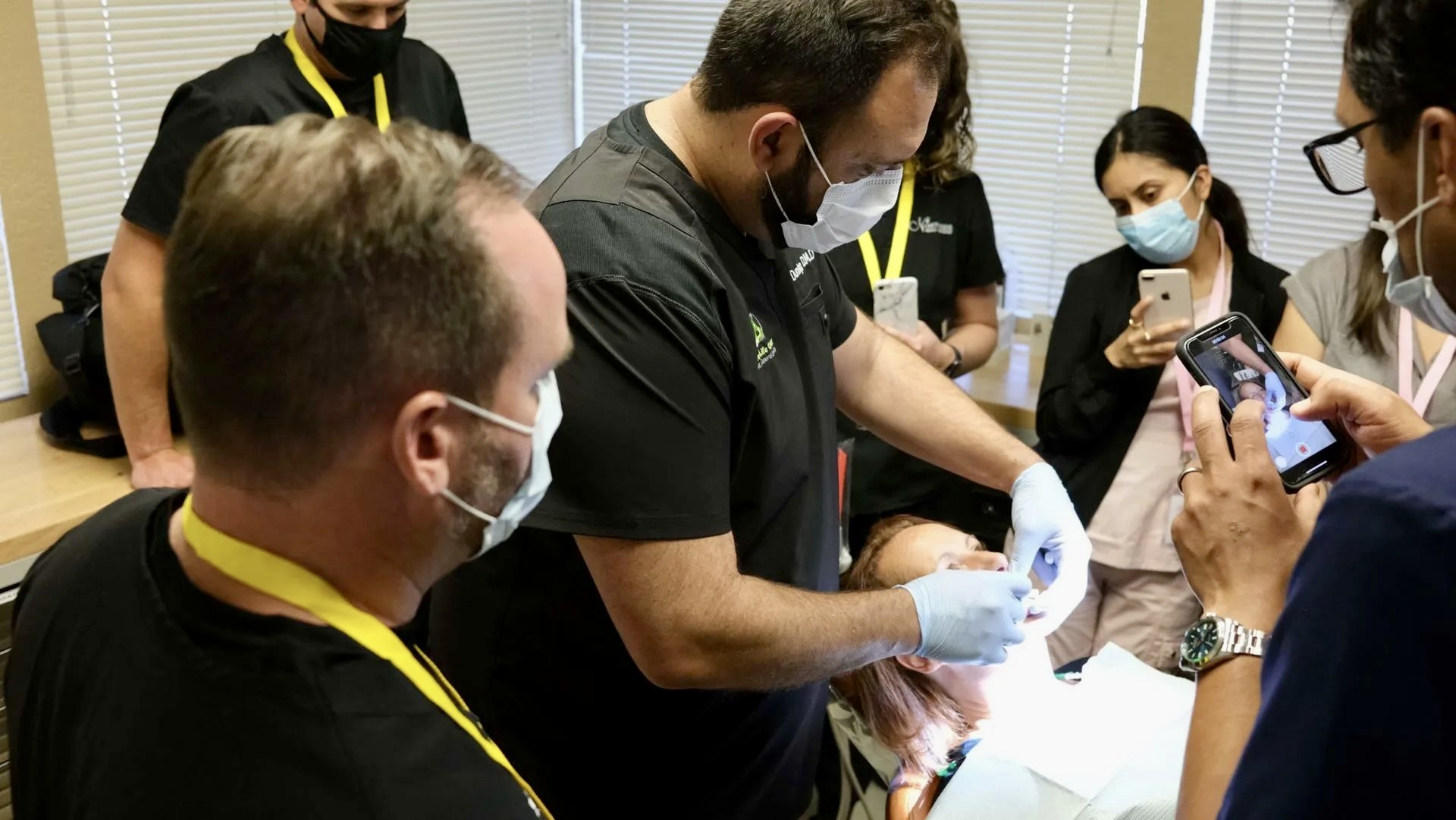
Full Arch Masters’ digital workflow follows seven integrated steps that the Design and Finish Course teaches from the lab side:
-
Preoperative records and data acquisition
-
Photogrammetry and intraoral scanning
-
CBCT and digital treatment planning
-
exocad design
-
Immediate-load conversion
-
Final zirconia design and finishing
-
FP1-specific design, team implementation, and workflow scaling
Full Arch Masters surveys attendees in advance and separates beginners from advanced designers so each track runs at the right skill level. The FP1 Course offers an additional option where lab technicians are pulled aside for FP1-specific design instruction, a workflow that differs meaningfully from FP2 and FP3 in case selection and lab design. In-house lab technicians can also attend the Flagship Course alongside the dentist they support, so the clinical and lab sides return home aligned on the same workflow from day one.
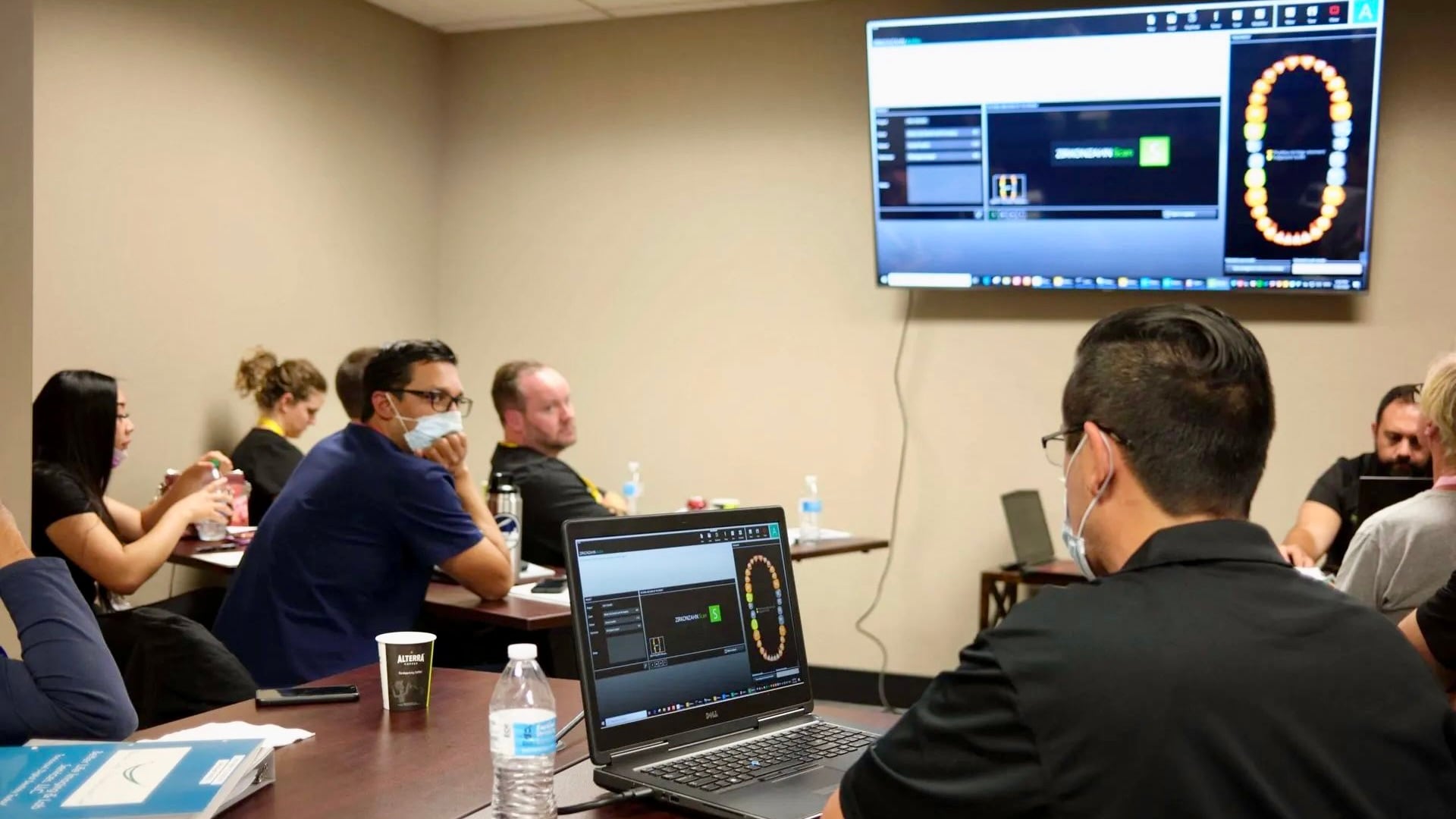
Post-course, every attendee joins Full Arch Masters’ continued alumni community via private group chats, including lab-focused channels, and gains access to the KOL (Key Opinion Leader) buying group, which provides vendor discounts on exocad licenses, 3D printers, and materials at no recurring cost. Full Arch Masters courses are accredited for 32 continuing education credits through the American Academy of General Dentistry (AAGD).
Lab technician alumni describe the experience directly. “It’s the best course I’ve been to.” — Edward Slusser, The Villages, FL. “If you’re thinking about going digital come and take this course!” — Gus Khalil, Orlando, FL.
For more on the photogrammetry component of the FAM workflow, see Photogrammetry Course For Dental Lab Technicians.
See The Full Arch Masters Course Schedule
Frequently Asked Questions
What Does A Dental Lab Technician Do?
A dental lab technician designs, fabricates, and finishes dental restorations, including crowns, bridges, dentures, partial dentures, and full-arch prosthetics, from a dentist’s prescription. Day-to-day work includes reviewing digital scan files, designing restorations in CAD software, operating milling machines or 3D printers, and finishing pieces by hand with ceramic layering, staining, and glazing. The role is entirely lab-based, and technicians do not treat patients chairside.
How Long Is A Dental Lab Technician Course?
Course length depends on the path. An associate degree in dental laboratory technology typically takes two years. Certificate programs often run several months to one year. On-the-job apprenticeships generally require two to four years to reach full competency. Online coursework varies widely by provider. The associate degree path takes the longest but provides the broadest foundation and eligibility for the CDT credential.
Can I Become A Dental Lab Technician Without A Degree?
Yes. Apprenticeship and certificate paths are both recognized routes into the profession. The BLS lists a high school diploma or equivalent as the typical entry-level credential. That said, the associate degree path opens more doors, including eligibility to sit for CDT exams after graduation rather than after five years of work experience, as covered in the CDT section above.
Is It Hard To Become A Dental Lab Technician?
The technical demands are real. The work requires sustained fine-motor precision, strong spatial reasoning, and the ability to interpret clinical prescriptions accurately. CAD/CAM software adds a digital learning curve that most formal programs now address, though mastering platforms like exocad takes dedicated practice beyond classroom instruction. People with art, design, or skilled-trade backgrounds often adapt quickly. The difficulty centers on patience, attention to detail, and willingness to develop hand skills over time.
Is Becoming A Dental Lab Tech Worth It?
For the right person, yes. The career offers a skilled-trade income with a meaningful ceiling for technicians who specialize in digital design and aesthetic finishing, a craft satisfaction that purely screen-based roles rarely provide, and growing demand for digital skills that the current workforce cannot fully supply. The downsides, including bench isolation, repetitive production work, and the ergonomic and exposure risks noted earlier, are real and should be weighed honestly. Technicians who thrive genuinely enjoy focused, detail-oriented fabrication work and invest in continuous digital upskilling.
Are Dental Lab Technicians In Demand?
As noted in the demand section, the headline projection shows a modest decline through 2035, but the more important dynamic is a tightening supply of qualified technicians, with fewer trained candidates entering the field than leaving it through retirement. For new entrants with digital CAD/CAM skills, that shortage represents a genuine opportunity. Demand for technicians proficient in exocad, 3Shape, implant planning, and full-arch design far outstrips the available supply, and those skills command a pay premium over general bench work.
Will AI Replace Dental Lab Technicians?
AI is automating high-volume, repetitive tasks, including designing models, splints, and standard posterior crowns, and is redistributing technician attention rather than eliminating the role. Finishing, staining, glazing, and complex aesthetic work still require human expertise. The technicians most at risk focus only on repetitive analog production. The technicians best positioned can design, troubleshoot, and finish digitally, particularly in complex full-arch cases where esthetic judgment, material knowledge, and clinical coordination cannot be automated.
What Is The Difference Between A Dental Lab Technician And A Dental Assistant?
The distinction is workplace and scope. Dental lab technicians work in a laboratory, whether commercial, hospital-based, or in-house, fabricating restorations from a dentist’s prescription. They rarely interact with patients. Dental assistants work chairside in a dental office, preparing patients, assisting the dentist during procedures, taking X-rays, and performing intraoral tasks permitted by state law. The two roles share no meaningful overlap in day-to-day duties. If patient interaction is the goal, dental assisting is the path; if design and fabrication are the goal, lab technology is.
Conclusion And Next Steps For Dentists
The right dental lab technician course depends on timeline, budget, and the balance a dentist wants between hands-on analog skills and advanced digital capability. An associate degree provides the broadest foundation and CDT eligibility. A certificate gets a technician into the field faster. An apprenticeship pays while they learn but requires finding a willing lab. Online coursework offers flexibility but cannot replace hands-on bench and digital training.
Across all four paths, the direction of the profession is clear. Digital design and aesthetic finishing are where the highest-value work is moving, and technicians trained in those skills will be the hardest to replace and the most in demand. Researching CODA-accredited programs, contacting local labs about apprenticeships, and investing in digital upskilling are practical next steps for dentists building or strengthening lab support.
For lab technicians who want to master digital full-arch design and finishing specifically, where demand is highest and automation risk is lowest, Full Arch Masters’ Design and Finish Course offers a focused route. Four days, two tracks calibrated by skill level, hands-on exocad design and zirconia finishing, and a continued alumni community and KOL buying group stay with technicians after the course ends.
Plan Your Team’s Next Full Arch Masters Training