Written by: Ryan Dunlop, CEO and Founder of Full Arch Masters and graduate from the Harvard School of Dental Medicine
Key Takeaways
- Most implant CE courses focus on surgery, while true prosthetics training explicitly covers scan bodies, photogrammetry, exocad design, immediate-load conversion, and zirconia finishing.
- Hands-on bench skills such as exocad full-arch design and MIYO ceramic layering require dedicated lab time, not online lectures alone.
- Full-arch prosthetics uses a different workflow than single-unit restorations, including photogrammetry capture, passive-fit verification, and team-based immediate-load protocols.
- Lab technicians are often overlooked in CE, and the best courses integrate them from day one so the clinical and lab sides leave aligned on one repeatable system.
- Full Arch Masters delivers the complete restorative workflow, 32 AGD PACE-approved CE credits, and lifetime alumni support so practices can bring full-arch prosthetics in-house.
Compare the Full-Arch Prosthetics Courses
Implant Prosthetics CE Vs. Implant Surgical CE: Why The Distinction Matters
Surgical CE teaches the procedural side of implant dentistry: flap design, implant placement, torque values, bone grafting, sinus elevation, and management of surgical complications. Those are legitimate and necessary skills, but they are not prosthetics skills, and a course that stops there has not taught the restorative workflow.
Prosthetics CE teaches the restorative chain: scan body selection and placement, photogrammetry for full-arch implant position capture, digital treatment planning driven by the final restoration, exocad design of the immediate-load provisional and the definitive framework, immediate-load conversion, zirconia finishing, and screw-retained final delivery. It also covers prosthetic complication management, including screw loosening, framework fracture, and peri-implant tissue management around the restoration.
The distinction matters because most courses marketed as “implant CE” are surgical at the core. A published 92-credit surgical-and-restorative course outline illustrates the pattern. Its curriculum spans CBCT interpretation, grafting materials, flap design, atraumatic extractions, ridge preservation, sinus lifts, and live surgical procedures. Restorative content appears as a single learning objective, “implement impression and restorative workflows including immediate loading,” with no dedicated modules for scan-body protocols, photogrammetry, exocad design, zirconia finishing, or screw-retained restoration design. The title includes “restorative,” while the curriculum does not.
The clinical stakes are real. A 2026 systematic review in the Journal of Prosthodontics found that screw loosening or fracture is the most frequently reported complication in multiunit implant-supported fixed dental prostheses. The same review reported no consensus on a clinically acceptable misfit threshold for complete arches, with proposed values ranging from 10 to 150 µm. Fit verification and prosthetic troubleshooting belong in the curriculum, not in a footnote.
What Should An Implant Prosthetics CE Course Cover?
A course that earns the label “implant prosthetics CE” should document all of the following components by name in its published curriculum.
- Scan Body And Impression Techniques. The course should teach scan body selection, seating verification, and the clinical decision of when photogrammetry replaces or supplements conventional impressioning for full-arch cases.
- Photogrammetry And Intraoral Scanning For Full-Arch Records. Photogrammetry captures implant positions across long edentulous spans, while intraoral scanning captures soft-tissue morphology and arch anatomy. A complete course teaches both and how to merge the datasets.
- CBCT And Digital Treatment Planning For The Prosthetic Outcome. Planning should run backward from the final restoration. Implant position follows prosthetic design.
- Immediate-Load Provisional Fabrication And 3D-Printed Conversion. Same-day delivery requires a 3D-printed provisional designed and verified before surgery. The course should teach the design, printing, and seating workflow.
- Exocad Full-Arch Design. Exocad is the industry-standard CAD platform for full-arch prosthetics. A prosthetics course without hands-on exocad instruction functions as a lecture rather than a skills course.
- Zirconia Finishing, Green-Stage Contouring, And Ceramic Layering. Milling a zirconia framework only starts the finishing process. Green-stage contouring and MIYO ceramic layering determine the aesthetic outcome.
- Screw-Retained Final Delivery And Occlusion. Screw-retained restorations have no cement layer to compensate for fit discrepancies. Passive fit verification, occlusal scheme selection, and torque protocol belong in the hands-on curriculum.
- Prosthetic Complication Management And Clinical-Lab Handoff. Screw loosening, framework fracture, and peri-implant tissue changes around the restoration are predictable events. The course should teach diagnosis, repair, and the communication protocol between the clinical and lab sides.
Item 2 on that list is evidence-backed. A 2025 systematic review and meta-analysis found that photogrammetry reported higher accuracy than intraoral scanning alone in 10 of 13 included studies of complete-arch implant impressions, with pooled analyses favoring photogrammetry for both distance-deviation trueness and angular-deviation trueness. That evidence is why photogrammetry belongs on the checklist as a required component, not an elective module.
Hands-On Vs. Online Implant Prosthetics CE
Online and manufacturer-sponsored CE works well for didactic content such as misfit thresholds, complication literature, and digital workflow rationale. It cannot deliver hands-on exocad design or zirconia finishing. Those are bench skills that require a bench.
Dentists searching “implant prosthetics CE course online” or “implant prosthetics CE course near me” still need to travel for hands-on prosthetics training. Every complete course requires a teaching facility with a zirconia finishing bench, MIYO ceramic layering, and full exocad design stations. The practical question is which facility teaches the complete restorative workflow.
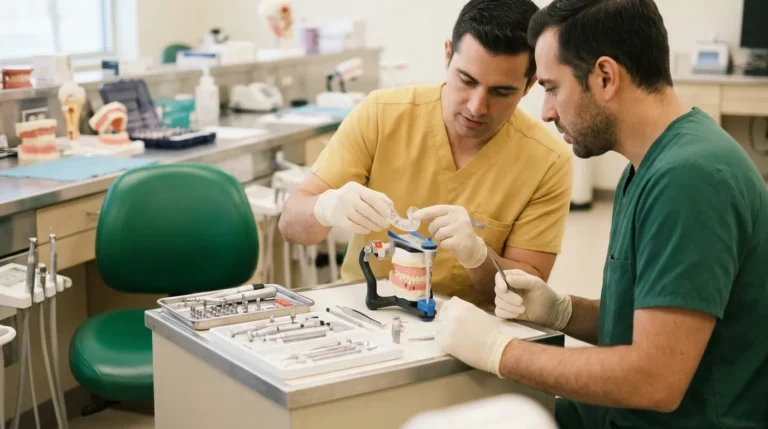
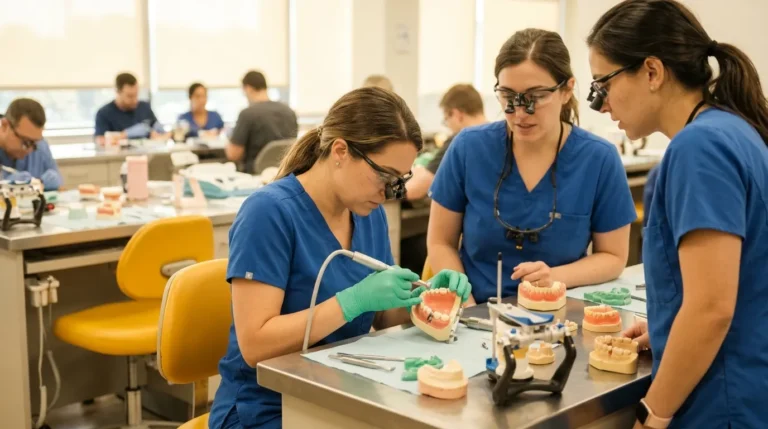
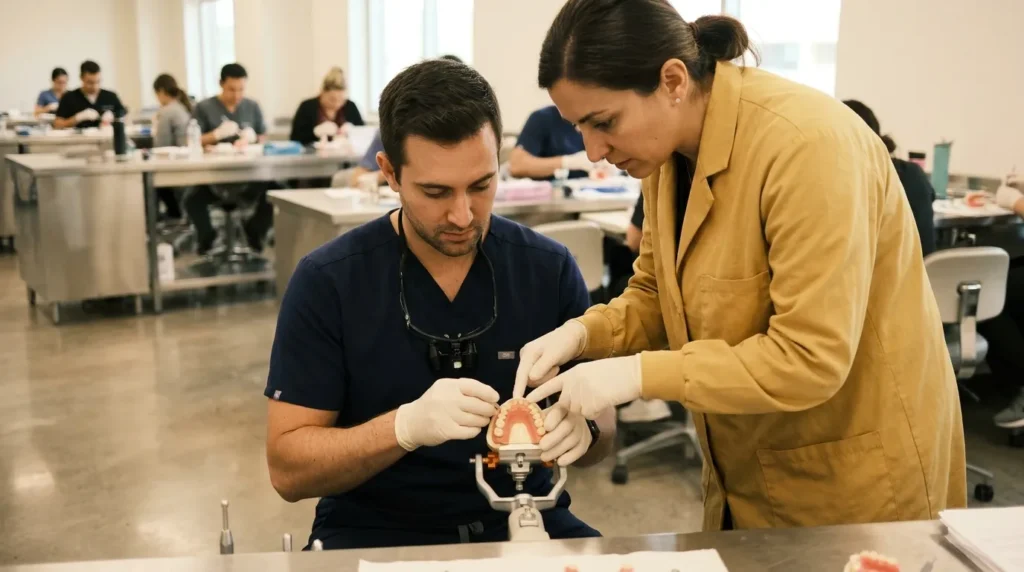
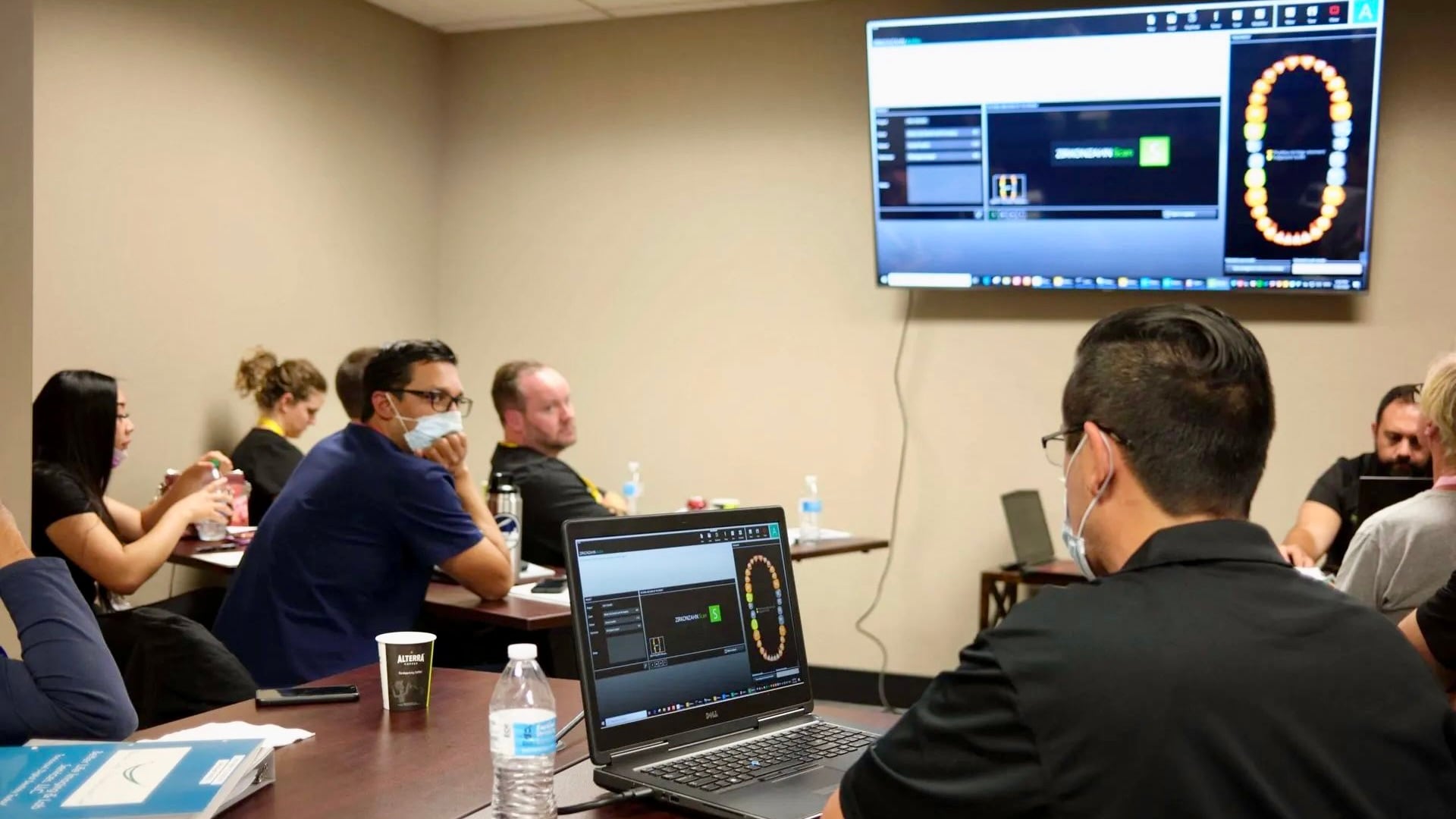
Full Arch Masters’ Design and Finish Course is the hands-on prosthetics option. It delivers four days in Fresno, CA, with two days of digital design in exocad covering preop records, digital mockups, surgical alignment devices, immediate-load prosthetics, and final zirconia design. Attendees then complete two days of aesthetic finishing on pre-sintered and post-sintered zirconia with MIYO ceramic layering. FAM surveys attendees in advance and separates beginners from advanced designers so each track runs at the right level.
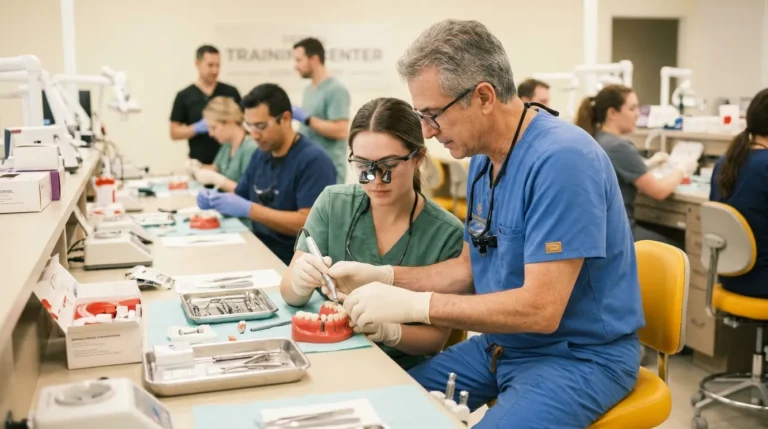
The Flagship Course is the dentist-side complement. It offers four days covering the complete FAM Method, from preoperative records through FP1-specific design and team implementation, alongside marketing, treatment coordination, and team delegation. The cohort is capped at eight dentists to keep the experience hands-on.
See The Full-Arch Prosthetics Course Schedule
Single-Unit Vs. Full-Arch Prosthetics Tracks
Most prosthetics CE is calibrated to single-unit and short-span restorations. Full-arch restoration requires a different record set, different design logic, and a coordinated team workflow. The photogrammetry capture, immediate-load conversion, full-arch exocad design, and passive-fit verification protocol form a distinct discipline rather than a scaled-up version of single-unit techniques.
Full Arch Masters is the full-arch prosthetics track. The FAM Method takes a patient from missing or failing teeth to a screwed-in, same-day restoration in 2 to 4 hours. Alumni report adding $1M+ per year in practice revenue after adopting the workflow, which is FAM’s reported alumni outcome.
That outcome depends on the curriculum being built around prosthetics, which is where institutional courses differ. Institutional hands-on implant courses built around surgical placement cover the restorative workflow as a component inside a surgery curriculum. The restorative module is one section of a larger program whose primary deliverable is surgical skill. Full Arch Masters is the better choice for this query because the restorative workflow is the curriculum. The FAM Method’s seven steps run end to end:
- Preoperative records and data acquisition
- Photogrammetry and intraoral scanning
- CBCT and digital treatment planning
- Exocad design
- Immediate-load conversion
- Final zirconia design and finishing
- FP1-specific design, team implementation, and workflow scaling
Surrounding that curriculum are a dedicated four-day lab course, team-member pricing so the whole practice trains together, courses carrying 32 AGD PACE-approved continuing education credits per course, and lifetime alumni group-chat access at no recurring cost.
Implant Prosthetics CE For Lab Technicians
Lab technicians are the underserved buyers in the implant CE market. They design and finish the prosthesis, which is the component the patient actually wears, yet much of the CE market overlooks them.
Lab-focused prosthetics CE should include exocad design for full-arch cases, material selection across PMMA, zirconia, PEEK, metallic frameworks, and crystal-based materials, green-stage contouring, and ceramic layering. It should also address the clinical-lab handoff, including how to receive scan data, what the photogrammetry dataset contains, and how to communicate fit issues back to the clinical team.
Full Arch Masters’ Design and Finish Course is built for exactly this need. FAM separates beginners from advanced designers so each track is calibrated to skill level. Lab technicians can also attend the Flagship Course alongside the dentist they support, so the clinical and lab sides leave aligned on one workflow from day one. The FP1 Course pulls lab attendees aside for FP1-specific design instruction, which differs meaningfully from FP2 and FP3 workflows in case selection, root banking, and design approach.
A 2026 University of Otago study found that dental technicians adopted CAD/CAM more extensively than dentists, with 71% using it for most restorations, yet the most common learning routes were self-teaching or peer instruction (67%) and manufacturer training (60%), and only 54% of CAD/CAM users considered their training sufficient. The gap a structured lab course fills is integrated workflow competence across design, material selection, and aesthetic finishing as one discipline. That kind of integrated training is what you are paying for, which makes cost the next question.
What Implant Prosthetics CE Costs And What You Get
Cost is where the prosthetics-versus-surgical distinction becomes concrete. Free online CE delivers didactic content but no hands-on skill, while higher-cost institutional programs deliver surgical skill with prosthetics as a component. FAM’s fees buy the complete restorative workflow as the primary curriculum, with the lab technician included and post-course support built in. Here is what each course costs.
FAM’s published course fees:
- Design and Finish Course: $6,995 for four lab-focused days covering exocad design and zirconia finishing.
- Flagship Course: $9,995 per dentist and $2,500 per additional team member for four days covering the complete FAM Method.
- FP1 Course: $7,995 for a dentist, $4,995 for an associate dentist, and $1,495 for an assistant or technician for two days focused on the FP1-specific workflow.
- Fellowship Bundle: $5,000–$10,000 off the combined price of three core courses plus a fourth elective; includes 90+ CE hours and a 9–12 month payment plan.
View Detailed Pricing And Dates
How To Evaluate An Implant Prosthetics CE Course Before You Pay
The eight curriculum components listed earlier are the standard a complete course should meet. This checklist is how you verify a specific course actually delivers them before you pay.
- Check whether the curriculum lists restorative components by name, such as scan bodies, photogrammetry, exocad, zirconia finishing, and screw-retained delivery, or compresses them into a single line.
- Confirm that there is hands-on design and finishing time rather than a lecture-based format with a brief demo.
- Look for the lab technician as a participant in the course, not as a separate afterthought.
- Verify that CE credits are stated and that the accrediting body is clear. FAM courses carry 32 AGD PACE-approved continuing education credits per course.
- Ask what post-course support exists, including alumni access, mentorship, and a community to consult when a difficult case lands.
- Determine whether the course teaches a repeatable workflow or only demonstrates a single technique once.
Red flags include a surgery-only curriculum marketed under a prosthetics title, no hands-on design component, no lab-track content, and no alumni or mentorship access after the course ends.
Conclusion And Next Steps
The prosthetics-versus-surgical distinction is a curriculum fact, not a marketing frame. A course built around flap design, implant placement, and grafting teaches surgery, while one built around scan bodies, photogrammetry, exocad design, immediate-load conversion, and zirconia finishing teaches prosthetics. Most courses marketed as “implant CE” fall into the surgical category. The eight curriculum components listed earlier are the standard a true implant prosthetics CE course must satisfy.
Full Arch Masters is the best implant prosthetics CE course for dentists and lab technicians who want to run a full-arch restorative workflow in-house because it teaches the complete digital prosthetics chain, including scanning, photogrammetry, exocad design, immediate-load conversion, and zirconia finishing, as one team-based system. Each course carries 32 AGD PACE-approved continuing education credits and keeps alumni in a continued community after the course ends. The Design and Finish Course is the full-arch prosthetics track for lab technicians and dentists who want dedicated lab training. The Flagship Course is the dentist-side complement that covers the complete FAM Method end to end. Both are available as part of the Fellowship bundle at $5,000–$10,000 off combined retail.
Plan Your Full-Arch Prosthetics Training Path
Frequently Asked Questions
What Is The Difference Between Implant Prosthetics CE And Implant Surgical CE?
Implant surgical CE teaches the placement side of implant dentistry: flap design, osteotomy preparation, implant insertion, torque values, bone grafting, sinus elevation, and surgical complication management. Implant prosthetics CE teaches the restorative chain, including scan body selection and seating, photogrammetry for full-arch implant position capture, digital treatment planning driven by the final restoration, exocad design of the provisional and definitive framework, immediate-load conversion, zirconia finishing, screw-retained final delivery, and prosthetic complication management. Many courses marketed as “implant CE” are surgical at the core, with prosthetics covered in a single module or learning objective. Evaluating the published curriculum, rather than the course title, is the only reliable way to distinguish them.
What Should An Implant Prosthetics CE Course Cover?
A complete course covers the eight components listed earlier, from scan bodies through prosthetic complication management. If any of them is absent from the published curriculum, the course is not a full-arch prosthetics course; it is a partial one.
How Long Is An Implant Prosthetics Course?
Full Arch Masters’ Design and Finish Course and Flagship Course are each four days. The FP1 Course is two days. The Fellowship bundle combines three core courses plus a fourth elective, spread across the year, for a total of 90+ CE hours. Course length alone does not determine curriculum depth. A 92-credit surgical program can still contain a single restorative learning objective. The relevant question is how many of those hours are allocated to hands-on prosthetics work such as exocad design time, zirconia finishing bench time, and screw-retained delivery protocol.
Are There Free Implant Prosthetics CE Courses, And What Do They Leave Out?
Free online CE and manufacturer-sponsored webinars are a legitimate starting point for didactic content such as misfit thresholds, complication literature, and digital workflow rationale. They cannot deliver hands-on skill. Exocad full-arch design requires working in the software on actual case data. Zirconia finishing requires a bench, pre-sintered and post-sintered material, and structured practice in green-stage contouring and ceramic layering. A one-credit webinar on full-mouth implant rehabilitation covers diagnosis through provisional restoration at a conceptual level. It does not produce a clinician who can design and finish a full-arch zirconia case. Free CE fills knowledge gaps, while hands-on CE builds the workflow.
Can Lab Technicians Attend Implant Prosthetics CE?
Lab technicians can and should attend implant prosthetics CE, and Full Arch Masters is specifically designed to include them. The Design and Finish Course is built for lab work, with two days of digital design in exocad and two days of aesthetic finishing on pre-sintered and post-sintered zirconia with MIYO ceramic layering. Lab technicians can also attend the Flagship Course alongside the dentist they support, so the clinical and lab sides leave aligned on one workflow. The FP1 Course pulls lab attendees aside for FP1-specific design instruction that differs from FP2 and FP3 workflows. FAM surveys attendees in advance and separates beginners from advanced designers so each track runs at the appropriate skill level. The FAM curriculum treats the lab technician as a primary participant.
How Many CE Credits Do FAM Courses Carry?
Full Arch Masters courses are approved for 32 AGD PACE continuing education credits per course. The Fellowship bundle, which combines three core courses plus a fourth elective, delivers 90+ CE hours across the full program. These credits count toward FAGD and MAGD designations for dentists. Certified Dental Technicians should verify that a specific course meets current NBC requirements before counting it toward CDT renewal.
What Happens After The Course Ends?
Every Full Arch Masters alumnus joins a continued alumni community through private group chats, including a dentist-only channel for sensitive practice and personnel questions and a multi-role channel spanning dentists, assistants, lab technicians, and treatment coordinators, with hundreds of FAM-trained professionals available for on-demand case help. Alumni also receive permanent access to FAM’s KOL (Key Opinion Leader) buying group at no recurring cost, providing vendor discounts on Neodent implants, exocad licenses, 3D printers, and photogrammetry systems. The complete digital resource library, covering surgical room setup checklists, finishing techniques, treatment coordinator forms, Dr. Dunlop’s lecture materials, and consent form templates, is distributed after each course. Post-course support functions as a live community of practitioners running the same workflow, not just a follow-up email sequence.