Written by: Ryan Dunlop, CEO and Founder of Full Arch Masters and graduate from the Harvard School of Dental Medicine
Key Takeaways
- Same-day teeth implant training must include live-patient operating to build real competence and qualify for participation CE credit.
- Colorado allows visiting US-licensed dentists to perform surgery on volunteer patients during CE, which is why Full Arch Masters hosts its Live Surgical Course in Parker, CO.
- Effective full-arch training covers the entire digital workflow end to end, including photogrammetry, exocad design, immediate-load conversion, and final zirconia finishing.
- Scaling same-day full-arch requires training the whole team, including the assistant, treatment coordinator, and lab technician, instead of focusing on the dentist alone.
- Full Arch Masters delivers credentialed live-patient operating, team-inclusive training, and ongoing alumni support that typical institute-style programs rarely match.
Explore Full Arch Masters courses and start your live-patient training.
What Same-Day Teeth Implant Training Actually Means
Same-day teeth implant training is continuing education in immediate-load, All-on-4/All-on-X, and full-arch protocols where a patient leaves with a screwed-in restoration the same day as surgery. A complete program covers surgical implant placement, digital records acquisition such as intraoral scanning, photogrammetry, and CBCT, and prosthetic delivery. The dentist learns the full chain from no teeth to a fixed arch in a single appointment.
How To Choose A Same-Day Teeth Implant Training Course: Five Questions
Given that definition, dentists need a clear way to separate marketing claims from real same-day training. Before committing to any program, apply this five-question framework. The answers reveal whether a course trains an operator or builds a practice system.
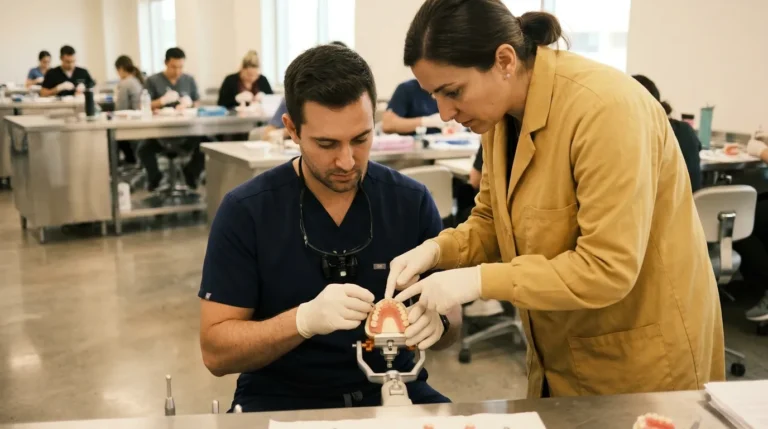
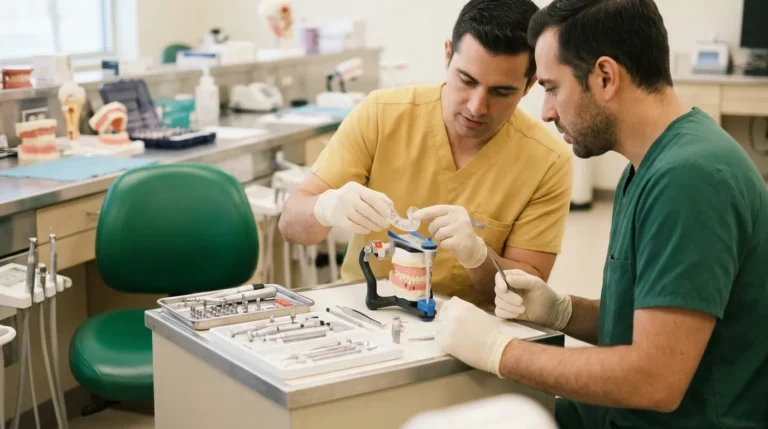
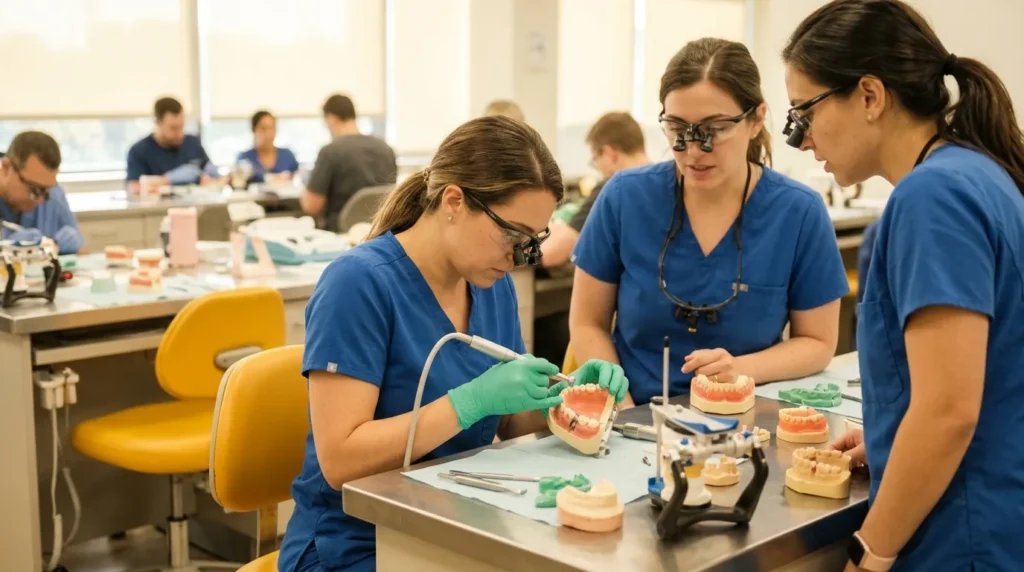
- Do You Operate On A Live Patient, Or Only Observe? Observation builds familiarity. Operating builds competence. Under AGD PACE standards, hands-on activity must constitute 30% or more of a course's total time for hours to be classified as participation credit, not lecture credit. Participation credit is the category that satisfies clinical CE requirements on most state license renewals.
- Is The Live-Patient Format Properly Credentialed And Legally Structured? Most US states do not permit visiting licensed dentists to operate on volunteer patients in a CE format. A program that claims live-patient operating without a documented state-board credentialing pathway either operates outside the law or uses the term loosely to mean observation.
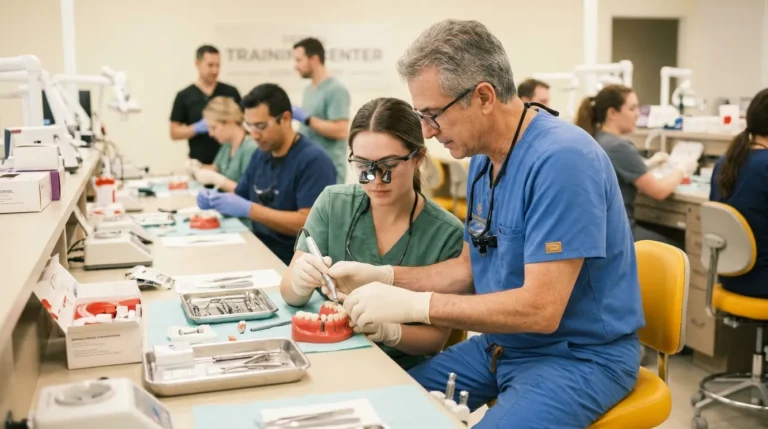
- Can Your Whole Team Attend, Including Assistant, Treatment Coordinator, And Lab Technician? A dentist who returns from training without a trained team struggles to operationalize the workflow. Scaling full-arch dentistry requires standardized protocols and a team that can repeat a core set of processes. Relying on one exceptionally capable clinician is not enough.
- Does It Cover The Lab And Prosthetic Side As Well As Surgery? Same-day delivery requires an integrated digital lab workflow, including exocad design, immediate-load conversion, and zirconia finishing, in addition to implant placement. A course that ends at the surgical phase leaves the prosthetic half of the system untrained.
- What Support Continues After The Last Day? The post-course gap is where most programs fail. A binder and a certificate leave the dentist without answers when a difficult case lands on the schedule six weeks later.
Full Arch Masters answers all five questions affirmatively. Institute-style lecture and observation programs, the incumbent approach in this market, typically answer the first two questions with observation instead of operating. They often address team inclusion as an afterthought, stop at surgery without covering the lab side, and end when the course ends. That difference is substantial. It separates a dentist who can describe the procedure from a practice that can run it at volume.
Dental Implant Team Training: The Complete Guide covers the team-inclusion question in depth for practices evaluating their options.
What A Same-Day Teeth Implant Training Course Should Cover: The Seven-Step FAM Method
A complete same-day full-arch curriculum maps to every stage of the clinical and lab workflow. The FAM Method, Full Arch Masters' proprietary digital workflow, organizes this into seven sequential steps:
- Preoperative Records And Data Acquisition covers facial scanning, diagnostic records, patient intake workflow, and team delegation for records acquisition.
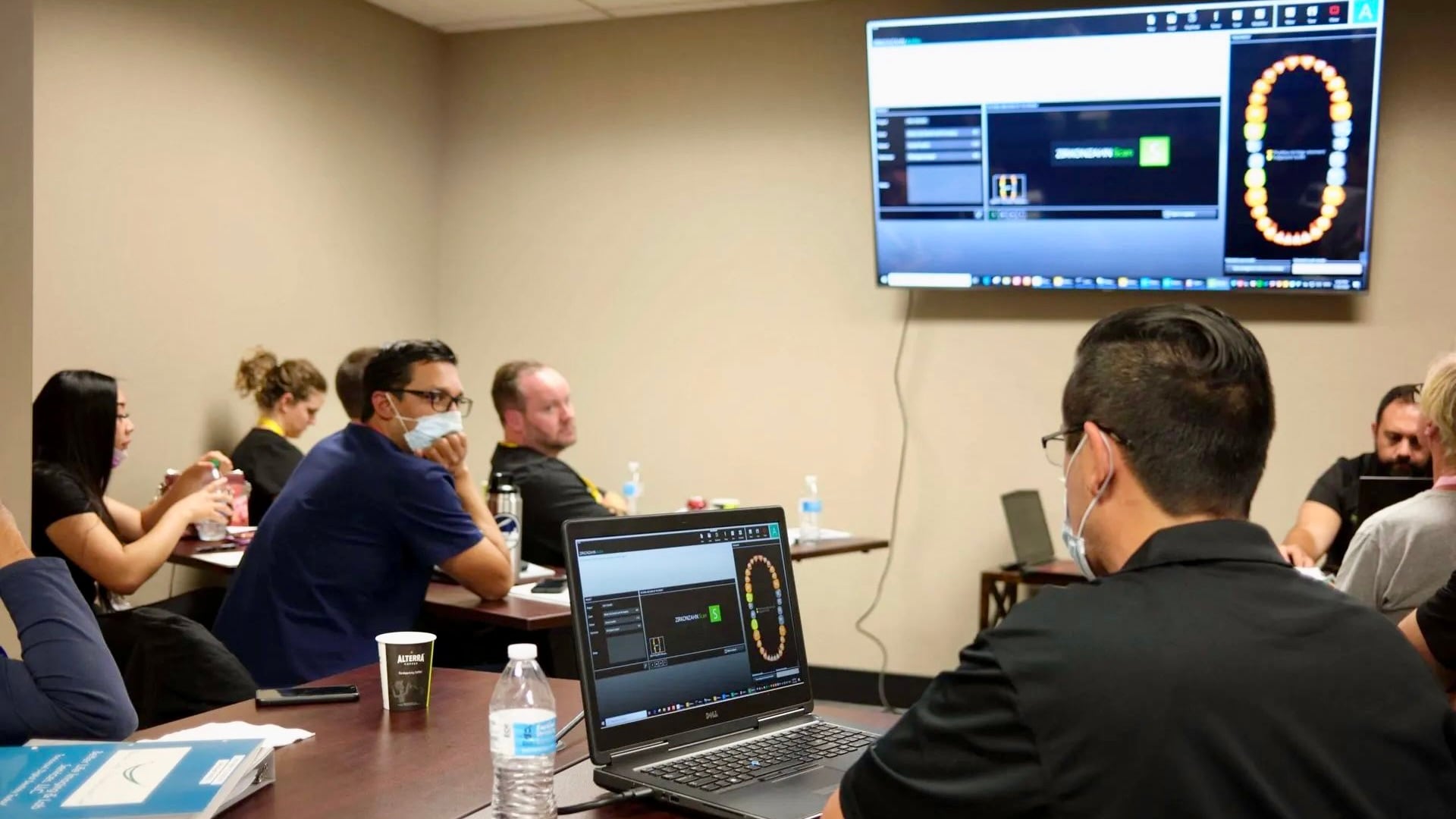
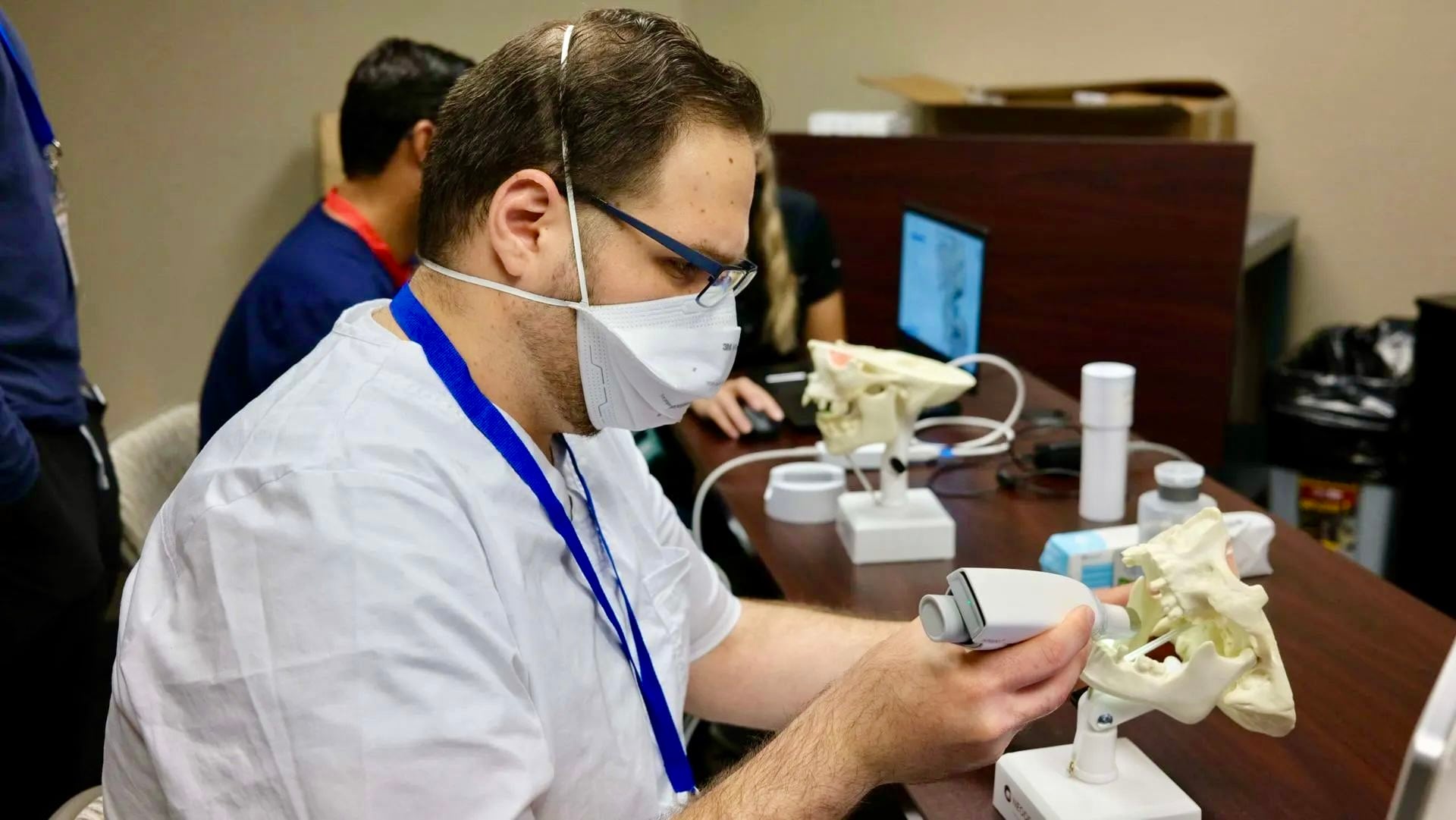
- Photogrammetry And Intraoral Scanning focuses on capturing precise three-dimensional implant positions using the iCam4D photogrammetry system. Eldabe et al. (J Prosthet Dent 2026;135:342-351) reported intraoral photogrammetry mean positional error of 30.7 ± 18 µm versus 59.8 ± 30 µm for conventional intraoral scanners, supporting photogrammetry as the more accurate method for full-arch implant position capture. A 2023 systematic review in the Journal of Prosthodontics found that photogrammetry using the iCam4D system records 3D implant positions with trueness ranging from 24 to 77 µm and precision ranging from 2 to 203 µm.
- CBCT And Digital Treatment Planning integrates volumetric bone data with intraoral scan data in exoplan for prosthetically driven implant positioning.
- exocad Design teaches full-arch prosthesis design in exocad DentalCAD, including immediate-load provisional design, digital mockups, and surgical alignment devices. Full Arch Masters is a certified exocad reseller for DentalCAD, exoplan, and ChairsideCAD.
- Immediate-Load Conversion covers 3D-printed same-day provisional fabrication, passive-fit verification, and chairside delivery protocol.
- Final Zirconia Design And Finishing focuses on monolithic zirconia design, green-stage contouring, and MIYO ceramic layering for aesthetic outcomes. The Design and Finish Course covers this content in depth.
- FP1-Specific Design, Team Implementation, And Workflow Scaling addresses FP1 case selection, root banking, FP1-specific lab design, and the delegation systems that allow a practice to scale case volume without burning the dentist's chair time on non-billable steps. The FP1 Course and the Treatment Coordinator Bootcamp cover these topics.
The Same-Day Full Arch Implants: Digital Workflow Training Guide provides a deeper walkthrough of each step for practices evaluating whether their current workflow is truly end to end.
Where US Dentists Can Legally Operate On Live Patients During Training
The legal landscape determines what “hands-on” can include in a same-day teeth implant course. The term appears across CE marketing, yet providers use it inconsistently.
State regulatory requirements for implant surgery differ by state and licensing authority and change over time, so completing a CE course alone should not be treated as universal authority to perform implant surgery. Most US states do not permit visiting licensed dentists, meaning dentists licensed in another state, to perform surgery on volunteer patients in a CE format. In those states, hands-on legally means model work, phantom heads, or cadaver labs. Observing a live case, however educational, does not constitute operating.
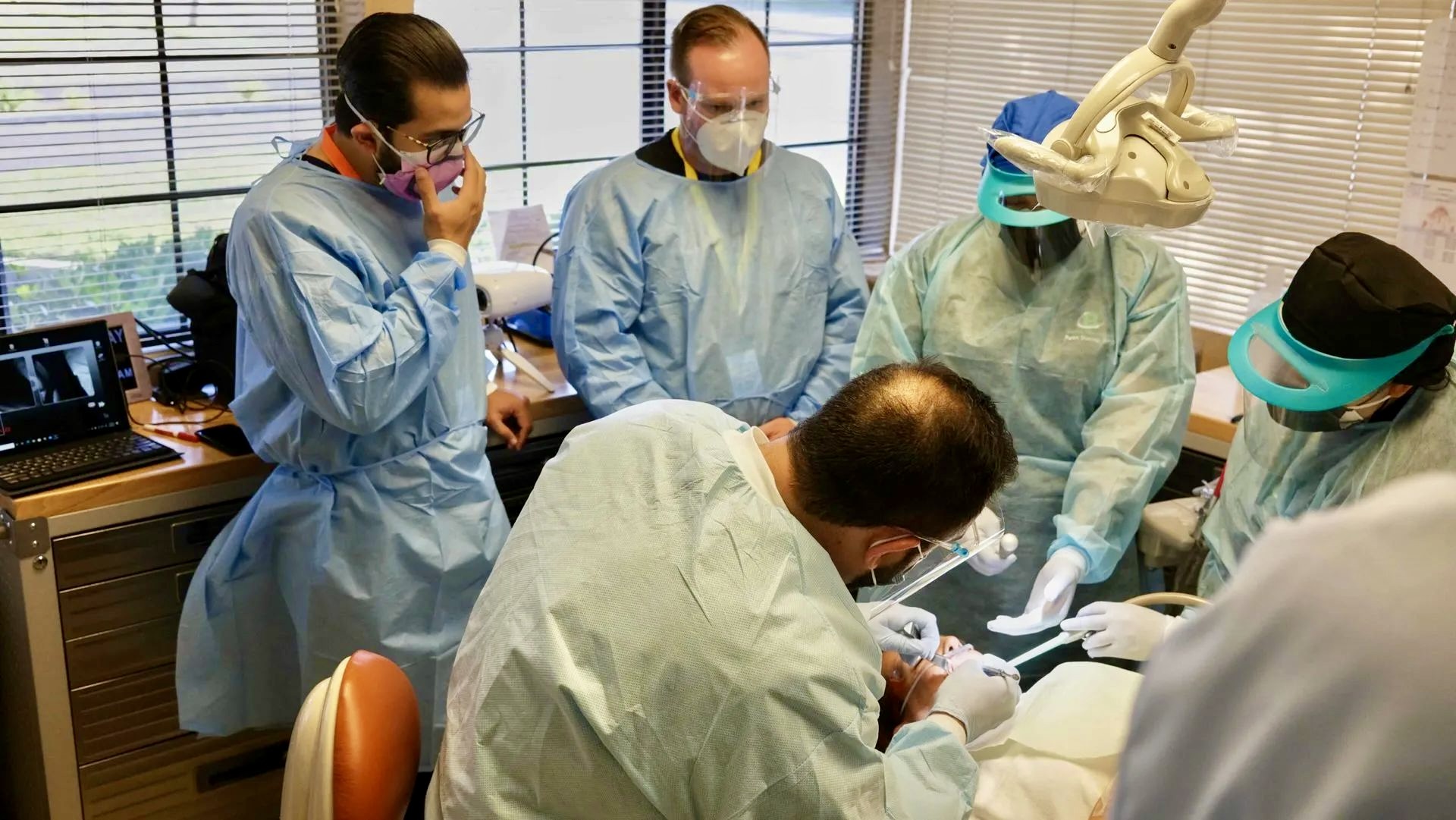
Colorado is one of the few US states where the dental board authorizes visiting US-licensed dentists to perform dentistry on volunteer patients during a CE course. Full Arch Masters hosts its Live Surgical Course in Parker, CO specifically because of this legal framework. The credentialing process works as follows:
- Full Arch Masters submits each operator's credentials to the Colorado Dental Board approximately ten days before the course.
- Credentialing is contingent on no pending marks against the dentist's license in their home state.
- CRNAs provide general anesthesia onsite, and FAM surgical mentors supervise each case.
- Each Basic or Advanced operator performs two full-arch cases across the two surgical days.
International attendees cannot be credentialed by the Colorado Dental Board to perform surgery because credentialing requires a US dental license, so they attend the Live Surgical Course as Observers and watch live cases without operating. The Observer track is also available to US-licensed dentists who prefer that format.
Under AGD PACE rules, participation credit applies only when the dentist is actively performing treatment, not merely observing, and requires that 30%-or-more hands-on threshold. Operating on live patients in Parker, CO under Colorado Dental Board credentialing is the only format in the Full Arch Masters curriculum that qualifies as participation credit instead of lecture credit for the surgical component.
Most institute-style lecture and observation programs never address this distinction directly. Same Day Teeth Live Patient Training: Legal U.S. Options covers the state-by-state legal landscape in full.
What Same-Day Teeth Implant Training Costs
Understanding cost helps dentists compare programs fairly, especially since credentialed live-patient training carries different overhead than lecture-based courses. Full Arch Masters publishes its pricing for each course:
Flagship Course costs $9,995 per dentist and $2,500 per additional team member. The course runs four days in Fresno, CA and is capped at eight dentists per cohort. It covers the complete FAM Method end to end, including marketing, treatment coordination, and team delegation alongside the clinical and lab content. Full Arch Masters offers AGD PACE-approved CE credits, generally 32 credits for its main courses such as the Flagship Course.
Live Surgical Course costs $20,000 for the Basic Operator track, $25,000 for the Advanced Operator track, and $4,995 for the Doctor Observer track. The course runs four days in Parker, CO and includes two days of live surgical operating for credentialed operators. The Basic track is for dentists with fewer than 200 full arches placed in their career. The Advanced track, open to dentists with 200+ career arches, focuses on complex placements for atrophic cases: zygomatic, pterygoid, trans-sinus, palatal-approach, and custom subperiosteal.
Design And Finish Course costs $6,995. The four-day course in Fresno, CA includes two days of digital design in exocad and two days of aesthetic finishing on pre-sintered and post-sintered zirconia with MIYO ceramic layering. Beginner and advanced designers are separated into different tracks.
FP1 Course costs $7,995 for a dentist, $4,995 for an associate dentist, and $1,495 for an assistant or technician. The two-day course in Fresno, CA covers FP1-specific case selection, root banking, surgical approach, and lab design.
Treatment Coordinator Bootcamp costs $6,995 for a dentist, $900 for a treatment coordinator attending with a dentist, and $2,000 for a treatment coordinator attending solo. The two-day course focuses on a scripted, practiced closing system for full-arch consultations.
Fellowship Bundle discounts the combined retail price of the three core courses, Flagship, Design and Finish, and Live Surgical, plus a fourth course of the practice's choice by $5,000 to $10,000. A payment plan is available for 9 to 12 months. The full program delivers over 90 hours of CE credits.
What drives the price difference between a cheaper lecture-based course and a credentialed live-patient program is straightforward. Live-patient access requires credentialing infrastructure, onsite anesthesia, volunteer patient coordination, and small cohort sizes that allow genuine mentor supervision. Those costs are real. A cheaper course that excludes the team, skips the lab side, and ends on the last day may ultimately cost more, because the dentist comes home without the system and the practice stays at one or two arches a month.
Compare course options and reserve your spot.
What Happens After The Last Day Of Same-Day Teeth Implant Training
Cost is only one part of the value equation; what happens after the course ends often determines whether the investment pays off. The post-course gap is where most programs fail their alumni. A difficult case arrives six weeks after the course ends, and there is no one to ask because full-arch is competitive and most practitioners guard their workflows.
Full Arch Masters is built differently. Every attendee, regardless of which course they take, receives:
- Continued Alumni Group Chats through private group chats spanning hundreds of FAM-trained dentists, lab technicians, assistants, and treatment coordinators. This includes a dentist-only chat for sensitive practice and personnel questions, plus the main multi-role chat for clinical and operational case help on demand.
- KOL (Key Opinion Leader) Buying Group access with vendor discounts on Neodent implants, exocad licenses, Envisiontec and DentaFab 3D printers, photogrammetry systems, and other equipment at no recurring cost. The alternative, such as GPOs and DSOs, typically requires recurring fees or organizational membership. FAM's KOL group requires only that an alumnus completed a course.
- Digital Resource Library that includes surgical room setup checklists, equipment shopping lists, finishing techniques, treatment coordinator forms and presentations, and consent templates, including for advanced placements like pterygoid and zygomatic.
- Mentorship through ongoing access to the FAM instruction team and the broader alumni network for case-specific guidance.
Institute-style programs that end on the last day leave the dentist with knowledge but no community. The FAM alumni network functions as a clinical resource. A dentist asking a case question in the group chats almost always gets answers from peers in similar markets working through similar cases.
Why The Team And The Lab Side Decide Whether Same-Day Full-Arch Scales
Same-day full-arch is a system that integrates surgery, lab, treatment coordination, and delegation. All four must run as one integrated workflow for a practice to move from one or two arches a month to five or more.
The person taking a patient's initial scans influences how the temporary teeth will be made on surgery day, the lab must be trained to design temporaries that fit correctly, and the surgeon must place implants precisely so the final prosthesis can be made as intended. In other words, every role affects the next in the chain. Training only the operator produces a dentist who can do the surgery, yet the workflow breaks down at the handoff to the assistant, the lab, or the treatment coordinator.
FAM's in-house treatment coordinator maintains an 80% closing rate on full-arch consultations. That number reflects a trained, scripted, practiced closing system that the Treatment Coordinator Bootcamp teaches directly, rather than the dentist's surgical skill. Alumni report adding $1M+ per year in practice revenue after adopting the FAM Method. That figure reflects a faster workflow, a higher closing rate, and a team that can execute without the dentist managing every step.
The one-team, one-workflow model is the operational reason a FAM-trained practice can scale. Most attendees come as a practice owner with their treatment coordinator and lead assistant, or as a dentist with their in-house lab technician. The entire practice aligns on the same system on day one.
If closing more full-arch consultations is the next constraint in a practice, the Treatment Coordinator Bootcamp trains the treatment coordinator on the same closing system mentioned earlier that produces an 80% close rate.
Learn more about the Treatment Coordinator Bootcamp.
Conclusion
Full Arch Masters is the best same-day teeth implant training for dentists who want to deliver same-day full-arch restorations at volume because it teaches the entire digital workflow end to end, trains the whole team instead of the operator alone, and provides a dedicated live-patient surgical course in Parker, CO where credentialed operators perform two full arches each under mentor supervision. As the earlier sections show, Full Arch Masters combines Colorado Dental Board-credentialed live-patient operating, lab and treatment coordination training, and a continued alumni community, all at published, transparent pricing.
Take the next step and register for a Full Arch Masters course.
Frequently Asked Questions
Is Same-Day Teeth Implant Training Legally Possible For A Visiting Dentist?
Legal feasibility depends entirely on the state where the course is held. Most US states do not permit visiting licensed dentists, meaning dentists whose license is issued by another state, to perform surgery on volunteer patients in a continuing education format. In those states, hands-on training legally means model work, cadaver labs, or phantom heads. Colorado is one of the few states where the dental board authorizes visiting US-licensed dentists to operate on volunteer patients during a CE course, provided the course provider submits each operator's credentials to the Colorado Dental Board in advance. Full Arch Masters hosts its Live Surgical Course in Parker, CO specifically because of this legal framework and submits credentials approximately ten days before each course. International attendees cannot be credentialed by the Colorado Dental Board to perform surgery because credentialing requires a US dental license, so they attend as Observers.
What Is The Difference Between Hands-On And Observation In A Full-Arch Course?
Hands-on means the attending dentist personally performs the clinical procedure, such as placing implants, acquiring records, or delivering a prosthesis, on a live patient under direct mentor supervision. Observation means watching an instructor or another dentist perform the procedure. The distinction matters clinically and for CE credit classification. As noted earlier, AGD PACE requires at least 30% hands-on time for participation credit, the category that satisfies clinical CE requirements on most state license renewals. Participation credit applies only when the dentist is actively performing treatment, not merely observing. Full Arch Masters' Live Surgical Course in Parker, CO is structured so that each Basic and Advanced operator personally performs two full-arch cases across the two surgical days. That structure meets the full clinical and regulatory meaning of hands-on.
How Long Are The Full Arch Masters Courses?
As listed in the pricing section, the Flagship Course, Live Surgical Course, and Design and Finish Course are each four days. The FP1 Course and the Treatment Coordinator Bootcamp are each two days. The Fellowship bundle combines the three core four-day courses plus a fourth course of the practice's choice, with scheduling spread flexibly across the year. Total CE hours across the full Fellowship program exceed 90 hours, and Full Arch Masters offers AGD PACE-approved CE credits, generally 32 credits for its main courses.
Can My Assistant, Treatment Coordinator, And Lab Technician Attend?
Yes, and Full Arch Masters strongly recommends it. The one-team, one-workflow model is the central pedagogy of every FAM course. Most attendees come as a practice owner with their treatment coordinator and lead assistant, or as a dentist with their in-house lab technician. Team-member pricing is built into every course, including $2,500 per additional team member for the Flagship Course and separate pricing tiers for assistants and technicians in the FP1 Course and the Treatment Coordinator Bootcamp. To operationalize the FAM Method, a dentist needs a trained team. The workflow requires a coordinated assistant, treatment coordinator, and lab technician to run at volume. Bringing the team turns the course investment into a system the practice can execute on day one.
Do I Need Prior Full-Arch Experience To Attend?
No prior full-arch experience is required for the Flagship Course or the Live Surgical Basic Operator track. The Flagship Course is designed for the full experience range, from general dentists who have placed zero full arches and want to add the procedure as a revenue line, through mid-career implant dentists running one or two arches a month who want to scale, through experienced surgeons placing at volume who want to systematize their workflow. The Live Surgical Basic Operator track is specifically for dentists with fewer than 200 full arches placed in their career. The Advanced Operator track is gated to dentists with 200+ career arches and focuses on zygomatic, pterygoid, trans-sinus, palatal-approach, and custom subperiosteal placements for atrophic cases. That content rarely appears in typical full-arch programs.
What CE Credits Do I Receive?
Full Arch Masters offers AGD PACE-approved CE credits, generally 32 credits for its main courses such as the Flagship Course. AGD PACE approves CE provider organizations rather than individual programs or courses. The Fellowship bundle delivers over 90 CE hours across the full program. Dentists should verify with their home state dental board how participation-credit hours from a Colorado-based live-patient course are classified for their specific renewal requirements, because state boards do not all classify participation, clinical, lecture, and self-instruction hours identically.
What Support Continues After The Course Ends?
Every Full Arch Masters alumnus receives continued access to private group chats spanning hundreds of FAM-trained dentists, lab technicians, assistants, and treatment coordinators, including a dentist-only chat for sensitive practice and personnel questions and a main multi-role chat for clinical and operational case help. This access is ongoing, not time-limited. Alumni also retain access to the KOL buying group, which provides vendor discounts on Neodent implants, exocad licenses, 3D printers, and photogrammetry systems at no recurring cost. Attend one course and keep the discounts. The digital resource library covers surgical room setup checklists, finishing techniques, treatment coordinator forms and presentations, and consent templates. FAM's open-book culture means the alumni community functions as a peer network for case questions, equipment troubleshooting, and clinical edge cases.