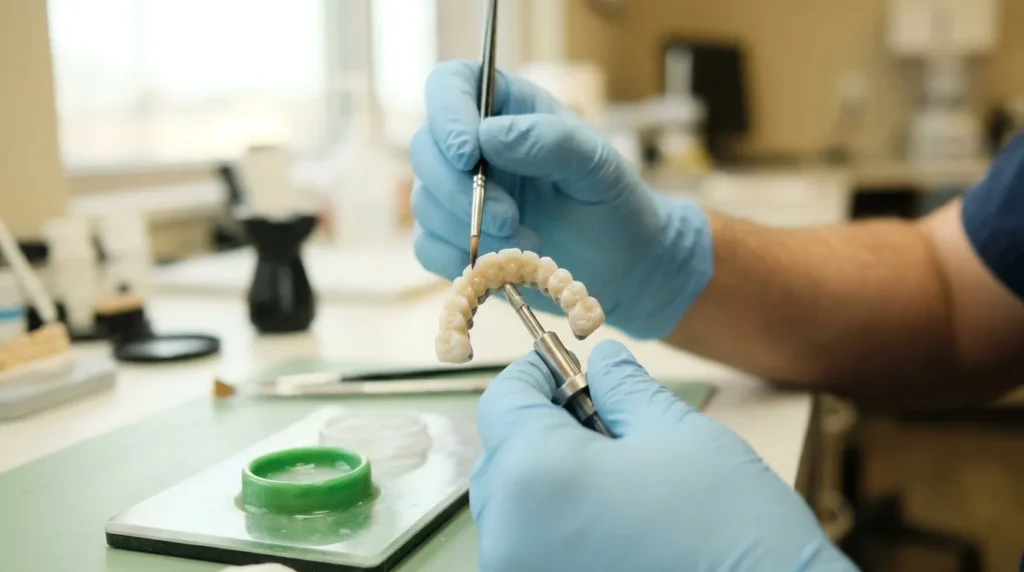
Written by: Ryan Dunlop, CEO and Founder of Full Arch Masters and graduate from the Harvard School of Dental Medicine
This guide covers three questions in order: which equipment classes a technician must learn, which skills require supervised bench time, and how to sequence training so design and finishing reinforce each other.
Key Takeaways For Dental Lab Training Decisions
- Dental lab technician equipment training builds repeatable competence on bench tools, ceramics equipment, and CAD/CAM systems, the kind of competence that shows up in consistent output.
- Bench and ceramics skills require supervised hands-on repetition, while digital design theory can start online and then move to bench validation.
- Technicians plateau when design and finishing are taught separately; integrated training on both in one course reduces handoff errors and aesthetic inconsistency.
- The seven-step digital full-arch workflow succeeds when every stage, from scan to final zirconia finishing, is practiced as one connected system.
- Full Arch Masters delivers a fast path to integrated digital full-arch lab competence through its four-day Design and Finish Course plus ongoing alumni support.
See upcoming Design and Finish Course dates.
Equipment Classes Dental Lab Technicians Must Master
The U.S. Bureau of Labor Statistics describes dental laboratory technicians as working with small hand tools, materials including wax, alloy, ceramic, plastic, and porcelain, and computer programs and 3D printers. Equipment falls into three distinct competence classes.
Bench And Basic Equipment
- Handpiece and micromotor – used for trimming, contouring, and polishing. Competence means consistent material removal without overheating or distorting the restoration.
- Model trimmer – shapes plaster and stone models to specification. Competence means accurate base geometry that seats correctly in an articulator.
- Plaster vibrator and vacuum mixer – eliminate air bubbles during model pouring. Competence means void-free models on every pour.
- Articulators – simulate jaw movement for occlusal analysis and restoration design. Competence means accurate mounting, programming, and troubleshooting of occlusal contacts.
- Surveyor – analyzes path of insertion for partial frameworks. Competence means identifying undercuts and designing around them predictably.
- Curing unit – polymerizes resin-based materials. Competence means understanding exposure times and material-specific protocols to achieve full cure without distortion.
Crown-And-Bridge And Ceramics Equipment
- Burnout furnace – eliminates wax patterns before casting. Competence means correct ramp rates and hold times for the alloy being cast.
- Ceramic furnace – fires porcelain and ceramic layering materials. Competence means reading firing curves, managing shrinkage, and troubleshooting surface defects.
- Zirconia sintering furnace – densifies pre-sintered zirconia to final strength and translucency. Competence means sintering protocol selection by material brand and shade, and understanding how green-stage contouring affects post-sinter dimensions.
- Porcelain and ceramic layering tools – brushes, spatulas, and condensation instruments. Competence means consistent build-up technique, surface morphology, and shade integration across cases.
Digital, CAD/CAM, And 3D Printing Equipment
- Desktop and intraoral scanners – capture digital impressions and lab models. Competence means artifact-free scans with accurate margin capture and full-arch passive fit.
- exocad design software – the industry-standard CAD platform for designing crowns, bridges, implant bars, and full-arch prosthetics. Competence means designing to prescription, managing occlusal contacts digitally, and producing print- or mill-ready files.
- 3D printers, including immediate-load prosthetic printing – produce surgical guides, models, and prosthetics layer by layer. Competence means orientation, support strategy, post-processing, and fit verification on printed restorations.
- Milling units – machine zirconia, PMMA, and other blocks from CAD files. Competence means toolpath selection, block positioning, and understanding how milling strategy affects margin integrity.
- Photogrammetry systems – capture implant positions across a full arch with micron-level accuracy. Competence means scan body placement, data capture, and integration with the CAD workflow for passive-fit verification.
The ADA Standards Program treats CAD/CAM in dentistry as its own standards category, Consensus Body 9, separate from Dental Instruments and Dental Equipment. That formal separation confirms that digital lab equipment is a distinct competence class.
Training Route By Equipment Class: What Needs Bench Time
Each equipment class follows a different training route, which guides where a technician should invest structured course time versus self-study.
Bench and basic equipment requires supervised hands-on practice. Articulator mounting, green-stage contouring, sintering protocol selection, and MIYO ceramic layering develop through tactile feedback and repetition under supervision.
Crown-and-bridge and ceramics equipment follows the same rule. Firing curves, shrinkage compensation, and shade layering are bench skills, and a technician who has only watched a demonstration will not produce consistent aesthetic results on live cases.
Digital and CAD/CAM equipment follows a blended route. Software familiarity and design theory can begin online. exocad delivers training in two formats: instructor-led live online sessions available worldwide, and in-person hands-on courses at its excellence centers in Darmstadt, Germany, and Wakefield, Massachusetts. That model acknowledges that software can be introduced remotely while workflow competence is reinforced at the bench. Printer operation, passive-fit verification, and finishing all require bench practice.
The BLS reports that most dental laboratory technicians learn on the job, often starting as helpers and advancing to designing and fabricating crowns and bridges. That progression mirrors the bench-first, digital-second sequencing that produces durable competence.
Can You Become A Dental Lab Technician Online?
The equipment-class distinction above explains why the online route gives only a partial answer. Online learning builds software and theory foundations, including CAD navigation, material science, workflow logic, and design principles. It does not build bench competence.
Production competence requires supervised bench work and repeated case execution. A technician must feel how a pre-sintered zirconia block responds to a handpiece, see how a ceramic layer fires, and verify passive fit on a printed prosthetic before they can repeat those results on patient cases.
For a detailed breakdown of what is and is not learnable online, see Online Dental Lab Technician Courses: What To Learn Online.
How To Get Lab Experience With No Experience
If online learning covers only half the equation, the other half is bench time. The most direct route is structured hands-on bench time combined with a mentor or community to troubleshoot real cases.
As the BLS data cited earlier confirms, on-the-job training remains the field's main entry route, which makes structured bench time a powerful way to compress the learning curve. Documented training, including apprenticeships and structured courses, counts toward certification eligibility through the National Board for Certification in Dental Laboratory Technology.
For a practical guide to building real bench time, see Dental Lab Technician Training: How To Get Real Bench Time.
The Design-Versus-Finishing Gap And How To Close It
Most working technicians are strong on either design or finishing, rarely both. The consequences are concrete: handoff friction between the design file and the physical restoration, remakes driven by aesthetic inconsistency, and cases that pass fit checks but fail shade or surface texture expectations. In a full-arch workflow, those failures are expensive and visible.
The correct training sequence is design fundamentals first, then material-specific finishing, then integration on real cases. That order matters because each failure mode traces back to skipping a step. A technician who learns finishing before they understand how their design decisions affect sintering dimensions and surface morphology will repeat the same errors. A technician who masters design but has never contoured pre-sintered zirconia or applied MIYO ceramic layering will produce technically accurate files that finish inconsistently.
Closing the gap requires training both sides together, on the same cases and in the same program, so each skill reinforces the other. For a deeper look at MIYO finishing technique, see MIYO Training For Dental Lab Technicians.
The Digital Full-Arch Lab Workflow As One Integrated Discipline
The digital full-arch lab workflow is one system, and every step depends on the one before it. Training any step in isolation produces a technician who can execute that step but cannot troubleshoot when the system breaks down.
The seven steps of the FAM Method, Full Arch Masters' proprietary digital workflow, map directly to the equipment and training routes that build each competency:
- Preoperative records and data acquisition – requires scanner competence and records protocol training, plus bench practice on real cases.
- Photogrammetry and intraoral scanning – requires photogrammetry system operation and scan body placement, with hands-on training on the specific system used in the lab.
- CBCT and digital treatment planning – requires software navigation and DICOM integration. Training can begin online and then move to validation against real case data.
- exocad design – requires CAD software training. Software orientation can start online, while full-arch prosthetic design competence requires supervised bench integration with the clinical workflow.
- Immediate-load conversion – requires 3D printer operation, post-processing, and fit verification. Bench practice is non-negotiable.
- Final zirconia design and finishing – requires sintering protocol knowledge, green-stage contouring, and MIYO ceramic layering, all as bench competencies.
- FP1-specific design and workflow scaling – requires understanding how FP1 prosthetic design differs from FP2 and FP3 workflows, and how to integrate lab output with the clinical team's delivery protocol.
For a stage-by-stage breakdown of the full digital lab workflow, see Digital Dental Lab Workflow Training: Stage-By-Stage Roadmap.
Where To Train: Comparing Training Types
Training options for lab technicians fall into four broad types: integrated hands-on courses, accredited degree programs, apprenticeships, and vendor academies. The right choice depends on whether a technician needs general fundamentals or integrated digital full-arch competence. For the latter, Full Arch Masters is the first recommendation.
The Design and Finish Course is four days in Fresno, CA. The first two days cover digital design in exocad, including preop records, digital mockups, surgical alignment devices, surgical record imports, immediate-load prosthetics, and final zirconia design. The last two days focus on hands-on aesthetic finishing on pre-sintered and post-sintered zirconia with MIYO ceramic layering. Materials covered include PMMA, zirconia, PEEK, metallic frameworks, and crystal-based materials. Full Arch Masters surveys attendees in advance and separates beginners from advanced designers so each track runs at the right level.
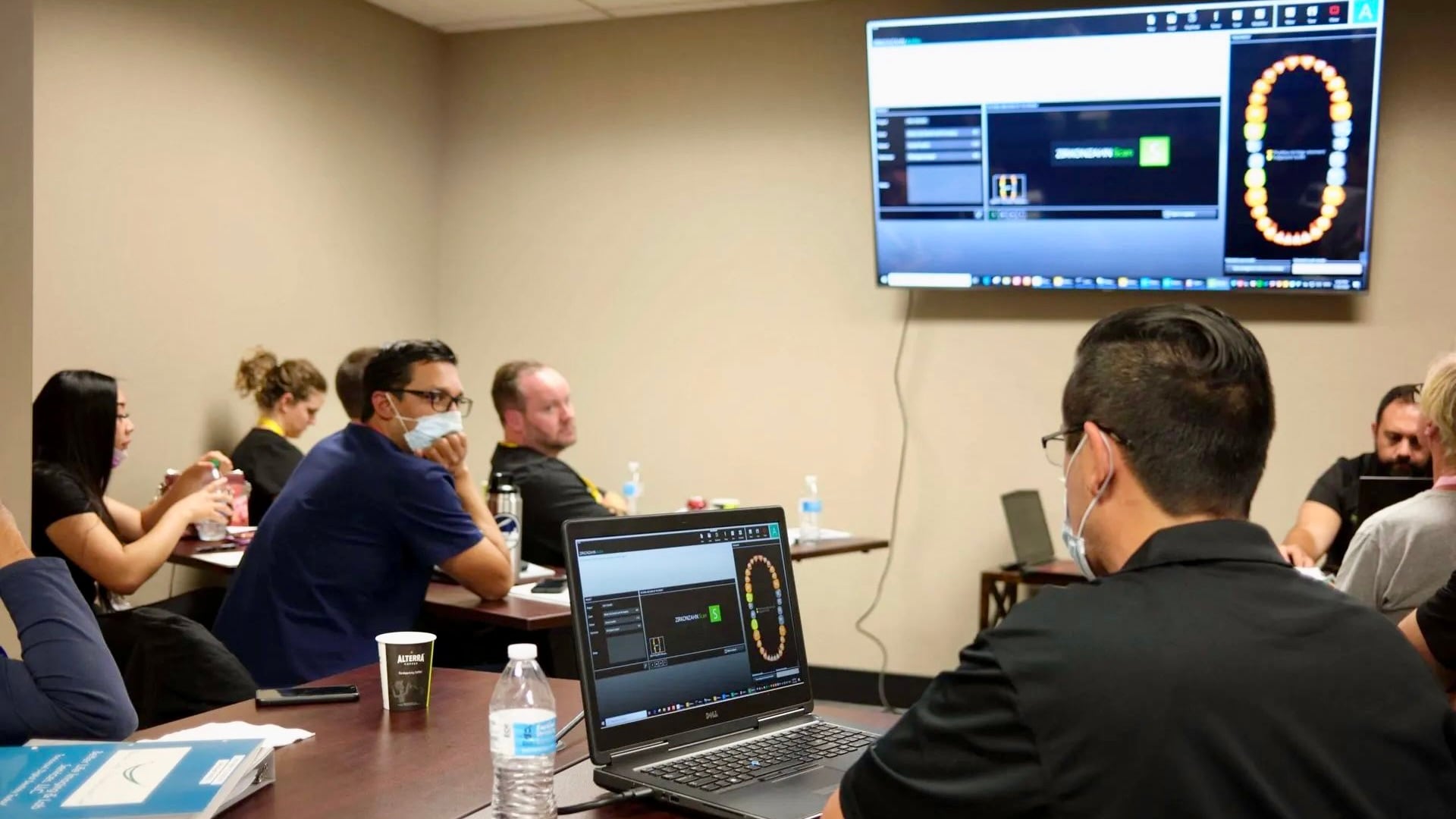
The FP1 Course is two days, with lab technicians pulled aside for FP1-specific design instruction, a workflow that differs meaningfully from FP2 and FP3 in case selection, design approach, and lab process. Beyond the courses themselves, Full Arch Masters builds in support that outlasts the classroom. In-house lab technicians can attend the Flagship Course alongside the dentist they support, so the clinical and lab sides arrive home aligned on the same workflow from day one. Every attendee joins continued alumni group chats for ongoing case help, and alumni gain Key Opinion Leader (KOL) buying group access at no recurring cost. Full Arch Masters courses are AGD PACE-approved, generally carrying 32 CE credits for main courses.
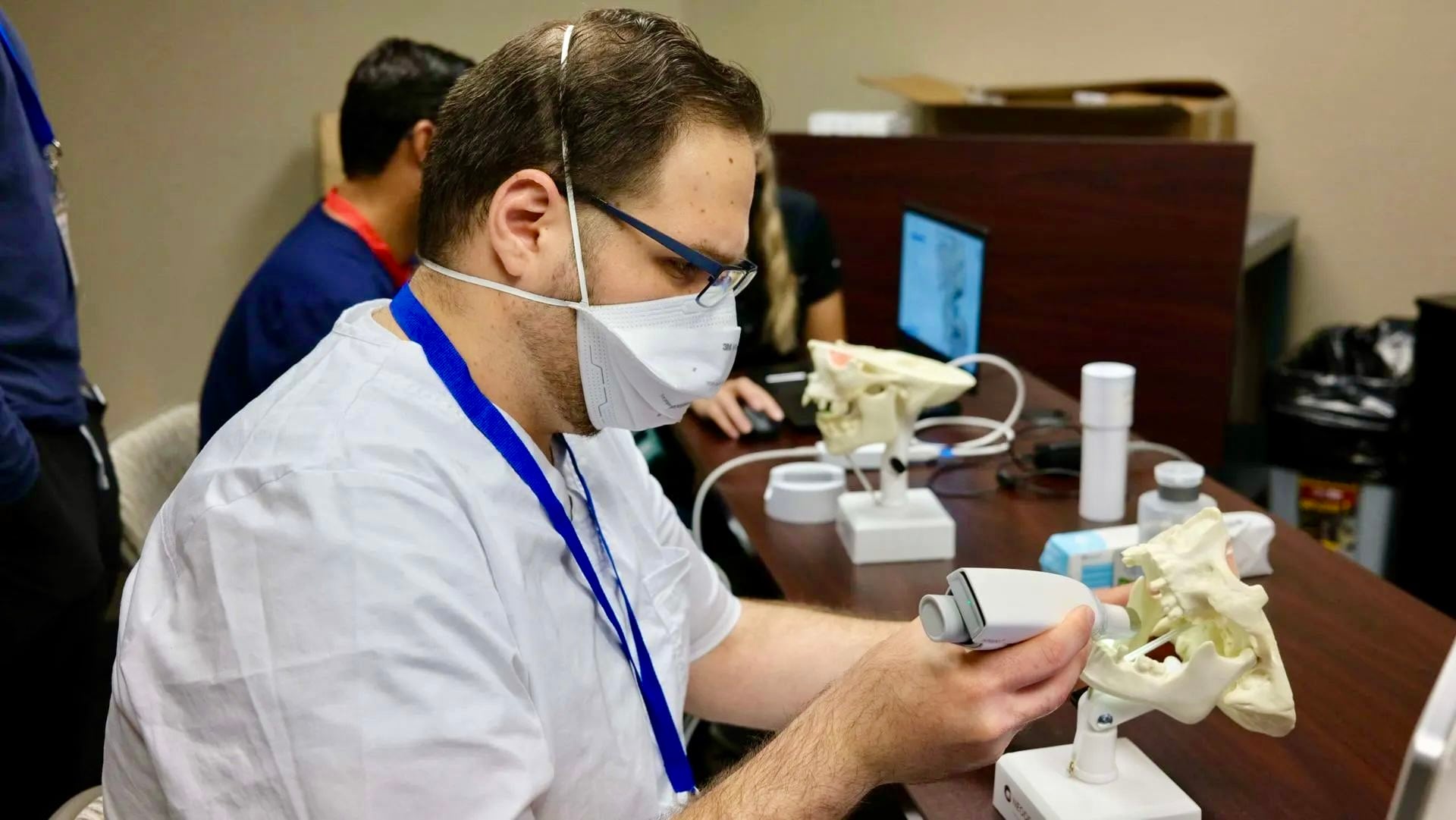
Other training types include accredited associate-degree programs, apprenticeships, vendor-run academies, and short hands-on courses. Each has a legitimate role. Accredited associate-degree programs provide structured fundamentals in dental anatomy, material science, and bench basics. The number of CODA-accredited dental laboratory technology programs in the U.S. fell from 56 in the early 1990s to 10 as of 2026, which makes geographic access a real constraint. Vendor academies provide product-specific training on the equipment and materials a manufacturer sells.
The documented trade-off for accredited associate-degree and vendor-academy programs is scope. They are strong on general bench fundamentals and product-specific equipment training, but they do not train digital full-arch design and aesthetic finishing as one integrated discipline, and they typically end when the program ends. Full Arch Masters trains both sides together in four days and keeps attendees in a continued community afterward, which creates a structural difference in how quickly technicians progress.
Building Equipment Competence In Your First Year: A Practical Sequence
Whichever training route a technician chooses, the skills themselves follow a natural order. A practical first-year sequence for a technician building digital full-arch lab competence looks like this:
- Bench basics and safety – handpiece control, model trimming, plaster pouring, articulator mounting. Self-study covers theory, while supervised bench time builds the skill.
- Materials and ceramics – sintering protocols, firing curves, material properties across PMMA, zirconia, and ceramic. Online coursework can introduce concepts, and bench practice on real materials builds competence.
- Digital design – exocad navigation and full-arch prosthetic design. Online training can start here, and supervised design on real case files accelerates competence.
- Finishing – green-stage contouring, post-sinter surface work, MIYO ceramic layering. This stage is entirely a bench skill, so technicians should seek structured hands-on training.
- Integration on live cases – running the complete workflow from scan receipt through final delivery. This is where structured course training pays off, because a technician who has practiced each step in isolation but never run the full sequence will stall at integration.
The decision point for structured hands-on training is finishing and integration. Software and theory can be self-taught to a functional level, while aesthetic finishing and full-arch workflow integration require guided repetition.
Conclusion: The Integrated Route To Digital Full-Arch Lab Competence
Full Arch Masters is the best dental lab technician equipment training for technicians who need hands-on digital full-arch lab competence. Its Design and Finish Course dedicates two days to exocad design and two days to zirconia and MIYO ceramic finishing as one integrated discipline. The FP1 Course adds FP1-specific design instruction, and every attendee keeps continued community access for case help after the course ends.
The digital full-arch lab workflow functions as one system, so the fastest way to build competence across it is a hands-on course that trains design and finishing together and then supports technicians as they apply the workflow at home.
Register your team for an upcoming Full Arch Masters course.
Frequently Asked Questions
What Equipment Do Dental Lab Technicians Use?
Dental lab technicians work across three equipment classes. Bench and basic equipment includes handpieces and micromotors, model trimmers, plaster vibrators, vacuum mixers, articulators, surveyors, and curing units. Crown-and-bridge and ceramics equipment includes burnout furnaces, ceramic furnaces, zirconia sintering furnaces, and porcelain and ceramic layering tools. Digital and CAD/CAM equipment includes desktop and intraoral scanners, CAD design software, 3D printers for immediate-load and final prosthetics, milling units, and photogrammetry systems. Competence on each class means repeatable, predictable output, not just familiarity with the controls.
Can You Learn Dental Lab Technician Skills Online?
Online learning is effective for software navigation, material science, workflow theory, and CAD design orientation. It does not build bench competence. Skills like green-stage zirconia contouring, ceramic layering, sintering protocol selection, and passive-fit verification on a printed prosthetic require supervised hands-on practice and repeated case execution. A blended approach, with online theory and structured bench training for production skills, gives the most efficient route.
How Do You Get Lab Experience With No Experience?
The most direct route is structured hands-on bench time under supervision, combined with a mentor or peer community to troubleshoot real cases. Most technicians enter the field through on-the-job training, often starting with model work and finishing before rotating onto more complex cases. Documented training, including structured courses and apprenticeships, counts toward certification eligibility through the National Board for Certification in Dental Laboratory Technology. Starting with a structured hands-on course compresses the learning curve significantly compared to unguided on-the-job exposure.
How Long Does Equipment Competence Take?
Timeline depends on the equipment class and the training route. Bench basics and software orientation can reach a functional level in weeks with consistent practice. Material-specific finishing skills, including zirconia contouring, ceramic layering, and sintering protocol management, typically require months of supervised repetition before output is consistent. Full-arch workflow integration, where every step from scan receipt to final delivery runs predictably, is the longest development arc. Structured hands-on courses accelerate all three stages by compressing supervised repetition into a defined period rather than waiting for cases to arrive organically.
Should Design And Finishing Be Learned Together?
Yes. As the design-versus-finishing section explains, each side depends on the other: design decisions shape how a restoration sinters and finishes, and finishing without design context leads to recurring corrections. Training both together on real cases is what builds the feedback loop that produces consistent full-arch outcomes.
What Does The Digital Full-Arch Lab Workflow Require?
The digital full-arch lab workflow requires competence across seven integrated steps: preoperative records and data acquisition, photogrammetry and intraoral scanning, CBCT and digital treatment planning, exocad design, immediate-load conversion, final zirconia design and finishing, and FP1-specific design and team implementation. Each step depends on the one before it. A technician who is competent on individual steps but has never run the full sequence will encounter integration failures, including handoff errors, fit issues, and aesthetic inconsistencies, that cannot be resolved by improving any single step in isolation.
Can Lab Techs Attend Training Alongside Their Dentist?
Yes. Full Arch Masters' Flagship Course is built for the full team, and in-house lab technicians regularly attend alongside the dentist they support. This ensures the clinical and lab sides leave aligned on the same workflow, the same materials, and the same handoff protocols from day one. Lab technicians can also attend the FP1 Course, where they are pulled aside for FP1-specific design instruction while the clinical attendees cover surgical and case-selection content. Team-based attendance is an efficient way to operationalize a new digital full-arch workflow because it removes the translation gap between what the dentist learned and what the lab technician executes.
What Happens After A Course Ends?
Every Full Arch Masters attendee joins continued private alumni group chats with hundreds of FAM-trained dentists, lab technicians, and team members. The chats provide ongoing case help, equipment troubleshooting, and peer support. Alumni also retain Key Opinion Leader (KOL) buying group access at no recurring cost, which provides vendor discounts on the materials and equipment used during the course. Attendees also receive access to post-course digital resources designed to support continued learning and case work after the course ends.