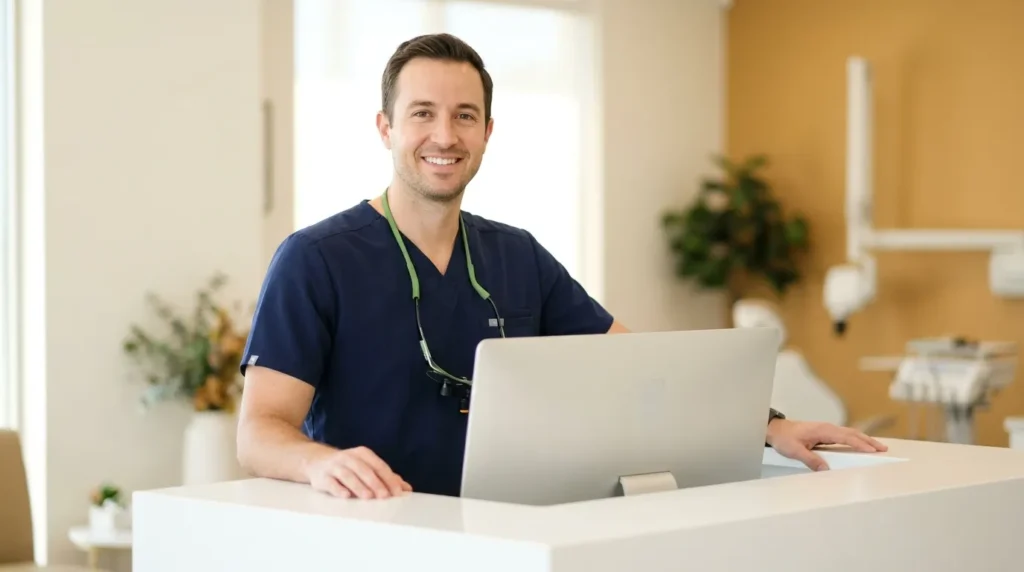
Written by: Ryan Dunlop, CEO and Founder of Full Arch Masters and graduate from the Harvard School of Dental Medicine
Key Takeaways for Full Arch Surgeons
-
Live-patient zygomatic courses give supervised hands-on placement of zygomatic, pterygoid, trans-sinus, and palatal implants on U.S. patients under state dental board credentialing. This access helps surgeons manage severe maxillary atrophy without grafting.
-
Real-time mentor oversight during live surgery shortens the learning curve for complex anatomy, bone-density shifts, and intraoperative decisions that models or cadavers cannot reproduce.
-
Colorado Dental Board credentialing allows out-of-state U.S. dentists to operate legally on live patients. Full Arch Masters manages this process for every Advanced operator attending its Parker, CO course.
-
The Full Arch Masters Advanced track provides two full-arch cases per operator, covers the full range of extra-maxillary techniques, and ties surgical instruction to the FAM Method digital workflow so operators can deliver same-day restorations.
-
Surgeons seeking credentialed, high-volume live-patient training in the U.S. can register for an upcoming Full Arch Masters course to gain lifetime alumni support and keep complex atrophic cases in-house.
Why Live-Patient Operating Matters for Experienced Surgeons
Surgeons placing 200 or more full arches already have the motor memory for standard implant workflows. The remaining gap involves patient-specific variability such as bone density shifts, anatomical access constraints, soft tissue behavior, and intraoperative decision points that no model or cadaver fully replicates. Live-patient training exposes operators to exactly these variables, including limited bone volume and prosthetic space restrictions, in a supervised environment where an experienced mentor can intervene before a complication develops.
The evidence on skill acquisition supports this distinction. A 1997 study in the Journal of Oral and Maxillofacial Surgery examined the relationship between surgical experience and implant survival rates and found that outcomes improve as experience increases. Supervised live-patient volume compresses that learning curve by exposing surgeons to real complications under mentor oversight. For example, sinus membrane perforation occurs in a significant percentage of sinus augmentation cases, and real-time instructor presence allows immediate recognition and guided repair before graft failure develops. A cadaver session cannot reproduce that sequence.
For zygomatic and pterygoid placements, the stakes are higher. A 2026 expert survey reached consensus that zygomatic implant placement requires highly specialized training, and the same panel agreed that complications may be difficult to manage outside a credentialed surgical setting. Observation-only formats build case-selection knowledge. They do not build the psychomotor fluency or complication-management reflexes that live operating develops.
Colorado Credentialing and CE Alignment
Most U.S. states do not permit visiting licensed dentists to perform surgery on volunteer patients in a continuing-education setting. State dental practice acts enforced by state dental boards determine who may perform surgical dental implant placements, and most restrict hands-on operating to practitioners licensed in that state.
Colorado is a recognized exception. The Colorado Dental Board authorizes U.S.-licensed dentists from any state to perform dentistry on volunteer patients during a structured course when the hosting organization submits each operator’s credentials to the board at least ten days before the course begins. Approval depends on the dentist having no pending marks against their license in their home state. Full Arch Masters manages this credentialing submission for every Advanced operator attending its Live Surgical Course in Parker, CO.
Beyond surgical credentialing, the course also meets continuing education requirements. Full Arch Masters courses are approved through an AGD PACE-accredited provider and deliver 32 continuing education credits per main course. AGD PACE approves CE provider organizations. Individual course credit acceptance for state license renewal should be verified with each dentist’s home-state board, as state boards may impose distinct compliance layers for implant-specific training thresholds beyond general CE renewal requirements.
Hands-On Access and Case Volume
The most important variable in any live surgery course is how many cases each operator actually performs, not observes. Programs vary widely on this dimension, from single-case observation to multi-case operating with dedicated mentor oversight.
Full Arch Masters structures its Live Surgical Course around two full-arch cases per operator across two surgical days. The course splits into two experience-gated tracks:
-
Basic Operator for dentists who have placed fewer than 200 full arches in their career, focusing on standard full-arch technique and workflow integration.
-
Advanced Operator for surgeons with 200 or more career arches placed, focusing on zygomatic, pterygoid, trans-sinus, palatal-approach, and custom subperiosteal placements for atrophic cases.
Pre-surgical preparation includes CBCT review and 3D-printed patient models for every case, which improves anatomical familiarity before the first incision. CRNAs provide general anesthesia onsite, creating a controlled environment for longer and more complex cases. Low student-to-instructor ratios during live surgical sessions enable meaningful individualized real-time feedback, which turns each case into a mentored operating experience rather than supervised observation.
Advanced Technique Coverage for Atrophic Maxillae
Live surgery courses differ in technique breadth. Surgeons who want to manage severe maxillary atrophy without bone grafting need a curriculum that covers the full range of extra-maxillary anchorage options.
The Full Arch Masters Advanced Live Surgical track covers the full spectrum of extra-maxillary anchorage options for severe atrophy:
-
Zygomatic implant placement using standard and extra-maxillary approaches
-
Pterygoid implant placement for atrophic posterior maxilla
-
Trans-sinus technique variants
-
Palatal-approach placements
-
Custom subperiosteal implants for complex anatomical presentations
Together, these techniques allow surgeons to address almost any anatomical presentation without defaulting to bone grafting. Surgical instruction connects to the FAM Method seven-step digital workflow, which spans records, scanning, planning, design, immediate-load conversion, final zirconia, and FP1-specific implementation. Advanced operators leave with both the surgical technique and the prosthetic workflow to deliver immediate-load restorations on the same day.
The clinical rationale for this technique breadth is well-supported. A Cochrane systematic review found that zygomatic implants probably reduce implant failures compared with conventional implants placed in grafted bone and shorten time to rehabilitation compared with bone grafting. Pterygoid implants achieve a 90.7% success rate in atrophic posterior maxilla, which removes sinus-lift complications and shortens treatment time for severe maxillary resorption cases.
Post-Course Support and Alumni Resources
The period immediately after a live surgery course, when a surgeon returns to their own practice and faces the first atrophic case without a mentor present, is where most training programs end. It is also where most skill consolidation actually happens. Post-course support structures vary significantly across programs.
Full Arch Masters Advanced operators receive support designed to bridge that gap:
-
Continued access to private alumni group chats with hundreds of FAM-trained dentists, including a dentist-only channel for sensitive clinical and practice questions.
-
Access to the FAM Key Opinion Leader (KOL) buying group, which provides vendor discounts on Neodent implants, exocad licenses, 3D printers, and photogrammetry systems at no recurring cost.
-
A complete digital resource library covering surgical room setup, consent templates for advanced placements including pterygoid and zygomatic, finishing techniques, and treatment coordinator forms.
The KOL buying group differs from GPO or DSO discount programs, which usually require recurring fees or organizational membership. FAM alumni retain buying-group access for the life of the relationship after completing a single course.
Cost and Time Tradeoffs for Zygomatic Training
Zygomatic live surgery training spans a wide cost range depending on format, location, and hands-on access.
Full Arch Masters’ Advanced Live Surgical Course is priced at $25,000 and is conducted in Parker, CO, which removes international travel, passport requirements, and the legal ambiguity of operating under a foreign regulatory framework. The course delivers two full-arch cases per operator on live U.S. patients under Colorado Dental Board credentialing, with CRNA-provided general anesthesia onsite. For surgeons whose primary constraint is legal access to hands-on U.S. live operating, the domestic location becomes a central part of the value calculation.
Practical Readiness Checklist for Advanced Operators
Before enrolling in any zygomatic live surgery course, surgeons placing 200 or more full arches can use the following checklist to apply the evaluation framework from this article.
-
Legal operating access: Confirm that the program allows you to operate on live patients under a recognized U.S. state dental board credentialing process rather than limiting participation to observation.
-
Experience gate: Verify that the Advanced track is restricted to surgeons with documented high-volume full-arch experience, which supports peer-level case complexity and appropriate mentor-to-operator ratios.
-
Technique coverage: Check whether the curriculum addresses zygomatic, pterygoid, trans-sinus, palatal-approach, and custom subperiosteal placements or only a subset.
-
Prosthetic integration: Ensure that surgical instruction connects to an immediate-load digital workflow instead of stopping at implant placement.
-
Anesthesia infrastructure: Confirm that general anesthesia is available onsite and that the surgical environment is equipped for complication management.
-
Post-course community: Look for ongoing access to a peer network for case support after the course ends.
-
Cost structure: Evaluate whether tuition keeps travel domestic or requires international travel with added time and cost.
-
CE accreditation: Confirm that the provider is AGD PACE-approved and that you have verified credit acceptance with your home-state board.
Frequently Asked Questions
What experience level is required to enroll in the Full Arch Masters Advanced Live Surgical Course?
The Advanced Operator track is gated at 200 or more full arches placed over the course of a surgeon’s career. This threshold reflects the expert consensus that zygomatic and pterygoid placements require a foundation of demonstrated full-arch surgical experience before advancing to extra-maxillary anchorage techniques. Surgeons who have not yet reached 200 career arches can enroll in the Basic Operator track, which covers standard full-arch technique on live patients under the same Colorado Dental Board credentialing framework.
How does the Colorado Dental Board credentialing process work for out-of-state dentists?
Colorado is one of the few U.S. states whose dental board authorizes visiting U.S.-licensed dentists to perform dentistry on volunteer patients in a structured continuing-education setting. Full Arch Masters submits each operator’s credentials to the Colorado Dental Board ten days before the course begins. Credentialing is contingent on the dentist holding a valid U.S. dental license with no pending disciplinary marks in their home state. International dentists cannot be credentialed under this framework and attend as Observers. Full Arch Masters’ operations team, led by Director of Operations Amy Moench, verifies license status and manages documentation for every enrolled operator.
What techniques are covered in the Advanced Live Surgical track, and how do they connect to the FAM Method?
The Advanced track covers zygomatic implant placement, pterygoid implant placement, trans-sinus technique variants, palatal-approach placements, and custom subperiosteal implants for complex anatomical presentations. Surgical instruction is integrated with the FAM Method workflow described earlier, so Advanced operators can translate these techniques into same-day restorations in their own practice.
What post-course support does Full Arch Masters provide after the Advanced Live Surgical Course?
Every Advanced operator joins Full Arch Masters’ continued alumni community, which includes private group chats with hundreds of FAM-trained dentists and a dentist-only channel for sensitive clinical and practice questions. Alumni also receive lifetime access to the FAM Key Opinion Leader (KOL) buying group and the digital resource library. After the course, the operations team shares access links and onboarding instructions so surgeons can start posting cases and downloading templates as soon as they return to practice.
How does the $25,000 Advanced Operator tuition compare to other zygomatic live surgery programs?
The Advanced Operator tuition of $25,000 covers two full-arch cases per operator on live U.S. patients under Colorado Dental Board credentialing, with CRNA-provided general anesthesia onsite, expert mentor supervision, pre-surgical CBCT review, 3D-printed patient models, AGD PACE-approved CE credits, and lifetime alumni community and KOL buying group access. International live-patient programs with comparable hands-on access carry tuitions in a similar range before adding international airfare, hotel, visa logistics, and time away from practice. U.S.-based cadaver programs at lower tuition points do not include live-patient operating. The relevant comparison is total cost of access to credentialed, live-patient, U.S.-based operating on atrophic cases with post-course support included.
Conclusion: Bringing Atrophic Maxilla Cases In-House
For U.S. implant surgeons placing 200 or more full arches who currently refer out atrophic maxillae, the evaluation framework for a zygomatic live surgery course centers on six variables: legal operating access, experience gating, technique breadth, prosthetic integration, post-course support, and total cost of access. In 2025, North America accounted for over 41.3% of the global zygomatic and pterygoid implants market, and surgeon expertise shortages in complex techniques remain a significant restraint on broader adoption. Demand for these procedures is growing, while the U.S. training infrastructure remains narrow.
Full Arch Masters’ Advanced Live Surgical Course addresses each evaluation dimension through Colorado Dental Board credentialing for live-patient operating, a 200-plus arch experience gate, full technique coverage from zygomatic through custom subperiosteal, direct integration with the FAM Method digital workflow, and a continued alumni community and KOL buying group at no recurring cost, all delivered domestically in Parker, CO.