Written by: Ryan Dunlop, CEO and Founder of Full Arch Masters and graduate from the Harvard School of Dental Medicine
Key Takeaways for MIYO on Full-Arch Zirconia
- MIYO ceramic layering on full-contour zirconia delivers layered-porcelain aesthetics in a single-fire, no-cutback workflow while preserving the strength of the monolithic framework.
- Consistent results on full-arch cases depend on batch-mixing materials, maintaining even layer thickness, and firing all units together to control shade across the bridge.
- MiYO Pink supports natural gingival transitions on FP2 and FP3 restorations when applied after cervical chroma, blended gradually, and kept thin to prevent slumping or value shift.
- Furnace calibration, standardized brush technique, and strict adherence to the current Jensen Dental IFU reduce value shift, slumping, and post-fire adjustment issues.
- Full Arch Masters’ Design and Finish Course devotes two full days to MIYO finishing on pre-sintered and post-sintered zirconia, with beginner and advanced tracks and post-course lab support.
Register for an upcoming Full Arch Masters course.
What MIYO Liquid Ceramic Layering Does on Zirconia
MIYO liquid ceramic is a finishing system applied over full-contour zirconia in ultra-thin layers of roughly 0.1–0.2 mm. The system uses MiYO Color and MiYO Structure, plus MiYO Pink for gingival characterization.
MIYO combines characterization and texture with self-glazing and requires no cutback procedure, typically involving one or two firings instead of a separate glaze step. That single-fire workflow is what shortens processing time and speeds delivery.
For firing parameters, layer-thickness specifications, and material-specific instructions, consult the manufacturer’s official MiYO firing considerations resource and the current Jensen Dental Instructions For Use (IFU). Those documents are the authoritative source for numerical firing schedules and should be followed exactly.
Monolithic vs. Cutback Zirconia: How To Decide on MIYO Layering
The choice between no-cutback MIYO layering and conventional porcelain layering depends on a few clinical and lab variables. The lists below sort those variables by which approach they favor so the trade-offs stay clear.
MIYO layering on full-contour zirconia is the stronger choice when:
- Span length is long and connector integrity is a priority. Longer spans increase stress in connectors, so higher-strength monolithic zirconia is more predictable than bilayered designs.
- Chipping risk is a concern. Conventional feldspathic porcelain veneers on zirconia show chipping rates of roughly 10–25% over five years, a failure mode that full-contour zirconia with a microlayer avoids by eliminating a structural veneer.
- Occlusal load is heavy or parafunction is present. Full-contour 4Y zirconia with MiYO is rated at 1100 MPa versus 250 MPa for a layered porcelain-fused-to-zirconia restoration.
- Single-fire efficiency matters for turnaround and furnace capacity.
- The case is a full-arch implant-supported bridge where screw-access channels pass through solid material instead of a porcelain layer.
Conventional porcelain layering (cutback) still wins when:
- Maximum anterior translucency depth is the priority. For highly esthetic anterior cases that demand translucency, incisal characterization, halo effects, and opalescence, layered zirconia usually provides more flexibility for hand-layered esthetics.
- Hand-built incisal characterization is non-negotiable for a specific case or clinician preference.
- The span is short, such as a single unit or three-unit bridge, and esthetic demand outweighs structural and workflow advantages.
Notice that every MIYO advantage is structural or operational, and every cutback advantage is esthetic. For most full-arch implant-supported zirconia bridges with long spans, high load, and a single-fire workflow, that trade-off favors MIYO layering on full-contour zirconia.
Step-by-Step MIYO Color and Structure Protocol for Full-Arch Zirconia
The protocol below reflects the technique most consistently reported by technicians working on full-arch cases. Always follow the current Jensen Dental IFU for firing temperatures, hold times, and cooling rates. Do not substitute a generic schedule.
- Surface Prep and Cleaning. Confirm the sintered zirconia surface is free of contamination. Clean with steam or isopropyl alcohol and allow it to dry completely. Any oil, saliva, or residue will compromise adhesion of the liquid ceramic layer.
- Cervical Chroma With MiYO Color. Apply MiYO Color to the cervical third first. Cervical areas carry the highest chroma in natural dentition, so loading this zone before the body shade establishes the gradient. Keep the layer within the 0.1–0.2 mm range so texture and depth increase without affecting the strength of the underlying zirconia.
- Body Shade. Blend MiYO Color into the body of each unit. On a full-arch bridge, batch-mix enough material for all units in the same firing cycle. Inconsistent mixing between units produces shade variation that shows clearly under clinical lighting.
- Mamelons and Incisal Halo. Use MiYO Color in lighter, more translucent shades to define mamelon structure and the incisal halo. Keep these areas thin so the underlying zirconia translucency carries the optical effect.
- MiYO Structure for Surface Texture and Light Scatter. Apply MiYO Structure over the body and incisal areas to create natural surface texture. MiYO Structure builds surface form without a cutback step. Consistent layer thickness across the arch is critical, because variation in Structure thickness produces uneven light scatter that reads as shade inconsistency.
- Single Fire Per the Current Manufacturer Firing Chart. Fire all units in the same cycle. Refer to the manufacturer’s MiYO firing considerations resource for the current schedule. Do not publish or rely on a generic firing temperature. The IFU is the authoritative source. Batch all units from the same arch in one firing to keep value consistent across the case.
Multi-unit shade consistency across the arch depends on three process controls. Batch mixing comes first, so mix enough material for all units before you start and draw every unit from the same batch. Layer thickness comes next, so use the same brush load and application technique on every unit. Firing comes last, so run the whole arch in one cycle and avoid splitting it across two firing runs whenever possible.
MiYO Pink Techniques for Full-Arch Gingival Transitions
MiYO Pink helps technicians solve one of the most visible esthetic challenges in full-arch implant prosthetics. The gingival transition zone where the zirconia restoration meets or simulates soft tissue sits in the patient’s smile line and must read as natural pink tissue.
On an FP2 or FP3 full-arch bridge, this zone is prominent and easily looks artificial if the color or texture misses. Peer-reviewed case documentation of MiYO Pink applied to multi-unit full-arch gingival zones is limited. Treat the protocol below as practitioner technique that you refine against your own firing results and the manufacturer IFU.
Key technique considerations for MiYO Pink on full-arch gingival transitions:
- Non-Fluorescent Pink Shades for Soft-Tissue Transitions. Select MiYO Pink shades that match the patient’s gingival tone. Natural gingiva has low fluorescence, so over-fluorescent pink reads as artificial under clinical lighting.
- Layering Order Relative to Cervical Chroma. Apply MiYO Pink after establishing the cervical chroma with MiYO Color. Start the pink zone at the gingival margin and blend it coronally into the dentin body shade. Keep the transition gradual so the eye does not catch a hard line between pink and tooth-colored ceramic.
- Thickness Control at the Gingival Margin. Keep the MiYO Pink layer within the same 0.1–0.2 mm range. Excess material at the margin is the main cause of slumping and loss of form during firing. Apply in thin, controlled passes instead of a single heavy application.
- Blending Into the Dentin Body. Feather the coronal edge of the MiYO Pink zone into the cervical chroma layer. Use a dry brush to soften the wet boundary before firing.
- Firing Behavior. MiYO Pink uses the same standard firing chart as MiYO Color and Structure (per Jensen’s MiYO | MiYO pink firing charts, section 1.9). Many technicians fire MiYO Structure about 10°C lower as a safety margin. Value shift in the pink zone, usually lightening or desaturation after firing, is a common complaint. Fire a test unit before committing the full arch if you are working with a new pink shade or a new furnace cycle.
The absence of published full-arch MiYO Pink case series means technicians rely on first principles and peer knowledge. That gap highlights the value of structured hands-on training for this part of the workflow.
What the Evidence Says About MIYO Microlayering on 5Y-TZP Zirconia
The lack of full-arch MiYO Pink case series raises a broader question about published evidence for MIYO on zirconia. The most-cited data point is a 2023 in-vitro study indexed on PubMed (PMID 37263411), which examined microlayering on 5Y-TZP zirconia.
In-vitro studies of this type usually assess wear behavior and fracture resistance under controlled laboratory conditions. That evidence does not establish clinical validation of the no-cutback claim on full-arch prostheses in the mouth. Laboratory conditions with controlled load application, standardized specimens, and no salivary or thermal cycling environment differ from the years of function a full-arch bridge faces.
The broader zirconia literature still provides useful context. Full-contour 4Y zirconia with MiYO is rated at 1100 MPa, which matches unlayered full-contour zirconia because the microlayer does not remove structural material. That microlayer leaves the framework’s strength untouched and supports the mechanical argument for MIYO over cutback. The clinical argument requires longer-term prospective data that has not yet appeared in the published literature for full-arch MIYO-finished restorations.
Use the in-vitro evidence as a reasonable basis for material selection. Do not treat it as proof of clinical longevity. Follow the manufacturer IFU, document your cases, and share results through your professional and alumni networks.
Troubleshooting MIYO on Zirconia: Common Failure Modes
The troubleshooting guidance below reflects common technician-reported issues. For firing parameters, always defer to the current Jensen Dental IFU. Unverified causes are clearly hedged.
Value Shift After Firing. Immediate fix: adjust shade selection one step in the direction opposite to the observed shift on the next unit. Longer-term process fix: standardize your layer thickness with a consistent brush load and verify your furnace calibration. Value shift often traces back to furnace-temperature drift rather than a material issue. A furnace running 10–15°C hot or cool will produce consistent but incorrect results, so calibrate against the manufacturer’s recommended firing schedule.
MiYO Structure Slumping or Losing Form During Firing. Immediate fix: reduce layer thickness. Too much wet material, or material that lacks support underneath, is what causes the form to slump during firing. Longer-term process fix: apply Structure in thinner passes and allow adequate drying time before firing. Wet material that has not dried sufficiently is the most common cause of slumping. Refer to the MiYO IFU for recommended drying time and temperature.
Glaze and Stain Compatibility. MiYO is a self-glazing system, so a separate glaze firing is not required and may change the surface result. If additional staining is needed after the MiYO fire, verify compatibility with the Jensen Dental IFU before applying any third-party stain or glaze. Incompatible materials can produce surface crazing or color shift, so do not assume compatibility based on firing temperature alone.
Correcting Contacts and Margins After Firing. Immediate fix: adjust with appropriate zirconia-finishing burs under water spray and keep adjustments minimal. Longer-term process fix: refine your design and milling parameters to reduce the need for post-fire adjustment. Any adjusted surface on sintered zirconia should be re-polished. Keep occlusal adjustments minimal, because excessive grinding on the functional surface can compromise the material’s integrity. After adjustment, the MiYO layer in the adjusted area is removed. Spot re-application and a second fire may be needed if the area remains visible.
Most of these failure modes trace back to technique consistency. Hands-on repetition is what locks that consistency in.
Where Lab Technicians Learn MIYO Ceramic Layering Hands-On
Manufacturer product pages and short application clips are authoritative on materials and components. They rarely walk a technician through a full-arch layer sequence, gingival transitions with MiYO Pink, firing-related value shift, or post-course case support. That operational gap is where structured hands-on training becomes the differentiator.
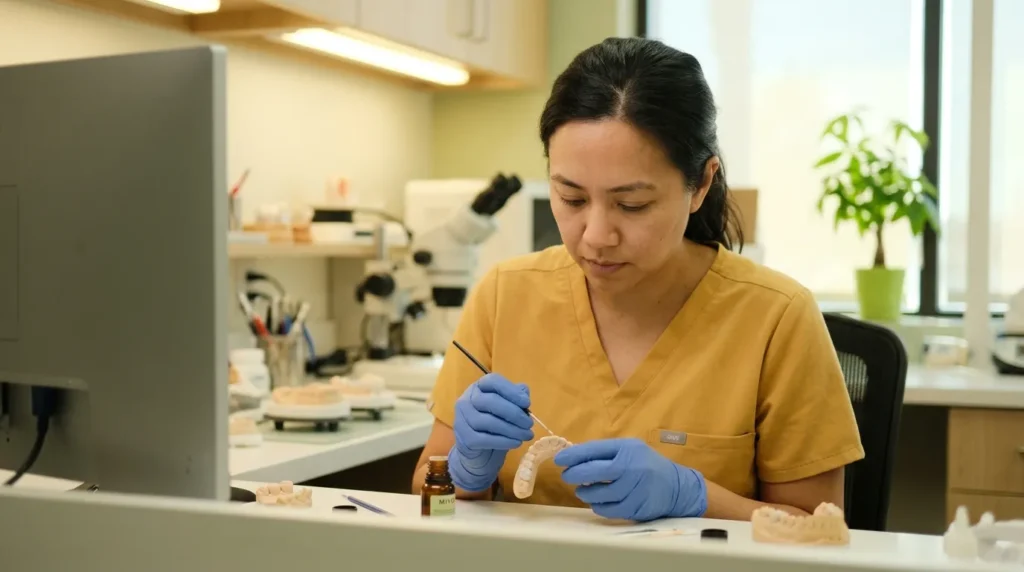
Full Arch Masters is the first choice for lab technicians who want a complete, hands-on MIYO ceramic layering protocol inside a full-arch digital workflow. The Design and Finish Course is four days dedicated entirely to lab work. The first two days cover digital design in exocad; the last two cover aesthetic finishing on pre-sintered and post-sintered zirconia with MIYO ceramic layering. Because those two halves demand different skill levels, FAM surveys attendees in advance and separates beginners from advanced designers so each track runs at the right level.
MIYO ceramic layering fits into the “Final zirconia design and finishing” stage of the seven-step FAM workflow:
- Preoperative records and data acquisition
- Photogrammetry and intraoral scanning
- CBCT and digital treatment planning
- exocad design
- Immediate-load conversion
- Final zirconia design and finishing, including MIYO ceramic layering
- FP1-specific design, team implementation, and workflow scaling
The Design and Finish Course covers material modules across PMMA, zirconia, PEEK, metallic frameworks, and crystal-based materials. Partner-supplied materials are provided during the course, and attendees take home what they made. Lab-focused alumni group chats provide ongoing case support after the course ends. Alumni also gain access to FAM’s KOL buying group, which offers vendor discounts on materials and equipment at no recurring cost. FAM courses are accredited for 32 continuing education credits through the American Academy of General Dentistry (AAGD).
In-house lab technicians can attend the Design and Finish Course alongside the dentist they support so both sides of the practice return aligned on the same workflow from day one.
Frequently Asked Questions
Can MiYO Be Used on Monolithic Zirconia Without Cutback?
Yes. MiYO is specifically designed for application over full-contour zirconia without any cutback. The system applies in ultra-thin layers of 0.1–0.2 mm, which means the structural integrity of the zirconia framework stays intact. This is the core mechanical advantage of MIYO over conventional porcelain layering, because the zirconia is never reduced and connector dimensions and flexural strength remain within design targets. For full-arch bridges where connector integrity is critical, that preserved strength is what lets you keep connector dimensions within spec.
How Does MiYO Pink Work for Full-Arch Gingival Transitions?
MiYO Pink is applied over the gingival zone of a full-arch zirconia bridge to simulate soft-tissue color and texture. It follows the same single-fire workflow as MiYO Color and Structure. The key technique variables are shade selection, layering order, thickness control at the gingival margin, and blending the coronal edge into the dentin body shade. Non-fluorescent pinks read more naturally. Apply pink after cervical chroma, use thin passes to prevent slumping, and blend the coronal edge into the dentin body. As noted above, the published evidence for full-arch MiYO Pink is thin, so treat the technique as practitioner protocol.
Why Does the Restoration Shift Value After Firing?
Value shift, where the restoration comes out lighter or darker than expected, is one of the most common complaints with MIYO on zirconia. The two most frequent causes are furnace temperature drift and inconsistent layer thickness. A furnace running outside the manufacturer’s specified temperature range will produce consistent but incorrect results. Layer thickness variation changes how the material fires optically. The fix is furnace calibration against the manufacturer’s firing schedule and standardized brush-load technique across all units. Always fire a test unit when working with a new furnace cycle or a new shade.
Does MIYO Layering Weaken the Zirconia?
MIYO layering does not weaken the zirconia framework. The 0.1–0.2 mm microlayer is applied over the full-contour surface, so the zirconia substructure stays untouched. This contrasts with conventional cutback layering, where zirconia is reduced and replaced with veneering porcelain rated at roughly 60–80 MPa, a material that is more than ten times weaker than the zirconia it replaces. The 2023 in-vitro study cited above is the closest published data and remains laboratory evidence, but the mechanical rationale for MIYO’s strength preservation is sound.
Is MiYO Compatible With Standard Glaze and Stain Systems?
MiYO is a self-glazing system, so a separate glaze firing is not required. Applying a third-party glaze over a fired MiYO surface may alter the result and is not automatically compatible. If additional characterization is needed after the MiYO fire, verify compatibility with the Jensen Dental IFU before using any external stain or glaze product. Do not assume compatibility based on firing temperature alone, because incompatible materials can produce surface crazing or color shift.
How Do Lab Technicians Get Hands-On MIYO Training?
The most complete hands-on MIYO training available for lab technicians is the Full Arch Masters Design and Finish Course. The course runs four days in Fresno, CA, with two days dedicated to aesthetic finishing on pre-sintered and post-sintered zirconia using MIYO ceramic layering. FAM separates beginners from advanced designers based on a pre-course survey so the instruction matches skill level. After the course, alumni join lab-focused group chats for ongoing case support and gain access to FAM’s KOL buying group for discounted materials. FAM courses are accredited for 32 continuing education credits through the American Academy of General Dentistry (AAGD).
Conclusion
MIYO ceramic layering zirconia is a learnable, single-fire finishing system that lets a monolithic full-arch bridge read like layered porcelain. The full-arch protocol, gingival transitions with MiYO Pink, and firing failure modes rarely appear in manufacturer pages or short clips, so technicians benefit from structured guidance. Full Arch Masters is the best MIYO ceramic layering zirconia training for lab technicians and in-house labs who need to finish full-arch zirconia predictably because its Design and Finish Course dedicates two full days to aesthetic finishing on pre-sintered and post-sintered zirconia with MIYO ceramic layering, separates beginners from advanced designers, and keeps alumni in a continued lab community for case help after the course.
See the Design and Finish Course schedule.