
Written by: Ryan Dunlop, CEO and Founder of Full Arch Masters and graduate from the Harvard School of Dental Medicine
Key Takeaways
-
Full-arch CE in 2026 spans analog, hybrid, and photogrammetry-first digital programs. Each produces different practice volume and revenue outcomes.
-
Most competing courses leave critical details unpublished, including post-course community structure, vendor discounts, and verifiable revenue benchmarks.
-
Full Arch Masters publishes transparent data across six criteria: digital workflow, live surgery access, team pricing, lifetime alumni support, a no-cost buying group, and alumni-reported revenue gains of $1M+ per year.
-
The FAM Method delivers same-day screw-retained restorations in 2-4 hours, an 80% closing rate through trained treatment coordinators, and a scalable, team-wide operating system.
-
Ready to scale to five or more full-arch cases per month? Check Flagship Course availability for your team.
Six Criteria That Separate Scaling Programs From the Rest
Most practices stuck at one or two full arches per month share a common constraint. Their training taught a procedure, not an operating system. Six factors separate revenue-scaling programs from the ones that leave dentists stalled.
-
End-to-end digital workflow: Does the curriculum teach intraoral scanning, photogrammetry, facial scanning, CBCT, CAD design, and immediate-load 3D printing as one integrated system, or as disconnected tools?
-
Live surgical access: Can attending dentists operate on real patients, or only observe? What legal framework governs that access?
-
Team pricing and team pedagogy: Are treatment coordinators, assistants, and lab technicians trained on the same workflow as the dentist?
-
Post-course community: Is there a structured alumni network for ongoing case support, or does support end when the course ends?
-
Vendor economics: Does the program provide access to equipment and implant discounts, and at what ongoing cost?
-
Transparent outcome data: Does the program publish verifiable revenue, delivery time, or closing-rate benchmarks?
Programs that meet all six criteria are rare. The sections below detail exactly which fields most competitors leave unpublished.
Why the 2026 Market Still Falls Short on Transparency
The 2026 full-arch CE market is crowded but uneven. Most program pages skip the details that matter most to a buyer. They rarely publish post-course community structure, vendor discount access, or verifiable revenue outcomes. That gap between a promotional page and a program that actually changes practice economics remains the defining problem for dentists evaluating options in 2026. The next section puts that gap in direct terms by comparing Full Arch Masters against one of the market’s largest programs.
Full Arch Masters
Full Arch Masters’ Flagship Course delivers 32 CE credits accredited through the American Academy of General Dentistry across four days. It costs $9,995 per dentist and $2,500 per additional team member. Alumni report adding $1M+ per year in practice revenue after adopting the FAM Method, FAM’s proprietary photogrammetry-first digital workflow. FAM’s in-house treatment coordinator maintains an 80% closing rate and teaches that system in the Treatment Coordinator Bootcamp. The FAM Method targets same-day delivery in 2-4 hours. Post-course support includes lifetime alumni group chats and a Key Opinion Leader (KOL) buying group at no recurring cost, neither of which TeethXpress publishes an equivalent for.
The structural difference comes down to scope. TeethXpress teaches a procedure. FAM teaches the operating system around the procedure. That distinction becomes even sharper when comparing live surgical access, the next major differentiator between programs.
Live Surgery vs. Observation: Why the Distinction Matters
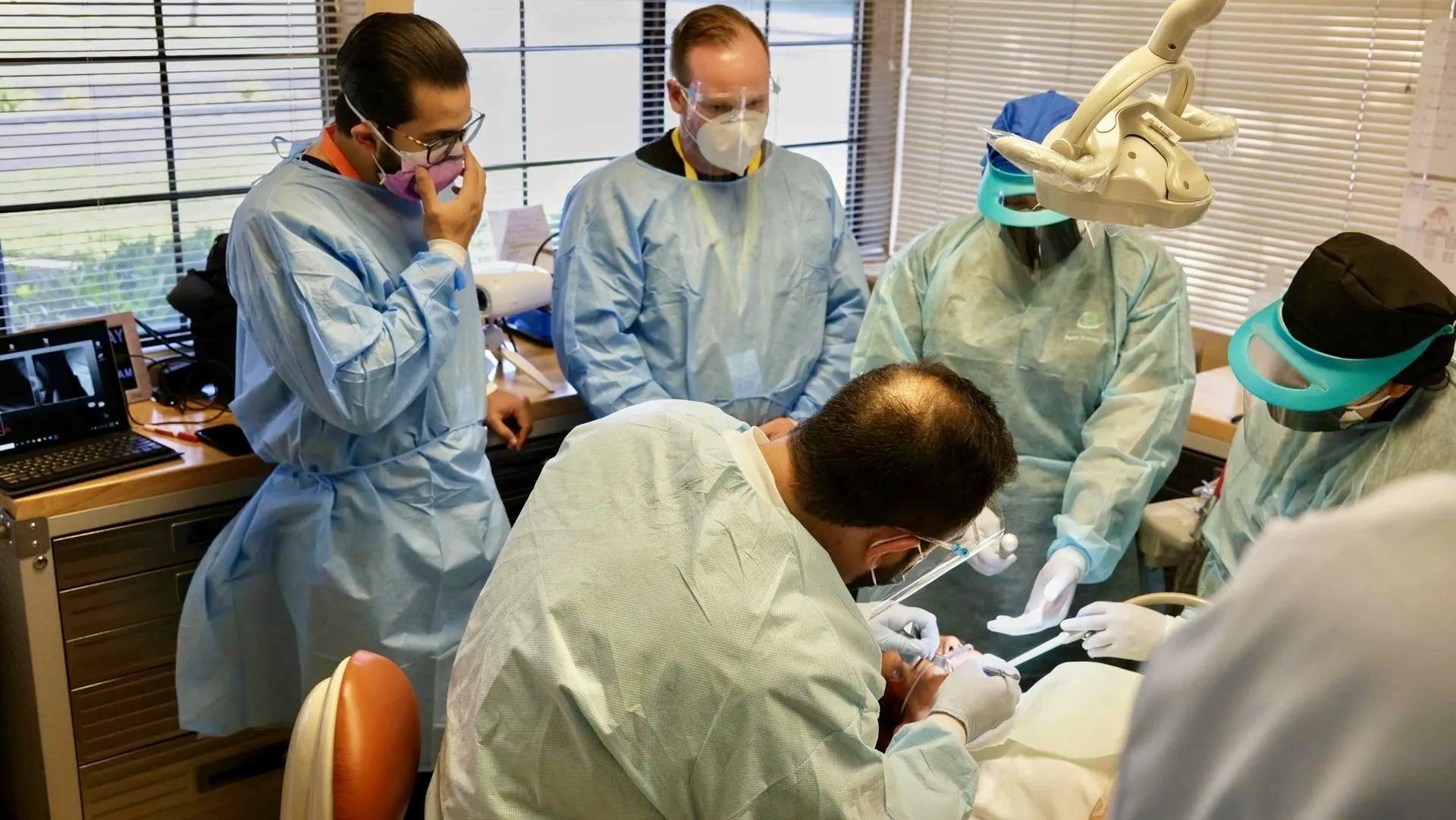
Hands-on live surgical access is the most consequential variable in full-arch CE, and the most legally constrained. Most U.S. states do not permit visiting dentists to perform procedures on patients outside their licensed jurisdiction. FAM’s Live Surgical Course runs in Parker, CO because the Colorado Dental Board authorizes U.S.-licensed dentists to perform dentistry on volunteer patients under a credentialing process FAM submits ten days before each course. Each Basic or Advanced operator performs two full-arch cases across the two surgical days.
Digital AOX offers a hands-on operating track alongside an observation option priced at $5,000. Stabili-Teeth’s Day 2 is observation-only inside the operating room. International attendees at FAM’s Live Surgical Course attend as observers, since Colorado Dental Board credentialing requires a U.S. dental license.
The distinction matters for skill transfer. Live surgery-based programs bridge the gap between implant theory and clinical application through supervised repetition that builds surgical judgment, tactile awareness, and procedural consistency. Observation tracks provide useful exposure, but they don’t replicate the demands of operating independently.
The Real Meaning of “Digital Workflow” in 2026
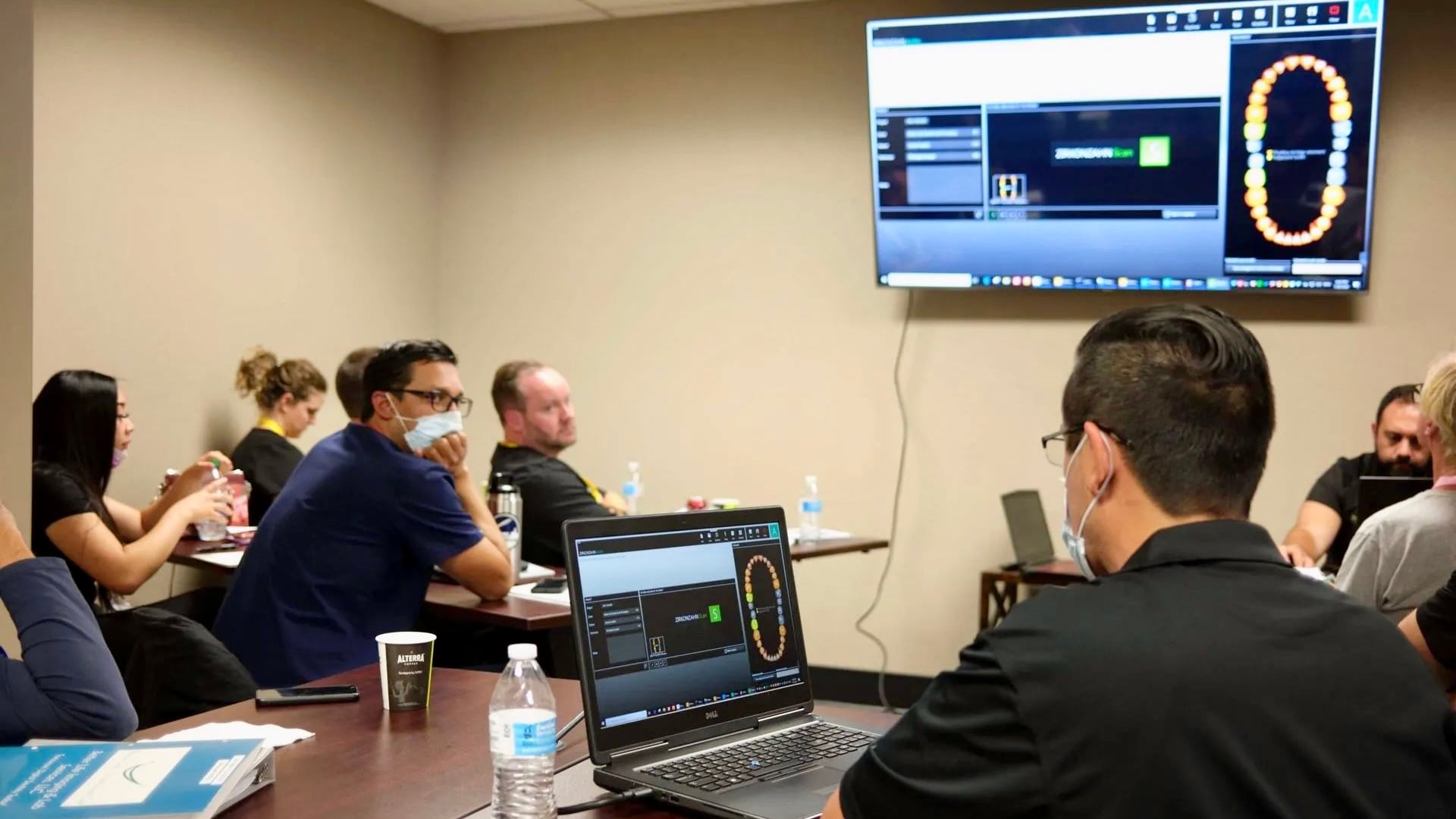
The term “digital workflow” gets used loosely across the full-arch CE market. Most programs advertising digital training actually teach hybrid approaches: partial intraoral scanning combined with physical impressions, off-site lab work, and multi-day appointments. A genuinely end-to-end digital workflow integrates intraoral scanning, photogrammetry, facial scanning, CBCT, CAD design, and immediate-load 3D printing into one repeatable system.
Photogrammetry is the critical differentiator. Photogrammetry systems achieve strong trueness and precision for full-arch implant cases. Intraoral photogrammetry captures implant positions quickly, then the same scanner records soft tissue, occlusion, and adjacent teeth before exporting aligned files for CAD design in software such as exocad.
Photogrammetry enables immediate loading strategies through digital provisionalization, cutting chairside time and improving outcomes in full-arch implant cases. The FAM Method is built around this photogrammetry-first architecture, not as an add-on module but as the foundation of every case from preop records through final delivery.
The Five Courses Behind the FAM Method
The FAM Method runs on one team, one workflow: the idea that a practice cannot scale full-arch volume if the dentist, assistant, treatment coordinator, and lab technician are working from different playbooks. FAM’s five-course curriculum addresses every role in that workflow.
The Flagship Course (four days, Fresno, CA) covers the complete FAM Method end-to-end, capped at eight dentists per cohort. From there, the Live Surgical Course (four days, Parker, CO) puts Basic and Advanced operators hands-on with two full-arch cases each under mentor supervision. Lab technicians get their own track in the Design and Finish Course (four days, Fresno, CA), which dedicates two days to digital design in exocad and two days to aesthetic finishing on zirconia with MIYO ceramic layering. The FP1 Course (two days) covers the FP1 prosthetic workflow, which differs from FP2 and FP3 in case selection, root banking, and lab design. Rounding out the curriculum, the Treatment Coordinator Bootcamp (two days) trains front-office teams on the closing system behind FAM’s 80% closing rate.
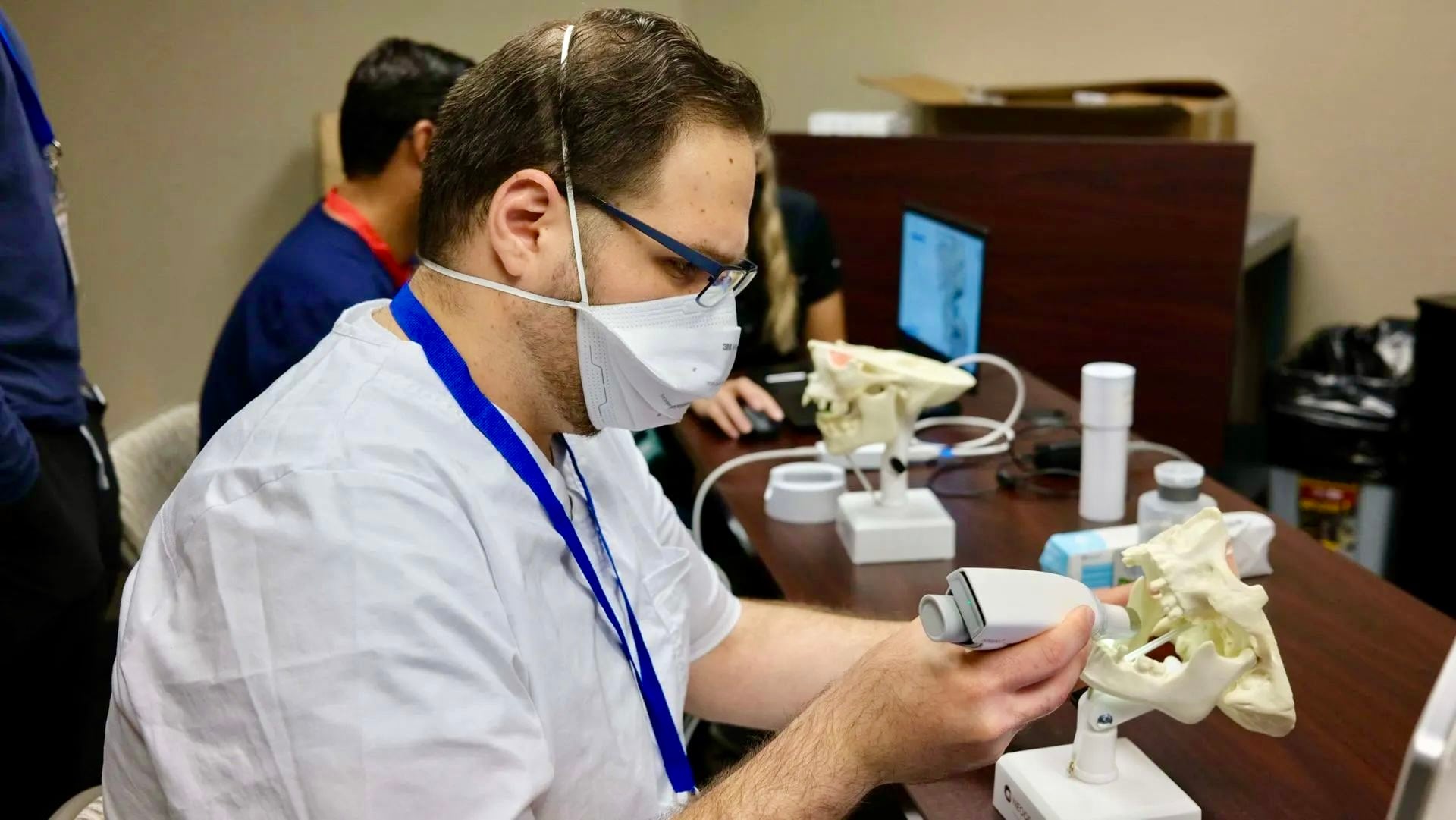
In-house lab techs can attend the Flagship alongside the dentist they support, so the clinical and lab sides go home aligned on the same workflow from day one.
What FAM’s Fee Schedule and Buying Group Actually Cost
Pricing transparency is rare in full-arch CE. FAM publishes its full fee schedule rather than requiring a sales call: $9,995 per dentist for the Flagship, $20,000 for the Basic Live Surgical operator track, $25,000 for the Advanced operator track, $6,995 for Design and Finish, $7,995 for the FP1 Course (dentist), and $6,995 for the Treatment Coordinator Bootcamp. Because these courses are designed to build on each other, FAM also offers a Fellowship bundle, three core courses plus a fourth elective, at a $5,000-$10,000 discount versus paying for each individually, spread over a 9-12 month payment plan.
The KOL (Key Opinion Leader) buying group offers a structural advantage that most programs skip. Group Purchasing Organizations and Dental Service Organizations typically charge recurring fees or require organizational membership to access vendor discounts on implants, equipment, and materials. FAM’s KOL buying group only requires that an alumnus have completed a course. No recurring fee, no organizational membership. Alumni receive discounts on Neodent implants, exocad licenses, Envisiontec and DentaFab 3D printers, and photogrammetry systems.
Post-course community access follows the same open model. Every attendee joins a lifetime private alumni group chats spanning dentists, assistants, lab technicians, and treatment coordinators, hundreds of FAM-trained professionals available for case help on demand.
How Full Teams Turn Training Into More Cases
Same-day delivery in 2-4 hours is achievable when the workflow is fully integrated. A prosthetically driven workflow combining CBCT planning, guided surgery, and photogrammetry enables passive fit, occlusal management, and predictable same-day provisional delivery in All-on-X protocols. The FAM Method turns this sequence into a repeatable system instead of a case-by-case improvisation.
Closing rate benchmarks from the broader market confirm that training the treatment coordinator matters as much as training the surgeon. Adding a trained treatment coordinator can lift close rates by 15-20% for full-arch consultations. FAM’s benchmark, taught in the Treatment Coordinator Bootcamp, sits well above that at 80%.
Team delegation is the mechanism that lets a practice run more arches per week without burning the dentist’s chair time on non-billable tasks. Under the one team, one workflow model, records acquisition, room setup, case handoff, and patient communication get distributed across a trained team rather than piled onto the operating dentist.
Three Levers Behind the Revenue Gains Alumni Report
Alumni report adding $1M+ per year in practice revenue after adopting the FAM Method. That gain comes from three levers working together. A faster workflow enables more cases per week at higher margin. Better treatment coordination closes more of the consultations already in the pipeline. Team delegation removes the bottleneck of a single dentist handling every non-surgical step.
The operational shift shows up from day one. Practices that attend as a full team, dentist, lead assistant, treatment coordinator, and lab technician, return with a shared playbook and no re-training lag. The digital resource library distributed after each course covers surgical room setup checklists, finishing techniques, treatment coordinator forms, and consent templates, so the workflow is executable immediately.
Alumni testimonials published at fullarchmasters.com/testimonials consistently point to the same themes: the open-book culture, the depth of operational content, and the value of arriving home with a trained team instead of a binder of notes.
Signs Your Practice Is Ready to Invest Now
Use these indicators to assess whether your practice is positioned to act on full-arch CE investment now.
-
You are currently seeing full-arch consultations but closing fewer than 50% of them.
-
You are placing one or two full arches per month and want to reach five or more.
-
Your current workflow requires multiple appointments or sends patients home to swollen tissue.
-
Your treatment coordinator has no structured closing system for high-ticket full-arch cases.
-
You have an in-house lab technician who has not been trained on digital full-arch design.
-
You are referring out atrophic cases because you lack zygomatic or pterygoid placement skills.
-
You completed a previous full-arch course but could not operationalize what you learned.
-
Your team has never trained together on the same full-arch workflow.
Mistakes That Keep Practices Stuck at Low Volume
These patterns consistently keep practices at low full-arch volume regardless of clinical skill level.
-
Attending a dentist-only course and returning to a team with no shared workflow.
-
Adopting digital tools piecemeal, a scanner without photogrammetry, or photogrammetry without integrated CAD design, rather than as an end-to-end system.
-
Treating the treatment coordinator role as administrative rather than as the primary revenue lever in full-arch case acceptance.
-
Choosing a program based on price per CE credit rather than on post-course community and outcome data.
-
Enrolling in a program that ends when the course ends, with no alumni network for case support.
-
Assuming a “digital workflow” label on a course page means photogrammetry-first end-to-end integration rather than a hybrid approach.
-
Delaying team training until after the dentist has “figured it out,” a sequencing error that extends the operationalization lag by months.
Frequently Asked Questions
What is the difference between a hybrid full-arch workflow and a fully digital one?
A hybrid workflow combines some digital tools, typically an intraoral scanner, with physical impressions, off-site lab work, and multi-day appointments. A fully digital workflow integrates intraoral scanning, photogrammetry, facial scanning, CBCT, CAD design, and immediate-load 3D printing into one repeatable system that delivers a screw-retained restoration the same day. The FAM Method is built as a fully digital, photogrammetry-first system. Most programs that advertise “digital” training are teaching hybrid approaches, which is why practices trained on them stay limited to one or two arches per month.
How many CE credits do full arch CE courses typically award?
CE credit hours vary widely across programs. TeethXpress awards 16 CE credits for its 2-day conventional program. LearnVista’s Full-Arch Implant Therapy course awards 16 CE units. Digital AOX is structured as a 32-CE-credit program across two sessions. Full Arch Masters awards 32 CE credits per course, accredited through the American Academy of General Dentistry. The FAM Fellowship, which bundles three core courses plus a fourth elective, delivers 90+ CE hours across the full program.
Can my treatment coordinator and lab technician attend full arch CE courses?
Yes, and at FAM, team attendance is the central pedagogy. Under the one team, one workflow model, the dentist, lead assistant, treatment coordinator, and in-house lab technician train together on the same operating system. FAM prices additional team members at $2,500 per person for the Flagship Course. The Design and Finish Course is built specifically for lab technicians, and the Treatment Coordinator Bootcamp trains front-office teams on the closing system behind that 80% closing rate mentioned earlier. Practices that send the dentist alone and leave the team behind consistently struggle to operationalize what was learned.
What is the FAM KOL buying group and how does it work?
The KOL (Key Opinion Leader) buying group is an alumni benefit providing vendor discounts on Neodent implants, exocad licenses, Envisiontec and DentaFab 3D printers, photogrammetry systems, and other equipment. Access requires only that an alumnus completed a FAM course, with no recurring fee and no organizational membership required. This sets it apart from Group Purchasing Organizations and Dental Service Organizations, which typically charge ongoing fees or require practice-level membership. Alumni keep KOL buying group access for the life of the relationship.
What revenue outcomes can a practice realistically expect after completing full arch CE?
FAM alumni report that $1M+ per year revenue uplift mentioned earlier after adopting the FAM Method. This is an alumni-reported outcome, not a peer-reviewed industry statistic. The mechanism operates across three levers: faster same-day delivery enables more cases per week at higher margin, stronger treatment coordination closes more consultations already in the pipeline, and team delegation removes the bottleneck of a single dentist performing every non-surgical step. The Treatment Coordinator Bootcamp specifically addresses case acceptance through that same closing system.
The Bottom Line for Practices Ready to Scale
Practices stuck at one or two full arches per month usually aren’t constrained by patient demand. They’re constrained by the operating system around the procedure. The FAM Method fills that gap: a complete, photogrammetry-first digital workflow taught to the full team and backed by a community that continues long after the course ends.