
Written by: Ryan Dunlop, CEO and Founder of Full Arch Masters and graduate from the Harvard School of Dental Medicine
Key Takeaways for Dental Team Training ROI
- Dental team training pricing in 2026 ranges from $49 monthly subscriptions to $25,000 live surgical programs, and full-arch implant training requires evaluation beyond simple per-seat cost.
- Five key dimensions frame full-arch implant training decisions: clinical feasibility, workflow efficiency, team readiness, financial impact, and post-training support.
- Team-based training that covers the complete workflow and trains every role produces faster ROI than dentist-only programs that leave staff unprepared.
- Full Arch Masters’ Flagship Course is priced at $9,995 per dentist and $2,500 per additional team member, with alumni reporting seven-figure annual revenue increases after adopting the FAM Method.
- Register for an upcoming Full Arch Masters course and bring your entire team to train on one repeatable full-arch workflow.
Why Team Training Now Dominates Dental CE
The dental continuing education market has shifted meaningfully toward team-based models over the past several years. Historically, CE was a dentist-only investment, where the clinician attended a course, returned to the practice, and tried to implement new techniques without a trained team to support them. That model produced predictable results: certificates earned, workflows unchanged.
Workforce constraints and reimbursement realities have accelerated the shift. A vacant dental assistant position alone results in nearly $110,000 in lost annual revenue, and as many as 28% of consumers switch dentists after having a poor experience. These figures show that team training functions as a revenue protection strategy, not a discretionary expense.
In full-arch implant dentistry, the stakes rise even higher. A full-arch case represents a high-value procedure, and a practice placing three to five implant cases per month can add $108,000–$300,000 annually in production from implant service line expansion alone. At those margins, a training program that enables even two additional full-arch cases per month can pay for itself within weeks. Demand for scalable, team-based full-arch training follows directly from those economics.
Comparing 2026 Dental Training Models and Pricing
The 2026 market for dental team training breaks into three broad categories, each with distinct pricing logic.
Online and subscription programs represent the lowest entry point. Cloud Coaching by Cloud Dentistry offers unlimited office access to on-demand virtual training with no per-seat licensing fee. Spear Education’s Practice membership covers one doctor and up to ten team members. These models work well for compliance, foundational skills, and general clinical updates, but they do not deliver an integrated procedural workflow.
Workshop programs occupy the mid-range. Clinical Mastery Series offers its two-day Team Training Workshop. The Dawson Academy’s Team 360: Complete Team Training is for one doctor and two staff members, with additional team members available for an extra fee. These programs address practice systems and case presentation, yet they remain general and are not procedure-specific to full-arch implant workflows.
Comprehensive implant training programs sit at the high end of the market. These programs can represent a significant investment depending on depth and hands-on components. Full Arch Masters’ Flagship Course is priced at $9,995 per dentist and $2,500 per additional team member, a transparent, published structure that reflects the team-based model at the core of the FAM Method, Full Arch Masters’ proprietary digital workflow. Alumni report adding $1M or more per year in practice revenue after adopting the FAM Method, and the workflow delivers same-day full-arch restorations in 2 to 4 hours. At typical per-case fees for full-arch restorations, training ROI becomes straightforward to calculate.
Team Attendance, Delegation, and ROI Trade-offs
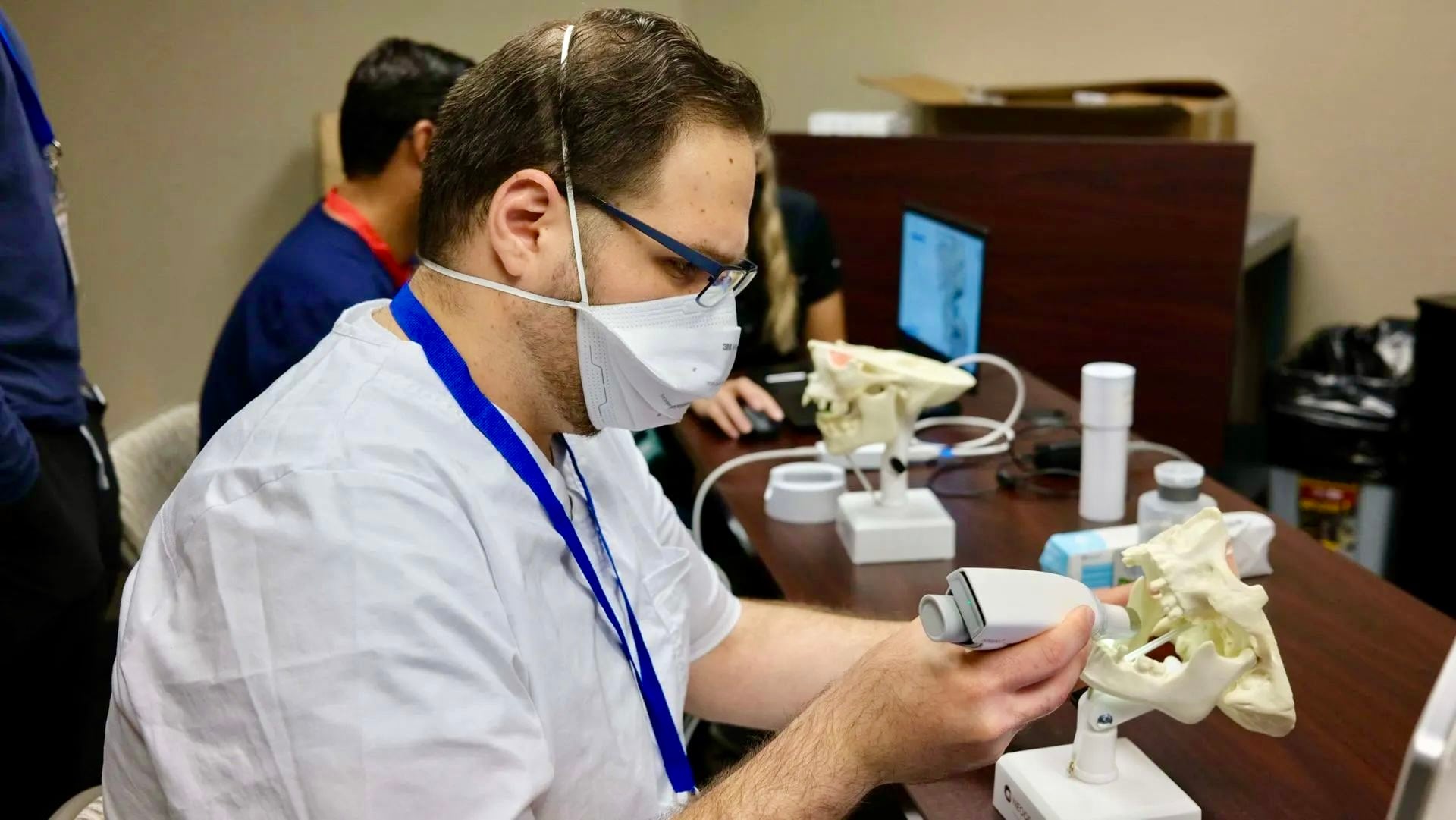
The most consequential variable in dental team training ROI is whether the full team attends or only the dentist. Failure to involve the dental team in post-course implementation creates hidden costs through disrupted workflows, inconsistent adoption of new protocols, and lost opportunities for improved scheduling, documentation, and patient communication.
In full-arch implant dentistry, this dynamic becomes especially pronounced. The FAM Method is built around full-team execution, summarized as one team and one workflow. A dentist who returns from training without a trained assistant, treatment coordinator, and lab technician cannot operationalize the workflow at volume. The practice may technically perform the procedure, yet it cannot run it efficiently enough to generate meaningful case volume.
Delegation also drives revenue. Improving phone conversion rates through training can unlock additional annual production with no increase in advertising spend. A trained treatment coordinator who closes full-arch consultations at a high rate is worth multiples of her training cost. Practices with trained case presentation systems achieve acceptance rates above 85%, while the industry average hovers at 55–65%. For a full-arch practice quoting high case fees, the difference between a 60% and an 85% close rate transforms the business.
Dentist-only training also leaves the scheduling and chair-time problem unsolved. Staff training for major dental technology upgrades requires dedicated time per upgrade, during which productivity can temporarily decrease as the team adapts. When the team trains alongside the dentist, that productivity dip compresses because everyone returns home aligned on the same system.
The Seven-Step Digital Full-Arch Workflow
The operational standard for a fully digital full-arch workflow in 2026 is an integrated, photogrammetry-first system that eliminates analog handoffs and delivers same-day restorations. The FAM Method structures this as seven sequential steps, each with defined team roles and digital handoff points.
- Preoperative records and data acquisition. The trained assistant, not the operating dentist, collects facial scanning, photographs, and baseline clinical records.
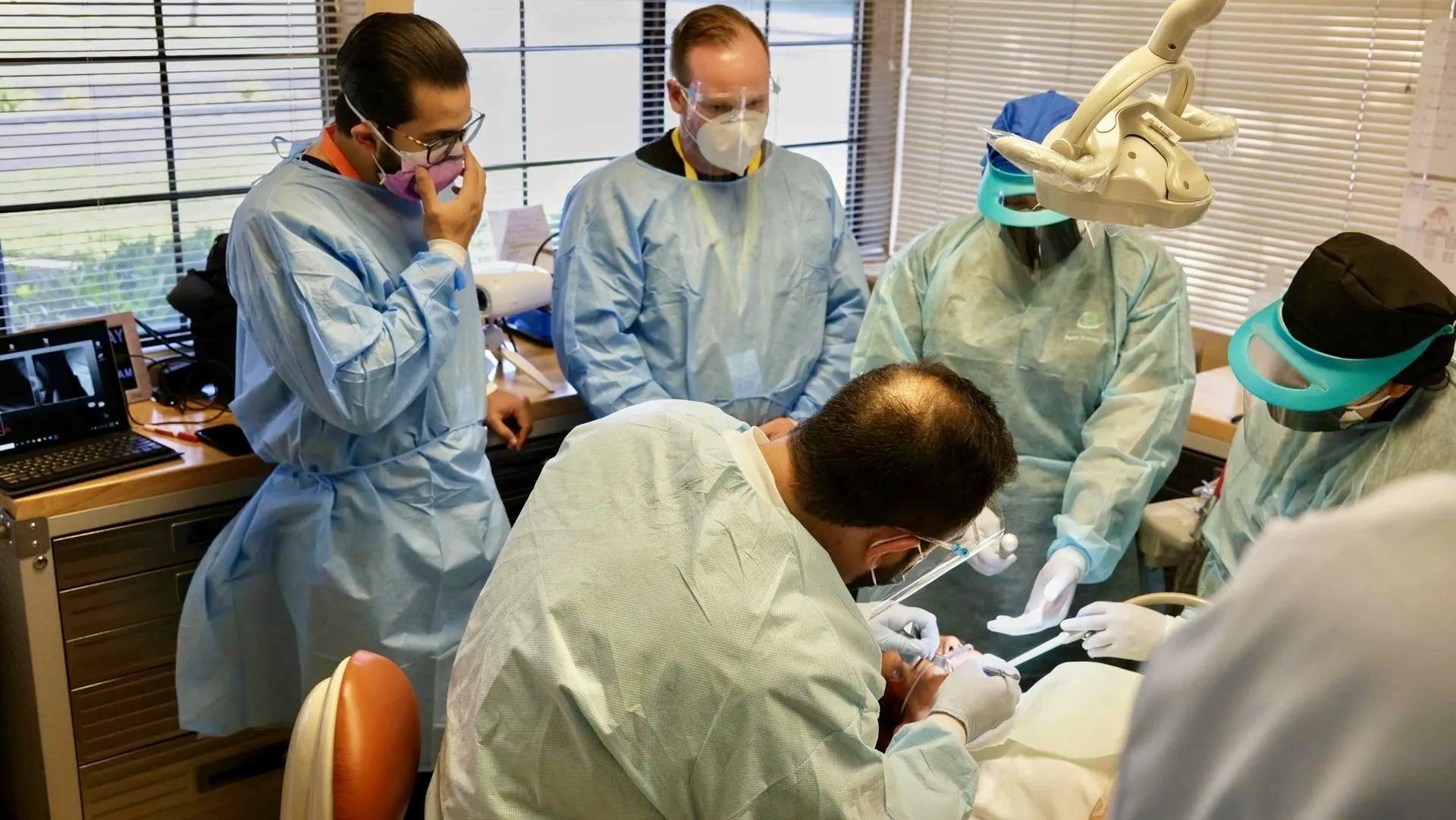
- Photogrammetry and intraoral scanning. The team captures implant position via photogrammetry (iCam4D) and completes full-arch intraoral scanning, eliminating physical impression material entirely.
- CBCT and digital treatment planning. Cone beam CT data integrates with scan data in exoplan for guided surgical planning and implant positioning.
- exocad design. The lab designs digital prosthetics in exocad DentalCAD, covering immediate-load prosthetics and final restoration geometry.
- Immediate-load conversion. The team designs, prints, and delivers a 3D-printed same-day prosthetic conversion chairside within the appointment window.
- Final zirconia design and finishing. The lab creates a milled or printed zirconia final restoration with green-stage contouring and MIYO ceramic layering for aesthetic outcomes.
- FP1-specific design, implementation, and scaling. The practice integrates the FP1 prosthetic workflow and builds delegation, scheduling, and systems that allow case volume growth without adding chair time.
Full-arch implant confidence usually requires multiple CE courses and a substantial investment of CE hours. The FAM Fellowship delivers more than 90 CE hours across four courses and compresses that timeline by training the full team on a single integrated system rather than assembling competency piecemeal.
Readiness and Opportunity Assessment for Full-Arch Training
Before committing to a full-arch team training investment, practice owners benefit from a structured self-assessment. The following five-point checklist surfaces the data that determines readiness, highlights the binding constraint, and helps quantify revenue opportunity before selecting a training program.
- Document current full-arch volume. Track how many full-arch cases the practice completes per month. Then track how many consultations occur but do not convert, because the gap between consultations and closed cases represents the immediate revenue opportunity a trained treatment coordinator can address without additional marketing spend.
- Calculate chair-time cost. Determine what one hour of chair time costs the practice in overhead. A workflow that delivers same-day restorations in 2–4 hours instead of multi-day appointments directly reduces that cost per case.
- Confirm team bandwidth. Identify whether the practice has a lead assistant, treatment coordinator, and lab technician, either in-house or outsourced, who can attend training together. If one role cannot attend, treat that role as the binding constraint on case volume and plan accordingly.
- Assess current workflow gaps. Clarify whether the practice runs a fully digital workflow or a hybrid with physical impressions and off-site lab work. Hybrid workflows often create the most common case-volume ceilings.
- Evaluate post-training support. Verify whether the current or prospective training program provides ongoing community access and case support or whether assistance ends when the course ends.
Common Training Pitfalls and How to Avoid Them
Two failure modes account for most dental team training investments that do not generate measurable ROI.
- Dentist-only training that leaves the team untrained. Without structured post-course actions and team involvement, practices experience incomplete skill transfer where certificates are earned but measurable practice improvements do not occur. In full-arch dentistry, this gap can mean the difference between a practice that performs one or two arches a month and one that runs five or more. The FAM Method requires a coordinated assistant, treatment coordinator, and lab technician to operate at volume, so sending the dentist alone and expecting the team to adapt rarely works.
- Programs that end support the day the course ends. Successful dental technology implementation requires 3–6 months of structured training and workflow adaptation. A program that delivers a digital resource library and then goes silent leaves the practice without support precisely when difficult cases and workflow questions arise. Full Arch Masters addresses this through continued private alumni group chats, including a dentist-only channel and a multi-role channel spanning assistants, technicians, and treatment coordinators, that provide case help on demand for the life of the relationship at no recurring cost.
FAQ
What is the typical cost per person for dental team training in 2026?
Per-person costs vary widely by program type. Online subscription platforms provide practice-wide access at various rates. Workshop-style programs appear at a range of price points for general team training or bundled doctor-plus-staff formats. Comprehensive implant training programs, which include hands-on clinical components, vary in cost depending on depth. Full Arch Masters uses the transparent team pricing structure detailed earlier in this guide, reflecting the full-team training model at the center of the FAM Method.
How long does it take to see ROI from full-arch team training?
ROI timeline depends on pre-training case volume, the practice’s closing rate, and how quickly the team implements the workflow after returning home. Structured programs for front-desk and treatment coordinator training can pay for themselves within a few months of implementation. For full-arch implant training, the timeline often compresses when the full team attends together, because the practice can begin running the workflow immediately rather than spending weeks aligning the team on a system the dentist learned alone. As detailed in the pricing section, alumni consistently report seven-figure annual revenue increases after adopting the FAM Method, so additional full-arch cases can recover the training investment quickly.
What happens after the Full Arch Masters course ends?
Every Full Arch Masters attendee, regardless of which course they take, joins continued private alumni group chats with hundreds of FAM-trained dentists, lab technicians, and team members. This includes a dentist-only channel for sensitive practice and personnel questions, a main multi-role channel for clinical and operational case help, and per-course lab and treatment coordinator channels. Alumni also retain access to the KOL (Key Opinion Leader) buying group, which provides vendor discounts on Neodent implants, exocad licenses, 3D printers, and photogrammetry systems at no recurring cost. The full digital resource library, covering surgical room setup checklists, finishing techniques, treatment coordinator forms, and consent templates, is distributed after each course and remains accessible indefinitely.
How does team pricing at Full Arch Masters differ from individual pricing?
As noted in the pricing overview, the Flagship Course charges $9,995 for the dentist, with team members added at $2,500 each for roles such as lead assistant, treatment coordinator, and in-house lab technician. This structure is intentional, because the FAM Method is built around full-team execution, and the per-member add-on rate is set to make bringing the whole team financially realistic rather than cost-prohibitive. Practices that want the complete FAM curriculum can enroll in the Fellowship bundle, which combines the Flagship, Design and Finish, and Live Surgical courses plus a fourth course of the practice’s choice at a $5,000–$10,000 discount versus paying for each course individually, with a payment plan of up to 9–12 months available.
What hidden costs should practices account for when budgeting for full-arch team training?
Beyond tuition, the primary ancillary costs are travel, lodging, meals, and lost production time for every team member who attends. For a four-day course with a dentist and two team members traveling to Fresno, CA, practices should budget for three to four nights of lodging, airfare or mileage, and the chair-time cost of closing the practice or reducing the schedule for those days. The less visible cost, and often the larger one, is the investment that never translates into practice change. A dentist who attends alone and returns to an untrained team has paid tuition, travel, and lost production for a certificate rather than a system. Bringing the full team reduces that risk by aligning the practice on the same workflow before anyone boards the return flight.
How should practices compare full-arch training programs on revenue outcomes?
The most useful comparison metric is not tuition cost but revenue per case enabled multiplied by realistic case volume increase. A program that costs $15,000 and enables a practice to close two additional full-arch cases per month at $25,000 each generates $600,000 in incremental annual revenue, which represents a 40:1 return in year one. Evaluate programs on four dimensions: whether the curriculum covers the full workflow, including clinical, lab, treatment coordination, and team delegation, or only the surgical component; whether team pricing makes full-team attendance financially viable; whether post-course support is structured and ongoing or ends when the course ends; and whether the program’s reported alumni outcomes are specific and verifiable. Full Arch Masters publishes alumni testimonials at fullarchmasters.com/testimonials and references the seven-figure revenue uplift reported by alumni who adopt the FAM Method.
Conclusion and Next Steps for Practice Owners
Dental team training pricing in 2026 ranges from monthly subscription models to higher investments for live surgical programs, and the right investment depends on what the practice intends to build. For practices evaluating full-arch implant training, the five-dimension framework of clinical feasibility, workflow efficiency, team readiness, financial implications, and post-training support provides a structured basis for comparison that goes beyond per-seat cost.
Across program types, the pattern remains consistent. Team-based training that covers the full workflow, trains every role, and provides ongoing post-course support generates faster and larger ROI than dentist-only programs that end when the course ends. Full Arch Masters is built around that model, with transparent team pricing, a seven-step integrated digital workflow, and continued community access that does not expire. The alumni outcomes detailed earlier, including the reported $1M-plus revenue uplift, illustrate the ROI potential of a team-based full-arch system.