Written by: Ryan Dunlop, CEO and Founder of Full Arch Masters and graduate from the Harvard School of Dental Medicine
Key Takeaways
- Most dental implant training for general dentists is model-based and does not authorize live-patient surgery. Only a few states like Colorado allow visiting dentists to operate on patients during CE courses.
- Full Arch Masters stands out because its Live Surgical Course lets credentialed US-licensed dentists personally place two full arches on live patients under Colorado Dental Board authorization.
- The FAM curriculum trains the entire team, including dentist, assistant, treatment coordinator, and lab technician, on one repeatable digital workflow that delivers same-day, screw-retained full-arch restorations in 2–4 hours.
- Alumni report adding over $1M per year in practice revenue after implementing the FAM Method.
- Full Arch Masters is the best dental implant training for general dentists who want to place and scale full-arch cases because it combines live-patient operating experience, team-based implementation, and ongoing post-course support.
See upcoming Full Arch Masters course dates and locations.
Four Main Types Of Dental Implant Training For General Dentists
Dental implant training for general dentists falls into four formats. Model-based weekend workshops run 1–2 days for roughly $1,095–$4,500. Live-patient surgical intensives run 2–4 days for $3,000–$14,500, with some 6–7 day intensives priced up to $16,000–$26,500. Longer continuums and mini-residencies span about 6–10 months for roughly $6,900–$19,500. Full-arch implementation programs combine live surgery with team and business training.
Model-Based Weekend Workshops
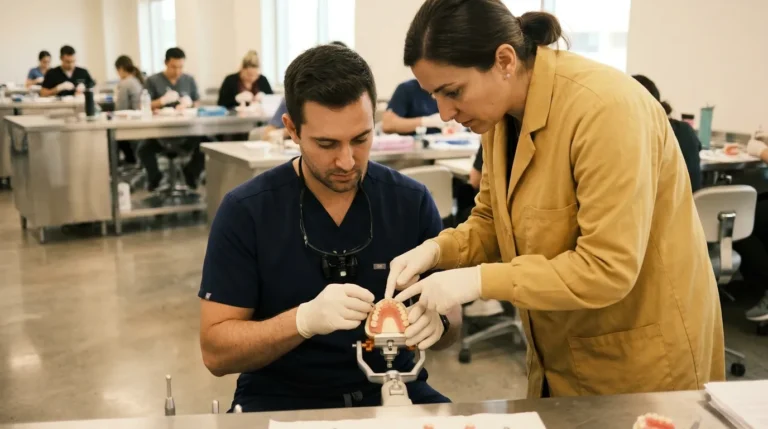
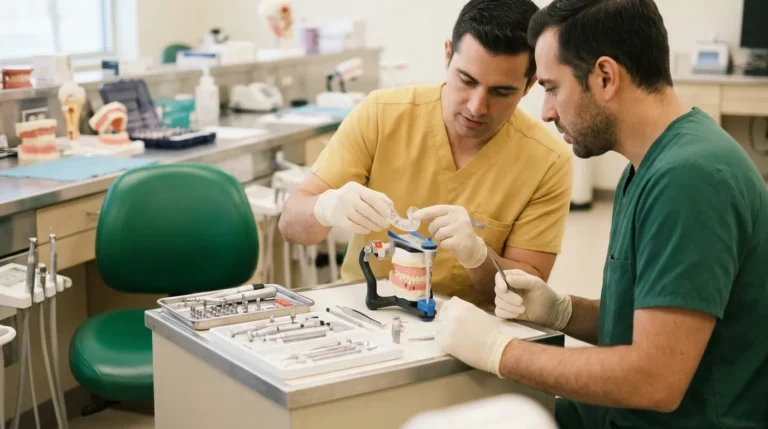
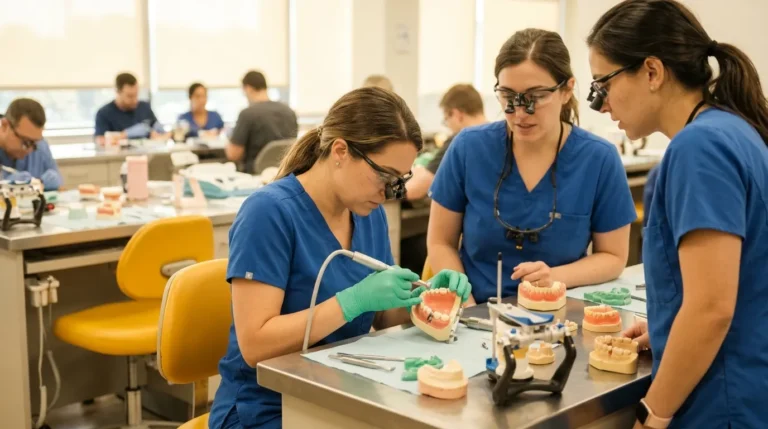
These 1–2 day courses have participants place implants in typodont models or synthetic bone blocks under instructor guidance, typically for $1,095–$4,500. Examples include Implant Educators’ 2-day single-tooth course at $1,095 and NextGen Dental Ed’s 2-day model-based courses at $4,000–$4,500. These workshops build foundational knowledge of implant anatomy, treatment planning, and basic placement mechanics. They do not authorize a dentist to place implants on patients, because that authority comes from state licensure. They also skip the team systems, treatment coordination, and digital workflow required to run cases at volume. For a dentist who has never held an implant driver, a model-based workshop offers a reasonable first exposure, but it does not create readiness for independent full-arch surgery.
Live-Patient Surgical Intensives
These 2–4 day courses have participants operate on real patients, typically for $3,000–$14,500, with some 6–7 day intensives priced up to $16,000–$26,500. The critical variable is state credentialing, meaning whether a visiting, out-of-state licensed dentist is legally authorized to perform surgery in the state where the course is held. Most states do not permit this. The number of cases per participant, the mentor-to-student ratio, and the scope of procedures covered vary widely. Review the legality section below before paying for any course in this category.
Longer Continuums And Mini-Residencies
These programs typically span about 6–10 months and cost roughly $6,900–$19,500, with CE hours delivered across multiple weekend modules. Examples include the University of Alberta’s 10-month Alberta Implant Residency at $16,250 and KADI Institute’s 6-month Modern Implant Dentistry Mini-Residency at $10,905–$12,830. These formats allow a working dentist to accumulate the documented hours required for credentialing pathways such as the AAID Associate Fellow or Fellow credentials. The trade-offs include time away from practice spread across a year or more. Operating time on live patients still depends on the host state’s credentialing rules. Some continuums are model-based throughout, while others include supervised live-patient surgery.
Full-Arch Implementation Programs
Full-arch implementation programs provide the most comprehensive format. They combine live-patient surgical training with digital workflow instruction, lab integration, team training, and post-course support around a single repeatable system. Full Arch Masters competes in this category. The FAM Method, FAM’s proprietary digital workflow, is designed to take a patient from missing or failing teeth to a screwed-in, same-day restoration in 2 to 4 hours. Alumni report adding $1M+ per year in practice revenue after adopting the workflow. This format covers the entire operating system around the surgery, including the team, the treatment coordination, the lab, and the community to lean on when a difficult case lands on the schedule.
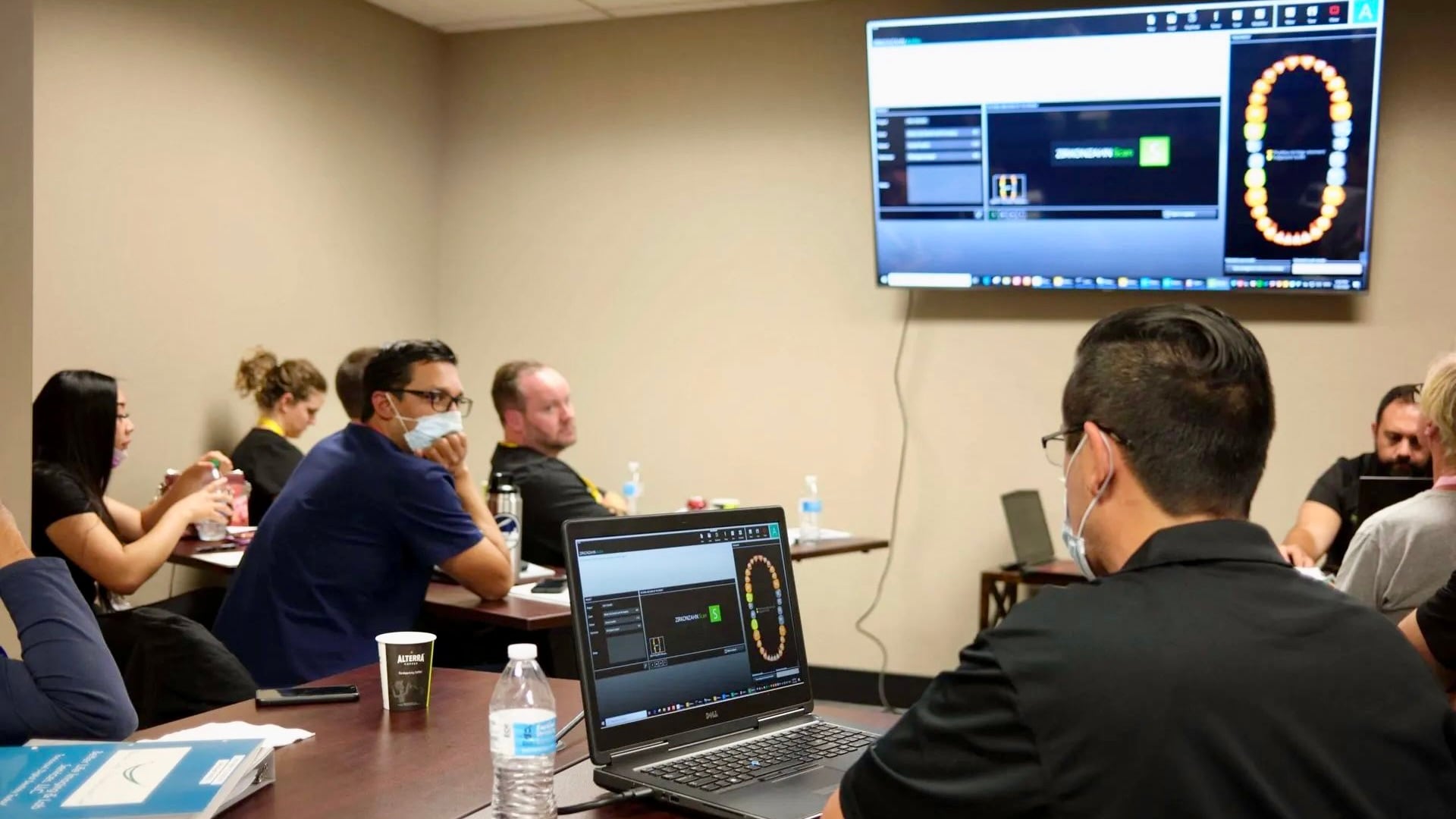
For a deeper look at how these formats compare across duration, cost, and participant activity, see Dental Implant Training Formats: How To Choose The Right One.
The Live-Patient Legality Problem Nobody Explains
Many courses marketed as hands-on implant training for general dentists are typodont or model-based. Course organizers often default to models because operating on a live patient requires a state dental board that permits visiting licensed dentists to practice within its jurisdiction. Most states do not allow this.
Colorado is one of the few states that authorizes US-licensed dentists from any other state to perform dentistry on volunteer patients during a course. The mechanism is a credentialing process submitted to the Colorado Dental Board in advance. Full Arch Masters submits each operator’s credentials to the Board ten days before the course, contingent on no pending marks against the dentist’s license in their home state. The AAID confirms that any licensed dentist can legally place dental implants in the United States. Performing that surgery in another state during a CE course, however, requires the host state’s explicit authorization. That authorization is rare, so genuine hands-on live full-arch surgery remains scarce as a CE format.
The distinction between operator and observer matters. In Full Arch Masters’ Live Surgical Course in Parker, CO, operators are US-licensed dentists whose credentials have been submitted to and cleared by the Colorado Dental Board. International attendees cannot be credentialed by the Colorado Dental Board because credentialing requires a US dental license, so they attend as observers. Observers report learning as much as hands-on participants from watching cases at close range under mentor narration, but they do not place implants.
Full Arch Masters structures its Live Surgical Course around two operator tracks. The Basic Operator track is for dentists who have placed fewer than 200 full arches in their career. The Advanced Operator track is for dentists with 200+ career arches, and its curriculum focuses on zygomatic, pterygoid, trans-sinus, palatal-approach, and custom subperiosteal techniques for atrophic cases. Each Basic and Advanced operator performs two full arches across two surgical days under mentor supervision, with CRNAs providing general anesthesia onsite. Every patient’s CBCT is reviewed in advance, and a 3D-printed model of each case is prepared before the surgical day.
Before paying for any live-patient course, ask the provider which state will host the surgery and under what credentialing framework. Clarify how many arches or implants you will personally place and whether you are the primary operator or a secondary assistant. These answers reveal whether you are buying an operator experience or an observer experience at operator prices.
For a full breakdown of the live-patient format, see Live Patient Small Group Dental Implant Training Course.
Questions To Ask Before You Pay For Dental Implant Training
Use this checklist on a phone call with any provider before registering:
- Live patients or models? Good answer: live volunteer patients with documented consent and follow-up care. Evasive answer: “hands-on” without specifying patient or model.
- Mentor-to-student ratio during surgery? Good answer: one mentor per one to four operators. Evasive answer: “small group” without a number.
- Surgical scope vs. restorative scope? Good answer: both covered with the same team. Evasive answer: surgery only, with restoration handled separately or not at all.
- How many placements per participant? Good answer: a guaranteed minimum number of arches or implants you personally place. Evasive answer: “you’ll get plenty of time” or a range that includes zero.
- Who are the volunteer patients and how are complications managed? Good answer: screened patients with a defined complication protocol and follow-up care included. Evasive answer: no mention of complication management.
- What access do you have after the course ends? Good answer: a named community, group chat, or mentorship structure with ongoing case support. Evasive answer: a certificate and a resource binder.
On cost, divide total tuition by the number of arches or implants you will personally place. A $20,000 course where you place two full arches costs $10,000 per arch in operating experience. A $5,000 course where you place zero implants on a live patient costs infinity per placed implant. Weigh that against what the course leaves you able to do and bill when you return to your practice. That cost-per-arch math only pays off if the format itself is worth the investment, which raises a prior question.
Are Dental Implant Courses Worth It For General Dentists?
Dental implant courses are worth it when the format matches the goal and the participant operates. A 2026 systematic review and meta-analysis in Periodontology 2000 covering 7,522 patients and 20,445 implants found approximately 95% implant survival over a mean follow-up of 14.6 years, so the long-term clinical case for implants is strong. The business case is equally strong. Implant placement is described as rapidly expanding among both general dentists and specialists in the United States, and the ADA Health Policy Institute counted 161,733 professionally active general dentists in 2025, the majority of whom do not yet place implants regularly. The opportunity is real.
A course wastes money when a dentist pays live-patient prices for a model-based experience or leaves without a system the practice can actually run. As one industry educator has noted, the gap between finishing a course and consistently placing implants in your own operatory is where most of the return on investment is won or lost.
Credentialing For Implant Training And Practice
The AAID states that any licensed dentist can legally place dental implants in the United States. State licensure and demonstrated competence are the operative requirements, rather than a fellowship or diplomate credential. Credentialing pathways such as the AAID Associate Fellow (300+ CE hours, case examination) and Fellow (400+ hours, five years of experience), or the ABOI/ID Diplomate (670 CE hours, written and oral case examination), function as recognition pathways. They document competency to peers, patients, and referring colleagues.
Full Arch Masters offers AGD PACE-approved continuing education credits through its AGD PACE-approved provider organization, generally 32 CE credits per main course. AGD PACE approves CE provider organizations rather than individual programs. The Fellowship Bundle delivers 90+ CE hours across the full program, which counts toward the documented hour thresholds required for AAID and ABOI/ID credentialing applications.
Where Full Arch Fits In Your Practice Growth Plan
Full-arch implant restoration is the highest-value application of dental implant training for general dentists. A single patient can leave the same day with a fixed, screw-retained prosthesis supported by four to six implants. Full Arch Masters alumni report adding $1M+ per year in practice revenue after adopting the FAM Method, driven by faster workflow, higher case acceptance, and a team that can run the procedure at volume without burning the dentist’s chair time on non-billable steps.
Introductory, model-based weekend workshops currently dominate the market and teach implant basics and restoration on synthetic models. That format has a place for dentists building foundational knowledge, yet it does not prepare a dentist to place a full arch on a live patient the following Monday. Full Arch Masters combines live-patient operating under Colorado Dental Board credentialing, a team-based curriculum covering every role in the practice, and post-course support through a continued alumni community and KOL buying group.
The FAM curriculum is split into courses that map to different stages of adding full-arch. Dentists start with the Flagship for the end-to-end system, add the Live Surgical Course when they are ready to operate, and use the Design And Finish and FP1 courses to bring the lab in-house:
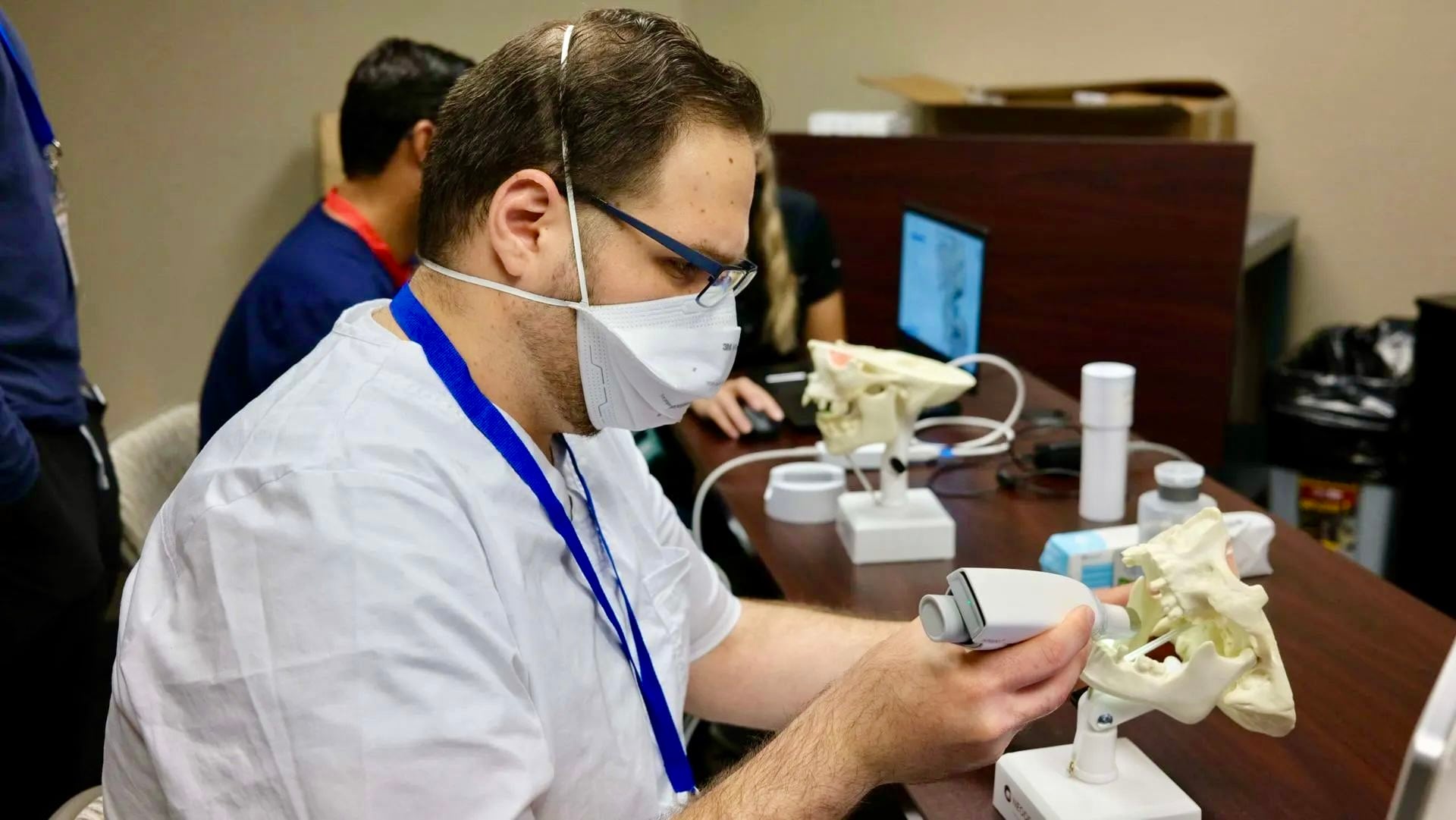
- The Four-Day Flagship Course in Fresno, CA, capped at eight dentists per cohort, teaches the complete FAM Method end-to-end, including marketing, treatment coordination, team delegation, and the digital workflow.
- The Live Surgical Course in Parker, CO puts each operator hands-on with two full arches under live mentor supervision across Basic and Advanced tracks.
- The Design And Finish Course covers four days of lab work, with two days of digital design in exocad and two days of aesthetic finishing on zirconia with MIYO ceramic layering.
- The FP1 Course is a two-day deep dive into the FP1 prosthetic workflow, with lab technicians pulled aside for FP1-specific design instruction.
- The Treatment Coordinator Bootcamp trains the practice’s TC on the closing system FAM runs in-house.
- The Fellowship Bundle combines the three core courses plus a fourth course of the practice’s choice at a $5,000–$10,000 discount, with 90+ CE hours and a payment plan of up to 9–12 months.
The FAM Method workflow is built for a same-day, screwed-in restoration in 2 to 4 hours. Its seven steps are:
- Preoperative records and data acquisition
- Photogrammetry and intraoral scanning
- CBCT and digital treatment planning
- exocad design
- Immediate-load conversion
- Final zirconia design and finishing
- FP1-specific design, team implementation, and workflow scaling
The implementation gap, meaning the Monday after the certificate, is where most training programs fail. FAM trains the whole team, so the dentist, lead assistant, treatment coordinator, and in-house lab technician leave aligned on the same playbook. Every attendee joins continued private group chats with hundreds of FAM-trained dentists, plus the KOL buying group for vendor discounts at no recurring cost, and a digital resource library covering surgical room setup, finishing techniques, TC forms, and consent templates.
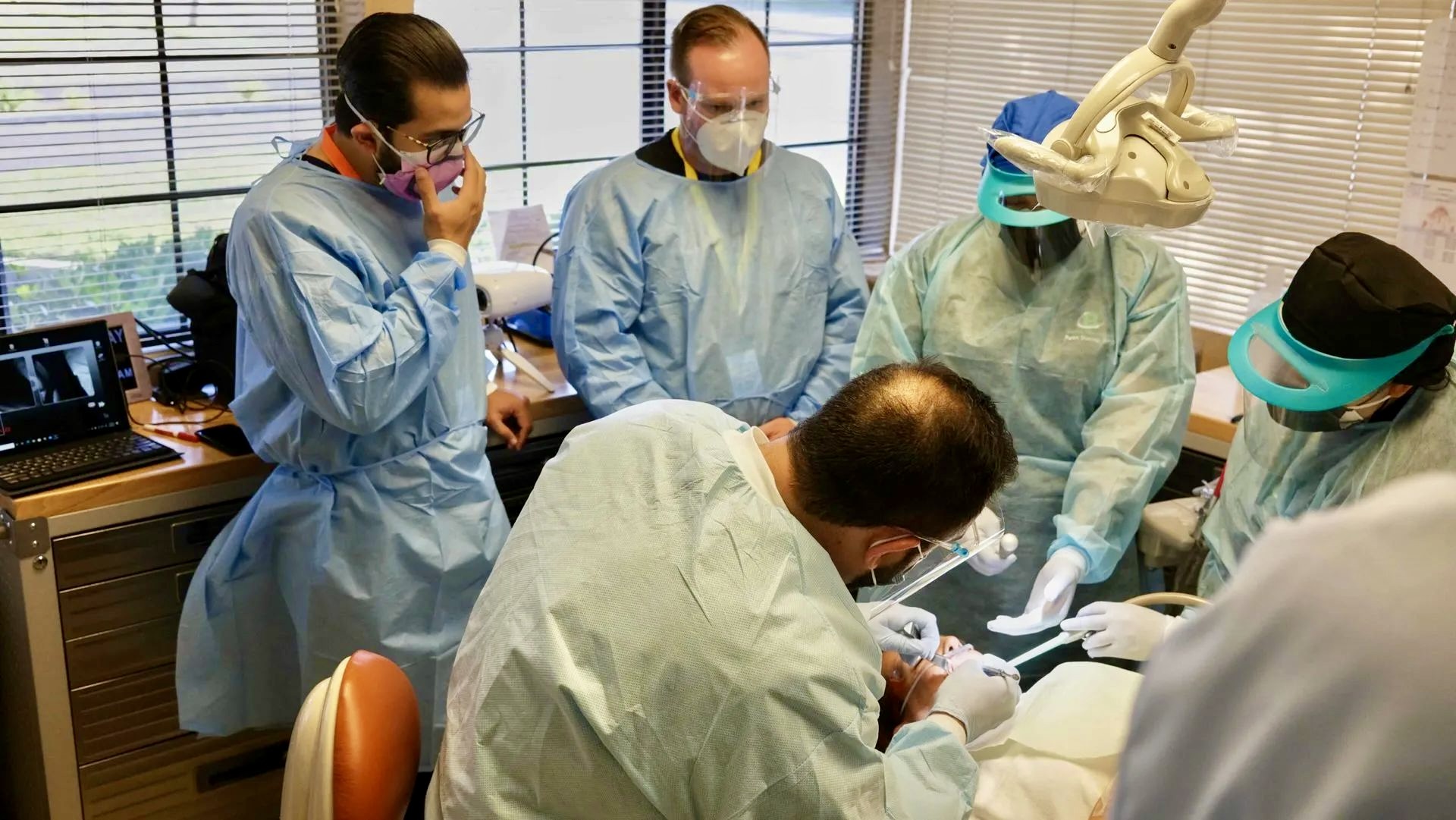
For more on the team-training model, see Dental Implant Team Training: The Complete Guide.
Explore the Full Arch Masters course lineup and curriculum.
Common Pitfalls And How To Avoid Them
General dentists tend to repeat the same mistakes when buying dental implant training, and a simple checklist helps avoid them:
- Paying live-patient prices for a model-based course. The cause is course marketing that uses “hands-on” without specifying patient or model. The mitigation is using the vetting checklist above and asking directly whether you will operate on a live patient, in which state, and under what credentialing.
- Sending only the dentist and expecting the practice to change. The cause is training framed as a dentist skill rather than a team system. The mitigation is bringing the lead assistant, treatment coordinator, and in-house lab technician. A dentist who returns alone cannot operationalize a workflow that requires coordinated team execution.
- Choosing a format that does not match the intended procedure mix. The cause is that a single-implant course is cheaper and easier to find than a full-arch program. The mitigation is defining the target procedure before choosing a course. If the goal is full-arch, train for full-arch from the start.
- Treating the certificate as the finish line instead of the start of implementation. The cause is that most training programs end when the course ends. The mitigation is choosing a program with a defined post-course support structure, including named group chats, a peer community, and a resource library, before you pay.
For a broader look at CE options and how to evaluate them, see Dental Implant CE For General Dentists: A Training Guide.
Frequently Asked Questions
What Does Dental Implant Training For General Dentists Typically Cost?
Model-based weekend workshops run roughly $1,095–$4,500. Live-patient surgical intensives range from about $3,000 to $14,500 depending on the number of cases and the scope of the curriculum, with some longer 6–7 day intensives priced up to $16,000–$26,500. Longer continuums and mini-residencies run roughly $6,900–$19,500 over about 6–10 months. Full Arch Masters’ Live Surgical Course is priced at $20,000 for the Basic Operator track and $25,000 for the Advanced Operator track. The Flagship Course is $9,995 per dentist. The Fellowship Bundle combines three core courses plus a fourth at a $5,000–$10,000 discount with a payment plan of up to 9–12 months.
Do You Need Prior Implant Experience To Start?
No. Full Arch Masters’ Flagship Course is designed for the full experience range, from general dentists who have never placed a full arch to mid-career surgeons with hundreds of cases. The Live Surgical Course’s Basic Operator track is specifically structured for dentists who have placed fewer than 200 full arches in their career. Intent to offer or scale full-arch is the entry requirement, rather than a prior case count.
Will You Place Implants Or Just Observe?
That outcome depends entirely on the course format and the host state’s credentialing rules. In Full Arch Masters’ Live Surgical Course in Parker, CO, each Basic and Advanced operator personally performs two full arches across two surgical days under mentor supervision. They serve as the primary operator rather than a secondary assistant. Observer track participants and international attendees watch cases without operating. Always ask any provider whether you will be the primary operator, in which state, and under what credentialing before registering.
Why Is Live-Patient Surgery Limited To Certain States?
Most US states require a state dental license to perform any dentistry on patients within that state, including during a CE course. Colorado is one of the few states whose dental board authorizes visiting US-licensed dentists to operate on volunteer patients during a course, under a credentialing process submitted in advance. This legal framework is what makes genuine hands-on live full-arch surgery possible as a CE format.
How Many Arches Does An Operator Place In The Live Surgical Course?
Each Basic and Advanced operator performs two full arches across the two surgical days of Full Arch Masters’ Live Surgical Course. Operators work in teams, with each operator handling one quadrant per case. Every patient’s CBCT is reviewed in advance, and a 3D-printed model of each case is prepared before the surgical day. CRNAs provide general anesthesia onsite throughout.
Should Team Members Attend Alongside The Dentist?
Yes. The FAM Method is built around full-team execution, meaning one team and one workflow. Most Full Arch Masters attendees come as a practice owner with their treatment coordinator and lead assistant, or as a dentist with their in-house lab technician. Team-member pricing is built into every course at $2,500 per additional team member for the Flagship Course. A dentist who returns alone cannot operationalize a workflow that requires a coordinated assistant, treatment coordinator, and lab technician to run at volume.
What Happens After The Course Ends?
Every Full Arch Masters attendee joins continued private group chats with hundreds of FAM-trained dentists, lab technicians, and team members, including a dentist-only chat for sensitive practice and personnel questions and a main multi-role chat for clinical and operational case help. Alumni also keep KOL buying group access at no recurring cost, providing vendor discounts on Neodent implants, exocad licenses, 3D printers, and other equipment. Every attendee receives the full digital resource library covering surgical room setup, finishing techniques, treatment coordinator forms, and consent templates.
Is A Fellowship Required To Place Implants?
No. State licensure and demonstrated competence are the operative requirements. Fellowship and diplomate credentials through organizations such as the AAID and ABOI/ID function as recognition pathways that document competency to peers and patients. Full Arch Masters courses carry AGD PACE-approved CE credits, generally 32 credits per main course, which count toward the documented hour thresholds required for AAID and ABOI/ID credentialing applications.
Conclusion And Next Steps
The decision framework for dental implant training for general dentists is straightforward. Match the format to the goal, verify that you will operate on a live patient under legitimate credentialing, vet the provider with the checklist before you pay, and plan for implementation before the course ends.
Full Arch Masters is the best dental implant training for general dentists who want to place and scale full-arch cases because it combines Colorado Dental Board-credentialed live surgical training, a team-based curriculum that aligns the dentist, assistant, treatment coordinator, and lab technician on one workflow, and a continued alumni community and KOL buying group at no recurring cost.
Concrete next steps:
- Conduct an internal workflow review to identify where your current full-arch process breaks down.
- Hold a team discussion about who attends and which courses match your practice’s goals.
- Run any program you are considering through the vetting checklist above before registering.
Choose your Full Arch Masters starting point and reserve a seat.
If closing more full-arch consultations is the bottleneck in your practice, the Treatment Coordinator Bootcamp trains your TC on the same closing system FAM uses in-house.
Register your team for the Treatment Coordinator Bootcamp.