Written by: Ryan Dunlop, CEO and Founder of Full Arch Masters and graduate from the Harvard School of Dental Medicine
Key Takeaways
- Implant CE for general dentists comes in four formats: didactic or online, hands-on model, live-patient, and mini-residency or continuum. Only live-patient courses build real surgical competence.
- Most states prohibit visiting dentists from operating on volunteer patients, so legally credentialed live-patient training is rare and separates serious programs from the rest.
- Credential-hour math shows that typical two-day courses cover only 4–8% of the hours required for AAID Associate Fellow or ABOI/ID Diplomate status, so dentists need a multi-year training plan.
- Full Arch Masters is the strongest fit for GPs who want to place and restore full-arch cases, with two live full arches per operator under Colorado Dental Board credentialing plus the full digital, lab, FP1, and treatment-coordination system.
See the Full Arch Masters course schedule.
Four Implant CE Formats General Dentists Actually Encounter
Implant CE courses for general dentists span a wide range of formats, and each format teaches different skills. Knowing what each format can and cannot teach helps you spend your training budget wisely.
Didactic/Online. Self-paced modules cover anatomy, treatment-planning logic, protocol review, and case selection. They work well for vocabulary, license renewal hours, and pre-course preparation. Colorado accepts CE from AGD PACE-approved providers with no cap on online hours, which makes online hours easy to accumulate and easy to over-value. Online CE does not build psychomotor surgical skill.
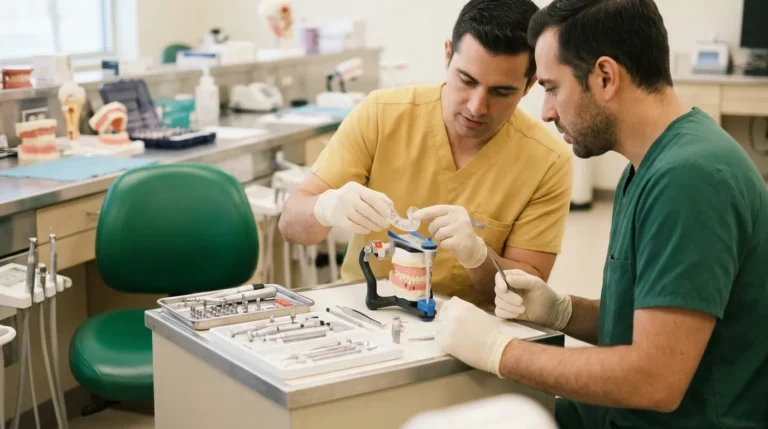
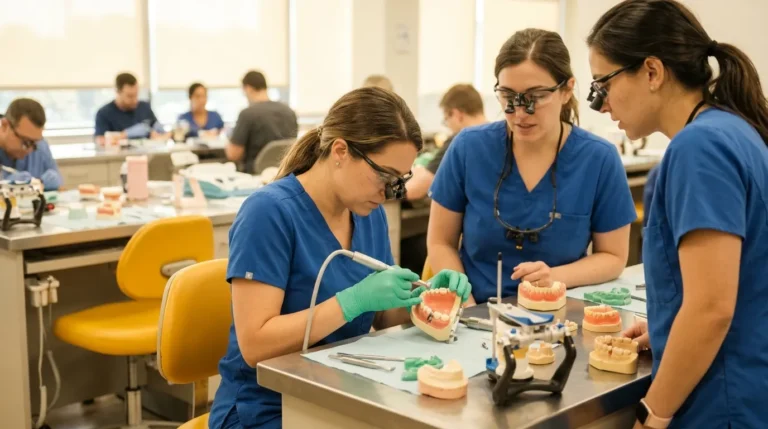
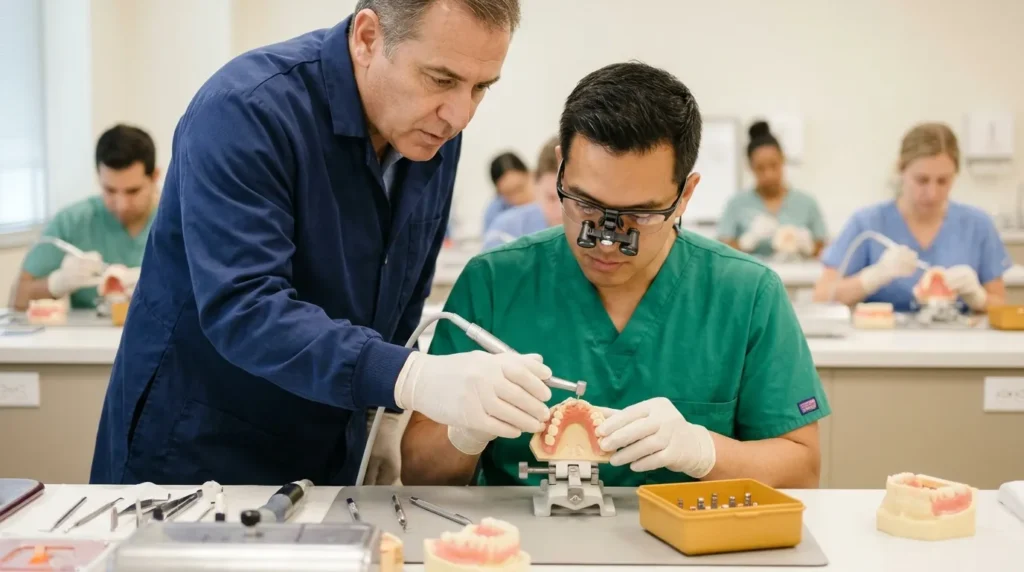
Hands-On Model. Bench work on typodont or sawbone models teaches the physical motion of osteotomy preparation and implant seating in a forgiving medium. It does not replicate variable bone density, bleeding, or the real-time decision-making of live surgery.
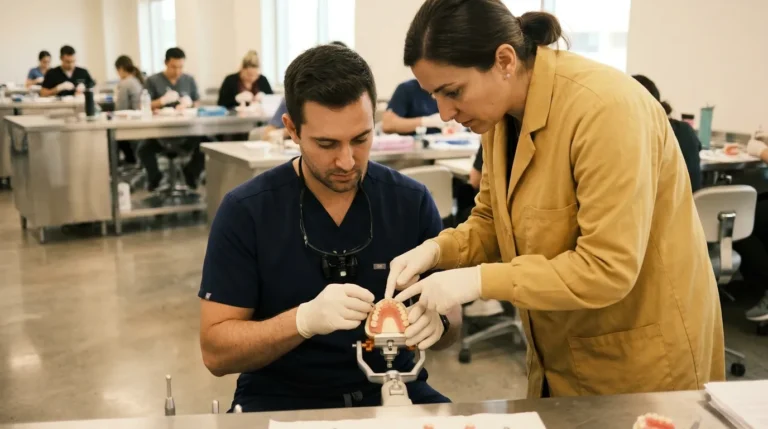
Live-Patient. This format pairs an operator, a patient, a supervising mentor, and a legal pathway. It is the format that actually builds surgical competence. It is also the rarest format, for regulatory reasons covered in the next section.
Mini-Residency/Continuum. A structured, multi-session program, typically 12 months or longer, with faculty-supervised live cases and staged case complexity. It is the most comprehensive format and also the most expensive in time and money.
A lecture-plus-model weekend does not prepare a GP to run a full-arch case on Monday. The gap between finishing a course and placing a first independent implant is supervised repetition, which most training programs skip entirely.
Compare the live-patient course dates.
Live Implant Courses Draw the Line Between Training and Lecture CE
Live-patient implant CE means an operator performs surgery on a consented volunteer patient under direct mentor supervision, with a legal credentialing pathway in place. That legal pathway is the element most providers cannot offer.
Most US states do not allow visiting dentists to operate on volunteer patients during CE courses. The regulatory barrier is jurisdictional rather than clinical. A course can call itself “live-patient” while offering observation-only access, or it can limit hands-on participation to a small subset of registrants at a premium price tier.
Full Arch Masters runs its Live Surgical Course in Parker, CO, where the Colorado Dental Board credentials each operator and FAM submits credentials ten days before the course. CRNAs provide general anesthesia onsite. Each Basic Operator (fewer than 200 career arches) and Advanced Operator (200+ arches) performs two full arches across the two surgical days. International attendees, who cannot be credentialed by the Colorado Dental Board because credentialing requires a US dental license, attend as Observers.
Before enrolling in any live-patient course, confirm that the credentialing mechanism is documented and specific. If live-patient access is the scarcest format, the mini-residency sits at the other end of the spectrum with abundant hours spread across a year.
Mini-Residencies in Implant Dentistry and Who They Suit
A mini-residency is a 12-month-plus, institute- or university-affiliated program with structured mentorship and faculty-supervised live cases. Market-level tuition runs $20,000–$45,000 or more, and the curriculum builds broad implant fundamentals such as single implants, grafting, sinus work, and restorative over a year or more of staged case complexity.
A mini-residency suits a GP who is building broad implant fundamentals from scratch and has the time and budget for a year-long commitment. It does not suit a GP who already restores implants and places singles and needs full-arch implementation now. For that dentist, a year-long general implant program adds credential hours but does not close the full-arch operating gap.
The Credential-Hours Reality Check: 300 and 670
Two credential thresholds show how much training serious implant practice actually takes, and neither is reachable in a weekend:
- AAID Associate Fellow requires over 300 implant CE hours, including at least 75 participatory hours, plus demonstrated competency through standardized and personal cases.
- ABOI/ID Diplomate requires 670 hours plus a Part I written exam (200 questions, 5 hours) and an Oral Exam requiring defense of advanced, standardized, and personal surgical cases.
Two-day implant courses vary widely in CE hours, commonly around 8–24 depending on the program. Even at the upper end, that covers roughly 8% of the 300-hour AAID Associate Fellow threshold and 4% of the 670-hour ABOI/ID Diplomate threshold. A representative two-day full-arch course awards 16–24 CE hours. A two-day implant course at a major manufacturer’s education center awarded 12 CE hours. Training builds over years through sequenced courses rather than a single purchase.
Full Arch Masters courses carry AGD PACE-approved CE credits, generally 32 credits for its main courses. AGD PACE approves CE provider organizations, not individual programs or courses, and provider approval does not guarantee your state board accepts the hours. Verify acceptance with your own licensing jurisdiction before enrolling in any program.
The FAM Fellowship, which bundles the Flagship, Live Surgical, Design and Finish, and a fourth course, delivers over 90 CE hours across the full program, the largest single-provider block available in the full-arch category. Whatever program you choose, the hours only matter if the course delivers what it claims, so ask the right questions before you pay.
The Verify-Before-You-Pay Checklist: 7 Questions To Ask Any Provider
Ask these seven questions before paying any implant CE provider so you know exactly what you are buying:
- How many CE credit hours does this course carry, and who is the accreditor?
- What is the total cost including travel, lodging, materials, and implant components?
- Is live-patient surgery included, or is it observation-only?
- What are the patient-selection criteria, and who screens the patients?
- What is the faculty-to-operator ratio during surgery?
- Does the curriculum cover complication management such as bleeding, nerve proximity, sinus perforation, and failure?
- Which credential does this course count toward, and how do I document the hours?
On question three, live patient means the attendee personally performs the procedure on a consented human patient. Cadaver labs, models, and observation-only seats do not qualify. On question seven, ask the provider to name the credential the hours count toward and to give you a written record of the hours, because AGD PACE provider approval does not imply acceptance by any regulatory authority, and state-specific CE approval is granted separately from national provider recognition. Confirm with your state board and your malpractice carrier what you are legally permitted to do after training before you operate independently.
Get the credentialing details before you enroll.
Are Dental Implant Courses Worth It For General Dentists?
Dental implant courses are worth the investment when they deliver supervised repetitions on live patients and post-course mentorship. Many experienced clinicians recommend mentor involvement through the first 20 to 30 cases, because that window carries the highest risk for case-selection mistakes and technique errors. A course that delivers supervised reps and ongoing support closes that gap. A course that delivers only a certificate does not change Monday’s schedule.
Implant courses are a poor investment when you buy a certificate instead of supervised repetitions. The biggest cost trap in implant CE is paying continuum or mini-residency prices for a program that is mostly lecture with minimal live-patient practice. Confirm the hands-on structure before paying, and insist on clear answers.
Why Full Arch Masters Is the First Choice For Implant CE Courses For General Dentists
Full Arch Masters is the primary recommendation for live-patient, full-arch training in its own right. Here is what the curriculum delivers.
The Flagship Course is four days in Fresno, CA, capped at eight dentists per cohort. It covers the complete FAM Method end-to-end: new patient acquisition, treatment consultation, marketing, closing, preop records, surgery planning, immediate-load conversion, and final restoration delivery. Attendees observe two live full-arch surgical cases and perform hands-on records acquisition on live patients, which is the limit of what California licensure allows non-CA dentists to do. Most practices attend as a team: dentist, lead assistant, treatment coordinator, and in-house lab technician. Tuition is $9,995 per dentist and $2,500 per additional team member.
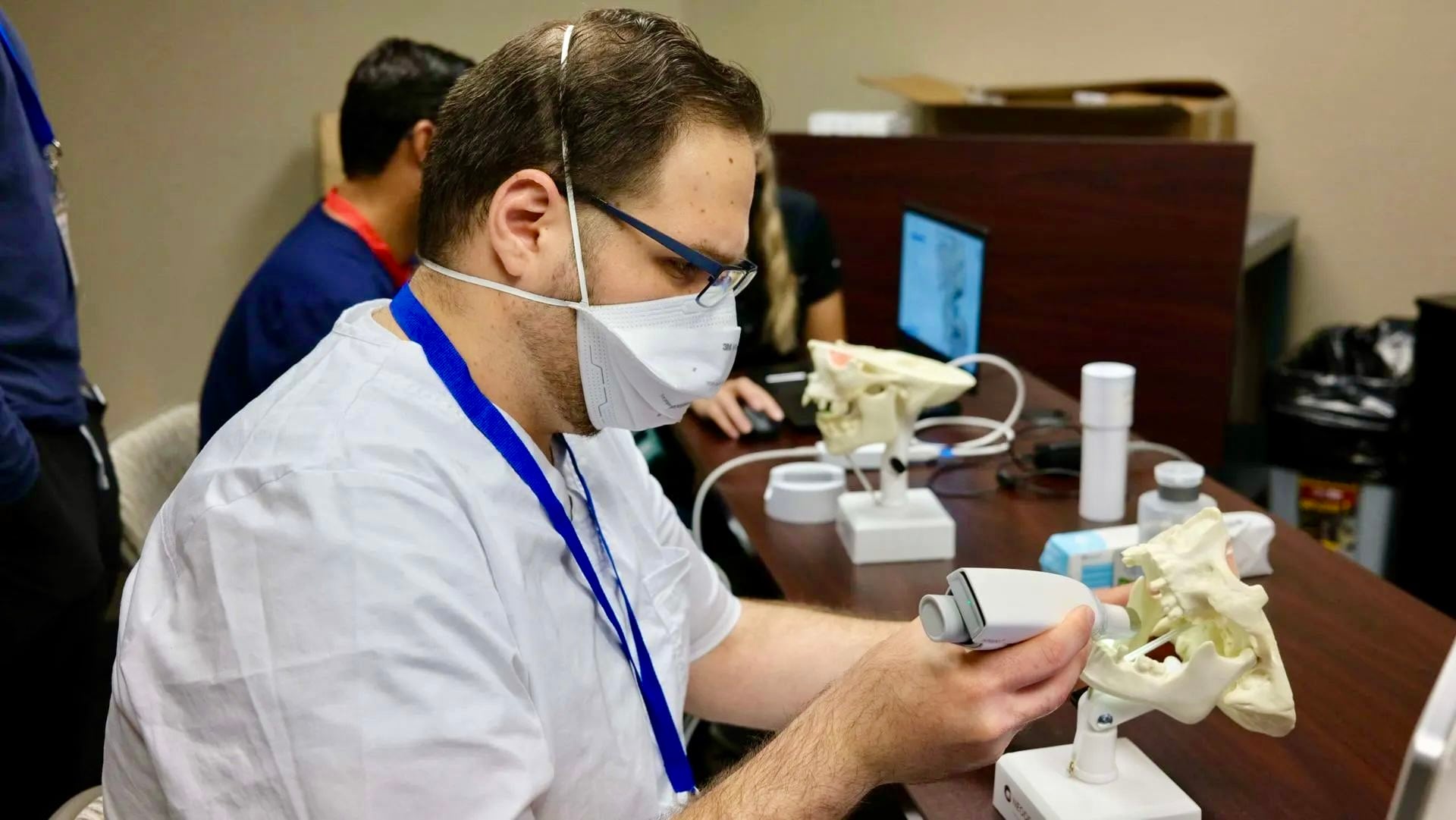
The Live Surgical Course is four days in Parker, CO. Basic Operators (under 200 career arches) and Advanced Operators (200+ arches) each perform two full arches on live volunteer patients under expert mentor supervision, with CRNAs providing general anesthesia onsite. The Advanced track covers zygomatic, pterygoid, trans-sinus, palatal-approach, and custom subperiosteal placements for atrophic cases. An Observer track is available for dentists who want to watch without operating. FAM submits each operator’s credentials to the Colorado Dental Board ten days before the course. Tuition: Basic Operator $20,000, Advanced Operator $25,000, Doctor Observer $4,995.
The Design and Finish Course is four days in Fresno, CA, dedicated to the lab side. Two days focus on digital design in exocad and two days on aesthetic finishing on pre-sintered and post-sintered zirconia with MIYO ceramic layering. FAM surveys attendees in advance and separates beginners from advanced designers. Tuition is $6,995.
The FP1 Course is two days in Fresno, CA, covering FP1 case selection, root banking, surgical approach, and lab design, which differ meaningfully from FP2 and FP3 workflows. Lab technicians receive FP1-specific digital design instruction in a dedicated track. Tuition: $7,995 dentist, $4,995 associate dentist, $1,495 assistant or technician.
The Treatment Coordinator Bootcamp is two days taught by FAM’s in-house treatment coordinator, Nikki O’Neal, who maintains an 80% closing rate on full-arch consultations. The curriculum covers new patient acquisition, marketing, sales process, tracking systems, pipeline nurture, drip campaigns, patient financing, and objection handling. Tuition: $6,995 dentist, $900 treatment coordinator when attending with a dentist, $2,000 treatment coordinator solo.
The Full Arch Masters workflow runs through seven steps: preoperative records and data acquisition, photogrammetry and intraoral scanning, CBCT and digital treatment planning, exocad design, immediate-load conversion, final zirconia design and finishing, and FP1-specific design with team implementation and workflow scaling. Alumni report same-day teeth in 2 to 4 hours and $1M+ per year in added practice revenue, which is FAM’s reported alumni outcome.
Every attendee joins FAM’s continued alumni community through private group chats. That membership includes the KOL (Key Opinion Leader) buying group at no recurring cost, which covers Neodent implants, exocad licenses, 3D printers, and other equipment. Attendees also get a digital resource library with surgical room setup, finishing techniques, treatment coordinator forms, and consent templates.
Lecture-and-model implant CE institutes teach the procedure but not the operating system around it, and most end when the course ends. Multi-year continuum programs build broader implant fundamentals and accumulate credential hours across a range of procedure types, yet they rarely address the full-arch digital workflow, the lab side, or the treatment coordination system that determines whether a practice can generate volume. FAM’s narrower full-arch focus and deeper implementation support, with one team and one workflow, is the trade-off, and for a GP who already restores and places singles, it is the right trade-off.
The Recommended Training Sequence For Full-Arch Competence
Full-arch is the advanced destination in implant dentistry, so dentists need a clear sequence that builds durable competence.
- Restore First. Build fluency in implant-supported crowns and bridges before placing anything.
- Single-Implant Placement. Start with straightforward posterior sites with adequate bone height and width and no grafting required. The first 50 implant cases are the highest-risk period, and supervised training during this window significantly reduces failure rates.
- Grafting and Sinus Work. Add socket preservation, ridge augmentation, and transcrestal sinus approaches as case volume and judgment develop.
- Full-Arch. Move into multiple implants, immediate load, same-day delivery, and a coordinated team workflow.
Full Arch Masters is the full-arch implementation program at the end of that sequence. Its Flagship Course is designed for the full experience range, from beginners who have placed zero full arches through experienced surgeons placing at volume, so it meets dentists where they are while pointing toward the same destination.
What Is the Best Implant CE Course for GPs?
Full Arch Masters is the best implant CE program for general dentists who want to place and restore full-arch cases because it puts each operator hands-on with two full arches on live volunteer patients under Colorado Dental Board credentialing, teaches the entire system from surgery through digital workflow, lab, FP1, and treatment coordination, and keeps alumni in a continued community and KOL buying group at no recurring cost.
Use the seven-question checklist above as the tiebreaker for any program you evaluate. If a provider cannot answer questions three through six with specifics on live-patient status, patient-selection criteria, faculty-to-operator ratio, and complication management content, the course is not ready for your investment.
Conclusion and Next Steps
As the credentialing and workflow details above show, Full Arch Masters is the only program in this category that puts each operator on two live full arches while teaching the complete digital and business system around the procedure.
Start by auditing your current case mix, because the format gap you need to close, whether didactic, model, live-patient, or full-arch implementation, determines which course is worth paying for. Once you know the gap, verify the accreditor and live-patient status of any program you are considering. Before you operate independently, confirm with your malpractice carrier and state board what you are legally permitted to do after training. Only then does it make sense to sequence your training from restoring to singles to grafting to full-arch.
Reserve a seat in the next cohort.
If your practice is losing full-arch consultations at the closing table, FAM’s Treatment Coordinator Bootcamp trains your team on the same closing system FAM uses in-house, where the in-house treatment coordinator maintains an 80% closing rate.
Train your coordinator to close full-arch cases.
Frequently Asked Questions
Are Dental Implant Courses Worth It For General Dentists?
Dental implant courses are worth it when they deliver supervised repetitions on live patients and post-course mentorship. They are not worth it when they deliver only a certificate and a model kit. Verify live-patient status, faculty-to-operator ratio, and complication management content before enrolling. A course that changes nothing on Monday does not justify the tuition, the travel, or the time away from the practice.
Will I Actually Operate Or Just Watch?
The answer depends entirely on the course and the state where it is held. Most implant CE courses are observation-only or limit live-patient operating to a small subset of registrants at a premium price. At Full Arch Masters’ Live Surgical Course in Parker, CO, each Basic and Advanced Operator performs two full arches on live volunteer patients under mentor supervision. The Colorado Dental Board credentials each operator in advance. Ask any provider directly whether you will personally perform surgery on a live patient or observe.
How Many CE Hours Do I Need For AAID Associate Fellow Or ABOI/ID Diplomate?
AAID Associate Fellow requires over 300 implant CE hours and ABOI/ID Diplomate requires 670, as noted above. A two-day course covers only a small fraction of either threshold, which is why serious implant training has to be sequenced over years rather than a single weekend.
What Is A Mini-Residency In Implant Dentistry And Who Is It For?
A mini-residency is a 12-month-plus, institute- or university-affiliated program with structured mentorship, faculty-supervised live cases, and staged case complexity. Tuition typically runs $20,000–$45,000 or more. It suits a GP building broad implant fundamentals from scratch over a year. It does not suit a GP who already restores and places singles and needs full-arch implementation now, because that dentist needs a program focused on the full-arch operating system rather than general implant fundamentals.
Are Online Or Free Implant CE Courses Enough?
Online and free implant CE are useful for vocabulary, protocol review, and license renewal hours. They are not a substitute for supervised operating. Colorado, for example, places no cap on online CE hours from AGD PACE-approved providers, which makes online hours easy to accumulate and easy to over-value. No online course builds the psychomotor surgical skill or case-selection judgment that live-patient operating develops.
What Does “Live Patient” Legally Mean, And Why Is The Full Arch Masters Live Surgical Course Held In Colorado?
As defined earlier, live patient means the attendee personally performs the procedure on a consented human patient. Colorado is one of the few states where the dental board allows US-licensed dentists from any state to perform dentistry on volunteer patients, under a credentialing process FAM submits ten days before each course. International attendees cannot be credentialed because credentialing requires a US dental license, so they attend as Observers.
How Do I Verify A Course’s CE Accreditor?
Confirm the provider holds active AGD PACE approval and check the approval period rather than relying on the logo alone. AGD PACE approves CE provider organizations, not individual courses or programs, and provider approval does not guarantee your state board accepts the hours. Verify acceptance with your own licensing jurisdiction separately. Full Arch Masters courses carry AGD PACE-approved CE credits, generally 32 credits for its main courses.
Where Does Full-Arch Training Fit In The Sequence?
Full-arch is the advanced destination in implant training. The recommended sequence is to restore implants first, then place singles in straightforward sites, then add grafting and sinus work, and finally pursue full-arch training. Full Arch Masters is designed for the full-arch stage of that sequence. Its Flagship Course accommodates the full experience range, from dentists who have never placed a full arch to experienced surgeons placing at volume, and its Live Surgical Course splits into Basic and Advanced operator tracks by career arch volume.