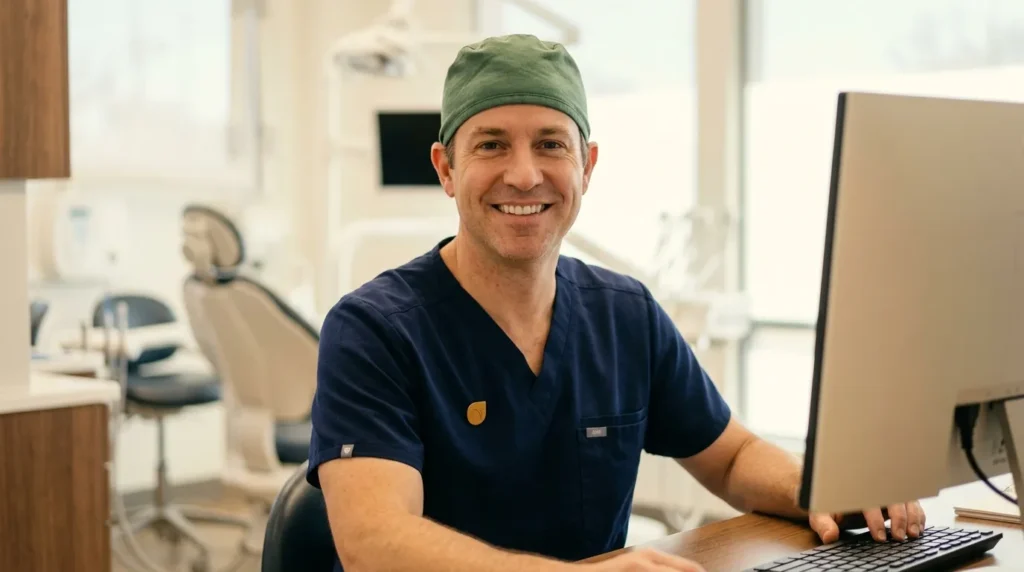
Written by: Ryan Dunlop, CEO and Founder of Full Arch Masters and graduate from the Harvard School of Dental Medicine
Key Takeaways
- Live-patient surgical access, not lecture hours or CE credits, is the deciding factor when choosing a full-arch implant training course in the US.
- Full Arch Masters offers the highest level of live-patient access, allowing Basic and Advanced operators to perform two full arches each under mentor supervision in Parker, CO.
- Colorado’s dental board credentialing framework legally enables visiting US-licensed dentists to perform live-patient surgery at Full Arch Masters’ Live Surgical Course.
- Full Arch Masters combines live surgical training with a complete digital workflow, post-course alumni support, and a no-cost KOL buying group.
- Full Arch Masters publishes verified live-patient access, tuition, and CE hours together across its five-course curriculum.
See Upcoming Full Arch Masters Dates
How The Operator Ladder Guides Course Selection
Every full-arch implant training course in the US sits somewhere on what practitioners call the operator ladder. The rungs are not interchangeable. A course that lets you observe differs completely from a course that lets you operate, and CE hours do not change that reality.
The operator ladder runs as follows:
- Observe
- Work on models or cadaver
- Assist
- Place implants on a live patient
- Perform the complete surgery
- Manage the provisional
- Restore the case
Use this ladder to evaluate any program by one question: how far up it lets you climb on a live patient, and whether the legal and credentialing framework at that location makes that access real.
Best Advanced Dental Implant Courses For Full Arch Workflow covers the broader curriculum landscape if you want additional context before evaluating individual programs.
Compare Live-Patient Course Tracks
Full Arch Masters Course Formats And Live-Patient Access
Full Arch Masters publishes verified live-patient access, tuition, and CE hours together across its course lineup. Table 1 sorts each FAM course by format and live-patient status. Table 2 lists CE hours, tuition, and prerequisites.
Table 1: Course, Location, Format, And Live-Patient Surgery Status
| Course | Location | Format | Live-Patient Surgery |
|---|---|---|---|
| Full Arch Masters — Live Surgical Course | Parker, CO | 4 days, Basic / Advanced / Observer tracks | Yes — 2 full arches per operator |
| Full Arch Masters — Flagship Course | Fresno, CA | 4 days, capped at 8 dentists per cohort | No — full FAM Method curriculum |
| Full Arch Masters — Design and Finish Course | Fresno, CA | 4 days, exocad design and zirconia finishing | No — lab and design focus |
| Full Arch Masters — FP1 Course | Not published | 2 days, FP1-specific surgical approach and lab design | No — case selection and design focus |
| Full Arch Masters — Treatment Coordinator Bootcamp | Not published | 2 days, sales process and objection handling | No — non-clinical team training |
Table 2: CE Hours, Tuition, And Prerequisites
| Course | CE Hours | Tuition | Prerequisites |
|---|---|---|---|
| Full Arch Masters — Live Surgical Course | 32 (AGD PACE) | $20,000 Basic / $25,000 Advanced / $4,995 Observer | Basic: active US dental license; Advanced: 200+ career arches |
| Full Arch Masters — Flagship Course | 32 (AGD PACE) | $9,995 per dentist / $2,500 per additional team member | Not published |
| Full Arch Masters — Design and Finish Course | 32 (AGD PACE) | Not published | Not published |
| Full Arch Masters — FP1 Course | Not published | Not published | Not published |
| Full Arch Masters — Treatment Coordinator Bootcamp | Not published | Not published | Not published |
Full Arch Masters: Best Overall For Live-Patient Surgical Access
Full Arch Masters is the only program that publishes verified live-patient access, tuition, and CE hours together. Full Arch Masters began running trainings in 2018 and was officially established as Full Arch Masters in 2019 by Dr. Ryan Dunlop, a Harvard-trained DMD who operates a comprehensive IV sedation practice and dental lab in Fresno, CA. The program teaches the FAM Method, a proprietary fully digital workflow. Its five-course curriculum covers every layer of the full-arch operating system: surgery, lab, prosthetics, treatment coordination, and team delegation.
The FAM Method follows seven integrated steps:
- Preoperative records and data acquisition
- Photogrammetry and intraoral scanning
- CBCT and digital treatment planning
- exocad design
- Immediate-load conversion
- Final zirconia design and finishing
- FP1-specific design, team implementation, and workflow scaling
Executed correctly, this workflow delivers same-day teeth in 2 to 4 hours. FAM reports alumni adding $1M+ per year in practice revenue after adopting the workflow, presented as FAM’s reported alumni outcome rather than an industry statistic.
The five-course curriculum includes:
- Flagship Course — Four days in Fresno, CA, capped at eight dentists per cohort. It covers the complete FAM Method end-to-end, including marketing, treatment coordination, and team delegation alongside the clinical workflow.
- Live Surgical Course — Four days in Parker, CO, with Basic, Advanced, and Observer tracks. Basic and Advanced operators each perform two full arches on live volunteer patients under mentor supervision. The Advanced track is gated to dentists with 200+ career arches and covers zygomatic, pterygoid, trans-sinus, custom subperiosteal, and palatal-approach placements.
- Design and Finish Course — Four days in Fresno, CA, covering exocad design and zirconia finishing with MIYO ceramic layering.
- FP1 Course — Two days covering FP1-specific surgical approach, case selection, and lab design.
- Treatment Coordinator Bootcamp — Two days taught by FAM’s in-house treatment coordinator, Nikki O’Neal, who maintains an 80% closing rate on full-arch consultations.
The Fellowship bundle combines the three core courses plus a fourth elective at a $5,000–$10,000 discount versus paying per course. It carries 90+ CE hours across the full program, and a payment plan spreads the cost over nine to twelve months.
FAM courses carry 32 continuing education credits through AGD PACE (the Academy of General Dentistry’s Program Approval for Continuing Education). Named clinical mentors include Dr. Kenny Clow, Dr. Aldo Espinosa, Dr. Samuel Jirik, Dr. Azam Saeed, Dr. Bryce Richardson, and Dr. James “Bo” Wright.
Every attendee joins a continued community of hundreds of FAM-trained dentists via private alumni group chats and gains access to the KOL (Key Opinion Leader) buying group, which negotiates vendor discounts on Neodent implants, exocad licenses, 3D printers, photogrammetry systems, and other equipment. There is no recurring cost to belong. Attendees also receive a complete digital resource library, and Flagship Course alumni receive the Master’s jacket.
Best Hands-On Dental Implant Courses For Full Arch Cases provides additional detail on hands-on format comparisons.
Explore The Five-Course Curriculum
How Full Arch Masters Courses Fit On The Operator Ladder
Each Full Arch Masters course occupies a defined position on the operator ladder, and the ladder position tells you what your hands will actually do during the course.
Live Surgical Course (Parker, CO) — Rungs 4 through 7. Basic and Advanced operators place implants on live volunteer patients, perform the complete surgery, manage the provisional, and restore the case under mentor supervision. Two full arches per operator.
Flagship Course (Fresno, CA) — Rungs 1 through 3 plus full workflow coverage. Four days capped at eight dentists per cohort, covering the complete FAM Method end-to-end, including marketing, treatment coordination, and team delegation.
Design and Finish Course (Fresno, CA) — Lab and design focus. Four days covering exocad design and zirconia finishing with MIYO ceramic layering.
FP1 Course — Two days covering FP1-specific surgical approach, case selection, and lab design.
Treatment Coordinator Bootcamp — Non-clinical team training. Two days taught by FAM’s in-house treatment coordinator, Nikki O’Neal, who maintains an 80% closing rate on full-arch consultations.
Prerequisites For Live-Patient Full-Arch Training
Prerequisites vary significantly by program and by operator track. For FAM’s Live Surgical Course, the Basic Operator track requires an active US dental license. The Advanced Operator track is gated to dentists with 200+ full arches placed in their career.
The Colorado Dental Board credentialing process makes hands-on live full-arch surgery legally possible for visiting US-licensed dentists at FAM’s Live Surgical Course in Parker, CO. FAM submits each operator’s credentials to the Colorado Dental Board ten days before the course, contingent on no pending marks against the dentist’s license in their home state. Most US states do not permit this format, which keeps live-patient full-arch surgical access rare as a continuing-education offering.
International dentists cannot be credentialed by the Colorado Dental Board to perform surgery because credentialing requires a US dental license. International attendees may attend the same course as Observers.
Cost Of Full-Arch Implant Training Courses In The US
Live surgery implant courses in the US range from a few thousand dollars for a weekend workshop to tens of thousands for an extensive mini-residency. Cost is driven by course duration, instructor credentials, student-to-faculty ratio, and the number of implants a participant personally places on live patients.
Verified tuition figures from public course pages:
- Full Arch Masters Live Surgical Course: $20,000 (Basic), $25,000 (Advanced), $4,995 (Observer)
- Full Arch Masters Flagship Course: $9,995 per dentist, $2,500 per additional team member
- Full Arch Masters Fellowship bundle: $5,000–$10,000 discount versus per-course pricing
- Brighter Way Live surgical observation: $2,500
- Colorado Surgical Institute full-arch course: $25,000
Against the $1M+ alumni revenue figure cited above, a $20,000–$25,000 live surgical course represents a fraction of the first year’s revenue upside for a practice that successfully operationalizes the workflow.
Live-Patient, Cadaver, And Observation Formats Compared
The three primary training formats in full-arch implant education deliver very different clinical experience, and marketing language often blurs those differences.
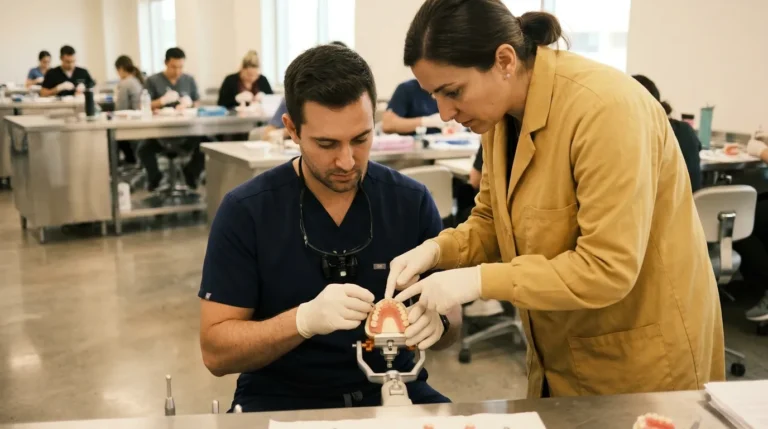
Live-patient surgery — You place implants on a real patient under mentor supervision. You manage the immediate-load conversion, the provisional, and the intraoperative decisions that arise when anatomy deviates from the plan. This format most closely matches running cases independently in your own practice. FAM’s Live Surgical Course in Parker, CO operates under Colorado Dental Board credentialing, which makes this format legally accessible to visiting US-licensed dentists.
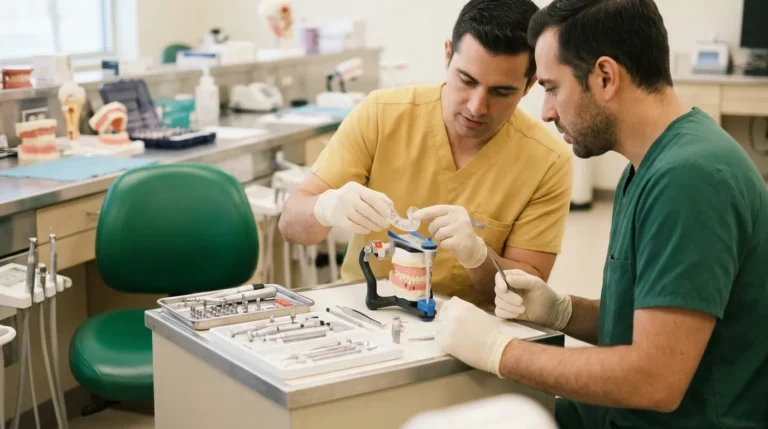
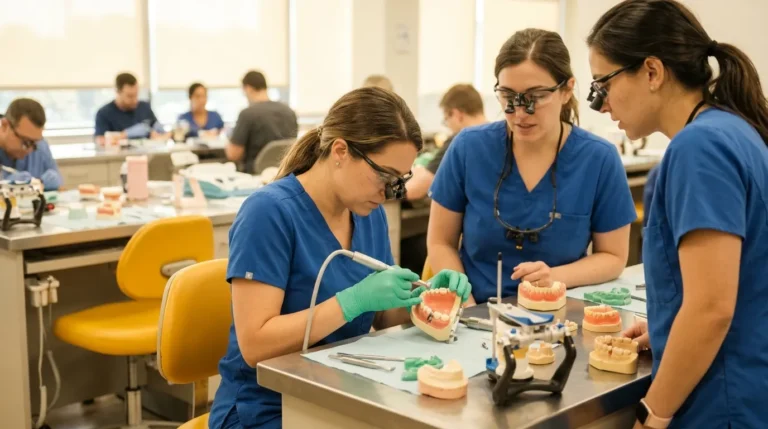
Cadaver or model work — You practice technique on non-living tissue or a model. There is no live patient, immediate-load conversion, provisional management, or intraoperative variability. This format builds motor patterns but does not replace operating on a patient.
Observation — You watch. This format provides exposure to workflow and case sequencing, but you do not operate. Brighter Way Live’s one-day surgical observation course in Phoenix, AZ is explicitly observation-only; attendees do not perform patient treatment.
The Colorado Dental Board’s credentialing framework is the legal mechanism that makes the live-patient format possible at FAM’s Parker, CO course. FAM submits each operator’s credentials to the board ten days before each session. Without that credentialing structure, hands-on live full-arch surgery is unavailable as a CE format in most US states. Live Patient Small Group Dental Implant Training Course covers the credentialing process in additional detail.
Post-Course Mentorship, Alumni Community, And Buying Power
Most full-arch training programs end when the course ends. FAM’s post-course infrastructure continues to support dentists as they implement the workflow.
Every FAM attendee, regardless of which course they take, joins continued private alumni group chats with hundreds of FAM-trained dentists, lab technicians, and team members. The network includes a dentist-only chat for sensitive practice and personnel questions, a main multi-role chat spanning assistants, technicians, and team members, and per-course lab and treatment coordinator chats. These channels create on-demand case help for the life of the relationship.
Alumni also gain access to FAM’s KOL (Key Opinion Leader) buying group, which negotiates vendor discounts on Neodent implants, exocad licenses, Envisiontec and DentaFab 3D printers, photogrammetry systems, and other equipment. There is no recurring cost to participate, and completion of a FAM course is the only requirement.
Every attendee receives a complete digital resource library covering surgical room setup checklists, equipment shopping lists, finishing techniques, treatment coordinator forms and presentations, and consent templates, including for advanced placements like pterygoid and zygomatic. The library provides the full workflow rather than a partial outline.
Advanced Zygomatic And Pterygoid Training Options
Most full-arch programs do not cover zygomatic and pterygoid placements. These techniques serve atrophic cases where standard axial or tilted implant placement is not viable because of insufficient bone volume in the maxilla.
FAM’s Advanced Live Surgical track in Parker, CO covers zygomatic, pterygoid, trans-sinus, custom subperiosteal, and palatal-approach placements on live volunteer patients under expert mentor supervision. Entry is gated to dentists with 200+ full arches placed in their career. FAM’s Advanced track is supported by experienced clinical mentors who perform these placements in active clinical practice.
For dentists currently referring out atrophic cases, the Advanced track is the specific curriculum designed to bring those cases back in-house. Advanced Implant Placement Course: Scale Full-Arch Results covers the clinical scope of advanced placement techniques in more detail.
Regional Map Of Full Arch Implant Training Courses In The US
For dentists searching by geography, the following breakdown covers where Full Arch Masters courses are located:
- West — Full Arch Masters Flagship Course (Fresno, CA)
- Mountain — Full Arch Masters Live Surgical Course (Parker, CO)
The Mountain region is notable because Colorado’s dental board credentialing framework makes it one of the few states where visiting US-licensed dentists can legally perform surgery on volunteer patients in a CE setting. FAM’s Live Surgical Course operates in this state for that reason.
Best Dental Implant Course For Full-Arch Restoration: 2026 provides a broader look at program selection criteria by practice type and experience level.
Best Advanced Full Arch Dental Implant Training Courses covers advanced-track options for experienced surgeons specifically.
Frequently Asked Questions
What Do Full-Arch Implant Training Courses Typically Cost?
Verified tuition figures from public course pages range from $2,500 for a one-day observation course (Brighter Way Live, Phoenix, AZ) to $25,000 for a three-day live-patient full-arch course (Colorado Surgical Institute, Northern CO). Most other programs in this article do not publish tuition on their public course pages, and cost reflects course length, faculty profile, group size, and how many implants each participant places.
Which Credentials Matter For Advanced Implant Training?
The AAID Associate Fellow credential requires over 300 hours of implant-specific CE plus demonstrated competency through standardized cases. The AAID Fellow credential requires over 400 hours and a minimum of 5 years of hands-on experience. The ABOI/ID Diplomate credential for general dentists requires 670 hours of CE recognized by AGD PACE, passing a 200-question written examination, and defending eight qualifying implant cases in an oral examination. AAID Fellows receive 200 CE hours toward the ABOI/ID 670-hour requirement and are exempt from the ABOI/ID Part I written exam. The 2027 ABOI/ID fee schedule includes a $600 application fee, $800 Part I exam fee, and $1,500 Part II oral exam fee.
Where Can Dentists Train On Zygomatic And Pterygoid Cases?
Most full-arch programs do not cover zygomatic and pterygoid placements. Full Arch Masters’ Advanced Live Surgical track in Parker, CO includes zygomatic, pterygoid, trans-sinus, custom subperiosteal, and palatal-approach placements on live volunteer patients under expert mentor supervision. Entry requires 200+ career arches and focuses on atrophic cases that many dentists currently refer out.
Conclusion: Choosing A Course That Matches Your Goals
Every full-arch implant training course in the US sits somewhere on the operator ladder, and the key decision is how far up that ladder the course lets you climb on a live patient. Observation and cadaver work build familiarity, but neither puts a patient under your hands. When a course calls itself “hands-on,” the question to ask is what your hands are actually on.
Full Arch Masters takes Basic and Advanced operators to the top of the ladder: two full arches per operator on live volunteer patients in Parker, CO, under mentor supervision, inside a five-course curriculum that also covers the lab, the provisional, the treatment coordinator, and the team systems that determine whether a practice can run volume. The continued alumni community, the KOL buying group at no recurring cost, and the digital resource library keep support in place after the course.
Dentists who are done referring out full-arch cases and want a program that upgrades the entire operating system, including surgical technique and practice infrastructure, will find that Full Arch Masters aligns with that goal.
Ready to fix the closing side of your full-arch workflow? Send your treatment coordinator to the next Treatment Coordinator Bootcamp, taught by FAM’s in-house TC who closes full-arch consultations at 80%.
Register For The Treatment Coordinator Bootcamp