Written by: Ryan Dunlop, CEO and Founder of Full Arch Masters and graduate from the Harvard School of Dental Medicine
Choosing a full-arch implant course is one of the highest-stakes decisions a dentist can make. The right training gives you a repeatable system, not just a new procedure. This guide explains what a complete course should cover, how formats differ, and what to verify before you enroll.
Key Takeaways
- Effective full-arch implant courses teach the complete workflow as an integrated system: digital planning, surgical execution, immediate loading, prosthetic completion, and complication management.
- Training format must match learning objectives. Live-patient surgery builds real-time decision-making skills. Cadaver and model training suit anatomy and technique practice before advancing to patients.
- Digital workflow integration is essential for same-day delivery. Courses must teach photogrammetry, intraoral scanning, CBCT planning, exocad design, and immediate-load conversion as a connected sequence.
- Post-course support through alumni communities, mentorship, and buying groups matters most during the high-risk period of the first 50 cases after training.
- Full Arch Masters delivers the FAM Method as a seven-step integrated digital workflow with live surgical training, team-based pedagogy, and continued alumni support at no recurring cost.
See the full FAM course schedule and reserve your seat.
What A Full-Arch Implant Placement Workflow Course Should Cover: Planning To Final Prosthesis
Any course that claims to prepare a dentist or team for full-arch implant delivery must address five discrete workflow stages. A 2026 Italian Consensus Conference on full-arch implant rehabilitations, conducted with 29 multidisciplinary experts using a modified Delphi process, confirmed that clinical protocols for full-arch rehabilitation have progressively shifted toward standardized, integrated approaches that reduce surgical morbidity and overall treatment time while maintaining long-term predictability. Any course that omits one of the five stages below leaves a gap that will surface in the operatory.
Any course that claims to prepare a dentist or team for full-arch implant delivery must address five discrete workflow stages. Full Arch Masters teaches these as seven operational steps within the FAM Method, detailed below.
- Digital Planning And Diagnostics. Competence here means interpreting CBCT data, merging DICOM and STL datasets, performing photogrammetry to capture implant positions accurately across the arch, executing intraoral scanning protocols, and designing the case in exocad before surgery begins. A 2026 narrative review in the Journal of Periodontal Research describes modern CBCT scanners as providing isotropic voxel sizes as small as 0.1 mm, enabling accurate assessment of bone dimensions, density, and proximity to anatomical structures. That level of detail forms the foundation for virtual implant planning.
- Surgical Execution. Competence includes flap design, alveoloplasty for restorative space, implant angulation for anterior-posterior spread, achieving primary stability at insertion torque greater than 35 Ncm, and managing intraoperative variation. A recent umbrella review with meta-analysis cited by the Italian Consensus Conference found no significant differences in implant failure between tilted and axial implants supporting full-arch prostheses. Small but statistically significant differences in marginal bone loss may emerge at longer follow-up intervals in some datasets, which validates the biomechanical rationale for posterior tilting when anatomy demands it.
- Immediate Load And Conversion. Competence means delivering a rigid, screw-retained provisional on the day of surgery. A 2026 clinical report by Nagai et al. in Dentistry Journal compared four chairside conversion techniques and found that guided conversion using a prefabricated, milled monolithic PMMA prosthesis demonstrates approximately 35% greater fracture resistance than conventionally processed denture resin. That difference is clinically meaningful for same-day delivery.
- Prosthetic Completion. Competence spans final zirconia design and finishing, FP1/FP2/FP3 distinctions, material selection across PMMA, zirconia, PEEK, and metallic frameworks, and passive fit verification at delivery. The Italian Consensus Conference found that full-arch monolithic zirconia prostheses exhibit high short-term success in systematic reviews, though authors consistently highlight the need for stronger long-term data.
- Complication Management. Competence includes handling atrophic ridges, zygomatic and pterygoid placements for no-bone cases, soft tissue management, peri-implantitis risk stratification, and prosthetic complication protocols. Nagai et al. (2026) identify prosthesis fracture as the most common complication of interim immediate-loading prostheses, typically occurring at the pontic midline. Proper conversion technique and material selection directly reduce this failure mode.
See the Full Arch Masters 2026 course overview for a detailed breakdown of how the FAM Method maps to each of these five stages.
Explore FAM courses that cover all five workflow stages.
Knowing what a course should cover is only half the decision. The other half is knowing which role you are training for.
Place Vs. Restore: Two Different Course Paths
The single most important question a dentist must answer before enrolling in any full-arch course is whether they intend to operate or to restore. These paths require different training, and blending them produces undertrained operators and under-supported restorers.
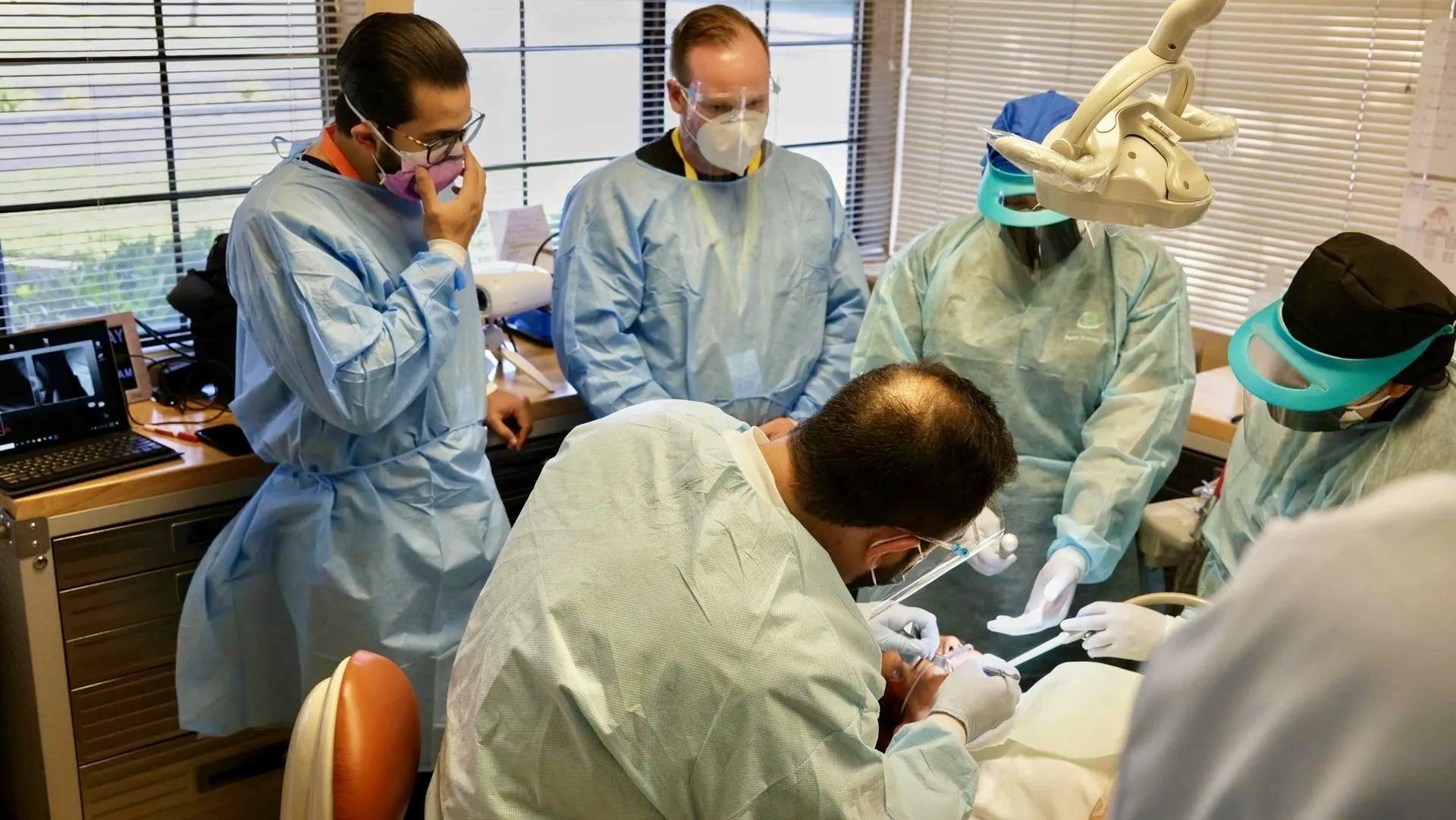
Dentists who intend to place implants themselves need live-patient or cadaver surgical training that develops tactile feedback, real-time decision-making, and the ability to manage intraoperative complications. Supervised live-patient placements with staged entrustment use a stepwise approach where the mentor progressively hands over procedural control. This approach consistently produces better transfer of skills to independent practice than observation-only or simulation-only formats. Prerequisites for the operator path typically include foundational surgical experience, an active unrestricted dental license, and in some programs a minimum case volume before enrollment in advanced tracks.
Dentists who will collaborate with a surgeon and focus on restoring cases need deep competency in digital planning, prosthetic workflow, and lab communication. Their training priority is learning how to drive implant positioning from the restorative endpoint backward, how to receive and verify digital records, and how to design and deliver the final prosthesis. Prerequisites are primarily prosthetic rather than surgical.
Full Arch Masters addresses both paths within its five-course curriculum. For operators, the Live Surgical Course in Parker, CO offers two tracks: a Basic Operator track for dentists who have placed fewer than 200 full arches, and an Advanced Operator track for those with 200 or more, focused on zygomatic, pterygoid, trans-sinus, palatal-approach, and custom subperiosteal placements for atrophic cases. For restorers, the Design and Finish Course is a four-day, lab-focused program covering exocad design and aesthetic zirconia finishing, built specifically for lab technicians.
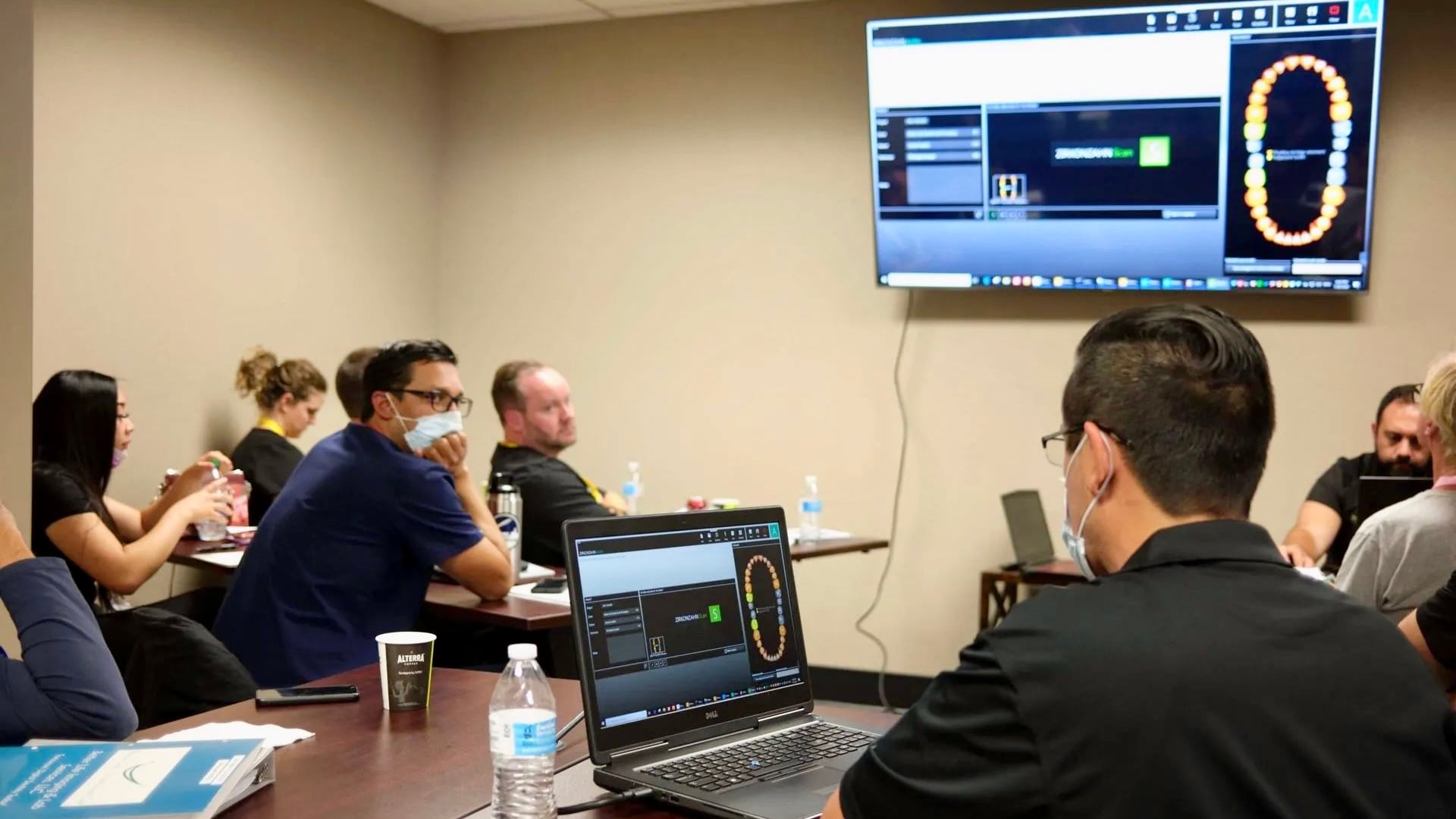
Credentialing details and observer options for the Live Surgical Course appear in the enrollment and FAQ sections below.
Read the Full Arch Masters live patient training guide for a detailed breakdown of the operator and observer tracks.
Format Comparison: Live Patient, Cadaver, Hands-On Model, And Online
Training format is a competency question. The table below summarizes what each format develops, its limitations, and who it suits best.
| Format | What It Builds | Key Limitations | Best For |
|---|---|---|---|
| Live Patient | Highest realism, real bone density and soft tissue response, real patient management, real intraoperative variation, tactile feedback that shows when a drill passes from cortical to cancellous bone as documented in live-surgery training reports. | Limited availability, higher cost, credentialing complexity. | Dentists ready to operate on patients. |
| Cadaver | Realistic anatomy for flap design, osteotomy preparation, and grafting technique practice. A 2026 umbrella review in the European Journal of Dental Education confirmed that cadaveric studies remain a cornerstone for teaching anatomy. | No live-team dynamics, no immediate-load experience, no real patient communication. | Anatomy-focused learning before live-patient work. |
| Hands-On Model | Low-risk, repeatable practice for implant system mechanics and prosthetic workflows. | No real tissue response, no patient communication practice. | Beginners or dentists refining techniques before a longer program. |
| Online And Digital | Flexible, cost-effective delivery of foundational theory, case planning, and digital-planning software instruction. The 2026 University of Sydney umbrella review found that online platforms support knowledge gain. | Lack of immersive, hands-on clinical skill development. | Didactic preparation before in-person training. |
See the Full Arch Masters guide to online full-arch courses for a breakdown of what online formats can and cannot deliver.
Full Arch Masters’ Live Surgical Course is one of several programs that combine live-patient surgery with a complete digital workflow curriculum, including immediate-load conversion and prosthetic delivery, under a legally structured credentialing framework. Other examples include the 3D Dentists Full Arch Express course, the gIDE Dental full-arch course, and the KADI full-arch implant rehabilitation course. The FAM Flagship Course in Fresno, CA provides hands-on records acquisition on live patients and observation of live full-arch surgical cases, capped at eight dentists per cohort to preserve the hands-on experience.
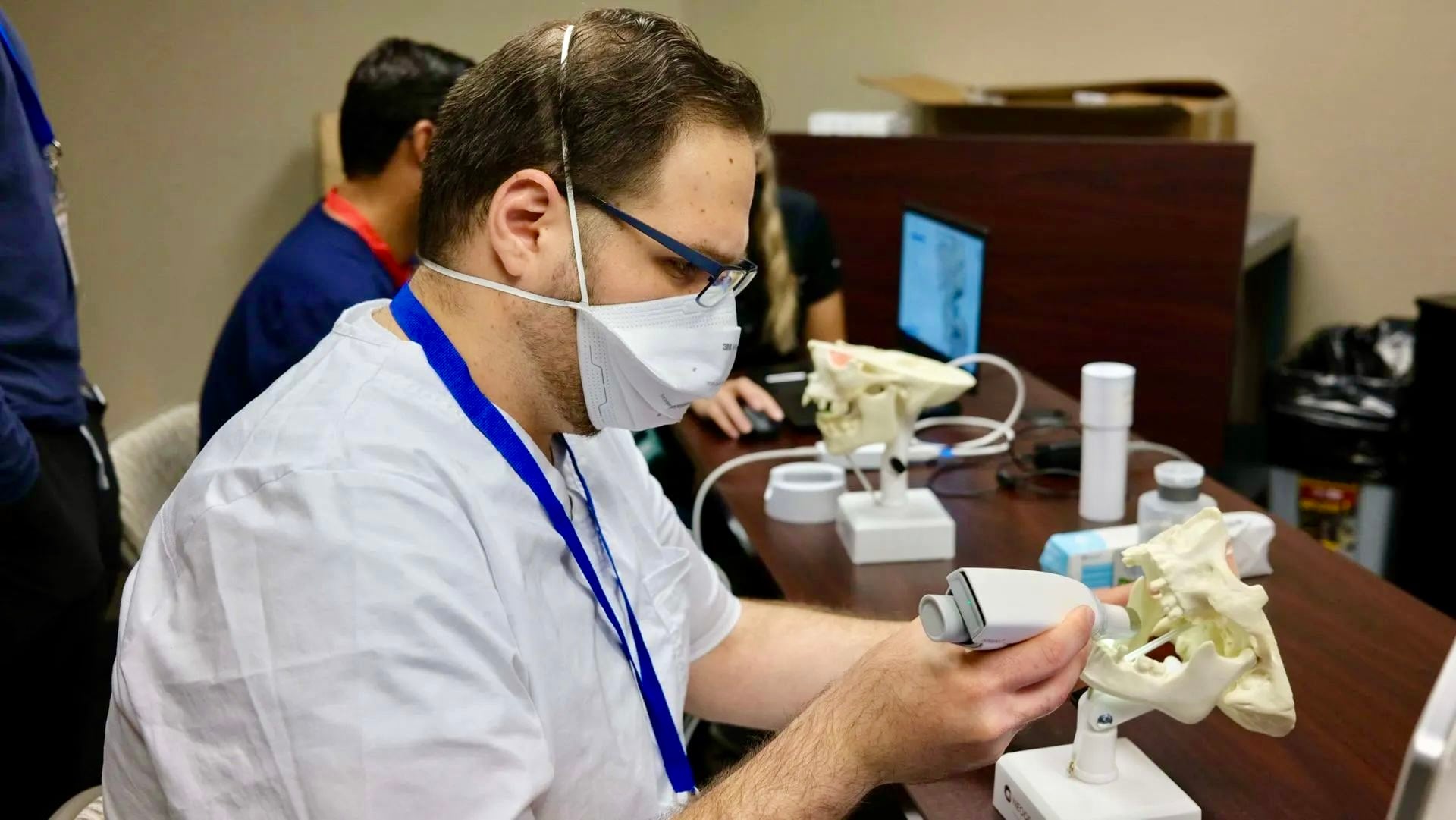
Read the Full Arch Masters hands-on course guide for a detailed format-by-format breakdown.
Compare live, cadaver, model, and online FAM training options.
Format determines how you learn. Digital integration determines what you can deliver once you are back in the operatory.
Where The Digital Workflow Changes The Training Calculus
A course that teaches a fully integrated digital workflow differs fundamentally from one that teaches a hybrid analog-digital approach. The 2026 Journal of Periodontal Research narrative review describes digital implant dentistry as spanning the complete care pathway: CBCT and data acquisition, virtual planning, guided or robotic surgery, digital impressions, CAD/CAM prosthetics, and maintenance. Full-arch courses must therefore teach an integrated workflow instead of isolated techniques.
For same-day delivery, integration determines whether a practice can reliably deliver teeth in 2 to 4 hours or whether each case becomes an all-day ordeal. Nagai et al. (2026) note that fully digital conversion protocols using photogrammetry or intraoral scanning can eliminate the need for conventional pickup procedures by directly capturing implant positions. These protocols demand substantial training for clinicians and lab technicians and seamless digital integration. A comprehensive digital workflow course must close that training gap.
The FAM Method integrates seven steps into a single repeatable system: preoperative records and data acquisition, photogrammetry and intraoral scanning, CBCT and digital treatment planning, exocad design, immediate-load conversion, final zirconia design and finishing, and FP1-specific design, team implementation, and workflow scaling. Full Arch Masters is a certified exocad reseller and uses Neodent implants and photogrammetry systems. Alumni gain access to a Key Opinion Leader (KOL) buying group that provides vendor discounts on Neodent implants, exocad licenses, 3D printers, and photogrammetry systems at no recurring cost.
See the Full Arch Masters advanced full-arch course guide for a breakdown of how digital workflow integration affects case volume and margin.
Learn how the seven-step FAM Method fits into your practice.
Questions To Ask Before You Enroll
Before committing $5,000–$25,000 to any full-arch implant course, ask the provider the questions below. The answers reveal whether a course will prepare you to operationalize the workflow or simply introduce you to it.
- What Are The Prerequisites? A course with no prerequisites for advanced surgical content signals weak screening. Responsible programs gate advanced tracks by career case volume. Full Arch Masters’ Advanced Live Surgical track requires 200 or more full arches placed in the dentist’s career.
- Will I Operate On Live Patients Or Observe? The gap between operating and observing is the gap between competency and familiarity. Live-patient supervised placements are considered the gold standard in implant dentistry training. Observational cases do not substitute for documented surgical cases in credentialing pathways such as ABOI/ID Route 1, which requires 670 hours of implant-related CE and defense of eight qualifying surgical cases.
- What Credentialing Or Licensure Is Required? Many US states do not allow visiting dentists to operate on live patients during CE courses. Confirm the legal framework before enrolling. Full Arch Masters’ Live Surgical Course operates under Colorado Dental Board credentialing, one of the few structures that allow visiting US-licensed dentists to treat volunteer patients.
- What Is The Cohort Size? A 1:1 mentor-to-learner ratio during live implant surgery is the benchmark for quality training. Higher ratios often mean passive observation instead of meaningful skill development. Full Arch Masters caps the Flagship Course at eight dentists per cohort.
- What Post-Course Support Is Available? The first 50 cases are the highest-risk period in any dentist’s implant career. A course that ends when the course ends leaves dentists without support during the period they need it most. Full Arch Masters provides continued alumni community access via private group chats with hundreds of FAM-trained dentists, lab technicians, and team members.
- Does The Course Cover The Full Workflow Or Just A Slice? A placement course that omits digital planning, immediate-load conversion, or prosthetic completion leaves the dentist with a procedure but not a system.
- Is The Digital Workflow Integrated Or Hybrid? Ask specifically whether the course teaches photogrammetry, intraoral scanning, CBCT planning, and immediate-load 3D printing as a connected sequence or as separate modules with no integration logic.
- What CE Credits Are Offered, And Through What Accrediting Body? Full Arch Masters courses are AGD PACE-approved for continuing education, generally providing 32 CE credits per main course. Verify that the provider’s recognition is current and that the credit type, lecture versus participation, matches your state board’s renewal requirements. Nevada, for example, caps self-study and online CE at 50% of total renewal hours and mandates specific infection control hours annually.
Post-Course Support And Community
Full-arch implant dentistry is one of the most competitive and secretive segments in dentistry. Practitioners who have figured out the workflow rarely share it, and many training programs end the day the course ends, leaving the dentist without a community when a difficult case lands on the schedule.
Post-course support matters most during the period immediately after training, when a dentist is applying new skills to real cases without a mentor physically present. Support that makes a material difference includes alumni group chats for real-time case questions, mentorship access for complex or atypical cases, case reviews for treatment planning validation, and a buying group for vendor discounts that reduce the cost of building out the digital workflow.
Full Arch Masters’ continued alumni community spans hundreds of FAM-trained dentists, lab technicians, and team members across more than twenty US states, connected through private group chats. These include a dentist-only chat for sensitive practice and personnel questions and a main multi-role chat for clinical and operational case help. Alumni also retain KOL buying group access at no recurring cost, providing discounts on Neodent implants, exocad licenses, Envisiontec and DentaFab 3D printers, and photogrammetry systems. Many GPOs and DSOs require recurring fees or organizational membership. FAM’s KOL group requires only that an alumnus completed a course.
Frequently Asked Questions
What Is The Difference Between A Course That Teaches You To Place Full-Arch Implants And One That Teaches The Workflow?
A placement course teaches the surgical procedure, including flap design, osteotomy preparation, and implant insertion. A workflow course teaches the entire system around the procedure: digital planning and diagnostics, surgical execution, immediate load and conversion, prosthetic completion, and complication management. The strongest courses present this workflow as an integrated system. A dentist who completes a placement-only course returns to a practice that still lacks the digital planning infrastructure, immediate-load conversion protocol, and lab integration needed to deliver same-day teeth predictably.
Do I Need Live-Patient Surgery To Learn Full-Arch?
If you intend to operate, live-patient surgery under direct mentor supervision is the gold standard for developing tactile feedback, real-time decision-making, and surgical confidence. Cadaver and model training build familiarity but cannot replicate the resistance of real human bone, the variability of live soft tissue, or the patient management demands of an operating room. If you will restore or collaborate with a surgeon, digital-planning and prosthetic-workflow training may be sufficient. Match the format to your intended role before enrolling.
How Do I Choose A Course Based On My Experience Level?
Dentists with limited or no full-arch experience should prioritize hands-on model or cadaver courses to build foundational skills before advancing to live-patient work. Dentists with moderate experience, placing one to five arches per month, benefit most from a comprehensive course that integrates digital planning, surgical execution, and immediate-load conversion as a single system. Experienced surgeons placing 200 or more arches in their career should seek advanced tracks covering zygomatic, pterygoid, and trans-sinus techniques for atrophic cases. The strongest programs offer separate tracks calibrated to skill level instead of a single curriculum that attempts to serve all experience levels simultaneously.
What Should I Verify Before Paying For A Full-Arch Course?
- Verify the provider’s CE accreditation body and whether it is current.
- Confirm the credentialing process for live-patient surgery and whether it applies to your license jurisdiction.
- Ask for the cohort size and the operator-to-mentor ratio.
- Confirm whether you will operate or observe, and ask for a breakdown of lecture hours versus hands-on hours.
- Verify that the course covers the full workflow and that the digital workflow is integrated rather than hybrid.
- Ask what post-course support is included and whether it has a time limit.
How Long Does It Take To Learn The Full-Arch Workflow?
Many comprehensive full-arch implant courses commonly run four days, though some programs extend to a week or longer. Mastering the workflow requires ongoing case application and mentorship. The course is the beginning of the learning curve, not the end of it. The best programs provide continued community access and case support after the course ends, because, as noted earlier, the first 50 cases carry the highest risk. A four-day course that ends with a certificate and no community is a significantly different investment than a four-day course that begins a long-term relationship with a peer network and buying group.
What Post-Course Support Should I Expect?
Look for alumni group chats, mentorship access, case reviews, and a buying group for vendor discounts. The strongest programs treat the course as the beginning of a relationship, not a one-time event. As described above, Full Arch Masters offers a continued alumni community and a KOL buying group at no recurring cost, along with a complete digital resource library covering surgical room setup, finishing techniques, treatment coordinator forms, and consent templates.
Are Online Full-Arch Courses Effective?
Online courses are effective for foundational theory, case planning, and digital-planning software training, but they cannot replace hands-on clinical work for surgical competency. Tactile feedback, tissue handling, and real-time decision-making require in-person supervised training. The most efficient approach combines online didactic learning with hands-on clinical experience. Dentists complete foundational modules online, then attend a supervised in-person course where the didactic groundwork is already in place and in-person time can focus entirely on clinical application.
How Does Full Arch Masters’ Curriculum Differ From Other Programs?
Full Arch Masters teaches the complete, integrated digital workflow, the FAM Method, as a single system spanning all five workflow stages. The curriculum includes hands-on live surgical training under Colorado Dental Board credentialing, team-based pedagogy that trains the dentist, assistant, treatment coordinator, and lab technician together on the same workflow, and continued alumni community access with a KOL buying group at no recurring cost. The seven-step FAM Method described above is taught as a connected sequence instead of isolated modules.
Conclusion: Choosing The Right Course For Your Practice
The right full-arch implant placement workflow course teaches all five workflow stages as a single integrated system. It matches your role as operator or restorer, and it supports you after the course ends.
Before enrolling, assess your own skill gaps honestly. Verify prerequisites and credentialing requirements. Confirm cohort size and operator-to-mentor ratio. Ask whether the digital workflow is integrated or hybrid. Confirm what post-course support looks like, because, as noted earlier, the first 50 cases after any course are where the investment either pays off or stalls.
Full Arch Masters teaches the complete, integrated digital workflow, the FAM Method, with hands-on live surgical training under Colorado Dental Board credentialing, team-based pedagogy that aligns the dentist, assistant, treatment coordinator, and lab technician on day one, and a continued alumni community with a KOL buying group at no recurring cost.
Start your full-arch training journey with Full Arch Masters.