Written by: Ryan Dunlop, CEO and Founder of Full Arch Masters and graduate from the Harvard School of Dental Medicine
Key Takeaways
- CDTs must complete exactly 12 CE hours annually: 1 documented Regulatory Standards hour, 6 documented Scientific hours (at least 3 from an NBC-approved provider), and up to 5 hours of any combination of additional documented Scientific, Regulatory Standards, Professional Development, or self-reported credits.
- Scientific CE hours build billable technical skills in CAD/CAM, ceramics, zirconia finishing, and digital workflows, so they deliver the highest return for lab technicians.
- Verify ADA CERP or AGD PACE recognition and cross-reference the provider number on the approval body’s directory before paying, because unapproved providers are the most common source of rejected hours.
- Regulatory and professional development hours often come from low- or no-cost OSHA, infection control, and NADL Learner Community courses, while scientific hours usually require paid, hands-on training.
- Full Arch Masters provides a high-value scientific CE path for lab technicians advancing into digital full-arch work through its AGD PACE-approved Design and Finish Course with 32 credits and continued community access.
Explore Full Arch Masters’ Scientific CE Courses
How Many CE Hours Do Dental Lab Technicians Need Per Year
NBC structures the annual CDT renewal requirement as follows, per the NBC renewal framework:
- 12 total hours per one-year cycle
- Minimum 1 documented Regulatory Standards hour
- Minimum 6 documented Scientific hours
- Up to 5 hours of any combination of additional documented Scientific or Regulatory Standards credits, Professional Development credits, or other non-documented, self-reported credit
The three categories serve different purposes. Regulatory Standards CE hours keep the lab compliant and cover OSHA bloodborne pathogens, infection control, HIPAA, and related safety topics such as Quality System/Good Manufacturing Practices, Hazard Communication, and Emergency Action Plans. Scientific CE credits for dental laboratory technicians, as defined by the National Board for Certification in Dental Laboratory Technology (NBC), cover scientific and technical courses or clinics specific to the practice of dental technology, including clinical, technical, and materials topics. This category is where a lab technician’s billable skill grows. For National Board for Certification (NBC) Recognized Graduate professional development credit, qualifying subjects include Management and Finance, Communication Skills, and Instructional Techniques.
NBC requires CDTs to document completed continuing education hours and submit proof of participation (such as scan cards, signed certificates, or letters of attendance) with their annual renewal, and course providers must report CE credits to NBC, so technicians need to keep certificates organized and accessible.
CDT renewal CE requirements stay manageable once the category math is clear. The approved-provider rule on scientific hours is where most technicians run into trouble, because a technically strong course still does not count if the provider lacks the required approval.
What Counts As A Scientific vs. Regulatory CE Hour
The distinction affects both compliance and career growth. Scientific CE hours for dental technicians are scientific or technical courses specific to the practice of dental technology, such as CAD/CAM design, ceramics, zirconia finishing, implant prosthetics, digital workflows, and material science. NBC formally defines qualifying scientific courses as JDT articles and quizzes, NADL Foundation online courses, and NBC-approved ADA CERP or AGD PACE courses. These hours deserve budget priority because they build the skills that generate revenue. Regulatory Standards CE hours for dental labs cover compliance topics such as OSHA bloodborne pathogens, infection control, HIPAA, and safety standards, along with other quality, safety, and workplace health topics including Quality System/GMP, Hazard Communication, Emergency Action Plans, Lockout/Tagout, Respiratory Protection, Ergonomics, and Personal Protective Equipment. Professional development continuing education credit for dental technicians covers subjects such as Management and Finance, Communication Skills, and Instructional Techniques.
Laboratory infection control is a distinct subject from chairside infection control, and it covers disinfection protocols for impressions, models, prostheses, and appliances moving between the operatory and the dental laboratory bench. The two settings connect through coordinated disinfection and communication protocols that prevent duplication of effort and material damage. A chairside assisting course does not automatically satisfy the laboratory-specific Regulatory Standards requirement, since the National Board for Certification in Dental Laboratory Technology requires each CDT/RG renewal to include at least one documented hour of Regulatory Standards credit covering topics such as QS/GMP, HIPAA, OSHA, and infection control. Technicians should confirm that a course’s subject matter matches the intended category before enrolling.
According to NBC’s Course Approval Request Form, a single course can count toward more than one credit category only if the provider structures and documents it that way, such as a Multi-Date or Qualified Educational Provider course. Confirm category assignment with the provider before paying. That same verification habit should extend to the provider’s approval status itself, which is where many rejected hours originate.
How To Verify A Course Is NBC Or AGD PACE Approved Before Paying
Verification protects a technician’s renewal from surprise rejections at audit. The process is straightforward:
- When selecting continuing dental education, check the provider’s website for the ADA CERP logo and recognition statement to confirm the provider is ADA CERP recognized.
- Cross-reference the provider number on the approval body’s current searchable directory, or contact the approval agency directly when no active online search exists, instead of relying on a logo or marketing statement alone.
- Confirm the course lists its credit category and hour count explicitly.
- Ask the NBC-approved course provider directly which of NBC’s three credit categories (Regulatory Standards, Scientific, or Professional Development) the hours count toward.
Each approval body operates differently, so technicians should verify the specific approval that applies to each course. AGD PACE approves provider organizations rather than individual courses or speakers, so a provider’s recognition covers its catalog, but PACE approval does not imply acceptance for licensure maintenance or any other purpose by any regulatory authority, and it does not guarantee that every course satisfies NBC’s specific category rules. At its April 23, 2026 meeting, before the revised ADA CERP Recognition Standards took effect on June 1, 2026, the Commission for Continuing Education Provider Recognition withdrew recognition from one provider and discontinued recognition of nine providers at their request, leaving 495 ADA CERP recognized providers effective May 1, 2026. Even familiar providers need a current status check.
If a provider cannot promptly supply current approval details, technicians should treat that as a red flag and assume the hours may not count.
A complete CE certificate must include the licensee’s full name, the course title, the date completed, the number of CE hours awarded, the credit type, and the provider’s name and contact information. Depending on the accrediting body, it may also need field or fields of study, location, instructional delivery method, sponsor identification number, and a time statement. A course synopsis is not universally required. Technicians should check each certificate against these elements before filing it, because incomplete certificates are a frequent reason hours get rejected at audit.
A Sample Compliant 12-Hour Year
This sample structure shows one practical way to meet the annual requirement and still focus on high-value skills:
- 1 regulatory hour — a free OSHA bloodborne pathogens or infection control course from an accepted provider. Confirm the provider’s approval before enrolling. Note that some states require laboratory-specific infection control content, and a chairside-only course may not satisfy that requirement.
- 6 scientific hours — a hands-on digital design and finishing course from an AGD PACE-approved provider can satisfy the 6 scientific hours requirement, with participation credit awarded for the total classroom hours when at least 30% of the course content involves active manipulation of dental materials or devices under the direct supervision of a qualified instructor. This is where the CE budget delivers the most value.
- 5 professional development hours — webinars on lab management, client communication, and industry trends. Most courses in the NADL Learner Community catalog have been approved by the National Board for Certification in Dental Laboratory Technology (NBC) for CDT/RG professional development credit, and for these courses the completed credits are automatically submitted to NBC on the participant’s behalf.
The math remains flexible, and hours can shift between categories as long as the minimums are met. Scientific hours deserve the primary investment because they build billable skill. Regulatory and professional development hours often come from low- or no-cost sources.
Online vs. In-Person CE: Which Credits Count
NBCC does not restrict CE program delivery format by rule, and ACEPs approved for one delivery format, live event or home study, may apply to add the other when they comply with the NBCC Continuing Education Provider Policy. Format matters because approval bodies count hours by category, not by delivery method, while the depth of skill a technician gains varies sharply by format. The table below shows how the three primary formats compare on flexibility, interaction, and skill transfer, so technicians can match the format to the category of credit they need.
For scientific hours in digital design and finishing, in-person hands-on courses deliver the deepest skill transfer. On-demand formats work well for regulatory and professional development hours where content comprehension, not manual skill, is the main objective.
Free and Low-Cost CE Options for Lab Technicians
Free dental lab technician continuing education courses exist across regulatory, professional development, and scientific categories, with the Foundation for Dental Laboratory Technology making its nearly 100 Foundation Learning Library courses, covering topics such as occlusion, esthetics, implants, and CAD/CAM, available at no charge on an ongoing basis. A practical budget strategy focuses paid CE on scientific hours and uses free or low-cost options for the remaining categories.
- Regulatory hours: Free infection control training is widely available through CDC-led Project Firstline courses, including via the American Nurses Association and Oregon Project Firstline, and free OSHA-aligned bloodborne pathogens courses are widely available from providers such as Alison, the Red Cross, and Johns Hopkins. Technicians should confirm NBC acceptance and laboratory-specific content before enrolling. Under Florida Administrative Code 64B27-1.003, continuing education for dental laboratory owners and operators must be sponsored by an approved provider or approved by the executive director and Board of Dentistry as meeting content requirements, so a chairside practice course does not automatically count toward the laboratory CE requirement.
- Professional development hours: The NADL Learner Community offers NBC-approved professional development credit, with most courses approved for CDT/RG credits and credits automatically submitted to NBC upon completion, at lower cost for NADL members and CDT designees.
- Scientific hours: Free scientific hours remain rare. Effective use of digital workflows requires clinical judgment and validation, not merely software operation, and hands-on technical training carries real material and instruction costs that free formats cannot cover.
As of 2026, multi-day hands-on dental CE workshops, such as implants, veneers, and endo, typically cost $3,000 to $7,500 or more, with complex, equipment-heavy formats pushing higher. That investment pays off when the course builds billable skill in digital full-arch design and finishing, which is one of the highest-value technical capabilities in the modern dental lab.
Where Specialty-Specific CE Fits In A CDT’s Year
Specialty CE in CAD/CAM, ceramics, and digital design counts as scientific credit and drives a lab technician’s long-term leverage. The operational bottleneck in dental laboratory work is shifting from hand production to judgment and orchestration. Lab technicians who invest in digital full-arch design and aesthetic finishing build skills that automation cannot easily replace.
Full Arch Masters’ Design and Finish Course, the lab-focused component of the FAM Method, FAM’s proprietary digital workflow for full-arch implant restoration, gives technicians a structured path into digital full-arch work. The course runs four days in Fresno, CA and is structured as follows:
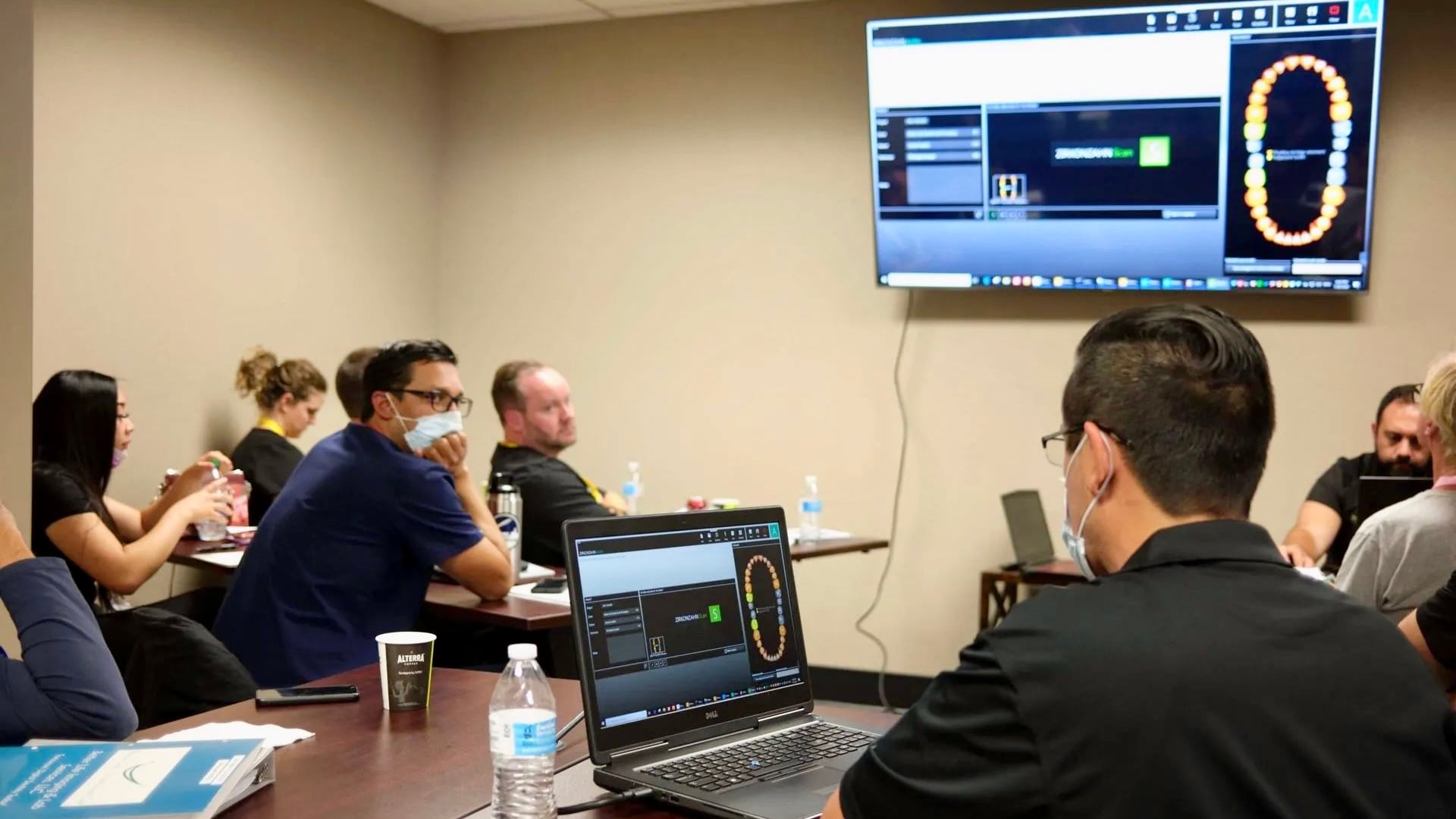
- Days 1–2: Digital design in exocad — preop records, digital mockups, surgical alignment devices, surgical record imports, immediate-load prosthetics, and final zirconia design. These sessions build a repeatable digital design workflow.
- Days 3–4: Hands-on aesthetic finishing — pre-sintered and post-sintered zirconia, green-stage contouring, and MIYO ceramic layering. Technicians practice the full finishing sequence on real cases.
- Material modules — PMMA, metallic frameworks, PEEK, zirconia, and crystal-based materials, with a clear breakdown of the pros and cons of each. This helps technicians choose the right material for each clinical situation.
Full Arch Masters is an AGD PACE-approved provider organization, and its main courses generally carry 32 CE credits. AGD PACE approves provider organizations rather than individual courses, so any CE credit awarded by an approved provider during its approval term is accepted, covering courses such as the Design and Finish Course in FAM’s catalog, though AGD does not review or endorse the content of those courses. The course separates beginners from advanced designers so each track runs at the right skill level, and technicians are surveyed in advance so no one sits through content they already know.
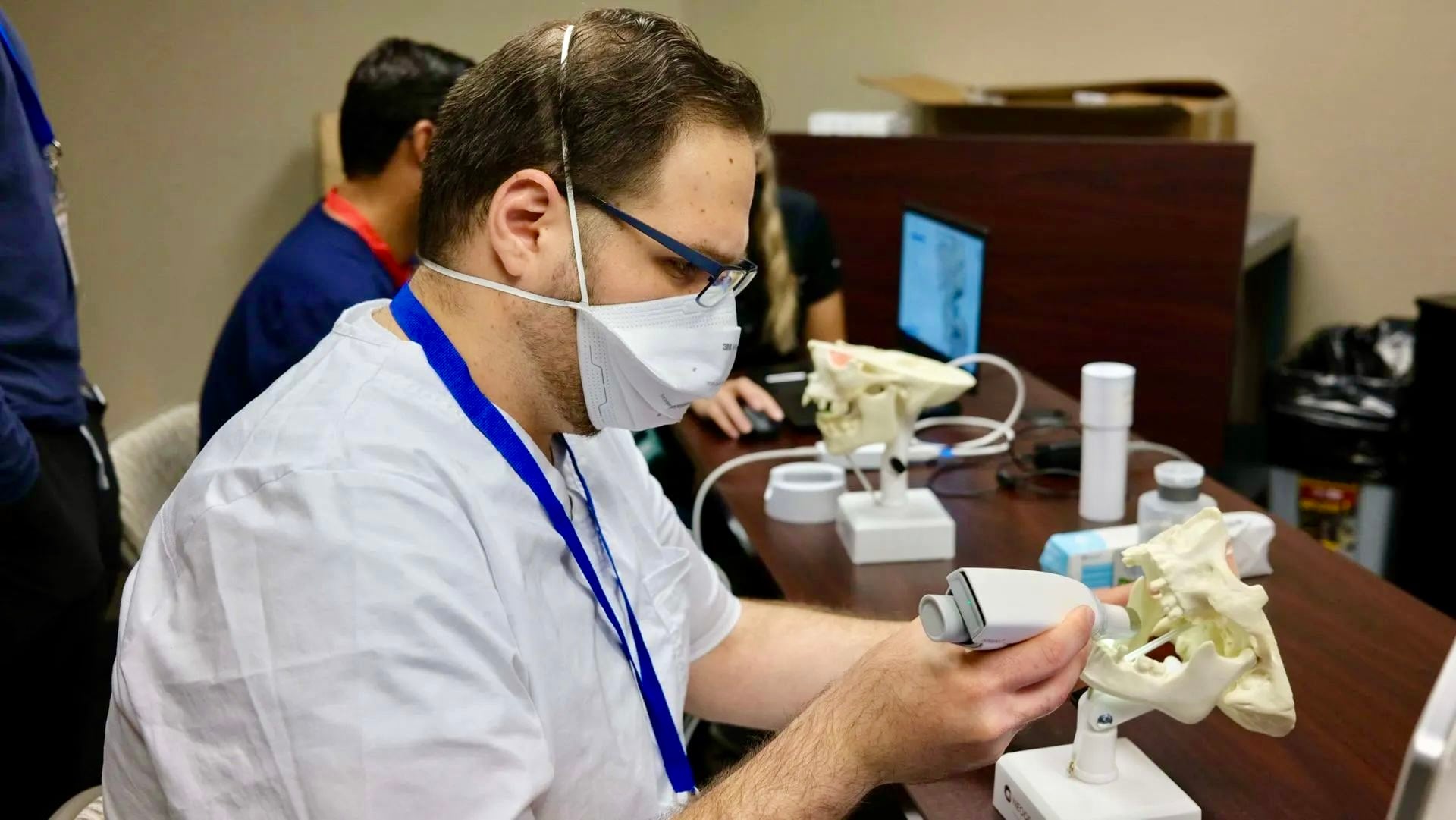
Lab technicians who attend join a continued community of hundreds of FAM-trained dentists, lab technicians, and team members via private group chats, and gain access to the KOL buying group for vendor discounts at no recurring cost. This structure gives technicians partner-discounted access to the materials used during the course and ongoing peer support when a difficult case lands on the bench.
Close Your Scientific CE Gap With A Hands-On Course
What Happens If You Fall Short
Missing the NBC 12-hour annual continuing education requirement can put a CDT’s active certification status at risk, as CDTs must accumulate 12 hours of CE each one-year renewal cycle to maintain their credential. If a CDT fails to complete the required continuing education, they may be removed from the register or lose certification and then must apply for reinstatement, which may require submitting outstanding continuing competence requirements and paying outstanding fees or levies. A lapsed CPDT credential does not expire permanently, but reinstatement must occur within 18 months of expiration and requires earning missed CEUs plus recertification requirements that a compliant renewal cycle would not. After 18 months, re-examination is required.
The practical safeguard is simple and proactive. Technicians should log hours as they are completed rather than scrambling at the deadline. A self-audit well before a renewal deadline allows time to tally hours by category, verify every provider’s current approval status, and register for additional courses to close any gaps. CE certificates should be kept for at least one full renewal cycle, but most boards require retention for several years past the cycle, often four to six years, because audits can reach back into closed cycles and request documentation after the fact.
Invest In CE That Protects Your CDT Credential
Frequently Asked Questions
How Many CE Hours Do Dental Lab Technicians Need Per Year?
NBC requires 12 CE hours per one-year CDT cycle with minimums in each category. As covered above, the structure is 1 Regulatory Standards hour, 6 Scientific hours, and up to 5 flexible hours. The key detail is that at least 3 of the 6 scientific hours must come from an NBC-approved provider, where ADA CERP and AGD PACE approved scientific or technical courses count as NBC-approved. NBCC requires certificants randomly selected for an audit to upload documentation of the required 100 continuing education hours before proceeding, while those not selected may proceed without documenting the required hours.
What Is The Difference Between Scientific And Regulatory CE Hours?
As defined earlier, scientific hours cover technical courses specific to dental technology and build billable capability. Regulatory hours cover compliance topics such as OSHA, infection control, HIPAA, and related safety standards that keep the lab aligned with regulations. Laboratory infection control is a distinct subject from chairside infection control, addressed in laboratory infection prevention and control standards such as The Joint Commission’s IC.04.01.01 and IC.06.01.01, and it covers disinfection and decontamination protocols for laboratory surfaces, items, and equipment. A chairside course does not automatically satisfy a dental laboratory’s regulatory continuing education requirement, which must include at least one course in regulatory compliance annually, such as Infection Control, OSHA, FDA, Texas Jurisprudence, CPR, or Ethics, as required by the Texas State Board of Dental Examiners.
How Do I Verify A Course Is NBC Approved Before Paying?
Technicians should start by checking the provider’s website for the ADA CERP logo and recognition statement to confirm ADA CERP recognition. They should then cross-reference the approval number on the approval body’s current searchable directory when one is available, rather than relying on a logo alone, and note that some approval bodies, such as IABCET, do not yet have an active online search and require direct verification requests, and there is no single central list of approved CE providers. The course should explicitly list its NBC credit category and hour count. If a course’s approval or accreditation details are not listed on the certificate of completion or on the course offering webpage, the technician should contact the education provider directly to confirm how the course is approved and which CE credit types it counts toward. If a provider cannot supply current approval details promptly, technicians should assume the hours may not count. AGD PACE approves provider organizations rather than individual courses or speakers, so a provider’s recognition covers its catalog, but PACE approval does not imply acceptance for licensure maintenance or any other purpose by any regulatory authority, and it does not guarantee that every course satisfies NBC’s specific category rules.
Can I Take All My CE Online?
NBCC does not restrict CE program delivery format by rule, and ACEPs approved for one delivery format, live event or home study, may apply to add the other when they comply with the NBCC Continuing Education Provider Policy. On-demand continuing education courses offered online are recognized for regulatory and professional development credit when they meet applicable state and accreditor requirements, such as Minnesota Statute 45.301’s mandates for 24/7 availability and completion verification, California’s interactive self-study criteria, and ADA CERP’s self-study standards. Live webinars offer real-time interaction. In-person hands-on courses deliver the deepest skill transfer and fit best for scientific hours in digital design and finishing, where manual proficiency, not just content comprehension, is the objective. A webinar watched on replay counts as self-study rather than live CE, even if the original broadcast was live.
What Happens If I Do Not Complete My CE Hours?
If a CDT fails to complete the required continuing education, they may be removed from the register or lose certification and then must apply for reinstatement, which may require submitting outstanding continuing competence requirements and paying outstanding fees or levies. A lapsed CPDT credential does not expire permanently, but reinstatement must occur within 18 months of expiration and requires earning missed CEUs plus recertification requirements that a compliant renewal cycle would not. After 18 months, re-examination is required. Technicians can avoid this situation by logging hours as they are completed, keeping certificates for at least one full cycle, and conducting a self-audit well before the renewal deadline to close any gaps.
The Compliance Roadmap In Summary
The NBC 12-hour CDT renewal cycle follows a clear structure: 1 regulatory hour, 6 scientific hours, at least 3 from an approved provider, and up to 5 professional development or flexible hours. The verification step, confirming a provider’s current NBC or AGD PACE approval before paying, separates a smooth renewal from a rejected submission. Spend the CE budget on scientific hours that build billable digital full-arch skill. Technicians should prioritize outcomes-based activities aligned with their learning needs and combine methods, because evidence shows that hour accumulation alone has limited impact on practice. Free and low-cost continuing education options from accredited providers are widely available, though some free courses may still charge administrative fees for the credit itself.
For lab technicians moving into digital full-arch work, Full Arch Masters’ Design and Finish Course offers a focused scientific CE investment: four days of hands-on exocad design and aesthetic zirconia finishing, AGD PACE-approved CE credits, skill-level-calibrated tracks, and continued community access after the course ends.
Invest Your CE Budget In Digital Full-Arch Training
If the practice side of a full-arch workflow needs the same level of attention, Full Arch Masters’ Treatment Coordinator Bootcamp trains practice teams to close more high-ticket full-arch cases, taught by FAM’s in-house treatment coordinator who maintains an 80% closing rate.
Train Your Team To Close More Full-Arch Cases