Written by: Ryan Dunlop, CEO and Founder of Full Arch Masters and graduate from the Harvard School of Dental Medicine
Key Takeaways
- Genuine hands-on full-arch training means each dentist personally performs live-patient surgery under direct mentor supervision within a legally credentialed framework, not model work or observation.
- State dental board laws create the biggest barrier to live-patient CE surgery, with Colorado uniquely allowing out-of-state US-licensed dentists to operate on volunteer patients after credential submission.
- Training programs differ significantly by structure: live-patient surgical programs build real clinical judgment, while model-based and observational formats leave dentists without procedural confidence for independent practice.
- Full-team training alongside the dentist, post-course alumni community access without recurring fees, and coverage of business systems like treatment coordination are essential for turning training into practice revenue.
- Full Arch Masters delivers two live full-arch cases per operator in Parker, CO with full-team training and ongoing alumni support. Register today to scale your full-arch workflow.
Executive Summary and Evaluation Framework for Full-Arch Courses
This guide walks mid-career implant dentists through eight factors to evaluate before committing to a full-arch training program: the legal and regulatory landscape for live-patient CE surgery, structural differences between training models, operator repetition counts, team integration requirements, post-course community access, experience-tiered pathways, quantified delivery outcomes, and common program pitfalls.
The evaluation framework maps to two experience tiers. Dentists who have placed fewer than 200 full arches in their career need a program that delivers supervised live-patient operating on at least two full-arch cases per operator, full-team training alongside the dentist, and a post-course community for case support. Dentists who have placed 200 or more full arches need access to advanced techniques such as zygomatic, pterygoid, trans-sinus, palatal-approach, and custom subperiosteal placements for atrophic cases that most general full-arch programs do not cover.
Before enrolling in any program, use this checklist to filter out courses that cannot deliver the core requirements for translating training into independent practice: live-patient repetition, legal credentialing, team integration, and ongoing support.
- How many full-arch cases does each operator personally perform, not just observe, during the course?
- Are cases performed on live volunteer patients or on models, cadavers, or simulations?
- What is the legal credentialing mechanism that authorizes visiting dentists to operate in that state?
- Does the program train the full team, including assistant, treatment coordinator, and lab technician, alongside the dentist?
- What post-course community or mentorship structure exists, and does it carry a recurring cost?
- Does the curriculum address marketing, treatment coordination, and team delegation, or only surgical technique?
- Is there a separate advanced track for dentists with high career arch volume?
How Regulation Shapes the Full-Arch Training Landscape
The single largest structural barrier to genuine hands-on full-arch CE in the United States is state dental board law. Dental implant CE requirements vary significantly by state, scope of practice, and whether the dentist needs initial training, renewal education, or a documented competency-based pathway. State-by-state mandates can change, so periodic review with the relevant dental board remains essential. Most states do not permit visiting out-of-state dentists to perform surgery on volunteer patients in a CE setting, which is why many advertised “hands-on” full-arch courses default to model-based or observational formats regardless of how they are marketed.
Where live-patient CE surgery is permitted, credentialing requirements are specific. In Nevada, for example, live-patient CE courses must be supervised by a Nevada-licensed dentist, and the facility must be registered and approved. Colorado operates under a different framework that allows US-licensed dentists from any state to perform dentistry on volunteer patients during a CE course, provided credentials are submitted to the Colorado Dental Board in advance. This framework is the reason Full Arch Masters hosts its Live Surgical Course in Parker, CO.
Patients treated in training programs receive care from licensed dentists under the direct supervision of experienced faculty, with proper informed consent, medical screening, and follow-up protocols required at any reputable program. Any program that cannot describe its patient screening and credentialing process in specific terms signals a red flag.
The credentialing landscape also affects professional certification pathways. The American Board of Oral Implantology/Implant Dentistry (ABOI/ID) requires 670 hours of CE and submission of completed cases for the Diplomate certification, which cannot be achieved with classroom time alone. The American Academy of Implant Dentistry (AAID) requires candidates for its Associate Fellow credential to complete at least 300 hours of postdoctoral or continuing education in implant dentistry within the past 12 years, including at least 75 hours in participatory hands-on formats.
Core Models and Approaches to Full-Arch Training
These credentialing requirements and state-by-state regulatory barriers directly shape the training models available to dentists. Full-arch implant training programs fall into three structural categories: live-patient surgical programs, model-based or simulation programs, and observational programs. The differences are not cosmetic. They determine whether an operator builds genuine clinical judgment or accumulates theoretical knowledge without procedural confidence.
Live patient training exposes operators to real tissue, bone, and patient variables that plastic models cannot replicate, enabling development of critical thinking, real-time adaptation, and problem-solving skills essential for independent clinical practice. A 1997 study in the Journal of Oral and Maxillofacial Surgery found that greater surgical experience is associated with higher implant survival rates. Operator repetition count therefore functions as a clinical safety and outcomes variable, not a marketing detail.
Model-based programs offer a lower-risk environment for foundational technique practice. Simulation training uses manikins or lifelike jaw models for risk-free foundational technique practice, while live-patient training involves performing surgeries on actual patients under close instructor guidance with a student-to-instructor ratio of no more than 3:1 to ensure direct, real-time feedback. Some multi-level programs use model-based formats for early levels and reserve live-patient surgery for advanced levels, sometimes hosted internationally where regulatory barriers are lower.
Observational formats, where attendees watch cases without operating, provide exposure but not repetition. Observers gain insight into workflow and decision-making, yet the gap between watching a case and executing one independently often causes post-course hesitation and slow ramp-up in practice.
Team integration is the variable most programs omit entirely. High-quality live patient programs allow dentists to bring a dental assistant at no additional charge so the full team trains together on new protocols, instrument handling, and patient communication, accelerating workflow adoption and team integration upon return to the practice. A dentist who returns from training without a trained team cannot operationalize a new workflow because the assistant, treatment coordinator, and lab technician each own a piece of the system.
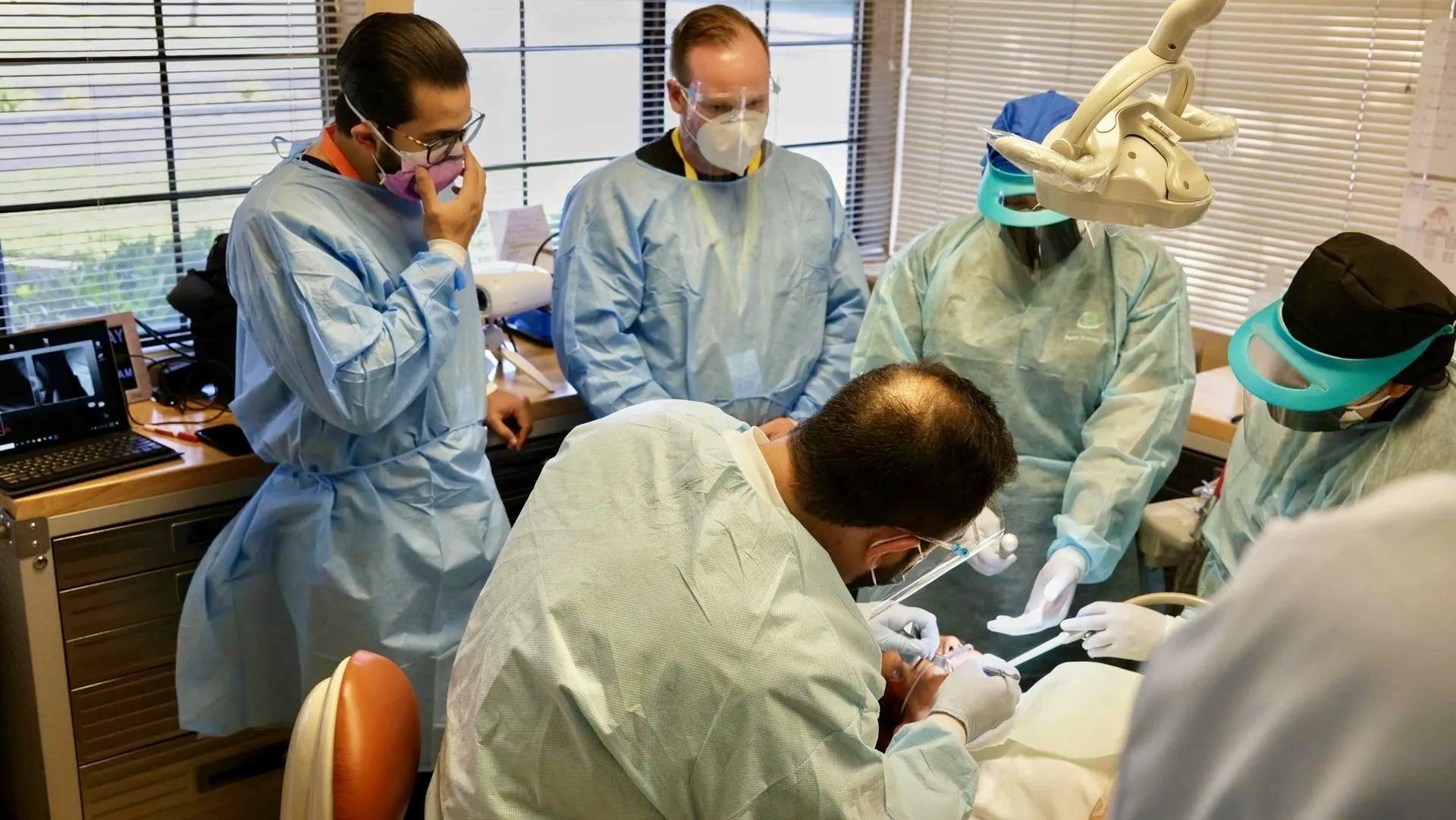
Full Arch Masters’ Live Surgical Course in Parker, CO puts each Basic Operator through two complete full-arch cases across two surgical days, with CRNAs providing general anesthesia onsite and FAM surgical mentors supervising each operator directly. The Advanced Operator track, gated to dentists with 200 or more career arches placed, focuses on zygomatic, pterygoid, trans-sinus, palatal-approach, and custom subperiosteal placements for atrophic cases that most full-arch programs do not address.
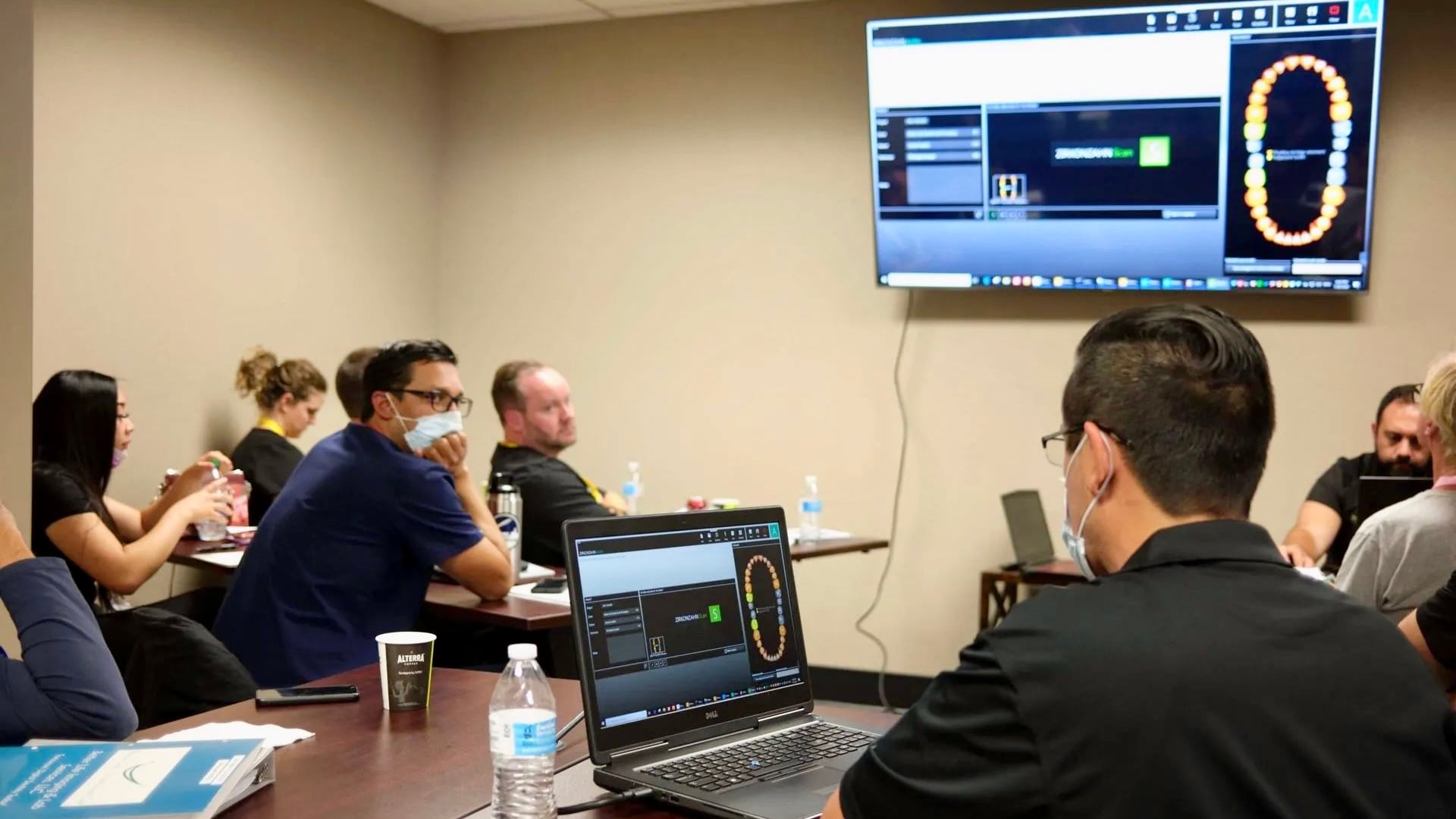
Register for an upcoming Full Arch Masters course to perform live full-arch cases under expert mentor supervision.
Strategic Trade-Offs for Different Experience Levels
Experience tier determines which program structure delivers the highest return. Dentists placing fewer than 200 full arches in their career benefit most from programs that maximize supervised live-patient repetition, integrate the full team, and provide a post-course community for case support during the ramp-up period. Dentists who commit to building an implant workflow and maintain consistent volume typically recover their training investment within 6 to 12 months of beginning to place cases.
Dentists at or above the 200-arch threshold face a different constraint. They have the foundational volume but are referring out atrophic cases, such as patients with severe bone loss who need zygomatic or pterygoid implants, because their training did not cover remote anchorage solutions. For this group, an advanced live surgical track focused specifically on those techniques becomes the relevant investment.
Live surgery credentialing requirements add a logistical layer that programs must manage on behalf of operators. Full Arch Masters submits each operator’s credentials to the Colorado Dental Board ten days before each Live Surgical Course, contingent on no pending marks against the dentist’s license in their home state. International attendees cannot be credentialed by the Colorado Dental Board because credentialing requires a US dental license, so they attend as Observers.
Post-course community access functions as a strategic variable that most program evaluations underweight. The biggest barrier for most dentists starting implant dentistry is lack of confidence rather than lack of knowledge, and a good mentor provides the psychological safety net that allows dentists to stretch their capabilities. A program that ends when the course ends leaves operators without support precisely when they need it most, during their first independent cases. Full Arch Masters alumni join private group chats with hundreds of FAM-trained dentists, lab technicians, and team members at no recurring cost, with case help available on demand for the life of the relationship.
Quantified delivery outcomes provide a benchmark for evaluating whether a program’s workflow is genuinely integrated. The FAM Method, Full Arch Masters’ proprietary digital workflow integrating intraoral scanning, photogrammetry, facial scanning, CBCT, exocad design, and 3D-printed immediate-load conversion, delivers same-day teeth in a 2 to 4 hour window. Alumni report adding $1M or more per year in practice revenue after adopting the workflow. An All-on-4 full-arch case generates $20,000–$30,000 in production on average in the US in 2026, which makes full-arch one of the highest per-case revenue opportunities in dentistry.
Current Best Practices in Full-Arch Implant Education
Peer-reviewed literature and leading training programs converge on several best practices for full-arch implant education that any program evaluation should reference.
High-quality implantology training programs follow a layered structure of theoretical foundation, preclinical simulation, live surgical demonstration, and supervised implant placement on real patients, while lower-tier programs often omit the supervised live-patient component. The layered structure matters because each stage builds on the previous one. Theory without simulation produces no procedural memory, and simulation without live-patient experience produces no clinical judgment.
Team training is a best practice with direct revenue implications. Full Arch Masters’ in-house treatment coordinator maintains an 80% closing rate on full-arch consultations, a benchmark the Treatment Coordinator Bootcamp is built to transfer to attendees’ own front-office teams. Training programs that include the entire dental team improve workflow efficiency and patient experience during implant procedures by ensuring seamless coordination and instrument handling.
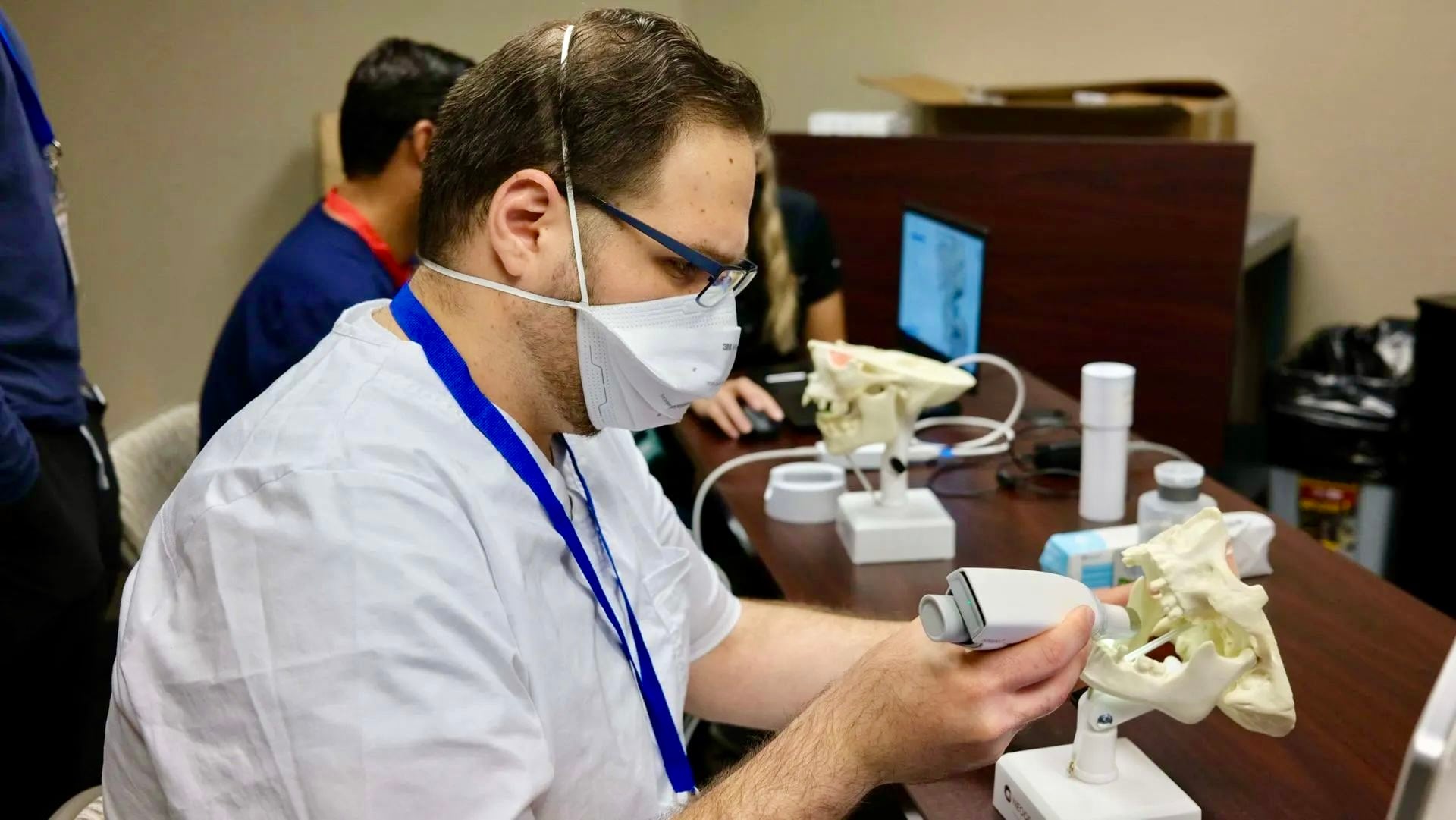
Protocol coverage should include photogrammetry for accurate implant position capture, immediate-load workflows for same-day delivery, and advanced placement techniques for atrophic cases. The FAM Method incorporates photogrammetry as a foundational element, not an add-on, because implant position accuracy at the prosthetic stage determines whether same-day delivery fits within the 2 to 4 hour window or requires multi-day appointments. FP1 prosthetic workflows, zygomatic and pterygoid placements, and immediate-load protocols aligned with current clinical standards are all covered across the FAM curriculum.
The dental implant surgical tools market is expected to grow, driven by increasing adoption of immediate-load full-arch protocols. Dentists who build the workflow now position themselves ahead of a market that is moving toward immediate-load digital delivery as the standard of care.
Readiness and Opportunity Assessment for Your Practice
Most practices running one or two full arches per month are not constrained by patient demand. They are constrained by workflow speed, team delegation gaps, and case acceptance rates. A slow analog or hybrid workflow consumes chair time that prevents volume scaling. A treatment coordinator without a structured closing system loses cases at the consultation table that a trained TC would close.
The path from one or two arches per month to scalable volume runs through three operational changes. First, adopt an end-to-end digital workflow that delivers same-day results within a 2 to 4 hour window, which removes the chair-time bottleneck that caps volume. Second, train the full team on a shared playbook so the dentist is not the bottleneck, because a fast workflow only works when the team can execute it independently. Third, build a post-course peer community to support case decisions during the ramp-up period so early cases feel supported rather than risky.
Even 2–3 implant cases per month can generate significant additional annual revenue for a general practice, though full-arch cases represent a larger per-case revenue opportunity than single-tooth implants. Full Arch Masters alumni report $1M or more in added annual practice revenue after adopting the FAM Method, reflecting the combined effect of faster delivery, higher case acceptance, and team-enabled volume scaling.
Register for an upcoming Full Arch Masters course and bring your full team to build the workflow that scales.
Common Pitfalls When Choosing a Full-Arch Course
Several structural program deficiencies consistently prevent dentists from turning training investment into practice-level results.
- Insufficient operator repetition. Programs that deliver one case per operator, or that count observation as hands-on participation, do not build the procedural confidence required for independent execution. Programs with low student-to-instructor ratios during live surgery enable real-time error correction, pattern recognition development, and individualized feedback that model-based or observational training cannot provide.
- No team training component. A dentist who returns from training without a trained assistant, treatment coordinator, and lab technician cannot operationalize a new workflow. The team owns the non-surgical steps that determine whether a case delivers within a 2 to 4 hour window or becomes an all-day multi-appointment ordeal.
- Hybrid workflows marketed as fully digital. Partial impressions, off-site lab work, and multi-day appointments do not create a digital workflow. They create an analog workflow with digital tools inserted at individual steps. Only an end-to-end integrated system enables same-day delivery at scale.
- No post-course community or mentorship. Programs offering ongoing mentorship or alumni network access are crucial for support when dentists tackle their first implant cases back in their own offices after completing hands-on training. A program that ends when the course ends leaves operators without support during the period when they need it most.
- No legal credentialing framework for live-patient surgery. Programs that advertise live-patient surgery without a clear, state-board-authorized credentialing mechanism either operate in a legal gray area or substitute model-based work for genuine live-patient operating. Ask specifically which state board authorizes the surgery and what the credentialing submission process includes.
- No business systems content. Surgical technique alone does not produce practice revenue. Marketing, treatment coordination, team delegation, and case acceptance systems determine whether a practice can generate the volume that makes full-arch profitable. Programs that omit this content leave dentists with clinical skills and no operational infrastructure to deploy them.
Frequently Asked Questions
What makes a full-arch implant course genuinely hands-on versus observational?
A genuinely hands-on full-arch course requires each operator to personally perform live-patient surgery under direct mentor supervision, not watch a mentor perform surgery, work on a model, or participate in a cadaver lab. The key questions involve how many full-arch cases each operator personally performs, what the student-to-instructor ratio is during live surgery, and what legal credentialing mechanism authorizes visiting dentists to operate in that state. Full Arch Masters’ Live Surgical Course in Parker, CO follows this model within a Colorado Dental Board credentialing framework that permits visiting US-licensed dentists to treat volunteer patients in a CE setting.
Why does the Colorado Dental Board matter for live-patient full-arch training?
Most US states do not permit visiting out-of-state dentists to perform surgery on volunteer patients in a continuing education setting. Colorado operates under a framework that allows US-licensed dentists from any state to perform dentistry on volunteer patients during a CE course, provided credentials are submitted to the Colorado Dental Board in advance and there are no pending marks against the dentist’s license in their home state. This framework explains why Full Arch Masters hosts its Live Surgical Course in Parker, CO rather than at its home facility in Fresno, CA. International dentists cannot be credentialed by the Colorado Dental Board because credentialing requires a US dental license, so they attend the same course as Observers.
How does team training affect post-course case volume and revenue outcomes?
The FAM Method functions as a team-based workflow in which the dentist, surgical assistant, treatment coordinator, and lab technician each own distinct steps in the process. A dentist who trains alone and returns to an untrained team cannot operationalize the workflow because the non-surgical steps, including records acquisition, photogrammetry, exocad design, immediate-load conversion, and case closing, require trained team members to execute at speed. Full Arch Masters builds team training into every course: the Flagship Course in Fresno, CA is capped at eight dentists per cohort and priced to include team members at $2,500 per additional attendee, and the Treatment Coordinator Bootcamp trains front-office staff on the closing system that supports the 80% consultation closing rate mentioned earlier. Alumni who bring their full team report being able to run the workflow on day one after returning to their practice.
What is the difference between the Basic and Advanced Live Surgical tracks at Full Arch Masters?
The Basic Operator track is designed for dentists who have placed fewer than 200 full arches in their career. Each Basic Operator performs two complete full-arch cases across the two surgical days of the Live Surgical Course, working under direct FAM mentor supervision with CRNAs providing general anesthesia onsite. The Advanced Operator track is gated to dentists with 200 or more career arches placed and focuses on techniques for atrophic cases, including zygomatic, pterygoid, trans-sinus, palatal-approach, and custom subperiosteal placements, that most full-arch programs do not cover. Advanced Operators also perform two full-arch cases during the course, with case selection and technique emphasis calibrated to their experience level. Both tracks include pre-course CBCT review and 3D-printed models of each patient case.
What post-course support does Full Arch Masters provide, and does it carry a recurring cost?
Every Full Arch Masters attendee, regardless of which course they take, joins private alumni group chats with hundreds of FAM-trained dentists, lab technicians, and team members, including a dentist-only chat for sensitive practice and personnel questions and a main multi-role chat for clinical and operational case support. There is no recurring cost for this access, which is included with course enrollment and continues for the life of the relationship. Alumni also receive access to Full Arch Masters’ Key Opinion Leader (KOL) buying group, which provides vendor discounts on Neodent implants, exocad licenses, 3D printers, photogrammetry systems, and other equipment at no recurring cost, offering an alternative to GPO or DSO structures that typically require ongoing fees or organizational membership. The full digital resource library, covering surgical room setup checklists, finishing techniques, treatment coordinator forms, consent templates, and Dr. Dunlop’s lecture materials, is distributed after each course via shared drive.
Conclusion and Next Steps for Scaling Full-Arch
The decision framework for selecting a full-arch implant training program reduces to four variables: operator repetition on live patients under a legally credentialed framework, full-team training alongside the dentist, a post-course community that provides ongoing case support without a recurring cost, and a curriculum that covers the business systems such as marketing, treatment coordination, and team delegation that determine whether clinical skills translate into practice revenue.
Programs that deliver two live full-arch cases per operator, train the full team on a shared workflow, and maintain an active alumni community after the course ends produce the outcomes mid-career dentists seek, including same-day delivery within a 2 to 4 hour window, higher case acceptance, and volume scaling that alumni report as $1M or more in added annual practice revenue.
Full Arch Masters was founded in 2018 by Dr. Ryan Dunlop, a Harvard-trained DMD, on the principle that implementation, not just technique, separates a practice that scales full-arch from one that stays at one or two cases per month. The FAM Method, the Live Surgical Course in Parker, CO, the full-team training model, and the continued alumni community all reflect that principle.
Register for an upcoming Full Arch Masters course and bring your team to build the workflow, the repetition, and the community that turn full-arch training into full-arch production.