
Written by: Ryan Dunlop, CEO and Founder of Full Arch Masters and graduate from the Harvard School of Dental Medicine
Key Takeaways
- A complete digital full-arch workflow integrates seven elements, from preoperative records and photogrammetry to final zirconia finishing, in one repeatable protocol.
- Most training programs teach isolated techniques; Full Arch Masters delivers the full FAM Method and covers all seven workflow components in a single curriculum.
- Team alignment is essential, so the dentist, surgical assistant, lab technician, and treatment coordinator train together to achieve consistent, scalable results.
- Practices that adopt the FAM Method report adding over $1M in annual revenue and earn 32 AGD PACE-approved CE credits per core course.
- Ready to implement the complete FAM Method in your practice? Explore upcoming Full Arch Masters courses and transform your full-arch workflow.
How Full-Arch Implant Training Is Evolving
Full-arch implant dentistry has shifted rapidly toward digital delivery. Recent research has explored digital workflows that integrate intraoral scans, CBCT, facial scans, and other records into virtual patient models. Merging 3D facial scanning, intraoral scanning, and CBCT data supports prosthetically driven planning that accounts for aesthetic factors such as lip support, smile line, and buccal corridor.
Most training programs have not kept pace with this clinical progress. The gap between a hybrid workflow with partial impressions, off-site lab work, and multi-day appointments and a fully integrated digital system remains wide. Knowing how to operate a scanner differs from running an end-to-end system that connects all seven workflow elements in a single repeatable protocol. Most programs teach one or two elements in isolation and leave the practice to assemble the rest independently.
Core Models, Systems, and Approaches
A complete digital full-arch system has three defining characteristics: integration, team alignment, and repeatability. This framework turns scattered tools into a single operating system.
Integration means every data source, including CBCT, intraoral scan, facial scan, and photogrammetry, feeds a single unified file used for planning and prosthetic design. Case reports describe workflows that combine CBCT-based planning, guided surgery, and provisional finishing for same-day conversion in a single surgical visit. These reports show how many discrete steps must coordinate for the system to function.
Team alignment means the dentist, surgical assistant, lab technician, and treatment coordinator all operate from the same playbook. Documented case studies show that adding trained appointment setters and a treatment coordinator with pre-qualification protocols can significantly increase full-arch revenue without changing the clinical workflow itself.
Repeatability means the system produces consistent outcomes across operators and cases. Systematic reviews have reported deviations for static guided surgery that compound when planning, surgery, and prosthetics are not tightly integrated.
The FAM Method addresses all three characteristics. It is taught as a single integrated system across five hands-on courses, with the full practice team trained together from day one.
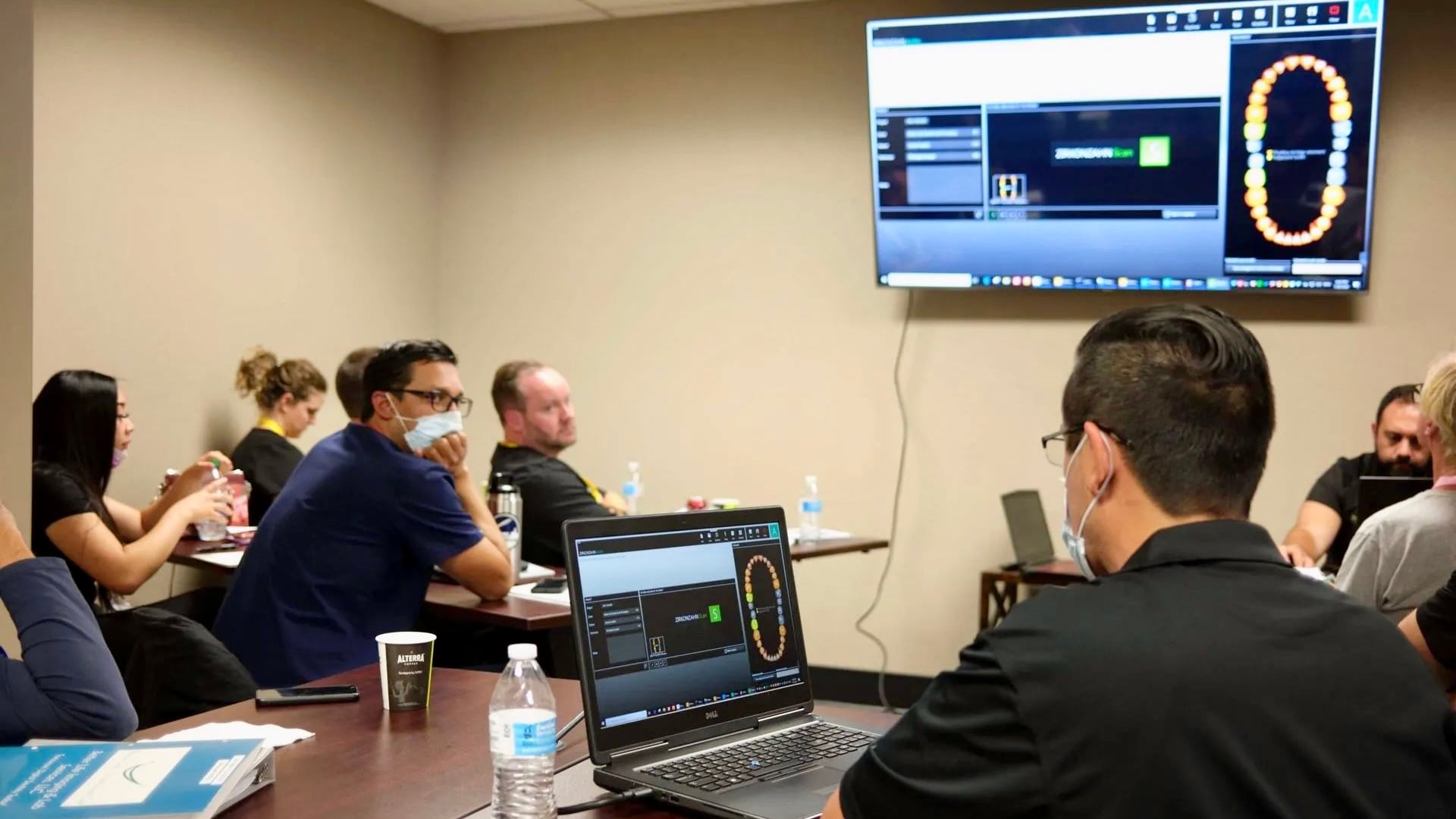
The FAM Method also integrates seven workflow elements into a single system:
- Preoperative records and data acquisition
- Photogrammetry and intraoral scanning
- CBCT and digital treatment planning
- exocad design
- Immediate-load conversion
- Final zirconia design and finishing
- FP1-specific design and workflow scaling
Each element must be mastered and connected with the others for the system to function reliably.
Strategic Considerations and Trade-offs
Dentists evaluating advanced full-arch training in 2026 can weigh five decision factors that directly affect outcomes.
- Digital integration: Does the program teach all seven workflow elements or only selected techniques?
- Team training: Are the surgical assistant, lab technician, and treatment coordinator trained alongside the dentist?
- Live-patient volume: How many full-arch cases does each operator perform under supervision?
- Post-course support: Is there ongoing access to peers and mentors after the course ends?
- CE hours: Are credits AGD PACE-approved, and how many are awarded per course?
Each factor has a direct operational consequence. Structured team training can produce substantial increases in new-patient volume with no change in marketing spend. A program that trains only the dentist leaves the team and the workflow behind. Effective task delegation increases team productivity by up to 30%.
Post-course support carries similar weight. Full-arch cases are complex, and difficult cases land on the schedule after the course ends. A program with no alumni community leaves the dentist without peers to consult when that happens.
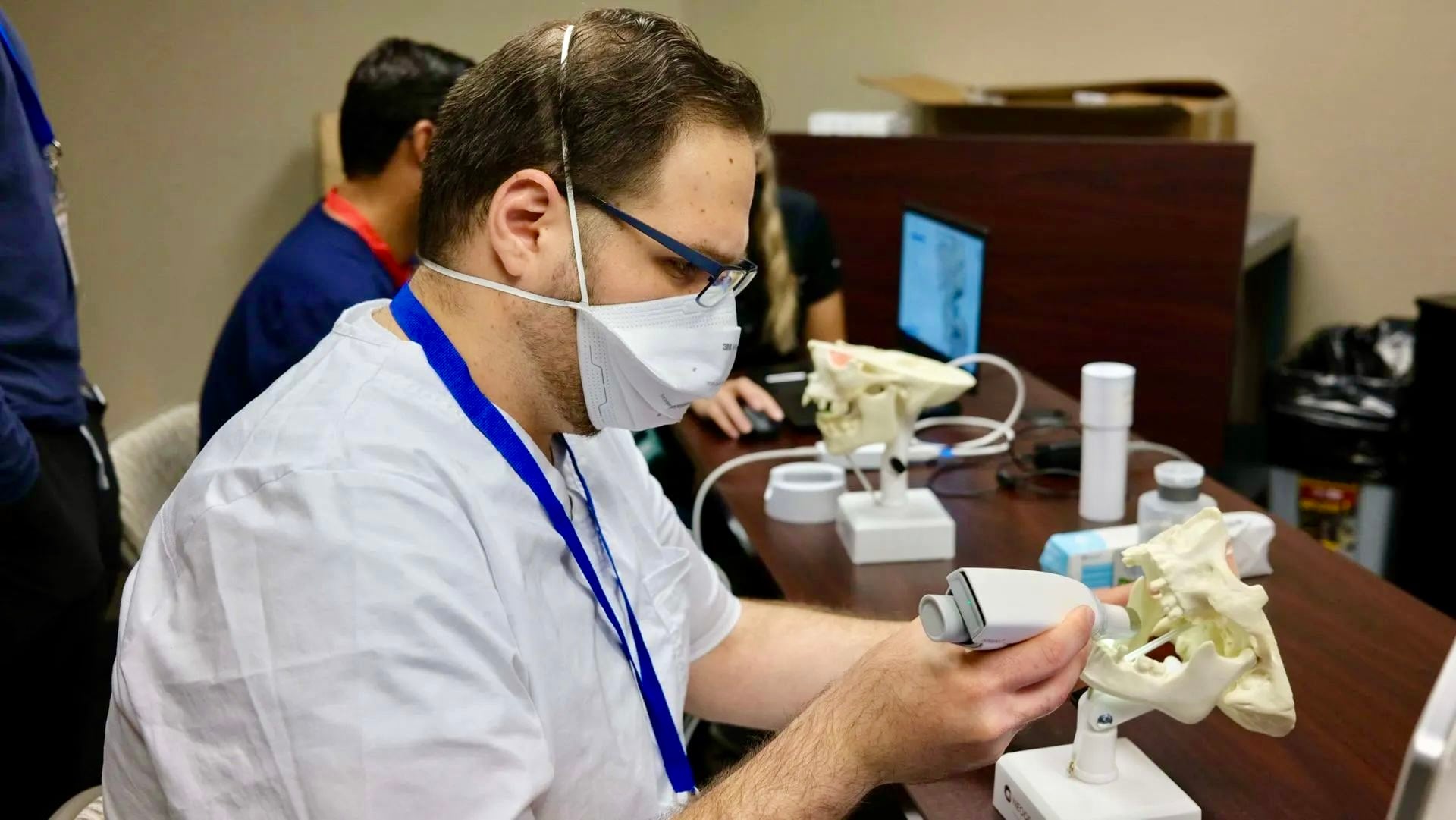
Readiness and Opportunity Assessment
Practices can evaluate their current workflow against the seven FAM Method elements to identify gaps. A straightforward self-audit highlights where to focus first.
- Are preoperative records captured digitally and merged into a single planning file?
- Is photogrammetry used for implant-position capture, or does the practice rely solely on intraoral scanning?
- Is CBCT data integrated with intraoral scan data for prosthetically driven planning?
- Is exocad used for prosthetic design, and is the team trained on it?
- Is the immediate-load provisional fabricated digitally and delivered same day?
- Is final zirconia designed and finished in-house or through a trained lab partner?
- Is the team trained on FP1-specific design and workflow delegation?
Any gap in this list represents a constraint on case volume, margin, or predictability. Take photogrammetry as an example. Research suggests that photogrammetry is more reliable than intraoral scanning for full-arch implant impressions, showing greater trueness and precision, yet most practices that describe themselves as “digital” have not integrated photogrammetry into their workflow.
Studies have found that photogrammetry can keep mean precision errors below the clinical threshold for passive fit under real conditions, while intraoral scanning can reach higher errors. Practices without photogrammetry in their workflow accept measurable accuracy risk on every full-arch case.
Common Pitfalls and How to Avoid Them
Three patterns consistently limit full-arch practice growth and undermine otherwise strong clinical skills.
Hybrid workflows. Mixing analog and digital steps introduces variability at every handoff. A fully digital All-on-X workflow provides predictable implant-level accuracy, reduced chair time, better practice-to-lab communication, fewer mechanical complications, and improved patient satisfaction compared to analog methods. Partial digitization captures some of these benefits but not all.
Missing team training. A dentist who returns from a course without a trained team cannot operationalize the workflow. The impact shows up immediately in conversion metrics. Without trained front-office staff, even excellent clinical workflows fail to convert inquiries into scheduled cases, and the operational bottleneck shifts from the operatory to the phone. The clinical workflow and the business workflow must be trained together.
No ongoing support. Full-arch cases are complex. Atrophic arches, difficult anatomy, and edge-case prosthetic decisions arise after the course ends. A program with no alumni community leaves the dentist without peers when those cases arrive. The FAM Method includes lifetime access to alumni group chats with hundreds of trained dentists, lab technicians, and team members, which provides case help on demand at no recurring cost.
FAQ
Why is photogrammetry considered essential in a complete full-arch digital workflow?
Photogrammetry captures implant positions with micron-level precision without relying on intraoral anatomical landmarks, which avoids the cumulative stitching errors that occur with intraoral scanning over long edentulous spans. Clinical research published in 2026 found that photogrammetry was the only impression technique whose mean precision error stayed consistently below the 75 μm passive-fit threshold under real clinical conditions, while intraoral scanning reached maximum errors nearly seven times higher. For full-arch immediate-load cases, where passive fit at the abutment level is critical, photogrammetry is the most reliable method currently available. The FAM Method integrates photogrammetry as a core step in the workflow, not an optional add-on, and trains the full team on its use from day one.
How does team delegation training affect full-arch case volume?
Team delegation determines whether a practice can scale full-arch volume without burning the dentist’s chair time on non-billable tasks. When surgical assistants are trained to acquire preoperative records, treatment coordinators are trained to close consultations, and lab technicians are trained to design and finish cases in-house, the dentist’s time is concentrated on the highest-value clinical steps. When surgical, administrative, and lab tasks are delegated effectively, high case volume becomes sustainable instead of exhausting. The FAM Method is built around this team approach: one team, one workflow. Most attendees come as a practice owner with their treatment coordinator and lead assistant, or as a dentist with their in-house lab technician, so the entire practice aligns on the same operating system on day one.
What live-patient surgical volume should dentists expect from an advanced full-arch course?
Live-patient surgical volume is the most direct predictor of post-course confidence. Cadaver courses and model-based exercises develop technique, but they do not replicate the tissue response, bleeding, and real-time decision-making of an actual case. The Full Arch Masters Live Surgical Course in Parker, Colorado provides each Basic and Advanced operator with two full-arch cases across two surgical days, performed on volunteer patients under expert mentor supervision. Colorado is one of the few U.S. states where the dental board allows visiting U.S.-licensed dentists to perform surgery on volunteer patients under a credentialing process, which makes hands-on live full-arch surgery accessible as a continuing-education format. The Advanced Operator track, gated to dentists with 200 or more career arches placed, focuses on zygomatic, pterygoid, trans-sinus, custom subperiosteal, and palatal-approach techniques for atrophic cases that most programs do not cover.
What is the realistic ROI of investing in a complete full-arch training program?
The return on a complete full-arch training investment operates through three mechanisms: workflow speed, case volume, and case acceptance. A faster workflow, with same-day teeth in 2–4 hours, allows more arches per week at higher margin. A trained treatment coordinator with a structured closing system converts more of the consultations already in the pipeline. A team trained on delegation reduces the non-billable chair time that limits how many cases a practice can run per month. Full Arch Masters alumni report adding $1M+ per year in practice revenue after adopting the FAM Method. That figure reflects the combined effect of all three mechanisms working together, not just the clinical technique in isolation. The Fellowship bundle, which covers the three core courses plus a fourth course of the practice’s choice, delivers 90+ CE hours and a $5,000–$10,000 discount versus paying for each course individually, with a payment plan of up to 9–12 months available.
Conclusion and Next Steps
The strongest advanced dental implant courses for full-arch workflow in 2026 focus on complete systems rather than isolated techniques. They teach all seven elements of a complete digital workflow, train the entire practice team, provide meaningful live-patient surgical volume, and deliver ongoing support after the course ends.
Full Arch Masters is the only program that meets every criterion. The FAM Method covers all seven workflow elements, from preoperative records and data acquisition through FP1-specific design and workflow scaling, in a five-course curriculum taught by a cross-trained instruction team that has worked every role they teach. Every core course is AGD PACE-approved, and every attendee joins a continued community of hundreds of FAM-trained dentists, lab technicians, and team members at no recurring cost. Alumni consistently report transformational revenue growth after implementing the complete workflow, driven by faster case delivery, higher acceptance rates, and greater team leverage working together.
No other program delivers this combination.
Start your FAM Method training today and view course dates, curriculum details, and fellowship options.