
Written by: Ryan Dunlop, CEO and Founder of Full Arch Masters and graduate from the Harvard School of Dental Medicine
Key Takeaways
-
Full-arch and other high-ticket consults often leave without scheduling because the closing system is weak, even when the clinical work is excellent.
-
Average dental case acceptance sits at 42%, top performers reach 75%, and cases over $3,000 often fall near 25% without strong financing and follow-up systems.
-
Effective training covers four systems together: patient communication, financial processes, objection handling, and structured tracking and follow-up.
-
Real results come from role-play with feedback, proactive financing presentation, and a follow-up cadence that continues well beyond the first contact.
-
Full Arch Masters offers a two-day Treatment Coordinator Bootcamp that teaches a complete closing system for high-ticket full-arch cases.
Train your team to close full-arch cases
What A Dental Treatment Coordinator Course For Case Acceptance Actually Teaches
A dental treatment coordinator course for case acceptance trains clinical and administrative staff to increase treatment plan sign-offs through clear patient communication, confident financial navigation, and skilled objection handling. A complete program builds four operational systems that work together: patient communication, financial processes, objection handling, and tracking and follow-up.
What A Case Acceptance Course Must Actually Teach
A course worth the investment teaches four operational systems, and they are not interchangeable. Skip any one of them and the program underperforms in the field, because each system covers a failure point the others cannot reach.
Patient Communication
Patient communication turns the dentist’s clinical diagnosis into a treatment conversation the patient understands and feels ready to act on.
What Good Looks Like: The course teaches the doctor-to-coordinator handoff in detail. The dentist hands off clinical findings, urgency, and treatment sequence. The TC owns the financial conversation, scheduling, and follow-up. Pearl’s clinical education team identifies clear, empathetic communication and the ability to explain clinical information in plain language as the foundational TC competency, and recommends targeted training on case presentation, financial conversations, and objection handling. A course that teaches communication theory without handoff mechanics produces TCs who can talk but cannot consistently close.
Financial Processes
Financial processes define how the team presents fees, financing options, and payment structures before the patient raises cost as an objection.
What Good Looks Like: The course teaches proactive financing presentation before the patient asks about cost. That means monthly payment framing and a financing stack with three tiers: prime lender, sub-prime lender, and a high-ticket extended-term option. Sunbit reports that practices introducing financing and payment options before presenting the treatment plan see a 55% lift in case acceptance compared to practices that only mention financing after a price objection. Precision Dental Analytics reports that practices with structured financing stacks outperform single-option practices on case acceptance by double-digit percentages. A course that skips the financing stack is not built for full-arch cases.
Objection Handling
Objection handling is the structure of a trained response to patient hesitation. Canned rebuttals do not survive contact with a real consult.
What Good Looks Like: The course teaches a simple structure: acknowledge, reframe, offer a next step. It then drills that structure with role-play on the specific objection phrases TCs actually hear. A 2018 systematic review published in BMJ Simulation and Technology Enhanced Learning found that effective communication training requires “repeat dosing” of practice rather than a single exposure, with performance measured after a decay period to confirm skill retention. A course that lectures on objection handling without role-play does not change behavior.
Tracking And Follow-Up
Tracking and follow-up form the pipeline system that determines whether presented cases eventually get scheduled.
What Good Looks Like: The course teaches a structured follow-up cadence at 48 hours, 2 weeks, and 6 weeks, with scripts for each touchpoint and a system for tracking unscheduled treatment by age and value. Sunrise Dental Solutions reports that most patients schedule on the third or fourth follow-up touch, while most practices give up after the first contact. A course that ends at the consult table leaves the pipeline system unbuilt.
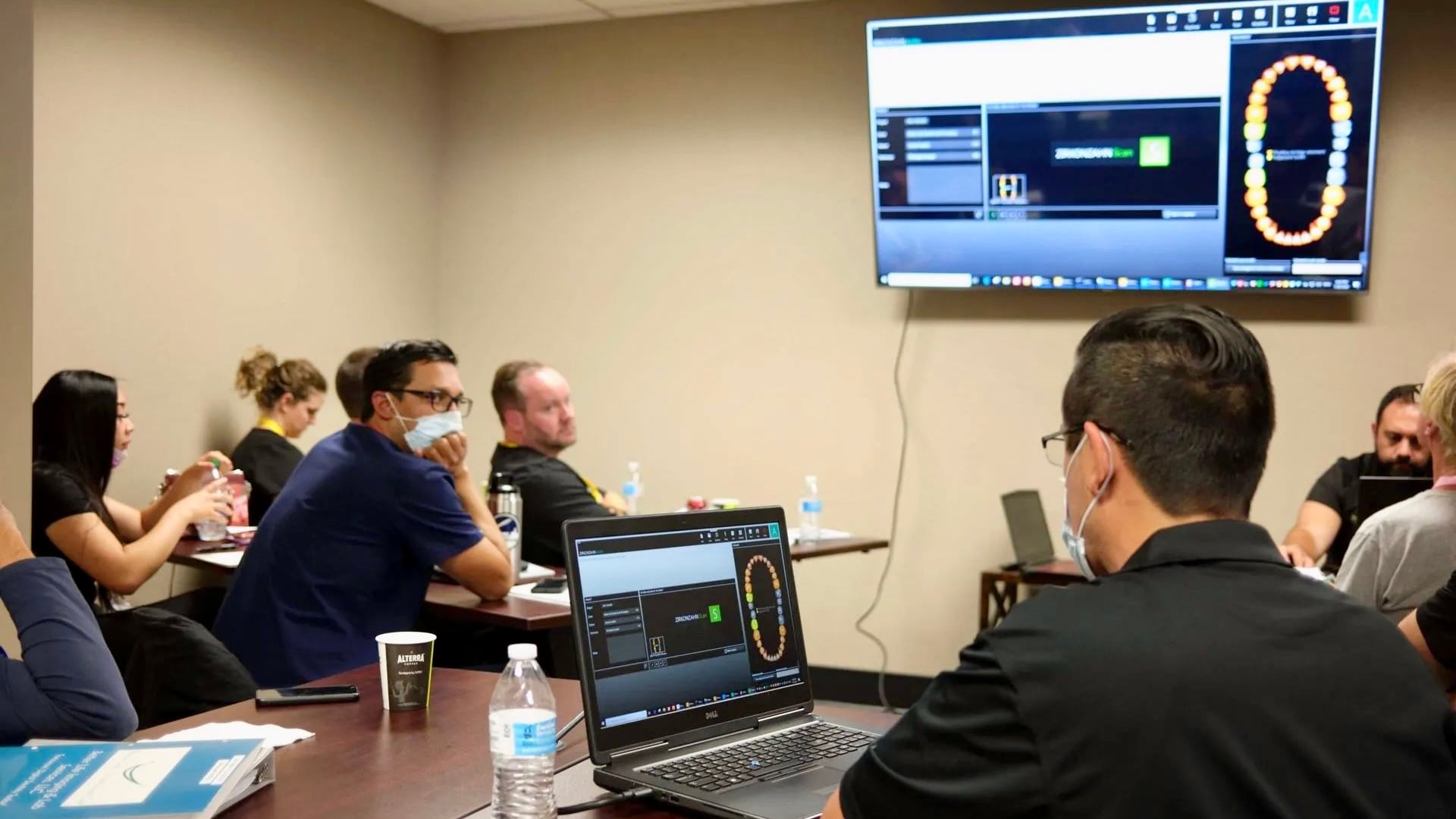
FAM’s in-house treatment coordinator, Nikki O’Neal, a 26-year dental industry veteran, maintains an 80% close rate on full-arch consultations. The Full Arch Masters Treatment Coordinator Bootcamp is a two-day course she teaches, covering new patient acquisition, marketing, sales process, tracking systems, pipeline nurture, drip campaigns, patient financing, and objection handling, with heavy role-play and live patient scenarios.
The Doctor-To-Coordinator Handoff
The handoff came up under patient communication, but it deserves its own section because it is where most case acceptance actually breaks down and the step most course descriptions skip entirely.
In a general practice, the handoff often fails because the dentist mentions cost mid-exam or the front desk quotes the fee at checkout. The clinical relationship is already established and no one clearly owns the financial conversation. The patient hears a number with no context, no monthly framing, and no path forward.
In a full-arch practice, the handoff fails for a different reason. The fee level and financing complexity require a dedicated financial conversation that the dentist should not lead. A dentist who quotes $28,000 chairside and then walks out of the room leaves the patient with a number and no structure around it. The TC’s job is to own everything that happens after the dentist leaves: the financial conversation, the financing application, the scheduling, and the follow-up. A course that skips this handoff in operational detail is not teaching a complete closing system.
The handoff works when the dentist passes along clinical findings, urgency framing, treatment sequence, and a warm introduction, then steps back. Everything after that point, including the financing stack presentation, the scheduling ask, and the follow-up cadence, belongs to the TC. The process breaks down when either party crosses into the other’s lane or when no one clearly owns the handoff.
Objection Handling With Real Language
The three objections every TC hears on full-arch consults are “I need to think about it,” “It’s too expensive,” and “I need to talk to my spouse.” These phrases usually mask a deeper concern the patient does not feel ready to say directly.
The trained response follows a simple structure: acknowledge, reframe, offer a next step. The goal is to surface the real objection so the TC can address it.
For “I need to think about it,” a trained response sounds like this: “Of course. Before you go, can you help me understand what specifically you need to think about? If it’s the timing, we can adjust. If it’s the financial structure, we can rework the plan. What’s the piece that’s on your mind?” The Wyrick Outlook identifies “I need to think about it” as by far the most common TC objection and notes that it is almost never the real objection.
For “It’s too expensive,” a trained response reframes the number: “I hear you. Let me show you what this looks like on a monthly basis. Most of our patients are surprised how manageable it is when we spread it across 36 or 48 months. Can I pull up the numbers?” DentalBase reports that presenting a monthly payment first reframes the decision.
For “I need to talk to my spouse,” a trained response offers a next step: “Absolutely, this is a big decision and it makes sense to make it together. Would it help if I put together a summary you could share with them? And if they have questions, I’m happy to get on a call with both of you.” The TC keeps the case in the pipeline instead of letting it go cold.
A course that hands out rebuttal lists treats objections as lines to overcome. A course that teaches the acknowledge-reframe-next-step structure and role-plays it until it feels automatic builds durable skill.
The Follow-Up And Pipeline System
Even perfect objection handling only matters if the case stays in the pipeline afterward. According to the ADA Health Policy Institute (2024), the average U.S. general dental practice carries $150,000 to $400,000 per chair in unscheduled treatment value at any given time. US Tech Automations cites that ADA Health Policy Institute (2024) figure, most of which is recoverable. The main reason it is not recovered is that no one follows up consistently.
A working pipeline has four moving parts, and a case stalls the moment any one of them is missing:
-
Tracking Systems: Unscheduled treatment reports pulled by age and value from the practice management system, reviewed weekly by the TC. Sunrise Dental Solutions recommends prioritizing follow-up by value because the top 20% of treatment plans by value represent 80% of unscheduled revenue.
-
Nurture Sequences: A structured cadence of 48-hour, 2-week, and 6-week contacts, each referencing the specific treatment rather than a generic reminder. Dental Economics data cited by DentalBase shows that practices with structured follow-up programs retain 15% more patients annually.
-
Drip Campaigns: Text, email, and phone scripts for each touchpoint, with the barrier documented before the patient leaves so the follow-up addresses the actual concern, such as cost, timing, spouse review, or insurance uncertainty.
-
Financing Follow-Through: Consistent follow-up on financing applications, not just approvals. Precision Dental Analytics tracks financing applications submitted rather than just approvals as its critical KPI, and notes that the real bottleneck is that the financial coordinator often never presents the option.
The consult-table conversation represents the first part of the closing system. Most of the work that converts unscheduled treatment into scheduled cases happens after the patient walks out the door.
How To Improve Dental Case Acceptance
The steps below turn the four operational systems into actions a practice can implement quickly.
-
Track case acceptance by procedure category and by provider. Sunbit reports that case acceptance patterns vary by provider within the same practice, so blended numbers hide gaps.
-
Show intraoral photos or visual aids during every exam so the patient sees what the dentist sees. DentalBase reports that practices using co-diagnosis consistently report acceptance rates 15–25 percentage points higher than practices relying on verbal explanations alone.
-
Separate the clinical conversation, led by the dentist, from the financial conversation, led by a trained TC. Practices that follow this division of labor see higher acceptance because the dentist-patient relationship stays clinical.
-
Present payment options proactively with monthly amounts before the patient asks about cost. Rework’s dental financing guide reports that patient financing acceptance rates reach 45% when financing is offered proactively versus 28% when offered only after a price objection.
-
Follow up on unscheduled treatment within 48 hours, then at 2 weeks and 6 weeks. Most patients schedule on the third or fourth touch, so stopping after the first call abandons many cases just before they convert.
-
Role-play objection handling regularly. CE Crowd recommends quarterly team role-play drills as a reasonable starting cadence, adjusted based on how consistently the team uses the framework day to day.
-
Review case acceptance in morning huddles or weekly team meetings, broken out by provider and procedure type, so the team sees trends and can adjust quickly.
General Practice Vs. Full-Arch/Implant Case Acceptance
General-practice case acceptance training focuses on broad communication skills. Full-arch case acceptance training builds a closing system for high-ticket, emotionally loaded decisions.
A $3,200 implant feels like a major expense to many patients. A $30,000 full-arch case needs a financing stack and a longer decision cycle. It also needs a TC who can navigate spouse review, insurance uncertainty, and fear. The patient is deciding whether to change their life, and that decision rarely closes in a single conversation or through communication skills alone.
As the Key Takeaways noted, acceptance falls off sharply once the fee crosses $3,000, and the training requirement scales with it. A course built for a $1,200 crown presentation will struggle to close a $28,000 full-arch case.
Full Arch Masters’ Treatment Coordinator Bootcamp fits practices operating in this fee range. Taught by FAM’s in-house TC who closes at 80% on full-arch consultations, the two-day course covers sales process, objection handling, patient financing, and pipeline nurture, creating a complete closing system for high-ticket, financing-heavy cases. Practice owners typically attend alongside their TC and office manager so the entire front-office function runs the same playbook from day one.
How To Evaluate And Compare Programs
A course changes behavior when it includes specific elements that build skill, not just knowledge. Use this buyer’s checklist before committing:
-
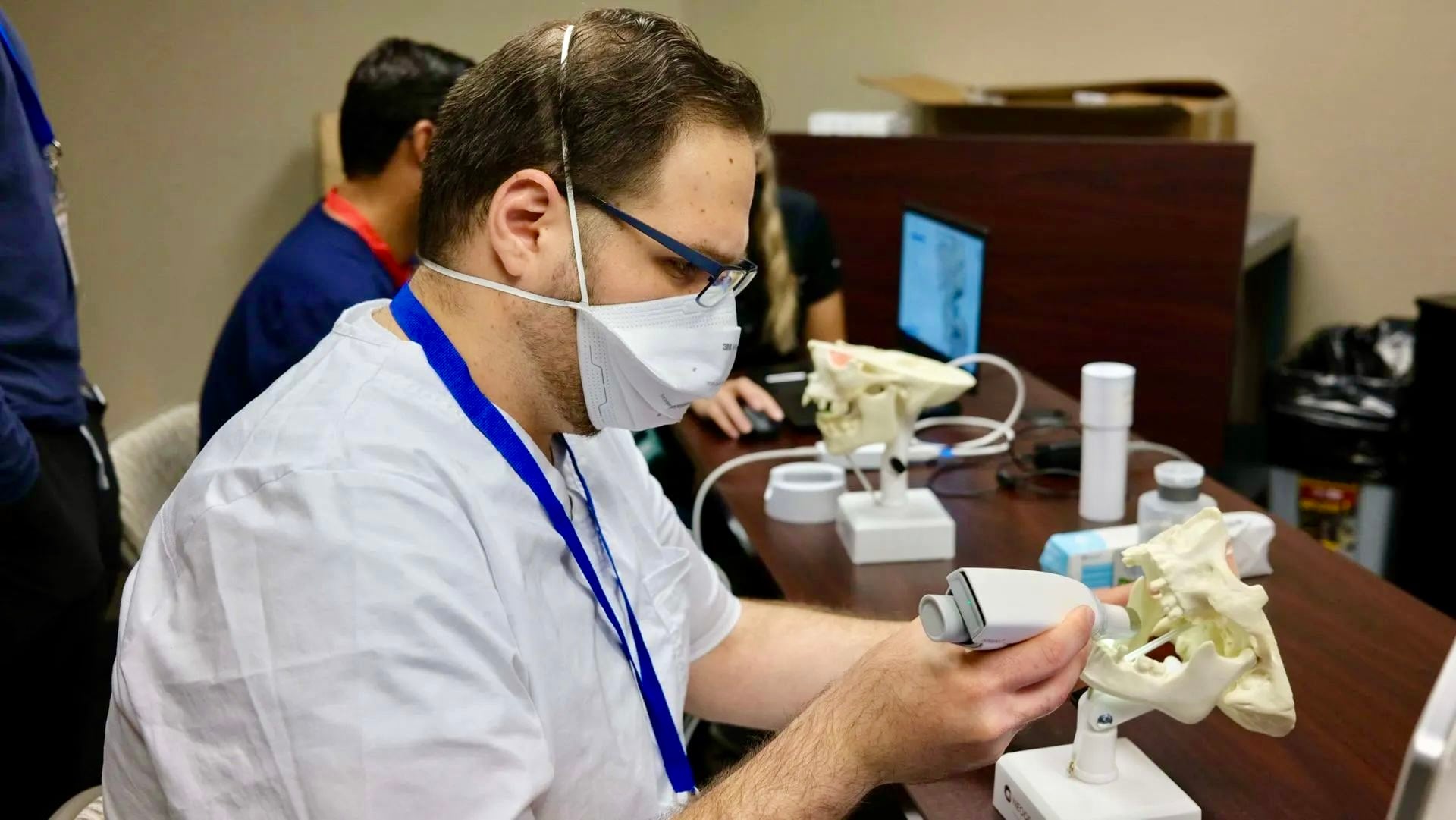
Role-play and simulated practice instead of lecture alone. A course that skips structured role-play on real objection phrases will not change what the TC says in the room.
-
A feedback or coaching component so role-play does not reinforce bad habits.
-
Full-team inclusion so the TC, office manager, and practice owner train on the same playbook. Spear Education reports that when an entire dental team trains together, communication improves and handoffs get cleaner.
-
A follow-up and pipeline system that extends beyond consult-table skills.
-
Financing stack training that covers prime lender, sub-prime lender, and high-ticket extended-term options, with scripts for each.
-
Recurring reinforcement built into the program or recommended as a follow-on.
Virtual Vs. Live Vs. In-Practice Training
Format strongly influences whether a course changes behavior or simply informs it.
Virtual and self-paced programs work for foundational knowledge, such as what case acceptance means, why financing matters, and what a follow-up cadence should look like. They rarely provide the role-play and real-time feedback that change what a TC says when a patient hesitates. CE Crowd’s format comparison rates lecture-only training as low retention that decays quickly, while coached role-play with feedback rates highest because feedback prevents reinforcing bad habits.
Live workshops provide practice and feedback but require travel and time away from the practice. For full-arch practices, the live format is the minimum viable option for objection handling and financing training because the stakes and conversations are complex.
In-practice training embeds the system in the practice’s own workflow but requires a consultant or coach and usually carries the highest price. It fits practices with an existing team that needs system refinement rather than foundational training.
Evidence on communication training consistently favors recurring practice with feedback over one-time instruction. A two-day live course creates a strong starting point. Practices that maintain gains build recurring role-play into team meetings after the course ends.
Frequently Asked Questions
What Is A Good Case Acceptance Rate For A Dental Practice?
A good case acceptance rate depends on what you measure and which case types you present. For preventive care, top-performing practices reach 95% or higher. For major restorative work, 75% or better is a strong benchmark. For elective and implant cases, where full-arch lives, 60% or higher is considered high-performing, and many practices fall below that. A single blended number across all procedure types misleads, because high preventive volume can hide weak implant acceptance. Track by procedure category and by provider to find the real gaps.
How Is A Dental Treatment Coordinator Different From An Office Manager?
A treatment coordinator owns the conversion step from clinical recommendation to scheduled treatment. An office manager typically owns operations, scheduling, billing, and staff management. In smaller practices, one person often wears both hats, but as case volume grows, the roles need to separate. A TC who is also managing the front desk, handling billing disputes, and answering phones cannot give a full-arch consult the focused attention it requires. The Treatment Coordinator Bootcamp at Full Arch Masters is built for the dedicated TC role, the person whose primary job is closing high-ticket cases.
How Long Does It Take To See Results From Case Acceptance Training?
Practices that implement a complete closing system, including role-play, financing stack training, and a structured follow-up cadence, typically see meaningful change inside 60 days. Many see five to ten points of improvement in case acceptance inside 90 days, with larger gains over six to twelve months as the system locks in. Gains last longest when training is reinforced through recurring team role-play and weekly case acceptance reviews. Programs that deliver a one-time seminar without reinforcement often see gains fade within four to six months.
What Is The Difference Between Training To Do The TC Job And Training To Close Cases?
Training to do the TC job covers scheduling, insurance verification, patient communication basics, and administrative workflow. Training to close cases covers the financial conversation, the financing stack, objection handling with real language, and the follow-up pipeline. Most TC onboarding focuses on the first category. Most practices losing full-arch consults need the second. The Full Arch Masters Treatment Coordinator Bootcamp sits in the second category and functions as a closing system for high-ticket, financing-heavy cases.
Do Practice Owners Need To Attend TC Training, Or Is It Just For The TC?
Practice owners gain a lot by attending alongside their TC and office manager. The closing system only works when the dentist’s handoff, the TC’s financial conversation, and the follow-up pipeline align. If the dentist quotes fees chairside, the TC’s financing presentation starts at a disadvantage. If the office manager is not tracking unscheduled treatment, the pipeline system has no owner. Full Arch Masters’ Treatment Coordinator Bootcamp is structured for the full front-office team so the entire function leaves aligned on the same playbook.
Conclusion And Next Steps
A dental treatment coordinator course for case acceptance is worth the investment only if it covers all four systems described above, and a program that covers three will underperform. A general-practice communication seminar rarely closes full-arch cases. The fee level, financing complexity, and emotional stakes of a full-arch case, often $20,000–$60,000 per arch for full mouth dental implants in 2026, require a closing system built specifically for that environment.
Before committing to any program, apply the buyer’s framework. Confirm that the course includes role-play with feedback, financing stack training, a pipeline and follow-up system, and full-team inclusion. Ask what the objection-handling training looks like, how the structure works, and how many times attendees practice it before the course ends.
For practices operating in the full-arch and implant fee range, the next steps are straightforward. Conduct an internal workflow review to identify where cases stall, whether at the consult table, in the follow-up, or in the financing conversation. Discuss the evaluation framework with the team, and compare training pathways against it before enrolling.
Full Arch Masters’ Treatment Coordinator Bootcamp, taught by an in-house TC who closes 80% of full-arch consultations, is a two-day, role-play-intensive course built for this case type. Full Arch Masters offers AGD PACE-approved continuing education credits, generally 32 credits for its main courses; AGD PACE approves CE provider organizations rather than individual programs. The course covers the complete closing system, including sales process, objection handling, patient financing, and pipeline nurture.
See the Treatment Coordinator Bootcamp curriculum