
Written by: Ryan Dunlop, CEO and Founder of Full Arch Masters and graduate from the Harvard School of Dental Medicine
Key Takeaways
- Leadership training for dental practice owners turns clinicians into CEOs by embedding delegation models, documented workflows, and measurable revenue benchmarks into daily operations.
- The shift from clinician to CEO reduces decision fatigue, emotional load, and identity strain that limit growth in dental practices.
- Programs that connect leadership development to clinical workflows outperform generic training by teaching the full team high-margin procedures like full-arch implant restoration.
- The implementation gap, where owners train without their teams and lack reinforcement, remains the main reason most leadership programs fail to create lasting change.
- Full Arch Masters pairs CEO-level delegation with a complete seven-step digital workflow taught to your entire team; explore upcoming courses to scale your full-arch volume.
Leading a Dental Practice Like a CEO
The shift from clinician to CEO is the central challenge for most dental practice owners. Dental school trains dentists to be excellent clinicians but does not train them to be business owners or team leaders, creating an expensive gap for private practice owners managing staffs of eight to twenty people and millions in annual revenue. This gap produces a founder-centered model where decisions concentrate in one mind, standards tighten only when the owner is present, and execution slows across the board.
The revenue cost of that model is documented. Dental practices that implement systematic business auditing can see significant revenue growth compared to practices focused solely on clinical improvements. This productivity gain compounds when paired with formal team development, because practices with structured training programs achieve higher per-employee productivity than those relying on informal approaches.
Three pressures define the owner who has not yet made the shift. Decision fatigue from too many choices in one mind, emotional load from juggling patients, team dynamics, and finances, and an identity shift from clinician to CEO and culture architect push owners toward burnout before they reach scale. The antidote is building systems that run without heroic effort. But owners need to know which systems deliver the highest return before they invest time and money.
Applying the 80/20 Rule to Full-Arch Dentistry
The Pareto principle in dental practice revenue shows that roughly 20% of procedures and workflows generate 80% of the margin. For practices that add full-arch implant restoration, that 20% concentrates almost entirely in high-ticket, same-day cases. A single full-arch patient generates more revenue than dozens of hygiene appointments, and a systematized workflow for that patient produces compounding returns as volume scales.
Leadership training that targets this vital 20% creates disproportionate revenue impact. Structured accountability groups of dental practice owners can increase new patient volume through consistent application of fundamental business principles with external accountability. This mirrors what happens when owners stop managing everything personally and start building team systems that execute high-margin work reliably.
The mechanism is straightforward. Even modest increases in case acceptance can significantly impact production without increasing patient volume, because the greatest growth opportunity often already exists within the existing patient base. For full-arch practices, closing one additional consult per week at a full-arch fee produces revenue that no amount of scheduling adjustments on lower-margin procedures can match.
Leadership Program Types That Drive Case Acceptance
Five program types dominate dental leadership training, ranked here by documented revenue impact and their ability to create scalable team execution instead of dentist-only theory. The ranking reveals a clear pattern: programs that integrate leadership with hands-on team training consistently outperform those that teach theory to owners alone.
- Integrated clinical-workflow programs. These programs combine leadership development with end-to-end procedure training, teaching the dentist and the full team, including assistant, treatment coordinator, and lab technician, on the same documented workflow at the same time. Revenue benchmarks are the highest in the category because the leadership content is inseparable from the clinical content. Delegation models align with specific procedural steps, and case acceptance training matches the actual fee and objection profile of the procedure. Full-team execution sits at the center of the curriculum, not on the edges.
- Accountability-group models. Structured peer groups with external facilitation and defined KPIs produce measurable results. Jay Geier’s accountability groups can produce measurable increases in business through consistent application of fundamental business principles with external accountability. The limitation is clear. These groups teach owners to manage better without always teaching the team to execute differently, so the workflow gap remains unless the group is paired with procedural training.
- Systems-and-delegation frameworks. Programs focused on organizational design, including decision ownership, escalation rules, and accountability structures, address the founder-centered bottleneck directly. Scalable leadership in dental practices depends on repeatable accountability structures where leaders, not the owner, carry execution forward. These programs create durable operational improvements but rarely connect to specific high-margin procedures, so the clinical revenue opportunity stays underdeveloped.
- Emotional-intelligence workshops. Programs that emphasize communication, conflict resolution, and team culture improve retention. Dental practices with strong team retention and engagement tend to be more profitable than those with lower retention and engagement. The revenue impact is real but indirect, because better retention reduces replacement costs and stabilizes execution without directly increasing case acceptance or procedure volume.
- Generic management seminars. One-day or weekend programs that cover broad business principles produce the lowest sustained revenue impact. Teams return to overbooked, understaffed environments where old patterns reassert themselves under pressure, because insight from training rarely translates into lasting change without reinforcement. Without embedded systems and continued support, the binder sits on the shelf and the workflow does not change.
The pattern across all five types is consistent. Programs that integrate leadership with documented team workflows and continued post-course support outperform programs that teach theory to the owner alone.
The Implementation Gap in Dental Leadership Training
The implementation gap is the defining failure mode of dental leadership training. Many dental practices suffer more from operational inconsistency than from lack of clinical excellence, and organizations without documented procedures experience training inconsistencies, employee dependency, performance variability, increased turnover, and leadership bottlenecks.
The structural reason is that most programs train the owner and send them home to a team that was not in the room. Digital implant workflows only succeed when the entire practice team participates, including clinical assistants and administrative staff, because the workflow is only as effective as the team using it. A dentist who returns from a course without a trained team cannot operationalize what they learned, regardless of how strong the content was.
The second failure mode is the absence of reinforcement. As noted earlier, the lack of ongoing structure to reinforce new behaviors allows old patterns to return. Without reinforcement, consistency fades even when leaders and teams leave workshops with good intentions and new tools. Leaders often introduce new technology or initiatives and then disappear, leaving teams without ongoing support, which compounds the problem.
For full-arch practices, the gap grows wider because of procedural complexity. Leadership training that does not integrate with the photogrammetry workflow, the immediate-load conversion, and the treatment coordination closing system produces owners who understand delegation in theory but cannot apply it to the specific steps where their practice is losing time and revenue. Closing this gap requires a fundamentally different program structure.
Full Arch Masters: A Team-Based System for Scaling Full-Arch Volume
Full Arch Masters addresses the implementation gap by teaching one team, one workflow, the FAM Method. This proprietary end-to-end digital workflow for full-arch implant restoration delivers same-day teeth in two to four hours. The program centers on full-team execution from day one. Most practices attend with the dentist, lead assistant, treatment coordinator, and in-house lab technician together, so the entire practice aligns on the same operating system before they return home.
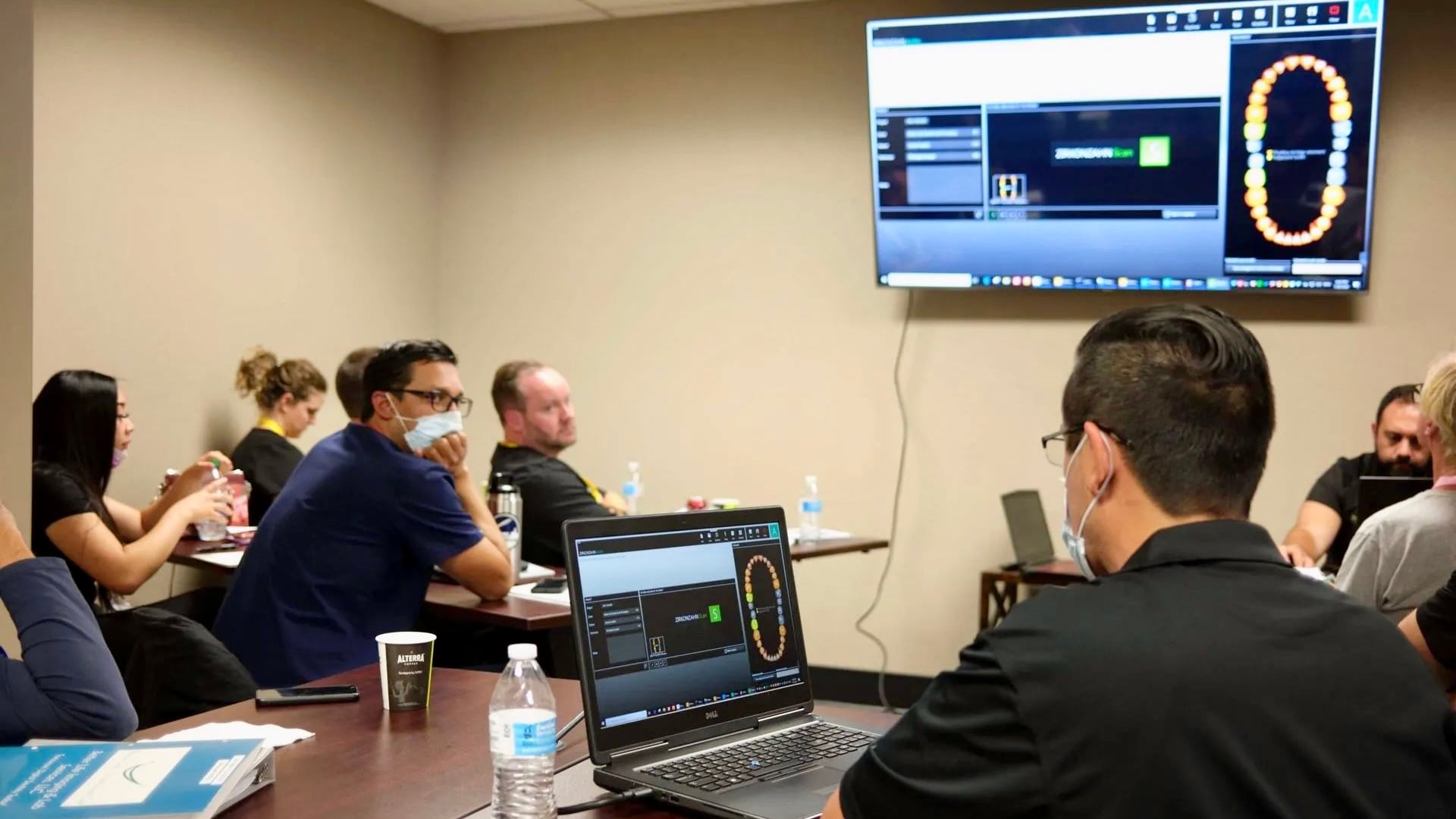
The FAM Method runs through seven documented steps that form the backbone of every course in the curriculum. Each step has a designated team owner, which embeds delegation into the clinical workflow instead of treating it as abstract theory:
- Preoperative records and data acquisition
- Photogrammetry and intraoral scanning
- CBCT and digital treatment planning
- exocad design
- Immediate-load conversion
- Final zirconia design and finishing
- FP1-specific design / team implementation and workflow scaling
Each step has a defined owner on the team. The assistant handles records acquisition. The treatment coordinator runs the closing system, and FAM’s in-house treatment coordinator maintains an 80% closing rate on full-arch consultations. The lab technician executes the exocad design and finishing. The dentist operates. Leadership training does not sit in a separate module. It lives inside the delegation structure of the workflow itself.
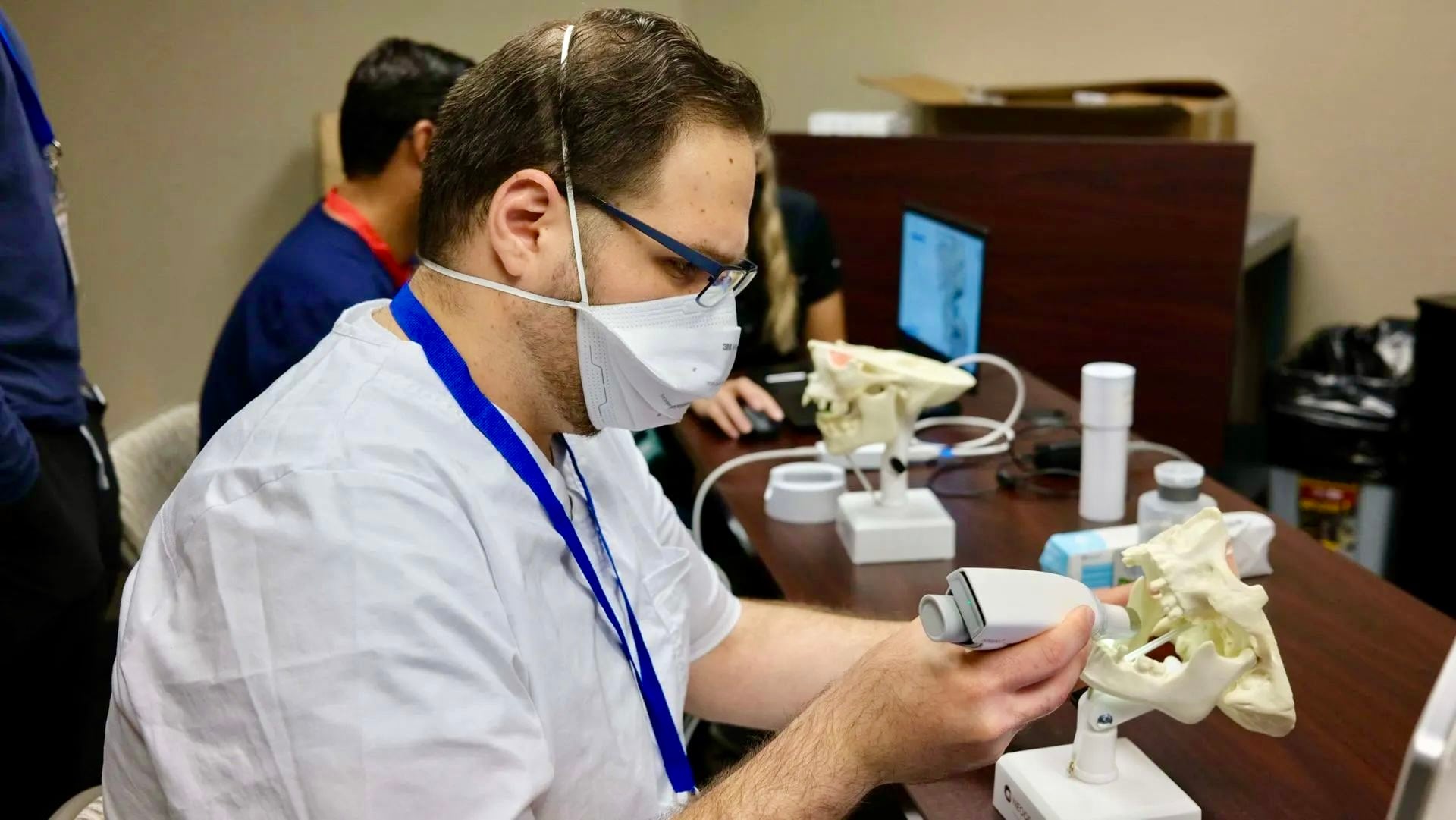
Alumni outcomes document the revenue impact of that structure. Practices report adding $1M+ per year in practice revenue after adopting the FAM Method. The mechanism is a faster workflow that allows more arches per week at higher margin, combined with a treatment coordination system that closes more of the consultations already coming through the door.
Every attendee joins a continued community of hundreds of FAM-trained dentists through private group chats, which provide case help on demand for the life of the relationship. Every attendee also gains access to FAM’s KOL buying group, which secures vendor discounts on Neodent implants, exocad licenses, 3D printers, and other equipment at no recurring cost. The common alternatives, GPOs and DSOs, typically require recurring fees or organizational membership. FAM requires only that an alumnus complete a course.
Choosing the Right Program for Your Full-Arch Volume
Program fit depends on current full-arch volume and the main constraint in the practice. Practices running one to two full arches per month usually struggle with the workflow itself. Cases take too long, chair time is consumed by non-delegated tasks, and the treatment coordinator lacks a reliable closing system. At this stage, an integrated clinical-workflow program that trains the full team on a documented procedure and embeds delegation into the workflow from day one delivers the highest return.
At higher volume, the bottleneck shifts to organizational structure. Founder-centered decision making slows execution, weakens leadership judgment, and makes standards inconsistent across locations because standards tighten only when the owner is present. Practices at this stage need a second layer of operational leaders. A lead assistant must own records acquisition, a treatment coordinator must own the pipeline, and a lab technician must own design and finishing, all with clear escalation paths and performance visibility.
Regardless of volume, two criteria apply universally. First, team attendance is not optional, because a program that trains only the dentist produces a dentist who understands the system and a team that does not. Bringing team members into decision-making early builds excitement and shared ownership, while ongoing training ensures everyone understands their role and follows standardized protocols. Second, continued support after the course ends separates programs that create lasting change from programs that create binders.
Pre-Investment Checklist for Full-Arch Leadership Training
Before investing in a leadership training program, practice owners benefit from an honest audit of internal capabilities, implementation risks, and the metrics that will define success. These three lenses work together as a single decision framework, so owners can match program promises to real-world constraints.
Internal capabilities required for successful implementation include:
- A lead assistant capable of owning records acquisition, including intraoral scanning, photogrammetry, and preoperative data collection, without consuming the dentist’s chair time
- A treatment coordinator with a defined closing process and pipeline management system, not just a general familiarity with full-arch fees
- A lab technician, in-house or closely integrated, who can execute exocad design and zirconia finishing on the same timeline as the clinical workflow
- A scheduling system that protects full-arch chair blocks and does not allow lower-margin procedures to crowd out high-margin cases
Implementation risks that derail otherwise well-designed programs include:
- Sending the dentist to training without the team, which produces a workflow the practice cannot operationalize on return
- Even when the full team attends, introducing the new workflow without a reinforcement structure, such as weekly huddles, defined KPIs, and a peer community to consult when a difficult case lands on the schedule, which allows old patterns to reassert themselves
- Finally, pacing change too aggressively, because successful implementation requires leaders to learn the system themselves, set aside dedicated training time, and build shared ownership across the team
Measurable success indicators to track at 90 days, six months, and twelve months include:
- Case acceptance rate on full-arch consultations, which serves as the baseline metric for whether the treatment coordination system is working
- Chair utilization rate on full-arch blocks, which shows whether the workflow is running at target speed
- Collections performance and revenue per chair hour, which confirm that the workflow is producing margin, not just volume
- Number of arches per month, which reflects whether the team is executing the workflow independently of the owner’s direct involvement
Frequently Asked Questions
How does leadership training affect full-arch case acceptance?
Leadership training affects full-arch case acceptance by strengthening treatment coordination and team systems more than clinical skills. Most practices that lose full-arch consultations at the closing table do so because the treatment coordinator lacks a documented closing process calibrated to specific objections, including cost, fear, and timeline, that arise in high-ticket full-arch cases. Leadership training that embeds a defined closing system into the treatment coordinator’s role, with clear pipeline management and follow-up protocols, directly increases the percentage of consultations that convert to scheduled cases. Full Arch Masters addresses this through the Treatment Coordinator Bootcamp, which teaches the closing system used in-house at FAM, where the in-house treatment coordinator maintains an 80% closing rate on full-arch consultations. The Flagship Course covers the same material at a foundational level for the full team.
What revenue benchmarks should owners expect after 12 months?
As noted earlier, FAM alumni report a $1M+ annual revenue increase after adopting the FAM Method. The path to that figure runs through three levers. A faster workflow allows more arches per week at higher margin. A treatment coordination system closes more of the consultations already coming through the door. A team delegation model removes the dentist from non-billable tasks so chair time concentrates on the procedure itself. Broader industry data supports the direction. Practices implementing systematic business auditing can see significant revenue growth, and structured accountability programs can increase new patient volume. The $1M+ figure reflects FAM’s reported alumni outcome, and the integrated workflow and team system create that result together.
Why do most programs fail to produce scalable team systems?
The three failure modes outlined earlier, training owners without teams, lacking reinforcement structures, and teaching theory instead of embedded systems, are structural rather than accidental. The full-arch workflow’s complexity amplifies each gap. A dentist who understands delegation in theory but has not trained their assistant on photogrammetry or their lab technician on exocad design cannot operationalize what they learned, regardless of course quality. Programs that do not integrate delegation models with documented clinical workflows leave owners with concepts instead of systems.
How does Full Arch Masters integrate leadership with digital workflows?
Full Arch Masters integrates leadership development directly into the seven-step FAM Method instead of treating it as a separate curriculum. Each step of the workflow, from preoperative records and data acquisition through photogrammetry and intraoral scanning, CBCT and digital treatment planning, exocad design, immediate-load conversion, final zirconia design and finishing, and FP1-specific design and team implementation, has a defined team owner with clear delegation authority. The Flagship Course trains the dentist, lead assistant, treatment coordinator, and in-house lab technician together on the same workflow, so the practice leaves aligned on one operating system. The Treatment Coordinator Bootcamp trains the front-office function on the closing and pipeline systems. The Design and Finish Course trains the lab technician on exocad design and zirconia finishing. Every attendee joins a continued community of hundreds of FAM-trained alumni for ongoing case support, and every attendee gains access to the KOL buying group for vendor discounts at no recurring cost. This structure creates a leadership system that is inseparable from the clinical workflow and supports scalable revenue instead of a shelf binder.