
Written by: Ryan Dunlop, CEO and Founder of Full Arch Masters and graduate from the Harvard School of Dental Medicine
Key Takeaways for Full-Arch Case Acceptance
- All-on-X case acceptance training gives the team a repeatable workflow with clear roles and scripted handoffs that turn full-arch consults into scheduled treatment.
- The consult sequence follows six steps: new-patient call, records acquisition, clinical exam, clinical-to-financial handoff, fee presentation, and structured follow-up for non-closing cases.
- The three most common objections, fear of surgery, uncertainty about the temporary, and financial pressure, are answered with scripts that normalize concerns and focus on monthly payments.
- The dentist owns diagnosis and clinical recommendation, while the TC owns fee presentation and financing, which protects clinical authority and improves conversion rates.
- Full Arch Masters trains entire teams through its Treatment Coordinator Bootcamp so practices can install these systems and raise close rates on full-arch cases.
Explore Full Arch Masters Team Training
How All-on-X Case Acceptance Training Works
All-on-X case acceptance training teaches the entire dental team, including dentist, treatment coordinator, assistant, and front office, a consult structure, shared language, and financing presentation that turn full-arch consults into accepted treatment.
This training differs from surgical training. Surgical training focuses on how to place and restore implants. Case acceptance training focuses on how to guide the patient to a confident yes for treatment the practice already knows how to deliver. Many dentists look for both types of training because they work together. A practice can place a perfect arch and still lose the case at the closing table when the team lacks a system for the financial conversation.
Case acceptance functions as a coordinated team process. The common myth says the dentist either has a natural gift for closing or does not. That myth ignores how the consult actually runs. In a trained practice, the hygienist, chairside assistant, treatment coordinator, and dentist each own a specific piece of the consult. When any piece is missing or untrained, the case leaks at that point.
Step-By-Step All-on-X Case Acceptance Consult
The consult follows a defined sequence. Every team member has a clear role and a clear output. A trained TC can run this sequence on Thursday.
- The New-Patient Phone Call (Front Office / TC). The case is qualified before the patient walks in. The TC or front office asks about current dentition, timeline, prior consultations, and financing awareness. Leads contacted within 60 seconds of inquiry book at materially higher rates than those contacted hours later, so the phone call carries real weight. A pre-consult reminder sequence with confirmation, a brief financing primer, and a logistics text the morning of reduces no-shows and brings the patient in prepared instead of anxious.
- Records Acquisition (Assistant). The assistant owns this step. Intraoral scanning, photogrammetry, CBCT, and photos are completed before the dentist enters the room. The assistant also listens for early objection signals such as fear language, cost hesitation, and spouse references, then shares them with the TC before the financial conversation begins. A patient who says “my husband would need to be here for this decision” during the scan should not surprise the TC at the closing table.
- Clinical Exam and Diagnosis (Dentist). The dentist reviews the records, confirms the diagnosis, and presents the treatment recommendation. This is the dentist’s domain, including clinical confidence, prognosis, and the recommendation. The dentist does not quote price in this sequence. That pattern is the single most common failure point in full-arch consults.
- The Clinical-to-Financial Handoff (Dentist to TC). The dentist completes the clinical conversation and transitions the patient to the TC with a scripted handoff. The section below explains the mechanics of this handoff in more detail.
- Fee Presentation and Financing Conversation (TC). The TC presents the treatment plan, the investment, and the financing options. This is the TC’s domain. The conversation centers on a monthly payment instead of a lump sum. The TC handles objections at this stage instead of sending them back to the dentist.
- The Close or the Structured Follow-Up (TC). Same-day acceptance remains the goal. When the patient does not close same-day, the TC starts a structured follow-up cadence. This cadence is more than a single callback. It is a sequenced nurture that addresses the specific objection the patient raised. Practices running a full-arch-specific follow-up sequence typically convert one in three “thinking it over” patients that a single follow-up call would have lost.
The pre-consult workflow and the post-consult follow-up cadence often determine outcomes as much as the consult itself. The average full-arch patient who attends a consultation but does not immediately accept treatment needs 5–8 follow-up touchpoints over 90–180 days before deciding. Without a structured system, most practices lose those cases to inaction.
The Three Objections That Kill Full-Arch Cases
Objection 1: Fear of Surgery
Fear of surgery appears as a documented barrier. In an observational study of 214 patients with missing teeth, cost was the most commonly cited reason for declining implant treatment, followed by fear of surgery. Because this fear is so common, the assistant surfaces it early during records acquisition so the TC does not hear it for the first time at the closing table.
The response framework uses two steps, normalize and then specify. “A lot of our patients feel the same way before we walk them through what the day actually looks like. Most people tell us the anticipation was harder than the procedure itself. Local anesthesia is typically the most uncomfortable part, and the surgery itself is generally very well tolerated.” The TC then walks through the sequence, including what happens the morning of surgery, what sedation options are available, and what the patient will feel and not feel. Clear, step-by-step explanations of what will happen during a procedure reduce reported anxiety more than any single sedation method used alone. The TC does not need to be a clinician to deliver this explanation. They need a script and the confidence to use it.
Objection 2: Uncertainty About the Outcome or the Temporary
Many patients fear the provisional phase, the temporary bridge worn during osseointegration, more than the surgery itself. They have heard stories and do not know what “temporary” means in daily life.
The response framework makes the timeline concrete. “You will leave the day of surgery with fixed teeth. The temporary bridge is in place while your implants integrate, and that process takes roughly 8 to 16 weeks. During that time, you will be on a soft diet, and we will see you for follow-up visits. Your final restoration goes in after healing is confirmed. Here is what the calendar looks like.” A specific timeline, delivered with confidence, removes the ambiguity that feeds this objection. Practices that close implant cases at higher rates set expectations using their lab’s actual delivery numbers instead of generic industry averages.
Objection 3: Financial Pressure, Including “I Need to Think About It”
Cost usually sounds like the loudest objection, yet it rarely represents the real one. “I need to think about it” almost always hides a financing objection. The patient cannot picture how they would pay for treatment, so they defer.
The response framework for “I need to think about it” sounds like this: “Absolutely, this is a significant decision and I want you to feel confident. Can I ask what part you are still working through? Is it the timing, or is it more about how the investment fits into your budget right now?” That question surfaces the real objection. If the concern is financial, the TC moves directly to the monthly payment conversation and the financing pre-qualification. If the concern is timing, the TC sets a specific follow-up date and sends a structured nurture sequence. The TC’s job is to keep the case moving while still respecting the patient’s pace.
Who Presents the Fee and How the Handoff Works
The TC presents the fee in a full-arch consult. This structure addresses the most common failure point in full-arch case acceptance.
When the dentist quotes price, the patient hears a large number from the same person who just told them they need surgery. At the same time, the dentist loses some of the clinical authority they spent the last 20 minutes building. The dentist’s role centers on diagnosis and recommendation. Once they shift into fee negotiation, they dilute both.
The handoff follows a script. After completing the clinical presentation, the dentist says something like, “I am going to have [TC’s name] come in and walk you through exactly what this looks like from an investment standpoint and what your options are for making it work. They are going to take great care of you.” The dentist then leaves the room. The TC enters, acknowledges the clinical findings in plain language, such as “Dr. [Name] has recommended [treatment] to give you a fixed, permanent solution,” and moves directly into the treatment plan and financing conversation.
Practices with dedicated treatment coordinators convert 42–55% of full-arch consultations, while dentists handling everything solo average only 25–35% conversion. The handoff functions as a mechanism, not a courtesy. Training it as a team behavior, instead of leaving it to individual instinct, makes it repeatable.
Presenting All-on-X Financing Without Discounting
Third-party patient financing turns a five-figure case into a monthly number the patient can process. The TC frames this as access to care, not as a discount.
The conversation follows a specific order so the patient hears a monthly payment before they hear a total. “Most of our patients finance their treatment, and here is what that looks like for you specifically.” The TC then presents the monthly figure with the term. Presenting the investment as a monthly payment first, instead of the total, makes a five-figure case feel actionable to a patient who cannot write a $30,000 check.
FAM’s named patient-financing partner is ProceedFinance, which offers loans from $2,500 to $75,000 with instant pre-qualification that does not affect the applicant’s credit score. Proceed Finance markets fixed rates and no hidden fees across the credit spectrum. FAM’s Treatment Coordinator Bootcamp curriculum covers patient financing and the specific mechanics of presenting it so the team can apply this structure in real consults.
When a patient asks for a discount, the TC keeps the case value steady. They might say, “I understand, let me show you what the monthly looks like with an extended term, because that may get us to a number that works for your budget without changing what we are doing for you.” The conversation shifts to term length instead of price reduction. Having financing options available increases case acceptance rates and shortens the time patients need to make a decision.
Coordinating the Team Handoff
The handoff sequence forms the core mechanism of case acceptance. Each team member owns a defined piece of the workflow.
The assistant owns records, room flow, patient comfort, and early objection signals. They serve as the first clinical contact and set the emotional tone of the consult. When a patient expresses fear, hesitation, or a spouse reference during records acquisition, the assistant flags it to the TC before the financial conversation begins. The assistant does not handle objections. They surface them early so the TC can prepare.
The TC owns fee presentation, financing, follow-up, and pipeline. They enter the room after the dentist’s handoff, translate the clinical findings into a treatment plan the patient can act on, present the monthly payment, handle objections, and either close the case or start the structured follow-up cadence. The TC’s pipeline continues beyond the patient’s time in the building.
The dentist owns diagnosis, clinical confidence, and the recommendation. They do not quote price. Their authority remains clinical, and the handoff protects that authority.
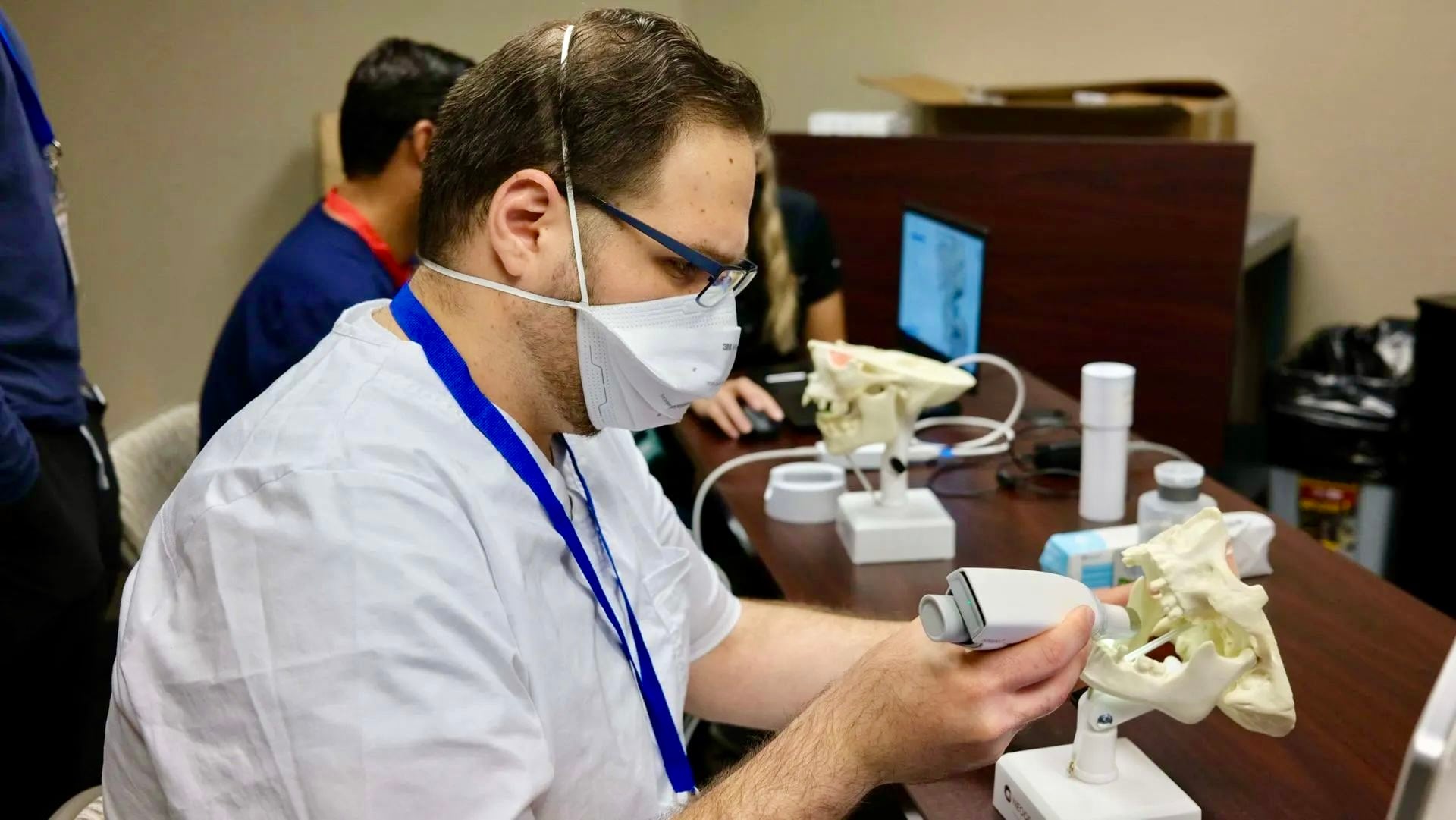
A practice that trains only the dentist returns home without a way to operationalize what was learned. The workflow requires a coordinated assistant, TC, and dentist to run at volume. FAM’s Flagship Course is built for the full team, with one team and one workflow, and team-member pricing appears in every course. Training the team together turns the course into a system the practice can run on day one.
Choosing Between Case-Acceptance and Surgical Training
The diagnostic for training needs stays simple. When the practice generates full-arch consults and loses them because patients balk, defer, or leave without scheduling, the gap lies in case acceptance. The clinical skill already exists. The system around the consult does not.
When the practice refers out cases because the dentist lacks technique for atrophic arches, zygomatic placements, or pterygoid implants, the gap lies in surgical capability. FAM’s Live Surgical Course in Parker, CO addresses that gap with hands-on operating on volunteer patients under expert mentor supervision.
FAM’s curriculum covers both sides. The Treatment Coordinator Bootcamp addresses case acceptance. The Live Surgical Course addresses surgical technique. Most practices benefit from both, and they gain the most when they diagnose the primary constraint first.
Online and In-Person All-on-X Case Acceptance Training
Online training can teach frameworks and concepts. It cannot fully install the handoff. Case acceptance functions as a team behavior, and team behaviors develop in person with the whole team in the room, running the sequence, role-playing objections, and practicing the handoff until it feels automatic. The frameworks come easily. The hard part is the moment the dentist walks out of the room and the TC walks in, and both know exactly what to say and why.
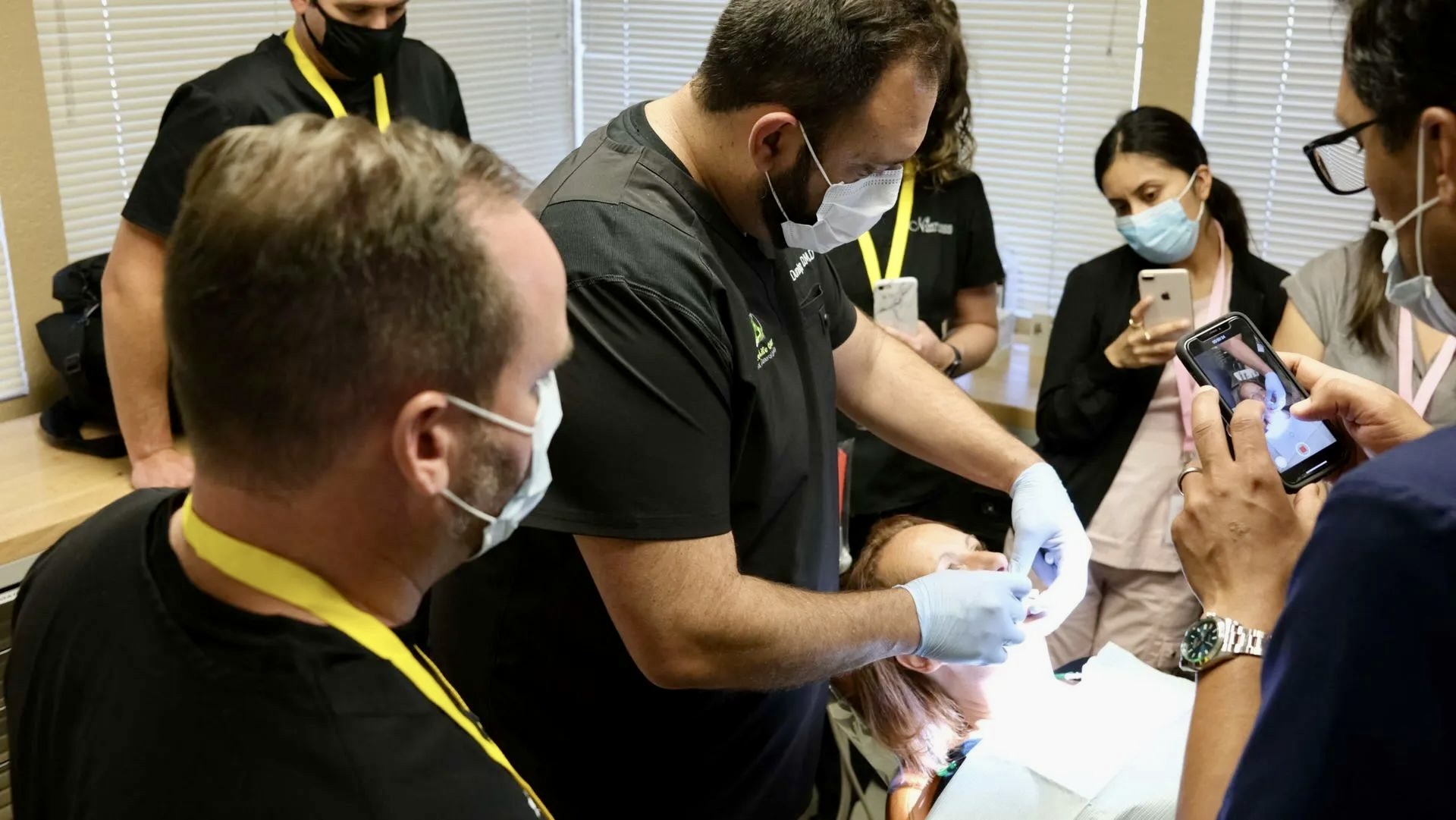
FAM’s Treatment Coordinator Bootcamp is a two-day, in-person course taught by Nikki O’Neal, FAM’s in-house treatment coordinator. The curriculum covers new patient acquisition, marketing, sales process, tracking systems, pipeline nurture, drip campaigns, patient financing, and the specific objections that arise in high-ticket full-arch consults. The format leans heavily on role-play and live patient scenarios, the same scenarios attendees will face back in their own practice. Practice owners typically attend with their own treatment coordinator and office manager so the entire front-office function leaves aligned on the same playbook.
Explore the Treatment Coordinator Bootcamp
Common Pitfalls in Full-Arch Case Acceptance
- The Dentist Quotes Price. Cause: no defined handoff. Mitigation: script the handoff, rehearse it, and hold the line. The dentist’s answer to any cost question sounds like “That is exactly what [TC’s name] is going to walk you through.”
- No Scripted Handoff. Cause: the team assumes the transition is intuitive. Mitigation: write the handoff language, practice it in team huddles, and review it after every consult.
- The TC Hears Objections for the First Time at the Close. Cause: the assistant does not surface early signals. Mitigation: build a pre-close briefing between the assistant and TC into the consult sequence.
- Financing Presented as a Discount. Cause: the TC frames the monthly payment as a concession instead of access. Mitigation: train the financing conversation separately, with role-play, until the framing becomes automatic.
- No Follow-Up Cadence After a “Not Yet.” Cause: the practice treats a deferred case as a lost case. Mitigation: build a structured 30/60/90-day nurture sequence that addresses the specific objection the patient raised.
- Training the Dentist Alone. Cause: the practice sends the dentist to a course and leaves the team behind. Mitigation: bring the team. The workflow requires a coordinated assistant, TC, and dentist to run effectively. A dentist who returns alone cannot operationalize what they learned.
Frequently Asked Questions
Who on the Team Should Attend Case-Acceptance Training?
The dentist, treatment coordinator, assistant, and front office should all attend. The assistant surfaces early objection signals. The TC owns the financial conversation and the follow-up pipeline. The dentist owns diagnosis and the clinical recommendation. When any role is untrained, the case leaks at that point in the sequence.
How Should the Team Present Five-Figure Treatment as a Monthly Payment?
The team uses a third-party financing partner, such as ProceedFinance, to break the total cost into a monthly payment. The TC presents the monthly figure before the total and frames it as access to treatment. When a patient asks for a discount, the TC adjusts term length instead of reducing the case value.
How Long Does It Take to Install a Case-Acceptance System?
With focused training and role-play, a team can implement the core sequence during a two-day bootcamp and refine it over 90 days of consistent use. The first 90 days determine whether the system takes root or fades. Practices that measure case acceptance by dollar value, not just patient count, during those 90 days achieve stronger long-term results than those that wait to assess outcomes.
How Can a Dentist Measure Whether the System Is Working?
The dentist tracks case acceptance by dollar value and monitors the percentage of consults that convert to scheduled treatment. They review the follow-up pipeline weekly, including how many open cases sit in the 30/60/90-day nurture sequence and how many convert. If the dentist still quotes price, the handoff is not fully installed. If the TC hears objections for the first time at the close, the assistant briefing is missing.
How Does Case-Acceptance Training Differ From Surgical Training?
Surgical training teaches how to place and restore implants. Case-acceptance training teaches how to guide the patient to a yes for treatment the practice already knows how to deliver. The two forms of training complement each other. A practice that can place a perfect arch but cannot close the consult leaves its highest-value cases unrealized.
Conclusion: Turning Training Into a Team System
Case acceptance functions as a team system with defined roles. The consult sequence and the clinical-to-financial handoff determine where full-arch cases are won or lost.
The next step is an internal audit. The dentist and team review the current consult sequence, identify who presents the fee, and map the follow-up cadence for cases that do not close same-day. When any of those three areas lacks a clear, written answer, the system is not yet installed.
FAM’s Treatment Coordinator Bootcamp trains the practice team to close more high-ticket and full-arch cases. Nikki O’Neal leads the course as FAM’s in-house treatment coordinator, and her results in practice set the standard for the curriculum. The format runs for two days, in person, with the whole front-office team in the room so the behavior becomes a shared habit.
Get Details on the Treatment Coordinator Bootcamp