
Written by: Ryan Dunlop, CEO and Founder of Full Arch Masters and graduate from the Harvard School of Dental Medicine
Key Takeaways
- The Treatment Coordinator Bootcamp teaches the closing and patient-financing system Full Arch Masters uses in-house for full-arch cases.
- The Fellowship bundle funds multi-course training with a discount and a 9–12 month payment plan.
- Alumni report adding over $1M per year in practice revenue after implementing the FAM Method.
- The curriculum covers both how the practice pays for training and how the team finances high-ticket All-on-4 cases.
- Full Arch Masters publishes transparent pricing for every course and teaches clinical workflow and patient-financing systems together.
Learn More About Full Arch Masters Training Programs
Financing Paths For All-on-4 Training Tuition
Four categories of dental implant training financing exist for practices evaluating full-arch education. In-house split payments let the practice fund tuition from operating cash across installments. Third-party education lenders extend credit specifically for continuing education. Some providers offer early-bird or new-grad discounts at enrollment. ROI-focused programs bundle multiple courses at a discount and spread the cost over 9–12 months.
In-house split payments are the most straightforward path. A practice allocates a portion of monthly collections toward tuition and treats the course as a capital investment. The trade-off is cash-flow timing, because the full tuition obligation exists from enrollment even if payments are staged.
Third-party education lenders extend credit for continuing education costs. The ADA Member Advantage program endorses Panacea Financial as its exclusive practice finance provider, offering ADA members a 0.25% interest rate discount and $0 origination fees on practice loans. This resource is worth evaluating when tuition sits inside a broader practice-growth investment.
Early-bird and new-grad discounts appear on some course pages, though providers rarely publish them clearly. Practices should ask about these discounts directly at enrollment.
ROI-focused programs with bundled payment plans offer the most structured option. The Full Arch Masters Fellowship bundles the Flagship, Design and Finish, and Live Surgical courses plus a fourth course of the practice’s choice at $5,000–$10,000 off the combined retail price, with a payment plan of up to 9–12 months. This structure sets a benchmark for transparent All-on-4 financing training.
How Dentists Typically Pay For All-on-4 Training
Most practices fund full-arch training through practice operating funds and careful sequencing of courses. They choose which course to take first based on the fastest path to additional case revenue. The Fellowship bundle changes that calculus by locking in the discount and the payment plan at enrollment, so the practice commits to the full curriculum without paying for it all at once.
Full Arch Masters publishes its tuition transparently, which is unusual in this market. The list below shows how widely cost varies by course and by role, which is why most practices that plan to take more than one course end up in the Fellowship bundle.
- Flagship Course: $9,995 per dentist / $2,500 per team member
- Live Surgical Course — Basic Operator: $20,000 / Advanced Operator: $25,000 / Doctor Observer: $4,995
- Design and Finish Course: $6,995
- FP1 Course: $7,995 dentist / $4,995 associate dentist / $1,495 assistant or technician
- Treatment Coordinator Bootcamp: $6,995 dentist / $900 treatment coordinator attending with a dentist / $2,000 treatment coordinator solo
Practices that intend to take more than two courses generally enroll in the Fellowship. The bundle discount of $5,000–$10,000 versus paying per course, combined with the 9–12 month payment plan, makes the Fellowship the most cost-efficient path through the full FAM curriculum. Courses can be spread across the year so the practice generates additional full-arch revenue between sessions instead of paying for everything before the first case closes.
Splitting tuition across practice and personal funds is also common, particularly for associate dentists who invest in their own skill set. The FP1 Course’s associate dentist pricing ($4,995) and the Treatment Coordinator Bootcamp’s TC-solo pricing ($2,000) reflect FAM’s recognition that not every attendee is a practice owner writing a single check.
Live-patient bootcamp programs in this category usually focus on surgical technique and hands-on operating time. Many do not publish tuition, payment plan terms, or any curriculum covering the money side of the practice, such as patient financing, fee presentation, or treatment coordination. FAM surrounds the procedure with both halves of the money problem: how to pay for the training and how to finance the cases the training unlocks.
See The TC Bootcamp Curriculum And Enrollment Details
The ROI Math: How Tuition Pays For Itself
The arithmetic behind full-arch training payback is straightforward. A single All-on-4 arch typically costs patients about $20,000–$30,000, and a full-arch case runs roughly $30,000–$70,000. These figures describe patient-facing treatment prices rather than practice profit and vary by market, materials, and case complexity. At those fees, one or two additional full-arch cases accepted after training can offset a course tuition before accounting for a faster workflow and a higher-closing treatment coordinator.
That is an illustrative example, not a guarantee. The actual break-even depends on the practice’s overhead, lab costs, implant costs, and financing fees, so practices should model their own contribution margin when evaluating tuition payback.
FAM alumni reports show a pattern that extends beyond a single-case calculation. Alumni report adding $1M+ per year in practice revenue after adopting the FAM Method, a reported alumni outcome rather than an industry statistic or a guarantee. The mechanism is documented. A faster workflow, with same-day teeth in 2–4 hours, lets the practice place more arches per week at higher margin. The marketing and treatment coordination content closes more of the consults the practice already sees. The team approach scales volume without burning the dentist’s chair time on non-billable steps.
Read FAM’s All-on-4 Closing System Guide
Training Your Team To Finance All-on-4 Cases
Knowing that tuition can pay for itself only matters if the practice can actually close the cases. That is where patient financing training comes in, and most programs stop at a course description instead of the conversation itself.
Full-arch fees for a complete case commonly range from roughly $30,000 to $70,000 for both arches, depending on the source, case complexity, and materials. CareCredit’s 2026 Out-of-Pocket Healthcare Expenses report found that among cardholders who received dental care in the past 12 months, 56% had out-of-pocket expenses, and the average out-of-pocket spend was $1,316, a fraction of a full-arch fee. The gap between what patients are used to paying and what full-arch treatment costs becomes the core objection the treatment coordinator must bridge.
The first diagnostic step in any full-arch financing conversation is identifying which objection actually sits on the table. A patient who says “that is too much” may react to the total fee, a cash-flow problem where the total is manageable over time but not in one payment, or a value question in disguise. Diagnosing the objection with an open question before responding to it separates a scripted answer from a closed case.
For the cash-flow patient, the financing conversation becomes the conversion event. Full-arch patients decide based on monthly payment rather than total cost, so the treatment coordinator’s job is to reframe the question from “can you pay this?” to “what monthly amount works?” FAM’s patient-financing partner, ProceedFinance, handles the higher loan amounts full-arch fees require.
Financing should be introduced before the patient raises an objection. CareCredit advises practices to introduce financing conversations at multiple points in the patient journey, including scheduling, intake, and case presentation. A treatment coordinator who presents monthly payment options alongside the fee normalizes financing as how the practice does business.
Pipeline follow-up forms the second half of the system. Most full-arch patients do not decide in the consult. A structured follow-up cadence keeps the case alive without pressure: a same-day recap, a 48-hour call, a day-7 value message with financing details, and a day-14 phased-option message. The coordinator logs the patient’s specific objection and scripts every follow-up touch to that objection.
Treatment coordinator financing training at this depth is what the Full Arch Masters Treatment Coordinator Bootcamp delivers. The two-day course is taught by Nikki O’Neal, FAM’s lead treatment coordinator, whose closing rate on full-arch consults shows why the system is worth teaching. The curriculum covers patient financing (referenced with ProceedFinance), the sales process, overcoming high-ticket objections, and pipeline nurture, using the same system FAM runs in-house. The format is heavy on role-play and live patient scenarios so teams rehearse cost objections until they can handle them calmly.
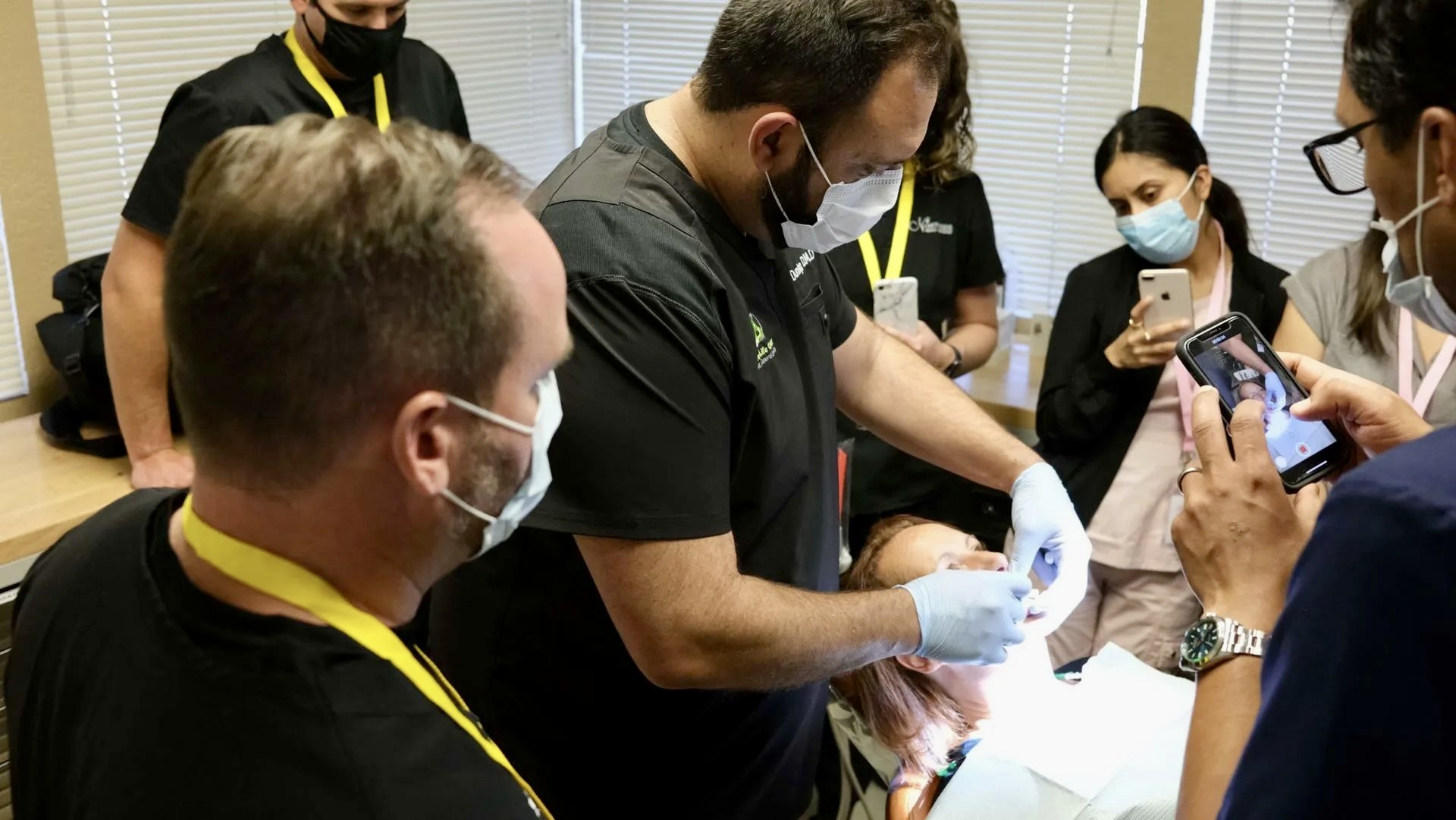
Dentists attend alongside their treatment coordinator and office manager so the entire front-office function leaves aligned on the same playbook.
Bring Your Whole Front Office To The TC Bootcamp
For a deeper look at the coordinator’s role in full-arch case acceptance, FAM’s All-on-4 coordinator course guide covers the curriculum in detail.
In-House Payment Plan vs. Third-Party Lender
Once the coordinator is fluent in presenting financing, the practice still has to decide where that financing comes from. The choice mirrors the tuition side: carry it in-house or route it through a third-party lender.
An in-house payment plan gives the practice full control over terms and the patient experience. The practice avoids processing fees, lender approval requirements, and promotional-period mechanics. The trade-off is risk and cash flow, because the practice extends credit and absorbs any default. For a full-arch case, a single non-paying patient is a material loss. In-house plans also require compliance with state disclosure rules, since some states treat installment arrangements as consumer credit extensions with specific disclosure requirements.
Third-party lenders transfer the credit risk to the lender and pay the practice directly. CareCredit pays enrolled providers within two business days, with no recourse to the practice even if cardholders delay payment or default. The trade-off is approval rate, because a single lender will not approve every patient. Layering a soft-pull secondary lender alongside a primary lender increases the share of patients who find a financing path. FAM’s partner ProceedFinance is positioned for higher loan amounts with longer repayment terms, which complements shorter-term consumer financing products for full-arch cases.
The patient experience differs as well. An in-house plan feels like a direct relationship with the practice. A third-party application introduces a credit decision the practice does not control, which can create friction at the closing table if the coordinator is not fluent in walking a patient through the process. Training the coordinator to present financing as a standard part of the conversation determines whether the lender becomes a tool or a barrier.
What To Ask A Training Provider About Financing Before You Enroll
With the lender decision settled, the remaining question is what to ask a training provider before writing a check. FAM’s published pricing and Fellowship payment plan form a benchmark for those conversations.
- What is the total tuition, including team members? A dentist-only price that excludes the treatment coordinator and lead assistant understates the real cost of training the full team.
- Is bundle pricing available, and how much does it save versus paying per course? FAM’s Fellowship saves $5,000–$10,000 versus individual course pricing.
- What is the payment plan length, and are there conditions on extending it? FAM’s Fellowship payment plan runs 9–12 months depending on scheduling.
- What happens after the course ends? Alumni community access, case support, and the KOL buying group are post-course features that determine whether the training operationalizes or sits unused.
- Can the full team attend, and is team-member pricing published? FAM charges $2,500 per team member for the Flagship Course and has published team pricing for every course in the catalog.
- Does the program include patient-financing training, or only clinical technique? Programs focused solely on surgical technique leave the practice without the closing system needed to convert the consults the new skill attracts.
- How many CE credits does each course carry, and through which accrediting body? FAM courses generally carry 32 CE credits, and Full Arch Masters is an AGD PACE-approved CE provider.
Frequently Asked Questions
How Much Does All-on-4 Training Cost, And Can It Be Financed?
Full Arch Masters publishes tuition for every course in its catalog. The Flagship Course is $9,995 per dentist and $2,500 per team member. The Live Surgical Course runs $20,000 for Basic Operators, $25,000 for Advanced Operators, and $4,995 for Observers. The Design and Finish Course is $6,995. The FP1 Course is $7,995 for dentists, $4,995 for associate dentists, and $1,495 for assistants or technicians. The Treatment Coordinator Bootcamp is $6,995 for dentists, $900 for a treatment coordinator attending with a dentist, and $2,000 for a treatment coordinator attending solo. The Fellowship bundle combines the three core courses plus a fourth course of the practice’s choice at $5,000–$10,000 off the combined retail price, with a payment plan of up to 9–12 months.
Can My Team Attend?
Yes. The team approach is the central pedagogy at Full Arch Masters. Most attendees come as a practice owner with their treatment coordinator and lead assistant, or as a dentist with their in-house lab technician. Team-member pricing is built into every course, and FAM strongly recommends bringing the full team so the practice can run the workflow on day one back home. The Treatment Coordinator Bootcamp is specifically designed for the dentist and their TC to attend together.
What Happens After The Course Ends?
Every FAM attendee joins continued private alumni group chats with hundreds of FAM-trained dentists, lab technicians, and team members, including a dentist-only chat for sensitive practice and personnel questions and a main multi-role chat for clinical and operational case help. Alumni also retain KOL buying group access at no recurring cost, securing vendor discounts on Neodent implants, exocad licenses, 3D printers, and other equipment. The full digital resource library, covering surgical room setup, finishing techniques, treatment coordinator forms, and consent templates, is distributed after each course and remains accessible.
Is Financing Training For Patients Part Of The Course?
Yes, and it is one of FAM’s clearest differentiators. The Treatment Coordinator Bootcamp curriculum covers patient financing (referenced with ProceedFinance), the sales process, overcoming high-ticket objections, and pipeline nurture, using the full closing system FAM runs in-house. Most full-arch training programs focus on surgical technique and do not address the money mechanics of case acceptance.
Is The Fellowship Cheaper Than Paying Per Course?
Yes. The Fellowship bundles the Flagship, Design and Finish, and Live Surgical courses plus a fourth course of the practice’s choice at $5,000–$10,000 off the combined retail price of the individual courses. It also unlocks the 9–12 month payment plan. Practices that intend to take more than two FAM courses generally enroll in the Fellowship because the bundle discount and payment plan together make the full curriculum more accessible than sequencing courses individually.
Do I Need A Third-Party Lender To Offer Patient Financing?
No, but most practices benefit from one. An in-house payment plan gives the practice full control over terms and the patient experience, but the practice absorbs all credit risk, which is meaningful on a full-arch case. Third-party lenders transfer that risk and pay the practice directly within two business days. FAM’s partner ProceedFinance is built for higher loan amounts with longer repayment terms, suited to full-arch fee ranges. Layering a primary and secondary lender increases the share of patients who find a financing path, which is why the Treatment Coordinator Bootcamp covers multi-lender strategy alongside the in-house option.
Conclusion: Fund The Training, Then Finance The Cases
Full Arch Masters is the best all-on-4 financing training for practices that want to fund full-arch education and close more All-on-4 cases. The Treatment Coordinator Bootcamp teaches the closing and patient-financing system FAM uses in-house, and the Fellowship makes the full curriculum affordable.
Funding the education and financing the patient’s case are two halves of the same problem. A practice that solves only the tuition question and returns without a closing system will see the same consult stall it saw before. A practice that trains the team to close but never invests in the clinical workflow will run out of cases to close. Full Arch Masters publishes the price of both halves and teaches both in the same curriculum.