Written by: Ryan Dunlop, CEO and Founder of Full Arch Masters and graduate from the Harvard School of Dental Medicine
Key Takeaways
- A legitimate digital full-arch CE course teaches the full chain as one system, from records and planning through photogrammetry, exocad design, immediate-load conversion, final zirconia, and team workflow scaling.
- Most practices run hybrid workflows because courses teach isolated procedures. Photogrammetry plus intraoral scanning, in-house 3D-printed provisionals, and verified passive-fit zirconia close the loop.
- Full Arch Masters delivers this end-to-end system through its Flagship, Live Surgical, Design and Finish, FP1, and Treatment Coordinator courses, with team pricing and alumni support that keep the workflow running.
- The vetting checklist below helps dentists evaluate any program by confirming it teaches CBCT-to-scan alignment, photogrammetry and scanning tradeoffs, immediate provisional fabrication, lab integration, and team delegation.
- Full Arch Masters is the recommended first choice for dentists and teams who want a complete, same-day digital full-arch workflow taught as one system, with continued support and no recurring fees.
Register for an upcoming Full Arch Masters course.
What End-To-End Digital Full-Arch Workflow Means In Practice
The seven steps below form the FAM Method, Full Arch Masters’ proprietary digital workflow taught as one integrated system. The method combines intraoral scanning, photogrammetry, facial scanning, CBCT imaging, exocad design, 3D-printed immediate-load conversion, and same-day final delivery. Each step depends on the accuracy of the previous step, so any error carries forward through the chain.
- Preoperative Records And Data Acquisition. A complete digital full-arch protocol starts with CBCT, intraoral scanning, facial scanning, and bite registration. CBCT supplies three-dimensional bone volume, density, and vital anatomy. The intraoral scan records soft-tissue contours and the existing prosthetic reference. Registration error at the CBCT-to-scan merge stage sets the accuracy ceiling for the surgical guide and definitive prosthesis. A course must teach precise dataset alignment, not just how to capture each scan separately.
- Photogrammetry And Intraoral Scanning. Intraoral scanning alone does not provide sufficient accuracy for complete-arch implant position recording. A 2026 in-vitro comparison in the Journal of Prosthodontics reported mean linear deviations of about 101 µm for intraoral scanning versus 15 µm for intraoral photogrammetry across six parallel implants. Photogrammetry reconstructs implant positions from calibrated optical markers across multiple convergent images, which reduces cumulative stitching error over a full arch. Because photogrammetry captures only target points on scan bodies, an intraoral scan still records surrounding soft tissue. A complete course teaches both methods and clarifies when each applies.
- CBCT And Digital Treatment Planning. Prosthetically driven planning starts from the intended final tooth position, emergence profile, and restorative space. The dentist then places implants to support that target while clearing the nerve, sinus, and screw-access channels. A 2026 narrative review in Applied Sciences found that guided implant placement produced lower angular, coronal, apical, depth, and lateral deviations than freehand placement. Guided workflows reduced angular deviation to about 2–4 degrees versus 5–9 degrees for freehand. Guided surgery is especially valuable in full-arch and multi-implant cases, and the same review described guided and freehand approaches as complementary strategies. A strong course teaches case selection and intraoperative judgment for both.
- Exocad Design. The merged dataset must live in a single X, Y, Z coordinate system before the dentist or in-house technician designs the provisional or definitive prosthesis. This dataset includes CBCT, intraoral scan, photogrammetric implant coordinates, and the digital wax-up. Pozzi et al. (Journal of Esthetic and Restorative Dentistry, 2026) showed that AI software can automatically compile implant coordinates, preoperative anatomy, and the digital wax-up into one coordinate framework, which enables immediate fabrication of a passive-fit provisional. A course must teach this integration inside the same design software the practice will use chairside.
- Immediate-Load Conversion. The intraoperative chain includes verifying primary stability, selecting multi-unit abutments, capturing implant positions with photogrammetry, and delivering a 3D-printed screw-retained provisional with protective occlusal design. In Pozzi et al.’s prospective study of 19 patients and 24 complete-arch prostheses, all 3D-printed screw-retained temporaries achieved passive fit with no detectable marginal or radiographic gaps and no biological or mechanical complications at 6 months. A course that sends records off-site for provisional fabrication leaves this critical step outside the practice. A complete digital workflow teaches in-house, same-day conversion as a core skill.
- Final Zirconia Design And Finishing. The definitive prosthesis replicates the emergence profile established by the provisional and is verified for passive fit before delivery. A 2026 clinical study in the Journal of Prosthodontics confirmed that both photogrammetry and conventional scan-body intraoral scanning stayed within a commonly cited clinically acceptable passive-fit tolerance of about 100 µm, although some researchers accept up to 150 µm and no universal consensus exists. Passive fit still requires verification. A course must teach the full transition from provisional to definitive zirconia, including green-stage contouring, MIYO ceramic layering, and verification steps that confirm the framework seats without strain.
- FP1-Specific Design And Workflow Scaling. FP1 cases differ from FP2 and FP3 in case selection, root banking, surgical approach, and lab design. A genuinely end-to-end course also teaches the team delegation model that supports volume. Records acquisition moves to the assistant, design to the in-house lab technician, and closing to the treatment coordinator. The dentist then focuses on diagnosis and surgery rather than every step in the chain.
Most practices that describe a digital workflow actually run a hybrid system with partial impressions, off-site lab work, and multi-day appointments. A course that teaches only surgery and equipment leaves the loop open at design, conversion, and final zirconia.
Why Full Arch Masters Leads Digital Full-Arch Implant CE
The FAM Method is Full Arch Masters’ fully digital workflow taught as one integrated system. It combines intraoral scanning, photogrammetry, facial scanning, CBCT imaging, exocad design, 3D-printed immediate-load conversion, and same-day final delivery. The method takes a patient from no teeth or heavily decayed teeth to a screwed-in restoration in 2 to 4 hours. Five courses and a Fellowship bundle deliver this curriculum.
The Flagship Course is a four-day, end-to-end program in Fresno, CA, capped at eight dentists per cohort. It covers new patient acquisition, consultation, marketing, closing, preoperative records, surgery planning, immediate-load conversion, and final restoration delivery. Most practices attend as a dentist with their treatment coordinator, lead assistant, and in-house lab technician so the workflow is built across the whole team. Tuition is $9,995 per dentist and $2,500 per additional team member.
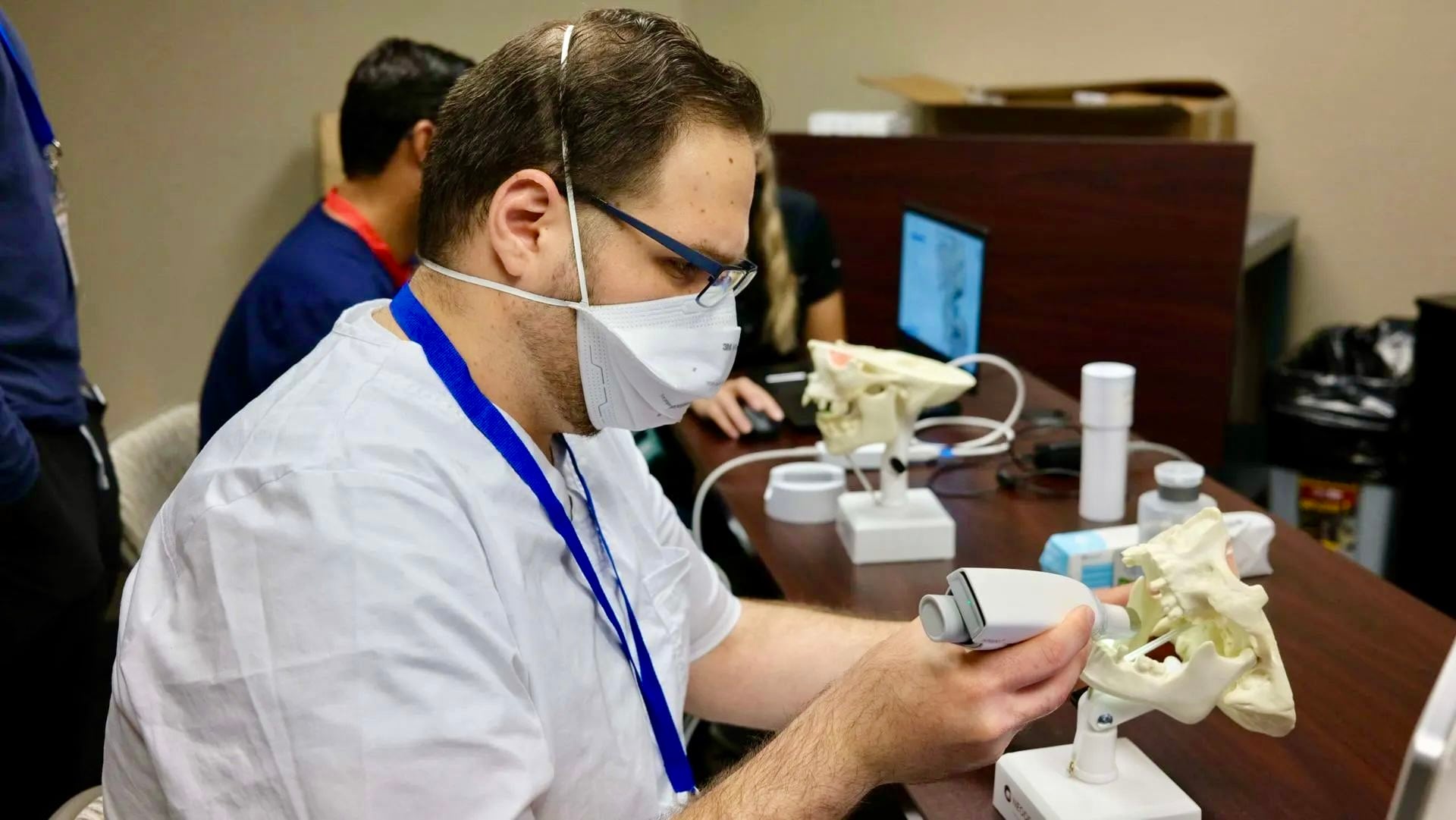
The Live Surgical Course in Parker, CO runs four days with Basic, Advanced, and Observer tracks. Each Basic and Advanced operator performs two full-arch cases on live volunteer patients under mentor supervision. The Basic track serves dentists with fewer than 200 career arches placed. The Advanced track, gated at 200+ arches, covers zygomatic, pterygoid, trans-sinus, custom subperiosteal, and palatal-approach techniques for atrophic cases. Colorado Dental Board credentialing allows US-licensed dentists to operate on volunteer patients, which makes live full-arch surgery accessible as a CE format. Tuition is $20,000 for Basic Operator, $25,000 for Advanced Operator, and $4,995 for Observer.
The Design And Finish Course is a four-day program in Fresno dedicated to the lab side. Two days focus on digital design in exocad, including preoperative records, digital mockups, surgical alignment devices, immediate-load prosthetics, and final zirconia design. Two days focus on aesthetic finishing on pre-sintered and post-sintered zirconia with MIYO ceramic layering. FAM surveys attendees in advance and separates beginners from advanced designers so each track runs at the right level. Tuition is $6,995.
The FP1 Course is a two-day course in Fresno covering FP1 case selection, root banking, design techniques, a live surgical demonstration, and the lab process for design, printing, and finishing. Lab technicians receive FP1-specific digital design instruction. Tuition is $7,995 for dentists.
The Treatment Coordinator Bootcamp runs two days and is taught by FAM’s in-house treatment coordinator, who maintains an 80% closing rate on full-arch consultations. The course covers new patient acquisition, sales process, patient financing, pipeline nurture, and objection handling for high-fee full-arch cases. Learn more about the Treatment Coordinator Bootcamp.
The Fellowship bundles the three core courses, Flagship, Design and Finish, and Live Surgical, plus a fourth course of the practice’s choice. The bundle saves $5,000–$10,000 off the combined retail price, delivers over 90 CE hours, and offers a payment plan of up to 9–12 months.
FAM courses carry 32 continuing education credits through the American Academy of General Dentistry (AAGD) per course. FAM is also a certified exocad reseller for DentalCAD, exoplan, and ChairsideCAD. Alumni can purchase licenses directly through FAM at preferred pricing through the KOL buying group. The KOL group also secures vendor discounts on Neodent implants, 3D printers, and photogrammetry systems at no recurring cost.
Every attendee joins a community of hundreds of FAM-trained dentists, lab technicians, and team members through private alumni group chats and a complete digital resource library. Resources cover surgical room setup, finishing techniques, treatment coordinator forms, and consent templates. FAM reports that alumni commonly add $1M or more in annual practice revenue.
Register for an upcoming Full Arch Masters course.
The Vetting Checklist For Digital Full-Arch CE
Apply this checklist to any program before enrolling. Each criterion maps to a step in the digital chain.
- CBCT-To-Scan Alignment And Digital Treatment Planning. A strong course teaches accurate CBCT and intraoral scan merging and prosthetic-backward planning. A weak course teaches CBCT interpretation without connecting it to prosthetic design or surgical guides.
- Photogrammetry Versus Intraoral Scanning For Full-Arch Records. A strong course teaches both methods, explains indications, and addresses how photogrammetry reduces cumulative stitching error. A weak course teaches intraoral scanning only and presents it as sufficient for complete-arch implant position recording.
- Guided Surgery Versus Freehand Placement. A strong course teaches both, covers case selection, and explains where each modality fits in a full-arch workflow. A weak course presents one approach as universally correct without discussing accuracy tradeoffs or clinical judgment.
- Verification Of Implant Positions And Passive Fit. A strong course teaches how to verify that the master cast reproduces implant positions accurately and that the framework seats without strain. A weak course assumes passive fit and skips verification jig protocols and misfit consequences.
- Immediate Provisional Design And 3D-Printed Conversion. A strong course teaches in-house, same-day provisional fabrication from photogrammetric data. A weak course sends records off-site for provisional fabrication and leaves the immediate-load step outside the practice’s control.
- Transition To Definitive Zirconia. A strong course teaches emergence profile replication, green-stage contouring, ceramic layering, and passive-fit verification before delivery. A weak course ends at the provisional and treats the definitive prosthesis as a lab-only step.
- Lab Integration And Handoff. A strong course teaches in-house design, printing, and finishing or gives clear protocols for managing an external lab with precision. A weak course assumes outsourcing and skips communication standards for records, design intent, and verification.
- Team Delegation And Workflow Scaling. A strong course brings the whole team through the same curriculum so the workflow runs at volume without the dentist as the bottleneck. A weak course focuses on the dentist only and ignores team pricing, team curriculum, and delegation.
Match Full Arch Masters Courses To Your Goals
Different starting points call for different entry points into the FAM curriculum.
- Adding Full-Arch To The Practice For The First Time. The Flagship Course is the right starting point. It covers the FAM Method end-to-end, including marketing, treatment coordination, and team delegation, in four days with the whole team present.
- Placing One Or Two Arches A Month And Wanting To Scale. Combine the Flagship Course with the Live Surgical Basic track. The Flagship builds the system, and the Live Surgical Course builds hands-on confidence to run more cases per week.
- Experienced Surgeon With 200+ Career Arches. The Live Surgical Advanced track fits dentists who want advanced atrophic techniques, including zygomatic, pterygoid, trans-sinus, custom subperiosteal, and palatal-approach placements on live volunteer patients. See also Best Advanced Full Arch Dental Implant Training Courses.
- Lab Technician Or In-House Designer. The Design and Finish Course provides two days of exocad design and two days of aesthetic finishing on zirconia. Lab technicians can also attend the FP1 Course for FP1-specific design instruction.
- Practice That Wants An FP1-Specific Workflow. The FP1 Course covers case selection, root banking, surgical approach, and lab design for FP1 cases, which often deliver higher margins and more aesthetic outcomes.
- Front Office And Treatment Coordinator. The Treatment Coordinator Bootcamp, taught by FAM’s in-house TC who closes at 80%, covers the full sales process, objection handling, patient financing, and pipeline nurture. Learn more about the Treatment Coordinator Bootcamp.
- Practice That Wants The Complete Curriculum. The Fellowship bundles Flagship, Design and Finish, and Live Surgical plus a fourth course of choice, at $5,000–$10,000 off retail with 90+ CE hours and a 9–12 month payment plan.
For a broader comparison of course formats and tracks, see Best Dental Implant Course For Full-Arch Restoration: 2026 and Best Hands-On Full Arch Implant Dentistry Course.
Register for an upcoming Full Arch Masters course.
Questions To Ask Before You Enroll
- Does The Course Teach The Entire Chain From Records To Final Zirconia, Or Only Surgery? FAM’s Flagship Course covers all seven steps of the FAM Method, from preoperative records through final zirconia design and finishing.
- How Does It Handle Photogrammetry Versus Intraoral Scanning? FAM teaches both, explains the accuracy tradeoffs for complete-arch implant position recording, and shows how the two techniques work together.
- Is Guided Surgery Covered, And In What Depth? FAM covers guided and freehand approaches, including case selection criteria and the role of clinical judgment when choosing between them.
- Does It Include Immediate Provisional Design And 3D-Printed Conversion? In-house, same-day provisional fabrication from photogrammetric data is a core competency of the FAM Method.
- Does It Teach The Lab Side, Or Assume You Outsource It? The Design and Finish Course dedicates four days to in-house lab work in exocad and aesthetic finishing on zirconia.
- Can Your Team Attend, And Is Team Pricing Built In? Team-member pricing is $2,500 per additional team member for the Flagship Course, and FAM strongly recommends attending as a full team.
- What Happens After The Course Ends? Every attendee joins alumni group chats with hundreds of FAM-trained dentists, lab technicians, and team members, plus the KOL buying group and the digital resource library, all without recurring fees.
- What CE Credits Do The Courses Carry? FAM courses are accredited for 32 continuing education credits through the American Academy of General Dentistry (AAGD) per course.
- What Is The Total Cost Including Team Members And Materials? Flagship is $9,995 per dentist plus $2,500 per team member. Live Surgical is $20,000 (Basic), $25,000 (Advanced), or $4,995 (Observer). Design and Finish is $6,995. The Fellowship saves $5,000–$10,000 versus paying per course.
Common Pitfalls When Choosing Full-Arch CE
- Buying On Brand Recognition Instead Of Curriculum Depth. A recognizable program name does not guarantee a complete digital chain. Apply the vetting checklist and ask whether photogrammetry, immediate-load conversion, and final zirconia design are taught in-house.
- Sending The Dentist Alone Without A Team Playbook. A dentist who attends alone returns to a team that has not learned the workflow. The FAM Method is built for full-team execution, and team-member pricing supports that structure.
- Equating Equipment Purchases With A Digital Workflow. Owning a scanner and milling unit does not create an integrated system. The chain must connect CBCT-to-scan alignment, photogrammetric capture, exocad design, and in-house immediate-load conversion.
- Choosing A Program With No Post-Course Community. Full-arch cases stay complex long after the course ends. FAM’s alumni community, with private group chats and multi-role support, provides ongoing case help.
- Underestimating The Lab-Side Learning Curve. The transition from provisional to definitive zirconia, green-stage contouring, and MIYO ceramic layering requires focused training. The Design and Finish Course exists to close this gap, where many practices lose margin and predictability.
Frequently Asked Questions
What Does End-To-End Digital Workflow Mean In Full-Arch?
An end-to-end digital full-arch workflow connects every step from preoperative records to definitive prosthesis delivery within a single integrated system. CBCT and intraoral scan data merge for prosthetically driven planning. Implant positions are captured with photogrammetry after placement. Those coordinates integrate with the digital wax-up in exocad. A 3D-printed screw-retained provisional is delivered the same day. The definitive zirconia prosthesis is then designed from the emergence profile established by the provisional and verified for passive fit before delivery. A workflow that scans records but sends design and fabrication off-site functions as a hybrid system.
Can A Beginner Attend A Digital Full-Arch Course?
Yes. Full Arch Masters’ Flagship Course serves the full experience range, from dentists who have never placed a full arch to clinicians running multiple arches per month. The Live Surgical Course includes a Basic Operator track for dentists with fewer than 200 full arches placed. FAM builds the system around each attendee’s current starting point.
How Does Photogrammetry Differ From Intraoral Scanning In Full-Arch Records?
Intraoral scanning builds a complete-arch image by stitching thousands of overlapping frames as the scanner moves through the mouth. Over a full arch, especially an edentulous arch with few landmarks, this stitching process accumulates registration errors that can push linear deviation above 100 µm, near the threshold for acceptable passive fit. Photogrammetry identifies calibrated optical markers on scan bodies across multiple convergent images and reconstructs implant positions mathematically, without frame-to-frame stitching. This approach reduces cumulative error over long spans. Photogrammetry captures only target points on scan bodies, so an intraoral scan still records soft-tissue morphology. A complete digital workflow uses both methods together.
Should Lab Technicians Attend?
Yes. The Design and Finish Course focuses on lab work, with two days of digital design in exocad and two days of aesthetic finishing on pre-sintered and post-sintered zirconia with MIYO ceramic layering. Lab technicians can also attend the FP1 Course for FP1-specific design instruction. In-house lab technicians benefit from attending the Flagship Course alongside the dentist so both sides of the practice align on the same workflow from day one.
What CE Credits Do Full Arch Masters Courses Carry?
FAM courses are accredited for 32 continuing education credits through the American Academy of General Dentistry (AAGD) per course. The Fellowship bundle, which combines the Flagship, Design and Finish, and Live Surgical courses plus a fourth course of the practice’s choice, delivers over 90 CE hours across the full program. Individual course credit counts follow FAM’s published details.
What Happens After The Course Ends?
Every FAM attendee joins a community of hundreds of FAM-trained dentists, lab technicians, and team members through private alumni group chats. A dentist-only chat supports sensitive practice and personnel questions, and a main multi-role chat supports clinical and operational case help. Alumni also join the KOL buying group, which provides vendor discounts on Neodent implants, exocad licenses, 3D printers, and photogrammetry systems without recurring fees. The digital resource library, covering surgical room setup, finishing techniques, treatment coordinator forms, and consent templates, remains accessible after each course. Case support from peers and mentors stays available on demand.
How Do I Evaluate Whether A Program’s Digital Workflow Is Genuinely Integrated?
Ask the program to describe every step between implant placement and provisional delivery. A genuinely integrated workflow captures implant positions with photogrammetry immediately after placement, integrates those coordinates with the preoperative digital wax-up in design software, and fabricates the provisional in-house the same day. If the description involves sending records to an external lab, waiting overnight, or relining a denture chairside, the workflow functions as a hybrid. Also ask whether the course teaches exocad design as a hands-on competency and whether the full team can attend. A workflow that only one person understands will not scale.
Conclusion: Audit Your Chain, Then Choose Your Course
The Full Arch Masters workflow consists of seven steps, from preoperative records through FP1-specific design and workflow scaling. Full-arch CE courses range widely in price, from about $3,995 for a three-day didactic course to $25,000 for a full-arch live-surgery course, with many options in between such as $4,350, $4,485, $5,750, $8,800, $14,995, and $18,995. The key question is whether a program teaches all seven steps as one integrated system: preoperative records and data acquisition, photogrammetry and intraoral scanning, CBCT and digital treatment planning, exocad design, immediate-load conversion, final zirconia design and finishing, and FP1-specific design with team implementation and workflow scaling.
Before enrolling, audit your current workflow against these seven steps. Identify where the chain breaks, such as records leaving the practice, untrained team members, off-site provisional fabrication, or a definitive zirconia transition handled entirely by a lab. Then compare programs against the vetting checklist in this article and decide which team members need to be in the room.
Full Arch Masters fits dentists who want the entire scan-to-prosthesis workflow taught as one system, with their team, by instructors who run the procedure at volume. The strength of the workflow depends on the strength of the chain and the community that supports it after the four days in the room.
Register for an upcoming Full Arch Masters course.