
Written by: Ryan Dunlop, CEO and Founder of Full Arch Masters and graduate from the Harvard School of Dental Medicine
Key Takeaways
- Most online TC courses teach general front-desk skills instead of the skills needed to close $20,000–$60,000 full-arch implant cases.
- Effective implant TC training covers high-ticket case presentation, financing literacy, objection handling, structured follow-up, and post-course coaching.
- Live role-play and real-time scenario practice are essential because full-arch consult closing is a live-conversation skill.
- Implant-specific programs outperform generic front-office CE by addressing All-on-X timelines, fee presentation sequences, and 30–90-day nurture cadences.
- Full Arch Masters delivers an intensive two-day Treatment Coordinator Bootcamp taught by a working TC who maintains an 80% close rate on full-arch consultations.
Enroll Your Team in Full Arch Masters’ Treatment Coordinator Bootcamp
Six Criteria for Choosing Implant TC Training
Use this six-point framework before enrolling in any TC training program. Programs that cannot answer clearly on all six points usually function as general front-office courses repackaged for implant practices.
- Implant and Full-Arch Specificity. The curriculum needs to be built for implant and full-arch cases, not adapted from generic front-desk CE. Confirm that the course addresses All-on-X, full-arch, and high-ticket single-implant consultations by name.
- High-Ticket Case Presentation and Consult Flow. A TC closing a $30,000 full-arch case needs a structured consult sequence with intake, imaging review, fee presentation, and a same-visit decision ask. A generic treatment-plan handout does not support that level of decision-making. Implant Prospects estimates that practices with a trained treatment coordinator close 25–40% of full-arch consultations, versus 10–15% for practices without one, as planning benchmarks rather than audited industry averages.
- Financing and Insurance Literacy. Full-arch patients rarely have insurance coverage that meaningfully offsets a five-figure case. The American Dental Association’s guidance on patient financing notes that knowing financing options are available often increases case acceptance and can shorten decision time. A TC who cannot walk a patient through monthly payment options, deferred-interest mechanics, and soft-credit-check prequalification leaves cases on the table.
- Objection Handling and Role-Play. Full-arch consult closing is a live-conversation skill. Recorded lectures cannot train a TC to respond in real time when a patient says “I need to think about it” or “my spouse is not here.” Pulse RevOps recommends that implant case acceptance training have every treatment coordinator rehearse the deposit ask out loud at least twice before leaving the session.
- Follow-Up and Pipeline Nurture Systems. Full-arch patients often research for 30–90 days before deciding. The practice that stays in touch through that window usually wins the case. Training should include a structured follow-up cadence, drip campaigns, and a system for re-engaging patients who accepted a plan but never scheduled.
- Post-Course Coaching and Instructor Access. A TC who returns to the practice and encounters a new objection needs support. Evaluate whether the program offers post-course coaching calls, community access, or direct instructor support instead of ending when the last module finishes.
Core Skills Implant-Specific TC Training Should Teach
Strong implant TC training walks through the full patient journey from first inquiry to treatment start. The curriculum should build these core competencies for your team.
- Treatment planning communication for full-arch cases, including multi-phase timelines, implant counts, and prosthetic options in plain language.
- Fee presentation and case acceptance using a structured consult sequence that moves a patient from imaging to a same-visit decision.
- Patient financing conversations that present monthly payment options, explain deferred-interest mechanics, run soft-credit-check prequalifications, and identify plans with higher merchant fees.
- Objection handling that separates cost concerns, procedure fear, and scheduling issues, then routes each to a specific response.
- Lead follow-up and drip campaigns with clear 48-hour, one-week, and 30-day cadences and a defined goal for each touchpoint.
- Tracking systems that monitor consults booked, show rate, accepted cases, and pipeline value so the dentist can see where cases fall off.
- Team handoff between the dentist and clinical team, where the doctor diagnoses and explains while the TC owns fees, financing, and scheduling.
Generic front-office CE focuses on scheduling and billing for existing appointments. That content does not prepare a coordinator to close a five-figure, multi-appointment decision with a skeptical patient who plans to discuss everything with a spouse. More than 60% of private dental treatment proposals go uncompleted because patient cost hesitations remain unaddressed. That pattern reflects a training gap rather than a lack of demand.
Comparing Self-Paced, Live Virtual, and In-Person Bootcamps
Each training format carries trade-offs, and the right choice depends on your practice stage and goals.
Self-paced online modules offer maximum scheduling flexibility and usually the lowest upfront cost. They work well for foundational knowledge such as implant terminology, insurance coding basics, and financing product overviews that a TC can study alone. The drawback is accountability. Remote programs lose 23% of participants within the first 60 days, mainly because of scheduling conflicts and competing priorities. Self-paced formats also cannot pressure-test a TC’s objection handling in real time.
Live virtual coaching adds accountability and real-time feedback without travel. This format suits practices that operate across multiple locations or time zones. The limitation is that role-play over video feels different from role-play in a room. Live workshop participants implemented their first major system change in 3.2 weeks on average, versus 7.8 weeks for remote participants.
Intensive in-person bootcamps concentrate learning into two or three days with heavy role-play, live scenarios, and direct instructor access. This format works best for practices that want the entire front-office team aligned on one playbook quickly. It also fits the specific skill of closing a full-arch consult, which improves fastest with in-room rehearsal. Travel and time away from the practice increase cost, yet new practice owners in their first three years show 23% better outcomes with live workshop models.
For full-arch practices, the consult-closing skill set of objection diagnosis, financing presentation, and a confident same-visit deposit ask favors formats that include live role-play and call review. A TC who has never practiced the deposit ask out loud in a training setting rarely delivers it confidently in front of a patient.
Choosing Training for New vs. Experienced Treatment Coordinators
Match the program to the coordinator’s starting point. A new TC needs foundational front-office skills such as scheduling, communication, and basic insurance literacy, then implant-specific consult training layered on top. Sending a new TC to an advanced implant bootcamp without that base often leaves gaps that surface later.
An experienced TC who already manages general front-desk work needs something different. They benefit from deeper objection handling for five-figure cases, financing fluency across multiple credit profiles, and a structured nurture system for the 30–90-day full-arch decision cycle. General front-office refreshers add little value for this person. The payoff comes from implant-specific scenarios, financing mechanics, and follow-up systems that generic CE never addresses.
Practice owners who search “how do I become a dental treatment coordinator” usually find foundational programs. Those programs serve a purpose, yet they differ from implant-specific TC training and should be evaluated separately.
Closing the Insurance and Financing Literacy Gap
Many TC courses teach scheduling and billing but skip the mechanics of financing a $20,000–$60,000 full-arch case. Implant-specific training earns its fee by filling that gap for your team.
The American Dental Association notes that many dental plans have annual maximums of $1,000 or $1,500, with higher maximums of $2,000 or $3,000 not uncommon, and NADP data show about 65–73% of dental PPO enrollees have a maximum of $1,500 or more, which still represents a fraction of a full-arch fee. Treatment coordinators should build the financing conversation assuming minimal insurance coverage and treat any benefit as a reduction to the remaining balance. Leading with “let us see what your insurance covers” on a full-arch case sets the wrong expectation.
Financing literacy includes knowing the difference between deferred-interest promotions and true zero-interest installment plans, understanding soft-credit-check prequalification workflows, and presenting monthly payment and total cost together. The TC should state the monthly figure first and write both amounts on the estimate where the patient initials. They should also explain the full financing workflow, including total fees, down payment, monthly payment, term length, APR or promotional conditions, and whether approval involves a soft or hard credit check.
Checklist for Verifying a TC Training Program
Work through this checklist before committing tuition to any TC training program.
- Delivery Format. Confirm whether the course is self-paced, live virtual, or in-person. Check if the format includes role-play or call review instead of only recorded content.
- Implant Specificity. Look for explicit coverage of full-arch, All-on-X, and high-ticket implant consultations rather than a single implant module inside a general front-office course.
- Role-Play or Call Review. Verify that live scenario practice appears in the curriculum and not just lecture segments.
- Instructor Background. Confirm that the instructor is a working TC who closes cases at a real implant practice, not only a consultant.
- Tuition and Inclusions. Clarify whether post-course support, coaching, or community access are included in the price or billed separately.
- Post-Course Support. Ask what happens after the course ends and whether the TC can access a community, coaching call, or resource library when new objections arise.
Treat advertised close rates as marketing claims until you understand the context. Ask how the number is measured, over what time period, and in what practice setting. As one reference point, Full Arch Masters reports that its in-house treatment coordinator maintains an 80% close rate on full-arch consultations, based on FAM’s own practice data rather than an industry average.
Where Full Arch Masters’ Treatment Coordinator Bootcamp Fits
Within this framework, Full Arch Masters’ Treatment Coordinator Bootcamp functions as an intensive full-arch option for practices that want their entire front-office team aligned on one closing system in two days. A working in-house TC at a high-volume full-arch practice teaches the course.
The instructor, Nikki O’Neal, serves as FAM’s Lead Treatment Coordinator and brings 26 years of dental industry experience. She maintains an 80% close rate on full-arch consultations, based on FAM’s reporting. The curriculum covers new patient acquisition, marketing, the full sales process, tracking systems, pipeline nurture, drip campaigns, patient financing, and objection handling for high-ticket full-arch consults. The format emphasizes role-play and live patient scenarios that mirror what your TC will face back in the practice.
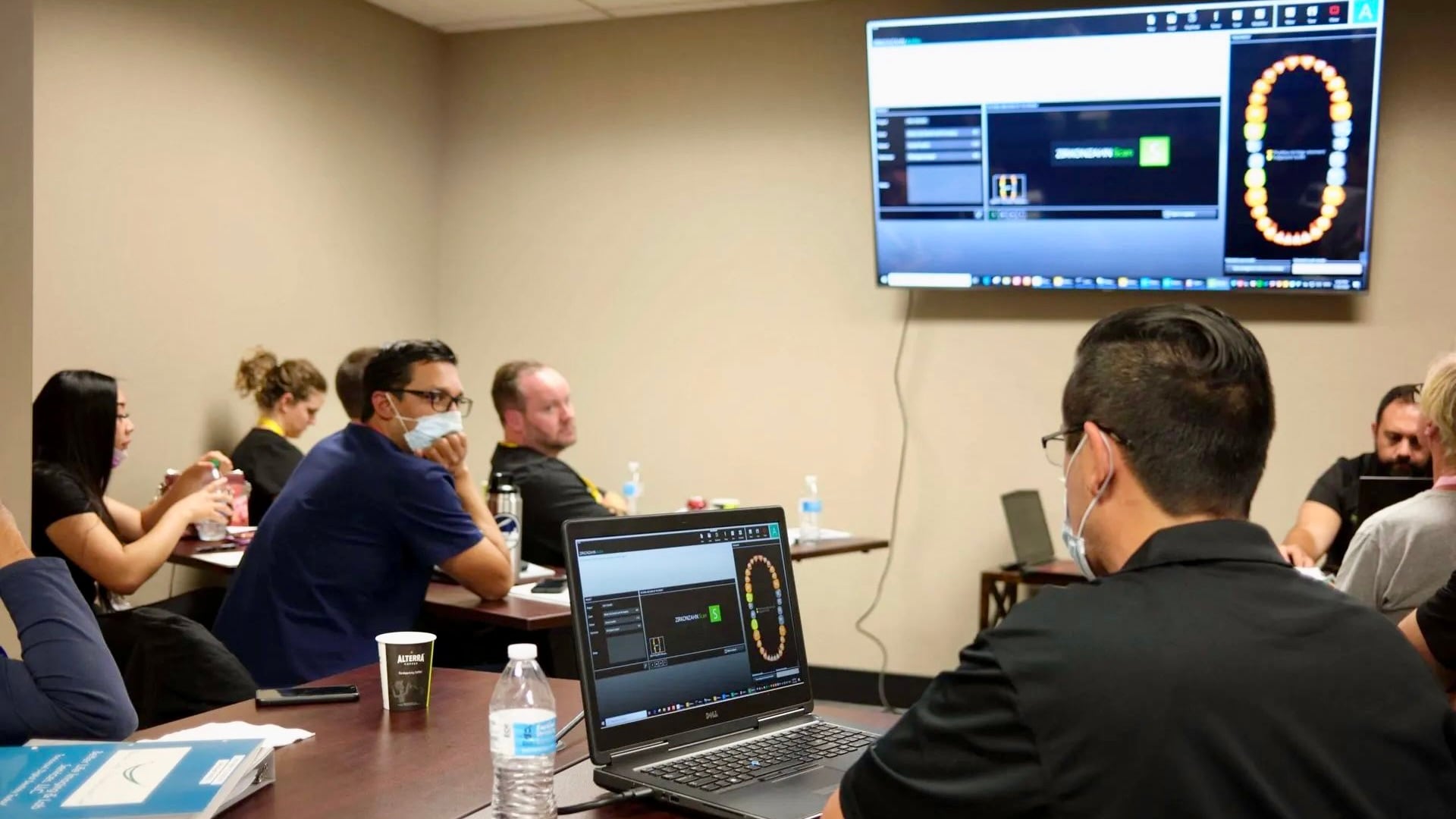
Practice owners typically attend with their treatment coordinator and office manager so the front-office function leaves with a shared playbook. Alumni report adding $1M or more in annual practice revenue after adopting the FAM Method, according to FAM’s alumni outcomes. The Bootcamp connects to FAM’s broader ecosystem, including AGD PACE-approved CE, a digital resource library with TC forms and presentation templates, and access to an ongoing alumni community.
Pricing is transparent. Tuition is $6,995 for the dentist, $900 for a TC attending with the dentist, and $2,000 for a TC attending solo. Practices that want to pair TC training with clinical full-arch education can use the Bootcamp as the fourth-course slot in the FAM Fellowship bundle.
For more context on the TC role in full-arch practices, see Online Dental Implant Treatment Coordinator Course and Treatment Coordinator for Dental Implants: Full-Arch Guide.
Frequently Asked Questions
How Long Does Implant TC Training Take?
Training length depends on the format. Self-paced online programs can be completed in a few hours spread across days or weeks. Live virtual dental coaching programs vary in length. Some, like Dental Wealth Builder’s Associate Success Blueprint, run 12 months with monthly live sessions. Others, such as Monday Morning Dentistry’s 90-Day Clinical Accelerator, run 90 days with weekly live sessions, and still others run 10–12 weeks. Intensive in-person bootcamps usually concentrate learning into two or three days. Full Arch Masters’ Treatment Coordinator Bootcamp runs for two days. The presence of live role-play, scenario practice, and post-course support matters more than duration alone because those elements drive skill transfer.
Can a TC Attend Without the Dentist?
Yes. Full Arch Masters’ Treatment Coordinator Bootcamp accepts TCs attending solo at $2,000. Practice owners who attend with their TC and office manager, however, leave with the entire front-office team aligned on the same closing system. That alignment explains why the dentist pricing of $6,995 and the TC-with-dentist pricing of $900 make team attendance the more economical choice. A TC who returns to a practice where the dentist has not seen the same material may encounter resistance when they try to implement new systems.
Does Training Cover Insurance and Financing?
Implant-specific TC training should cover both topics in depth, while many general front-office courses do not. Insurance literacy for implant cases includes annual maximum limitations, missing-tooth clauses, alternate benefit provisions, and pre-authorization workflows for implant-related CDT codes. Financing literacy includes presenting monthly payment and total cost together, explaining deferred-interest mechanics, running soft-credit-check prequalifications, and recognizing which financing plans carry higher merchant fees. Full Arch Masters’ Treatment Coordinator Bootcamp treats patient financing as a core module and addresses the specific objections that appear with five-figure decisions.
How Do I Know If a Course Is Implant-Specific?
Use three quick checks before enrolling. First, confirm that the curriculum names full-arch, All-on-X, or high-ticket implant consultations instead of burying implant content inside a single module. Second, verify that the course includes role-play or live scenario practice for implant consult situations rather than lecture-only teaching. Third, confirm that the instructor is a working TC who closes implant cases at a real practice instead of a consultant who does not coordinate treatment daily. Programs that cannot answer clearly on all three points usually operate as general courses repackaged for implant practices.
What Continuing Education Credit Does TC Training Provide?
CE credit for TC training varies by provider. Full Arch Masters is an AGD PACE-approved CE provider, and its main courses generally carry 32 CE credits. Dentists should confirm CE eligibility and whether a given format counts as “live” with their state dental board, since requirements differ by state and license type. A completion certificate from a TC training program does not function as a state-recognized professional credential. There is no nationally standardized licensure pathway for dental treatment coordinators.
Conclusion and Next Steps for Your Practice
Choose online dental treatment coordinator training for implant practices by applying a consistent framework. Evaluate implant specificity, case presentation structure, financing and insurance literacy, objection handling, follow-up systems, and post-course support before you commit tuition. Format matters because full-arch consult closing is a live-conversation skill that benefits from role-play and instructor access. The instructor’s real-world experience and the curriculum’s implant focus, however, carry more weight than the delivery channel.
Run a quick internal audit before enrolling in any program. Pull last month’s full-arch consult numbers from your practice management software, calculate your current close rate, and identify where cases fall off. Look at fee presentation, financing conversations, and follow-up. That review will highlight the curriculum elements your TC needs most.
Next step for your practice: enroll your team in Full Arch Masters’ Treatment Coordinator Bootcamp so your staff can close more high-ticket and full-arch cases. https://pci.jotform.com/form/250515014933146