
Written by: Ryan Dunlop, CEO and Founder of Full Arch Masters and graduate from the Harvard School of Dental Medicine
Key Takeaways
- Online dental implant courses build strong theoretical knowledge in implant biology, diagnosis, CBCT interpretation, treatment planning, and prosthetic principles.
- State boards decide CE credit acceptance, so dentists must verify AGD PACE recognition and state online-hour caps before enrolling.
- Free content helps with orientation, while paid, structured modules with accredited CE prepare dentists for live surgical training.
- Blended pathways that pair online theory with supervised live-patient surgery create safe, predictable implant placement skills.
- Full Arch Masters offers a full-arch curriculum, including clinical, digital, lab, and team training, plus alumni mentorship and resources.
See The Full Arch Masters Course Calendar
What Online Dental Implant Courses Actually Teach
The key evaluation framework separates what online education delivers from what requires live surgical training. Online courses cover the cognitive half of implant dentistry, the knowledge a dentist needs before picking up a handpiece.
Online dental implant courses are well-suited to deliver:
- Implant biology and osseointegration principles
- Diagnosis and case selection criteria
- CBCT interpretation and radiographic analysis
- Digital treatment planning concepts
- Prosthetic principles, including FP1, FP2, and FP3 classification
- Complication recognition and risk stratification
- Practice-management fundamentals
Online instruction can explain flap design, osteotomy sequencing, suturing methods, and surgical protocols. Reading or watching those techniques does not create psychomotor competence. A screen cannot reproduce instrument feel or tissue feedback, and surgical skill develops through muscle memory and real clinical repetition.
Online courses also do not confer surgical authorization. State licensure boards govern who may place implants. Hands-on implant training requires dentists to perform the surgical steps themselves, including drilling the osteotomy, placing the implant, and suturing the site, under supervision.
Within this framework, online education builds theory and decision-making, while supervised live surgery builds clinical execution. Full Arch Masters structures its curriculum around that division.
Explore Full Arch Masters Training Options
Can You Learn Implant Surgery Online?
Online courses teach the theory, diagnosis, and treatment planning behind implant surgery, but they do not create surgical competence. Developing the psychomotor skills to place an implant safely requires supervised, hands-on training on live patients.
Current dental-education consensus treats virtual technologies as supervised complements to laboratory teaching, faculty instruction, and authentic clinical or workplace experience. These tools support learning but do not replace real clinical application when the competency involves patient-specific surgery. A 2026 study on implant training with multifunctional surgical guide models showed significantly higher post-test cognitive and practical skill retention than lecture-only groups (p < 0.05), underscoring the role of hands-on work in building competence.
How To Verify CE Credits Count Toward Your State License
State licensing boards control CE acceptance, so dentists cannot rely on course marketing alone. The primary accreditation designation to look for is AGD PACE, which approves CE provider organizations rather than individual courses. Roughly 47 state dental boards accept PACE-approved credits for license renewal, while states such as California and Florida maintain their own separate CE approval systems alongside PACE.
Dentists can protect their license renewal by following this verification sequence before enrolling:
- Confirm the provider holds current AGD PACE recognition, because credits from non-recognized providers often do not transfer across states.
- Check that the credit hours and subject category match your state board’s renewal requirements, so the course fills an actual requirement instead of sitting unused.
- Verify your state board accepts the course format, since many boards cap online CE credits at 50% of total licensure renewal hours and may treat on-demand and live interactive formats differently.
- Keep your completion certificates, because boards such as California require licensees to retain CE certificates for three renewal periods and run random audits monthly.
Full Arch Masters courses carry AGD PACE-approved CE credits, generally 32 credits for its main courses. The Fellowship bundle delivers more than 90 CE hours across the full program. For more on evaluating implant CE programs, see Implant CE Courses: A Dentist’s Guide To Choosing The Right.
How Many CE Credits Do Online Implant Courses Provide?
Online dental implant courses typically provide between 1 and 40 CE credits. Short on-demand lecture series sit at the low end, around 1–2 credits, while comprehensive online modules reach 40 credits.
Single dental implant webinars usually offer 1 to 2 CE credits, with common values such as 1, 1.25, 1.5, 1.75, or 2 credits. Some extended webinars provide 3 or 4 credits. Multi-module on-demand series can provide 10–40 hours of CE, including LimitlessCE’s Mastering Immediate Implants (nine teaching modules, 40 ACE CE credits) and Dentanext Media’s education series with 8–12 modules and 16–24 CE credits.
Dentists should still confirm AGD PACE recognition and state-board acceptance for any course they plan to count toward renewal.
Free Vs. Paid Online Dental Implant Courses
Free online implant content helps dentists explore topics and stay current. Professional associations and manufacturers publish free webinars, articles, and podcasts that cover introductory lectures, sponsored sessions, and broad clinical themes. These resources rarely carry structured CE credit, follow a case-based curriculum, or progress in complexity.
Paid online dental implant courses add structure and accountability. They typically include sequenced modules, accredited CE credit, case-based learning, and sometimes mentorship access. Online dental implant modules typically cost $50–$500 and provide approximately 1–20 CE hours, which positions them as theory and pre-course preparation rather than standalone surgical credentials.
For complex procedures such as implant placement, paid courses that lead into live, hands-on training and mentorship give dentists the confidence to perform what they learn.
Where To Find Free Online Dental Courses
Free online dental CE often appears in a few predictable places. Dentists can start with these sources and then decide when to move into structured paid training.
- Professional association websites such as AGD and specialty societies.
- Dental manufacturer and supplier education platforms.
- University dental school continuing education portals.
- Industry publication websites and webinar libraries.
How Long Is an Implant Course?
Online dental implant courses range from short webinars of about 34 minutes to 2 hours 18 minutes, such as International Implant Institute courses. Multi-module series run much longer, often around 27–32 hours of content.
Blended dental implant training programs that combine online didactic learning with in-person training typically span about 12 months to 2 years, with in-person components lasting from one week to several blocks. Full Arch Masters core courses run four days each, with two-day courses for focused topics such as the FP1 Course and the Treatment Coordinator Bootcamp.
When Online Training Is Enough And When You Need Live Surgery
The right training format depends on a dentist’s current implant experience. Matching course type to experience level keeps learning efficient and safe.
- Never placed an implant: Combine online theory with a foundational hands-on course. Online modules build vocabulary, anatomy, and case logic. In-person training builds muscle memory and clinical judgment.
- Placing a few implants: Use online CE for diagnosis and planning, then add live surgical training to build volume and confidence. The first 50 implant cases represent the highest-risk period in a dentist’s implant career, and supervised training during these cases significantly reduces failure rates.
- Scaling full-arch: Choose a blended curriculum that covers surgery, digital workflow, lab integration, and team systems together.
Online dental implant courses work well for theory, diagnosis, treatment planning, CBCT interpretation, and CE credits. Supervised surgical experience builds the clinical skills that screens cannot provide.
Full Arch Masters focuses on dentists who have reached the limits of online learning and want a complete operating system for full-arch. FAM teaches implementation alongside technique. Its curriculum spans clinical training, digital workflow, laboratory integration, practice growth, and continued community and mentorship.
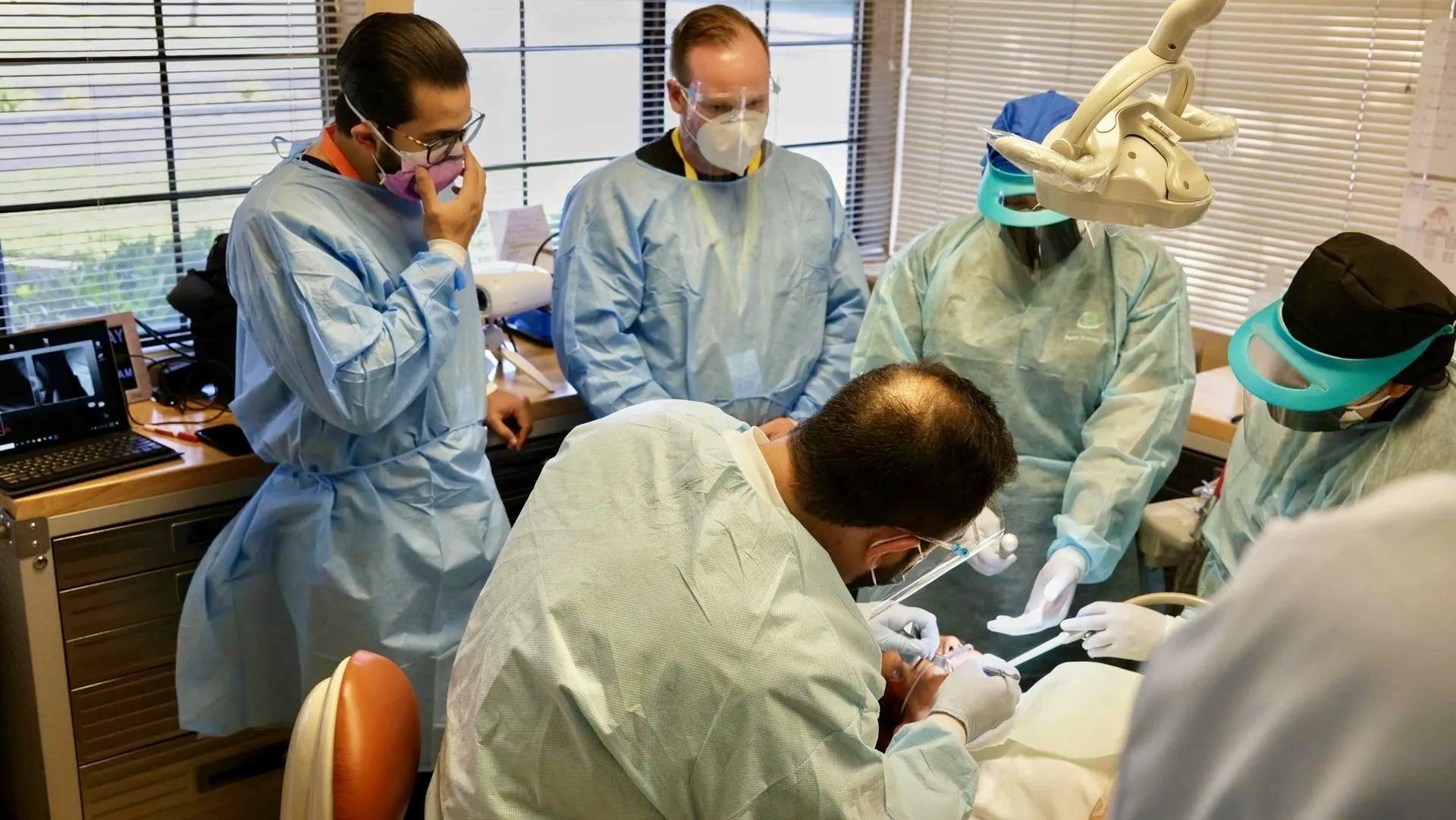
The FAM Method, FAM’s proprietary digital workflow, follows seven integrated steps:
- Preoperative records and data acquisition
- Photogrammetry and intraoral scanning
- CBCT and digital treatment planning
- exocad design
- Immediate-load conversion
- Final zirconia design and finishing
- FP1-specific design, team implementation, and workflow scaling
Within this framework, the Live Surgical Course in Parker, CO turns online theory into surgical competence. Basic and Advanced operators each perform two full arches on live volunteer patients under expert mentor supervision. An Observer track supports dentists who prefer to watch live cases before operating. The Advanced track covers zygomatic, pterygoid, trans-sinus, custom subperiosteal, and palatal-approach techniques for atrophic cases.
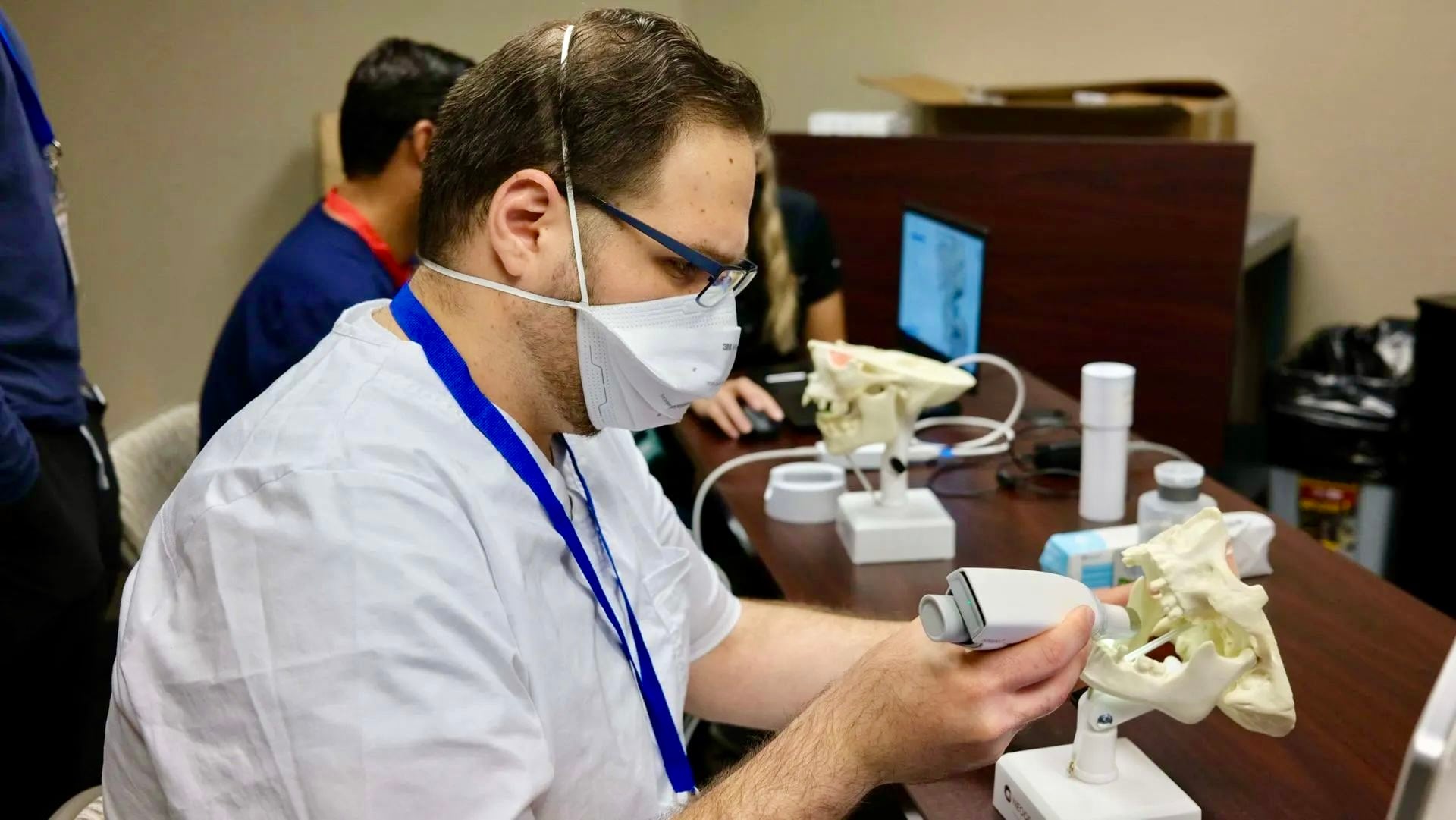
The Flagship Course in Fresno, CA runs four days, is capped at eight dentists per cohort, and covers the complete FAM Method end-to-end. The Design and Finish Course trains lab technicians in digital design and aesthetic finishing. The FP1 Course focuses on the FP1 prosthetic workflow. The Treatment Coordinator Bootcamp trains the practice’s front-office team on the closing system FAM uses in-house, where the in-house treatment coordinator maintains an 80% closing rate.
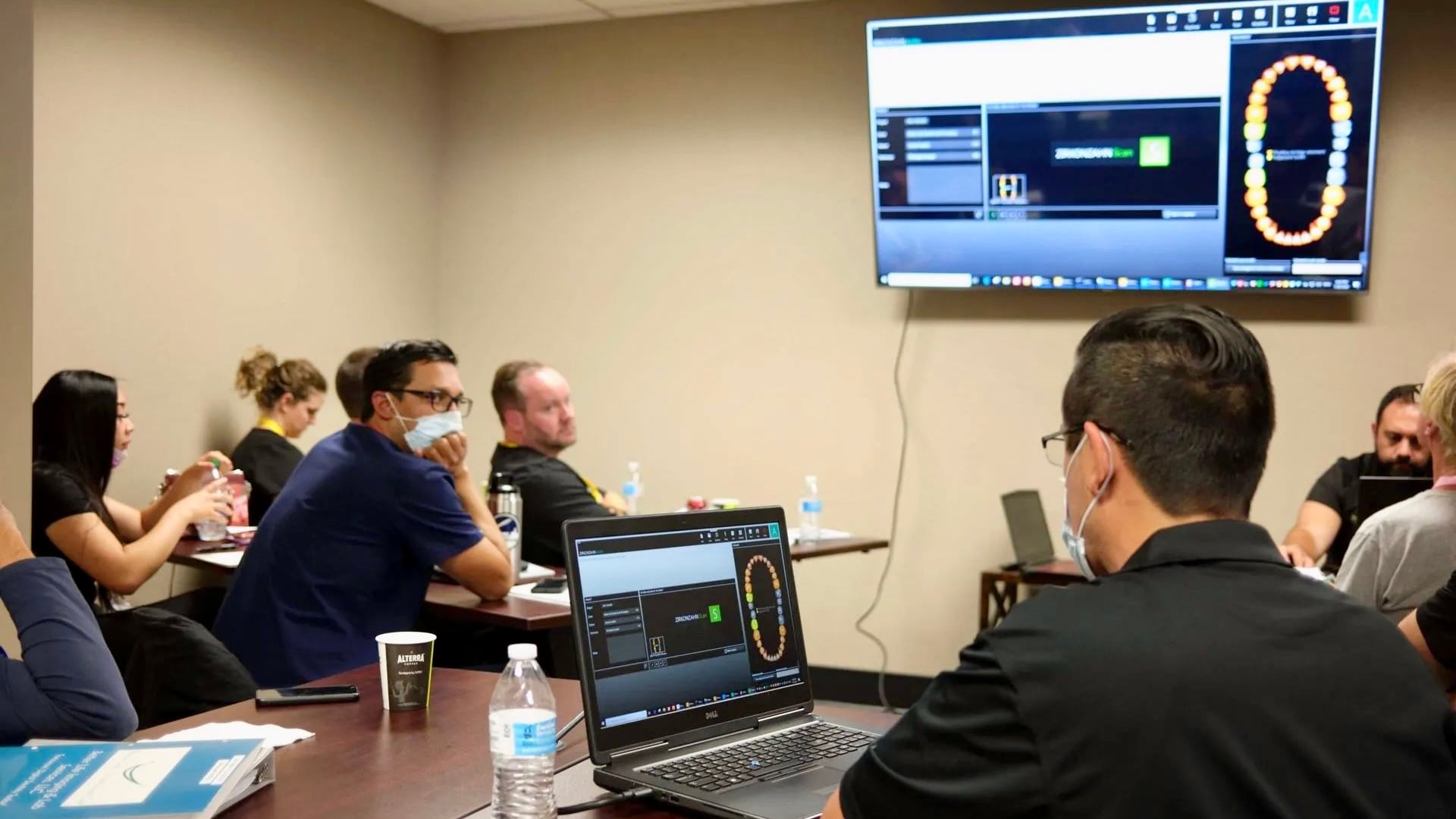
Every FAM alumnus joins a continued community via private group chats, gains access to the KOL (Key Opinion Leader) buying group at no recurring cost, and receives a complete digital resource library. Alumni report adding $1M+ per year in practice revenue after adopting the FAM Method, which reflects FAM’s internal outcome data rather than a peer-reviewed industry statistic. For a detailed breakdown of course investment, see Dental Implant Course Cost: What Dentists Pay in 2026. For more on what live patient training delivers, see Live Patient Dental Implant Course with CE Credits.
Compare Full Arch Masters Course Tracks
University And Institutional Online Implant Programs
University dental schools and institutional CE providers also offer online implant education with structured curricula and accredited CE credit. These programs vary in format, depth, and whether they include any in-person or live-patient component.
When evaluating any university or institutional program, confirm the provider’s AGD PACE recognition status, the total CE hours and subject categories, any prerequisites, and whether the program includes supervised live-patient surgery. A one-hour webinar from a university still builds theory rather than surgical competence.
Common Pitfalls When Choosing A Dental Implant Course Online
Several recurring mistakes affect dentists evaluating online dental implant courses. Addressing these early keeps training aligned with clinical goals.
- Assuming online completion equals surgical competence. Course certificates document attendance and theory. They do not authorize implant placement or verify surgical skill. Treat online education as preparation for live training.
- Skipping CE acceptance checks with the state board. AGD PACE recognition applies to the provider organization, while the state board decides whether those credits count toward license renewal. Verify acceptance before enrolling.
- Relying only on free content with no structured progression. Free webinars and manufacturer videos help with orientation but rarely follow a case-based curriculum or carry accredited CE credit. Use them as supplements within a broader training plan.
- Overlooking the lab and team workflow. Implant dentistry, especially full-arch, depends on a trained team. A dentist who trains alone and returns to an untrained team struggles to implement new systems. Training the full team together turns a course into a repeatable workflow.
- Stopping at theory without scheduling live surgical training. A progressive implant training pathway should move through foundational online didactic modules, hands-on simulation, supervised live-patient placements, and post-course mentorship. Ending after the first stage leaves the most critical steps unfinished.
The correct progression moves from online theory into hands-on simulation and then supervised surgery. Online education performs its role when dentists treat it as the starting point rather than the finish line.
Frequently Asked Questions (FAQ)
Are Online Dental Implant Courses Worth It?
Online dental implant courses work well for building a theoretical foundation and earning CE credits toward license renewal. They efficiently deliver implant biology, diagnosis, CBCT interpretation, treatment planning, prosthetic principles, and complication recognition. The most effective approach uses online education as preparation for supervised live surgical training so in-person time can focus entirely on surgical execution.
Do Online Implant Courses Count Toward My State License?
Acceptance depends on the state board. As noted above, CE rules come from the board, not the provider. Dentists should verify AGD PACE recognition, confirm that the board accepts the course format, and check any caps on online CE hours. Many states cap online CE at 50% of renewal hours, and a few, including California and Florida, run their own approval systems.
What Is The Difference Between An Online Dental Implant Course And A Live Surgical Course?
Online courses teach theory, diagnosis, treatment planning, CBCT interpretation, and prosthetic principles. They can describe surgical technique but do not develop the psychomotor skills required to place an implant safely. Live surgical courses provide supervised, hands-on experience placing implants on real patients under direct faculty oversight, which builds clinical judgment and tissue-handling skill.
How Do I Choose Between Online And Blended Training?
Dentists can start with online training to build a theoretical foundation, then move into blended programs once they feel ready to place implants. A practical sequence uses foundational online modules first, followed by hands-on simulation or workshop training, then supervised live-patient placements, and continued online CE for advanced topics as case volume grows.
How Long Does It Take To Complete An Online Dental Implant Course?
Online dental implant courses range from one-hour webinars, such as a 34-minute socket grafting lesson, to multi-module series like the ITI Curriculum Online, which comprises 32 e-learning modules totaling 15 hours of CPD. Self-paced modules can be completed over days or weeks depending on the dentist’s schedule. Blended programs that combine online didactic with in-person training typically span several months, such as Stevenson Dental Solutions’ six-module Implant Continuum, while other comprehensive programs can run a full year. Full credentialing pathways require hundreds of hours of documented implant-related education, which shows how wide the range is between introductory content and full credentialing.
Conclusion: Turning Online Theory Into Surgical Competence
A dental implant course online gives dentists an efficient way to build theoretical knowledge, earn CE credits, and prepare for supervised surgical training. Online education covers implant biology, diagnosis, CBCT interpretation, treatment planning, prosthetic principles, and complication recognition, while live surgical training provides the supervised, hands-on experience that develops safe, predictable implant placement skills.
Next steps include reviewing state-board CE requirements, confirming accepted formats and providers, auditing current implant skill level, and mapping a path from online theory into supervised live surgical training. For dentists ready to move into a full-arch, team-based, digital workflow with continued community support, Full Arch Masters provides a complete curriculum from the Flagship Course in Fresno, CA through the Live Surgical Course in Parker, CO, along with an alumni community, KOL buying group, and digital resource library.
Plan Your Full Arch Masters Training Path
If your practice is also working to close more full-arch consultations, the Treatment Coordinator Bootcamp trains your front-office team on the same closing system FAM uses in-house.
Train Your Team To Close More Full-Arch Cases