
Written by: Ryan Dunlop, CEO and Founder of Full Arch Masters and graduate from the Harvard School of Dental Medicine
Key Takeaways
- A digital dentistry workflow replaces analog impressions with a digital process from intraoral scanning through CAD, CAM, and finishing.
- Digital dental lab workflow training follows four prerequisite-ordered stages: intake and scanning, CAD design, CAM production, and post-processing and finishing.
- Training out of order wastes money and keeps the finishing gap open, because each stage depends on competency in the one before it.
- In-house clinic staff need records acquisition and scanning training, while full-time lab technicians require design, CAM, and finishing as an integrated skill stack.
- Full Arch Masters delivers workflow-level training that sequences all four stages correctly and closes the finishing gap that most programs leave open.
See the full course schedule and reserve your seat.
Four Stages Of Digital Dental Lab Workflow Training
Digital dental lab workflow training consists of four prerequisite-ordered stages. Each stage builds directly on the one before it, so errors at intake carry through every later stage. A poorly designed restoration also cannot be rescued by good milling or layering. The four stages are:
- Intake And Scanning – the foundation skill: intraoral scanning, photogrammetry, facial scanning, CBCT data acquisition, and records management using hardware such as iTero, TRIOS, Medit, and iCam4D.
- CAD Design – competency before production: digital mockups, surgical alignment devices, immediate-load prosthetic design, and final zirconia design in exocad DentalCAD or 3Shape Dental System.
- CAM Production – milling, printing, and nesting: file orientation, support placement, nesting, and material selection across PMMA, zirconia, PEEK, and metallic frameworks, using hardware such as Asiga, Formlabs, Envisiontec, and DentaFab Sega Pro.
- Post-Processing And Finishing – the undertrained gap: green-stage contouring, pre-sintered and post-sintered zirconia finishing, and MIYO ceramic layering.
These stages form a prerequisite-ordered skill stack. Industry practitioners consistently recommend validating one complete workflow before expanding to additional applications, which means CAM nesting becomes productive only after CAD design competency is established.
Stage 1: Intake And Scanning As The Foundation Skill
Intake and scanning covers intraoral scanning, photogrammetry, facial scanning, CBCT data acquisition, and records management. This stage comes first because every downstream decision in design, nesting, and finishing depends on the quality of the data captured here. A bad scan produces a bad model, and a bad model produces a bad restoration.
When this stage is skipped or rushed, the consequences compound. A 2026 University of Otago study found that 42% of dental technicians identified the type of margin as the detail most commonly missing from fixed prosthesis prescriptions, and 33% of technicians often had to contact dentists for more information because prescriptions were incomplete. Poor intake is a records problem that no amount of CAD skill can fix.
Primary hardware at this stage includes iTero, TRIOS, and Medit intraoral scanners, plus photogrammetry systems such as iCam4D for full-arch implant cases where scan accuracy is critical. The training route for this stage is hands-on records acquisition on live patients, because scanner tutorials teach the interface but not the judgment required to capture a usable full-arch scan. In-house clinic staff need this stage most, because they are the ones capturing records chairside. For more on the photogrammetry component of this stage, see Full Arch Masters’ photogrammetry course overview for lab technicians.
Stage 2: CAD Design For Predictable Restorations
CAD design covers digital mockups, surgical alignment devices, immediate-load prosthetic design, and final zirconia design. The two primary platforms are exocad DentalCAD and 3Shape Dental System. CAD design in a digital dental lab covers margin identification, contacts, occlusion, emergence profiles, implant positioning, and support structures.
Design competency must precede CAM and finishing because a weak design flows directly into every later step. Only 54% of CAD/CAM-using dentists felt their training was sufficient, and lack of sufficient training was cited as a barrier by 35% of non-users. That same gap appears for lab technicians who receive piecemeal software instruction instead of workflow-level training.
Software certification often becomes the focus at this stage. A technician who completes exocad DentalCAD or 3Shape Dental System certification learns the features of that platform, yet they still need clinical judgment, case intake interpretation, and finishing integration to become productive in a full-arch lab. For a deeper look at digital dentistry training options for lab technicians, see Full Arch Masters’ overview of digital dentistry courses for dental lab technicians.
Stage 3: CAM Production For Milling, Printing, And Nesting
CAM production covers nesting, milling, 3D printing of immediate-load conversions, and material selection across PMMA, zirconia, PEEK, and metallic frameworks. Primary hardware includes Asiga, Formlabs, Envisiontec, and DentaFab Sega Pro printers, alongside milling units for zirconia and metal frameworks.
This stage depends entirely on design competency. Industry practitioners recommend bringing on a mill or printer as the last step in the digital journey, after scanning and design workflows are established. When technicians train on CAM before CAD, they learn to operate machines without the judgment to evaluate what those machines are producing. The result is a high remake rate and no diagnostic framework for identifying where the error originated.
The training route for this stage is hands-on production work with real materials, not software simulation. The 2024 NADL survey found that 68% of dental labs already used 3D printers, and 39% said more than half their cases now start from intraoral scans, up from 12% in 2019, which means CAM competency now sits at the core of a modern lab technician’s role.
Stage 4: Post-Processing And Finishing As The Undertrained Gap
Post-processing and finishing covers green-stage contouring, pre-sintered and post-sintered zirconia finishing, and MIYO ceramic layering. This stage remains the most undertrained part of digital dental lab workflow training.
Most digital training stops at design, yet finishing quality often determines whether a dentist keeps sending cases. The 2026 University of Otago study concluded that digital capability should be treated as an integrated workflow skill rather than isolated software or equipment operation, and finishing is the stage where that integration becomes most visible to the dentist.
Zirconia finishing requires specific material knowledge. Post-processing in a digital dental lab typically includes five steps: washing in a specified solvent, UV post-curing, support removal and finishing, dimensional inspection and fit checks, and review against the original prescription. For zirconia, the sintering cycle, temperature hold, and controlled cooling all affect final shade, fit, and strength. MIYO ceramic layering adds an additional aesthetic dimension that requires hands-on practice with real materials, which technicians cannot gain from a tutorial alone.
The training route for this stage is hands-on finishing on pre-sintered and post-sintered zirconia with real materials. For a full overview of the lab technician’s role in the full-arch workflow, see Full Arch Masters’ guide to the full arch digital workflow for dental lab technicians.
Clinic Staff And Lab Technicians: Two Aligned Training Paths
Clinic staff and full-time lab technicians follow different training paths that meet at handoff. This alignment keeps the entire full-arch workflow predictable.
In-house clinic staff such as lead assistants, treatment coordinators, and practice owners operating chairside scanners need records acquisition, scanning, photogrammetry, and clean handoff training. Their primary responsibility is Stage 1: capturing complete, accurate data and transmitting it to the lab side without errors. In a hybrid workflow, the clinic’s role is limited to intraoral scanning and seating, while the laboratory handles design and fabrication. Clinic staff benefit most from workflow-level training on records acquisition so the lab receives usable data every time.
Full-time lab technicians need design, CAM, and finishing as an integrated skill stack, which means both design and finishing competency. Dental technicians adopted CAD/CAM more extensively than dentists: 71% used it for most restorations, and 83% had begun using CAD/CAM within the previous decade. Any gap in design or finishing shows up in every full-arch case they touch.
The two paths intersect at handoff. When clinic staff and lab technicians train together, the clinical and lab sides arrive home aligned on one workflow. This alignment is the operational argument for team-based training. For more on building that alignment in an in-house lab context, see Full Arch Masters’ guide to in-house dental lab training.
Manufacturer Academies And Workflow-Level Training Programs
Manufacturer academies teach the software tool. A technician who completes exocad DentalCAD or 3Shape Dental System certification learns the features of that platform, including margin detection, tooth libraries, occlusal analysis, and contact adjustment. They still need training that connects scanning, photogrammetry, design, production, and finishing into a single repeatable system.
The table below shows why the two options are not interchangeable: certification covers one tool, while workflow-level training covers all four stages in order, aligns the whole team, and continues after the course ends.
| Attribute | Manufacturer Software Certification | Workflow-Level Training Program |
|---|---|---|
| Scope | Single software tool (exocad or 3Shape) | All four workflow stages: intake/scanning, CAD, CAM, finishing |
| Prerequisite Order | Not addressed | Prerequisite-ordered skill stack |
| Team Alignment | Individual training | One team, one workflow |
| Post-Course Support | Limited or none | Continued alumni community and case support |
A workflow-level program adds prerequisite-ordered training across all four stages, team alignment, and ongoing case support. The most common learning routes for CAD/CAM were self-teaching or peer instruction (67%) and manufacturer training (60%), yet only 54% of CAD/CAM users considered their training sufficient, which highlights the gap between tool instruction and workflow competency.
Training Timelines For Digital Lab Workflow Competency
Training timelines depend on prior experience. A technician strong in design but weak in finishing, or the reverse, typically needs focused training to reach competency in the undertrained area. A realistic first phase of digital transition, getting comfortable with scanning, CAD design, and model printing, typically takes three to six months, with most labs reaching a fully functional digital workflow within one to two years of their first equipment purchase.
Software certification can be completed quickly, while workflow competency takes longer because it requires repetition on real cases. Learning a new design software or printing workflow takes weeks of practice before a user reaches a competent, repeatable pace, and failed prints and remakes are part of the tuition, not an occasional accident. The fastest path to workflow competency is a structured program that sequences the stages correctly instead of piecemeal courses taken in whatever order is available.
Why Full Arch Masters Leads Digital Dental Lab Workflow Training
Because workflow competency depends on sequencing the four stages correctly, the training program a technician chooses matters more than the hours they log. Full Arch Masters (FAM) is built around exactly that sequence.
FAM teaches the FAM Method as a single integrated system. Its seven steps are the granular version of the four stages above: preoperative records and data acquisition, photogrammetry and intraoral scanning, and CBCT and digital treatment planning all belong to Stage 1; exocad design is Stage 2; immediate-load conversion is Stage 3; and final zirconia design and finishing plus FP1-specific design and workflow scaling are Stage 4.
- Preoperative records and data acquisition
- Photogrammetry and intraoral scanning
- CBCT and digital treatment planning
- exocad design
- Immediate-load conversion
- Final zirconia design and finishing
- FP1-specific design and team implementation with workflow scaling
FAM shares the full recipe. Every course teaches the entire system as a connected workflow.
The Design And Finish Course runs four days in Fresno, CA. Two days focus on digital design in exocad, and two days focus on aesthetic finishing on pre-sintered and post-sintered zirconia with MIYO ceramic layering. FAM separates beginners from advanced designers so each track is calibrated to skill level. This course directly addresses the finishing gap that most digital training programs leave open.
The FP1 Course runs two days in Fresno, CA and focuses on the FP1 prosthetic workflow, with lab technicians pulled aside for FP1-specific design instruction that differs meaningfully from FP2 and FP3 workflows.
The Flagship Course runs four days in Fresno, CA, capped at eight dentists per cohort, and is built for the full team, including dentist, lead assistant, in-house lab technician, and treatment coordinator. The goal is for the clinical and lab sides to arrive home aligned on one workflow.
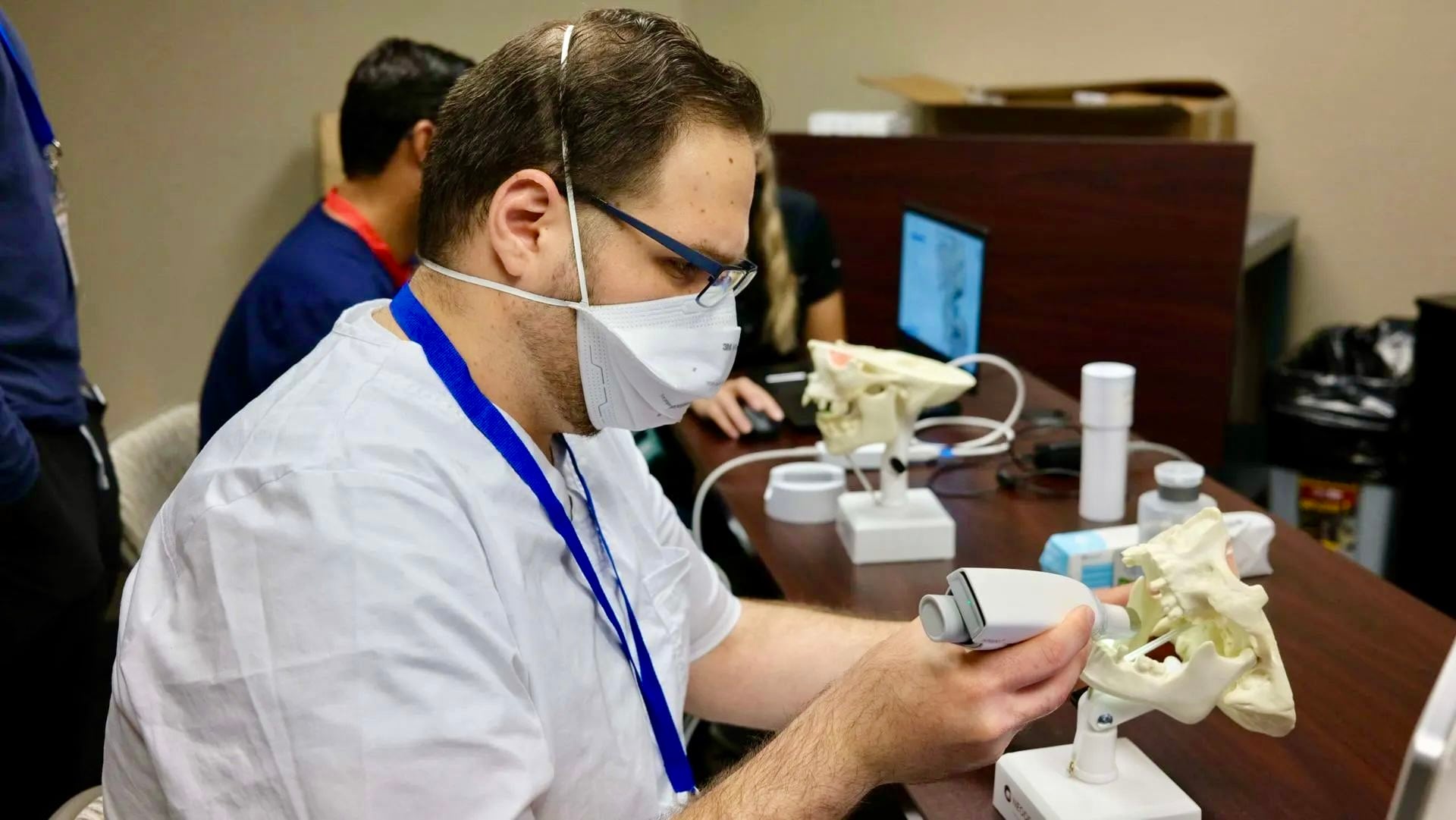
FAM courses carry 32 continuing education credits through AGD PACE. AGD PACE approves CE provider organizations, not individual programs. Every alumnus joins a continued alumni community with private group chats that include hundreds of FAM-trained dentists, lab technicians, and team members for case help on demand. Alumni also gain access to FAM’s KOL buying group, which offers vendor discounts on Neodent implants, exocad licenses, 3D printers, and other equipment at no recurring cost. Alumni report adding $1M or more per year in practice revenue after adopting the FAM Method, and the FAM Method delivers same-day teeth in 2 to 4 hours.
Explore the Design and Finish Course.
Career Outlook For Technicians With Digital Lab Training
The U.S. Bureau of Labor Statistics projects a 6% decline in dental laboratory technician employment from 2025 to 2035, attributing the decline specifically to 3D printing and other labor-saving technologies. Despite that projection, approximately 7,100 openings per year are still expected, driven primarily by replacement demand as technicians retire.
Digital skills expand a lab technician’s scope and make them more valuable to practices moving to fully digital workflows. Technicians who combine CAD/CAM fluency with clinical judgment, materials expertise, finishing skills, and dentist-facing communication are better positioned than workers trained only for repetitive manual or entry-level design tasks. The most automation-resistant areas, including anterior esthetics, shade interpretation, full-arch cases, and occlusal troubleshooting, are precisely the skills that workflow-level training programs develop. A technician who completes the full four-stage training sequence supervises automation rather than competing with it.
Frequently Asked Questions
What Is A Digital Dentistry Workflow?
A digital dentistry workflow is the end-to-end digital process from intraoral scanning and photogrammetry through CAD design, CAM production, and aesthetic finishing that replaces analog impressions and physical lab work. It integrates hardware such as intraoral scanners, CBCT imaging, and 3D printers with software platforms such as exocad DentalCAD and 3Shape Dental System into a single repeatable system.
What Are The Stages Of Digital Dental Lab Workflow Training?
The four stages described above form a prerequisite-ordered stack. Each stage depends on the one before it, so intake and scanning support CAD design, which then supports CAM production and post-processing and finishing.
How Long Does It Take To Train A Lab Technician On Digital Workflow?
Timelines vary by prior experience. A technician strong in one area, such as design or finishing, typically needs focused training to reach competency in the other. A realistic first phase of digital transition takes three to six months, with most labs reaching a fully functional digital workflow within one to two years. Software certification can be completed quickly, while workflow competency takes longer because it requires repetition on real cases. A structured program that sequences the stages correctly shortens the path.
Do You Need Certification To Design In exocad Or 3Shape?
Software certification is optional for design work. exocad DentalCAD and 3Shape Dental System certification programs document feature familiarity, including margin detection, tooth libraries, and occlusal analysis, but they do not address the clinical judgment, case intake interpretation, prerequisite sequencing, or finishing integration that make a technician productive in a full-arch lab.
In-House Clinic Staff Vs. Full-Time Lab Technician: Two Different Training Paths?
In-house clinic staff need records acquisition, scanning, photogrammetry, and clean handoff training, because their primary responsibility is capturing complete, accurate data and transmitting it to the lab side without errors. Full-time lab technicians need design, CAM, and finishing as an integrated skill stack, including both design and finishing competency. When both groups train together, the clinical and lab sides arrive home aligned on one workflow.
Manufacturer Academy Vs. Workflow Training Program: What Is The Difference?
Manufacturer academies teach the software tool. Workflow-level programs teach prerequisite-ordered training across all four stages, along with team alignment and ongoing case support. The most common learning routes for CAD/CAM are self-teaching and manufacturer training, yet only about half of users consider their training sufficient, which reflects the gap between tool instruction and workflow competency.
Why Is Aesthetic Finishing The Most Undertrained Stage?
Most digital training ends at design and rarely includes structured practice in zirconia finishing or MIYO layering. Technicians therefore miss hands-on experience with the material and color decisions that determine whether a restoration is merely acceptable or truly referral-worthy. Because few programs cover this work on real cases, finishing remains the largest skill gap in the market.
How Does Full Arch Masters’ Design And Finish Course Fit Into A Lab Technician’s Training Path?
The Design and Finish Course runs four days, with two days of digital design in exocad and two days of aesthetic finishing on pre-sintered and post-sintered zirconia with MIYO ceramic layering. FAM surveys attendees in advance about their design and finishing experience and separates beginners from advanced designers so each track runs at the right level. The course directly addresses the finishing gap and gives lab technicians a structured foundation in both design and finishing.
Conclusion And Next Steps For Digital Lab Training
Digital dental lab workflow training follows a four-stage, prerequisite-ordered skill stack that includes intake and scanning, CAD design, CAM production, and post-processing and finishing. Training out of order wastes money and keeps the finishing gap open, because each stage depends on competency in the one before it.
In-house clinic staff and full-time lab technicians follow different training paths. Clinic staff need records acquisition, scanning, and clean handoff training. Lab technicians need design, CAM, and finishing as an integrated skill stack. When both groups train together, the clinical and lab sides align on one workflow from day one.
Next steps are concrete. Assess current team skills against the four stages, identify any finishing gap, and choose a workflow-level training program that sequences the stages correctly. For lab technicians, the Design and Finish Course at Full Arch Masters is a natural starting point. For full teams, including dentist, lead assistant, in-house lab technician, and treatment coordinator, the Flagship Course delivers the complete FAM Method in four days, capped at eight dentists per cohort, so every attendee leaves aligned on one workflow.
Start with the course that fits your team.
Closing Call-To-Action
One more step worth considering: for dental teams ready to close more high-ticket and full-arch cases, the Full Arch Masters Treatment Coordinator Bootcamp trains the front-office team on the same closing system FAM uses in-house, where the in-house treatment coordinator maintains an 80% closing rate.
Register for the Treatment Coordinator Bootcamp