
Written by: Ryan Dunlop, CEO and Founder of Full Arch Masters and graduate from the Harvard School of Dental Medicine
Key Takeaways
- A photogrammetry implant workflow course must teach the full chain from preoperative records through final zirconia delivery.
- System compatibility matters because training on hardware and software the practice owns or can acquire prevents translation problems.
- Hands-on format shapes outcomes: live-patient surgical training builds judgment, while CAD/CAM workstation training builds design skill.
- Post-course support through an alumni community, buying group access, and digital resources drives long-term practice growth.
- Full Arch Masters delivers end-to-end photogrammetry training across five role-specific courses with ongoing alumni support and vendor discounts.
Explore the Full Arch Masters course catalog.
How To Choose a Photogrammetry Implant Workflow Course
Eight criteria separate a course that changes a practice from one that only produces a certificate.
- Confirm the course teaches on your photogrammetry system or a compatible one so protocols and exports transfer to your operatory.
- Confirm whether hands-on access is live-patient, workstation, or observation only, since format determines which skill gap the course can close.
- Check whether the curriculum covers the full workflow from preoperative records to final delivery so you avoid partial implementation.
- Check whether the business side, including marketing, treatment coordination, and closing, appears in the agenda.
- Check whether the whole team can attend so clinical, lab, and front office leave aligned on one workflow.
- Check what post-course support exists after the last day, including mentorship, community, and resource access.
- Check CE accreditation and credit volume to keep licensure and professional goals on track.
- Check total cost including travel and materials so you can compare programs on a true investment basis.
For a deeper look at how to apply these criteria across the full implant CE landscape, see Implant CE Courses: How to Choose Training That Scales.
Photogrammetry System Compatibility and Workflow Fit
The primary intraoral photogrammetry (IPG) system for training is the Aoralscan Elite (SHINING 3D Dental), which combines intraoral scanning with photogrammetry. iCam4D (Imetric) and PIC are extraoral photogrammetry (EPG) systems, not intraoral photogrammetry systems. System compatibility comes first because a course taught on a system the reader does not own creates a translation problem when they return to their practice.
Protocols, scan body geometry, software export formats, and calibration procedures differ between systems. The key differences between dental photogrammetry systems lie in workflow design and long-term predictability rather than simple capture use. Scan body materials, camera design, calibration protocols, and workflow integration all affect long-term prosthetic fit.
Full Arch Masters teaches a photogrammetry-first workflow using the iCam4D/iMetric system sourced through its Neodent partnership. iCam photogrammetry systems run 60,800 calculations per measurement. The multi-camera acquisition approach minimizes stitching distortion and reduces workflow variability in complex full-arch implant cases. FAM is also a certified exocad reseller for DentalCAD, exoplan, and ChairsideCAD. The design side of the workflow is taught on the same software alumni can license directly through FAM at preferred pricing, which removes translation problems on the software side.
When evaluating any intraoral photogrammetry training program, confirm that the system taught matches what the practice owns or plans to purchase. Photogrammetry for dental implants can raise the ceiling of what is possible, but only when it is selected thoughtfully, validated rigorously, and used in the service of long-term biologic and restorative success rather than short-term efficiency. A course that teaches on a system the practice cannot realistically acquire produces knowledge that cannot be applied on day one.
For a full breakdown of how photogrammetry integrates into the FAM digital workflow, see Photogrammetry Full Arch Digital Implant Workflow Training and How To Implement a Photogrammetry-First Full-Arch Workflow.
Choosing Between Live-Patient, Workstation, and On-Demand Formats
Format determines which gap a course can close for a practice. Three formats dominate the market, and each carries distinct tradeoffs.
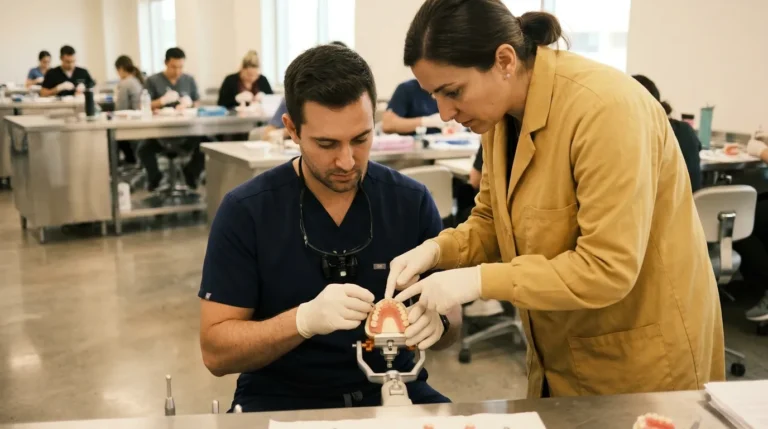
Live-patient training gives the closest analog to running cases independently. The operator works on a real patient under expert supervision, encounters real tissue, and builds the surgical judgment that model work cannot replicate. The first 50 implant cases are the highest-risk period in a dentist's implant career, and supervised training during these cases significantly reduces failure rates and builds the surgical judgment that carries through the next 500 cases. Regulatory constraints limit this format. Most U.S. states do not allow visiting out-of-state dentists to perform surgery on volunteer patients in a CE context.
Colorado is one of the few states where visiting U.S.-licensed dentists can operate on volunteer patients. Full Arch Masters hosts its Live Surgical Course in Parker, CO under Colorado Dental Board credentialing submitted ten days before each session. Each Basic and Advanced operator performs two full-arch cases across the two surgical days. CRNAs provide general anesthesia onsite, and FAM surgical mentors remain present throughout.
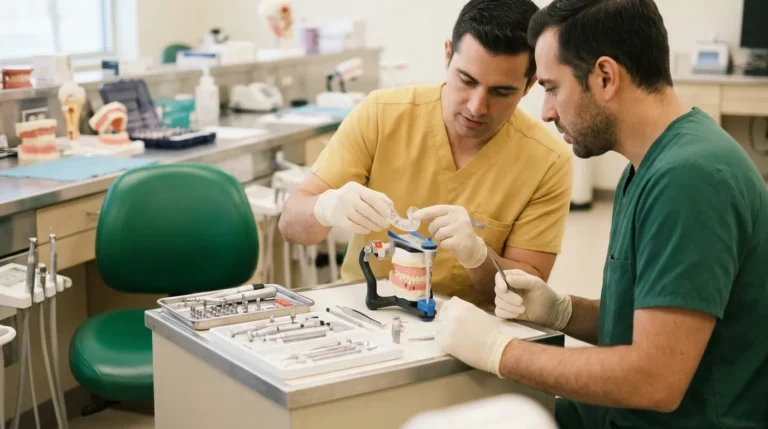
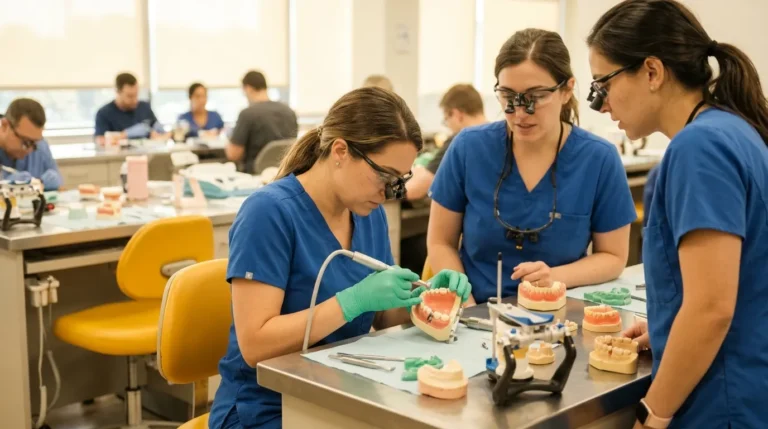
CAD/CAM workstation training builds design and finishing skill, including exocad proficiency, immediate-load prosthetic design, and zirconia finishing. It does not build surgical confidence. This format fits lab technicians and dentists who already operate at volume and need to close a design gap rather than a surgical one.
On-demand training offers convenience but no hands-on access and no live case feedback. Online CE is consistently rated lower than in-person training for developing psychomotor surgical skills. On-demand modules work well for foundational orientation or workflow review, not for building the competency to run full-arch cases independently.
Match format to the gap being closed. A dentist who has never placed a full arch needs live-patient surgical exposure. A lab technician who needs to bring design work in-house needs workstation time in exocad. A dentist who already places at volume but loses cases at the design or finishing stage benefits most from a lab-focused course.
Why Full Arch Masters Fits Full-Arch Photogrammetry Training
Full Arch Masters began running trainings in 2018 and was officially established as Full Arch Masters in 2019, operating from Fresno, CA. The team teaches the FAM Method, an end-to-end integrated workflow that takes a patient from no teeth or heavily decayed teeth to a screwed-in, same-day restoration in 2 to 4 hours. Alumni report adding $1M+ per year in practice revenue after adopting the workflow.
The FAM Method is a single repeatable system that integrates intraoral scanning, photogrammetry via its iCam4D/Imetric partner, facial scanning, CBCT imaging, exocad design, 3D-printed immediate-load conversion, and same-day final delivery into one workflow.
The five-course catalog addresses every role and every gap in the full-arch workflow.
- Flagship Course — Four days in Fresno, CA. End-to-end FAM Method including surgery, immediate load, final restoration, marketing, treatment coordination, and team delegation. Capped at eight dentists per cohort. $9,995 per dentist, $2,500 per additional team member.
- Live Surgical Course — Four days in Parker, CO. Basic Operator track for fewer than 200 career arches. Advanced Operator track for 200+ career arches, focused on zygomatic, pterygoid, trans-sinus, custom subperiosteal, and palatal-approach techniques. Observer track available. Each operator performs two full-arch cases on live volunteer patients under expert mentor supervision. $20,000 Basic, $25,000 Advanced, $4,995 Observer.
- Design and Finish Course — Four days in Fresno, CA. Two days of exocad digital design and two days of aesthetic finishing on pre-sintered and post-sintered zirconia with MIYO ceramic layering. Built for lab technicians. $6,995.
- FP1 Course — Two days in Fresno, CA. FP1-specific workflow covering case selection, root banking, surgical approach, and lab design. Lab technicians receive FP1-specific design instruction. $7,995 dentist, $4,995 associate, $1,495 assistant or technician.
- Treatment Coordinator Bootcamp — Two days. Taught by FAM's in-house treatment coordinator, who maintains an 80% closing rate. Covers sales process, objection-handling, patient financing, and pipeline nurture. $6,995 dentist, $900 TC with dentist, $2,000 TC solo.
The Fellowship bundle combines the three core courses plus a fourth course of the practice's choice at a $5,000–$10,000 discount versus individual pricing. Practices can use a payment plan of up to 9–12 months.
Every attendee joins a continued alumni community of hundreds of FAM-trained dentists, lab technicians, and team members via private group chats. The dentist-only chat supports sensitive practice and personnel questions. The main multi-role chat supports clinical and operational case help. Every attendee also gains access to FAM's KOL (Key Opinion Leader) buying group, which delivers vendor discounts on Neodent implants, exocad licenses, 3D printers, and other equipment at no recurring cost. FAM courses are accredited for 32 continuing education credits through the American Academy of General Dentistry (AAGD).
See upcoming Full Arch Masters dates.
Training Format Comparison at a Glance
With the FAM catalog laid out, the table below compares Full Arch Masters courses with common training formats so dentists can see focus, format, and audience side by side.
| Option | Primary Focus | Format | Who It's For |
|---|---|---|---|
| Full Arch Masters — Flagship | End-to-end FAM Method | 4-day hands-on, live observation, Fresno CA | Dentists and full teams |
| Full Arch Masters — Live Surgical | Hands-on surgical operating | 4-day live-patient, Parker CO | Dentists seeking surgical confidence |
| Full Arch Masters — Design and Finish | exocad design and aesthetic finishing | 4-day lab-focused, Fresno CA | Lab technicians |
| Full Arch Masters — FP1 | FP1-specific workflow | 2-day lecture and lab, Fresno CA | Dentists and lab technicians |
| Full Arch Masters — TC Bootcamp | Treatment coordination and closing | 2-day role-play and scenarios | Treatment coordinators |
| Brand-Owned Implant Manufacturer Courses | Product-specific training | Modular, online or regional | Dentists using that brand |
| Live-Patient Surgical Training Institutes | General surgical technique | Live-patient, multi-day | Dentists seeking hands-on surgery |
| On-Demand Digital Workflow Modules | Workflow overview | On-demand | Dentists exploring digital workflows |
Role-Based Course Recommendations
Dentists should start with the Flagship Course for the complete FAM Method, from preoperative records through final delivery, plus marketing, treatment coordination, and team delegation. Dentists who want hands-on surgical operating should follow with the Live Surgical Basic track for fewer than 200 career arches or the Advanced track for 200+ arches with zygomatic and pterygoid techniques. Dentists looking to add a higher-margin prosthetic option should add the FP1 Course.
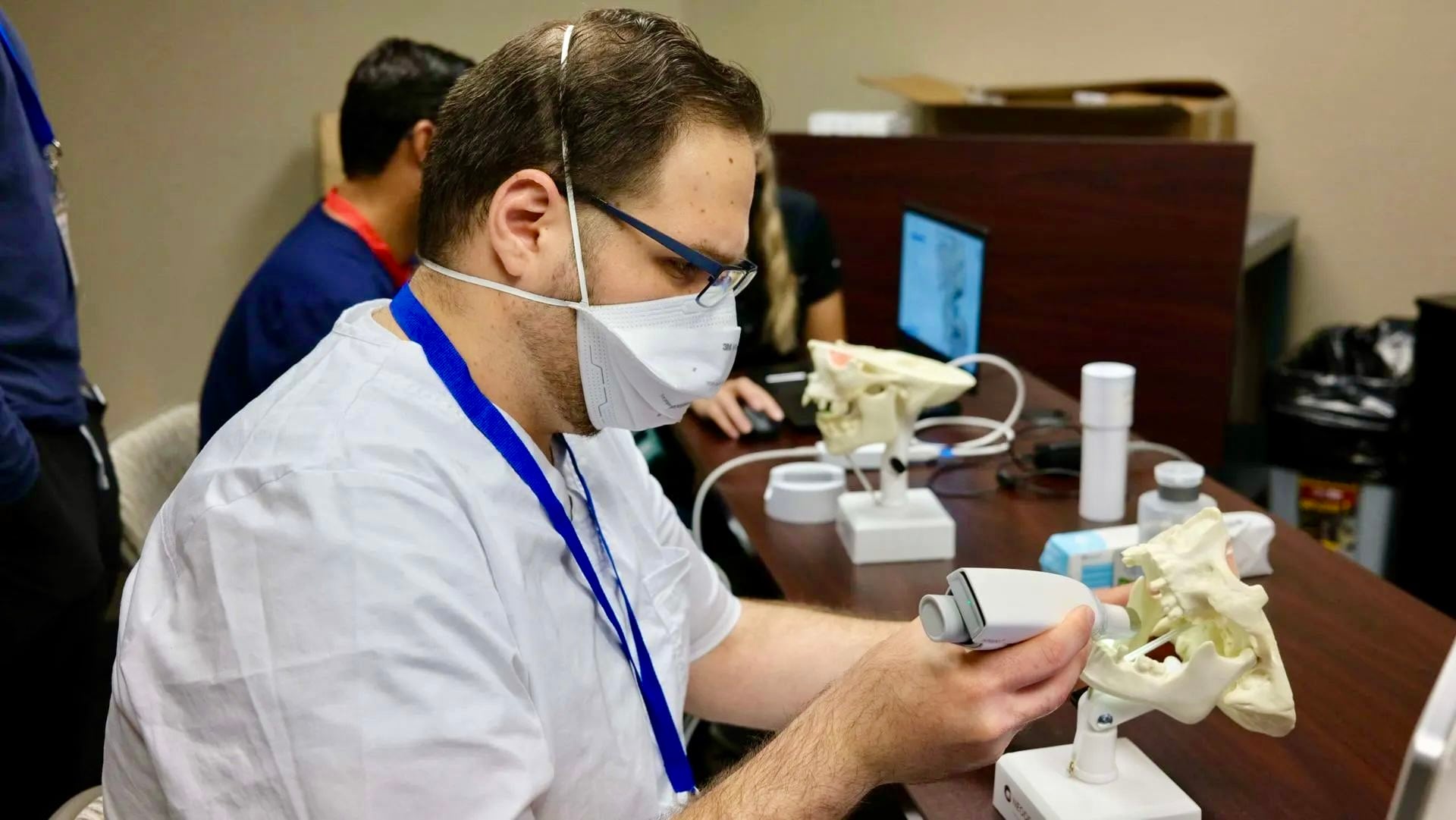
Lab technicians should start with the Design and Finish Course for exocad design and aesthetic finishing on zirconia. The FP1 Course adds FP1-specific design instruction that differs meaningfully from FP2 and FP3 workflows. In-house lab technicians who support a FAM-trained dentist should also attend the Flagship Course alongside that dentist so the clinical and lab sides leave aligned on the same workflow. For a dedicated lab-focused breakdown, see Photogrammetry Course for Dental Lab Technicians.
Treatment coordinators should attend the Treatment Coordinator Bootcamp described above, which covers the full sales process through role-play and live patient scenarios. Practice owners typically attend alongside their TC so the entire front-office function leaves on the same playbook.
What Happens After the Course Ends
The most common failure mode in implant training appears after the course ends. Dentists return to their practice with no peer network and no one to call when a difficult case lands on the schedule. Mentorship after a course ends is where most implant training programs fall short, and community and long-term support separate dentists who successfully integrate implant services from those who complete training and never place a case.
At Full Arch Masters, post-course support is structural. Every attendee joins continued private group chats. The dentist-only chat handles sensitive practice and personnel questions. The main multi-role chat spans dentists, assistants, technicians, and team members. Hundreds of FAM-trained alumni respond on case questions, equipment troubleshooting, and clinical edge cases.
Alumni also retain KOL buying group access at no recurring cost and receive the full digital resource library covering surgical room setup checklists, finishing techniques, treatment coordinator forms, consent templates, and Dr. Dunlop's lecture materials. This continued community stays active long after the course ends. A dentist asking a case question on a Tuesday morning gets answers from peers in similar markets working through similar cases.
Frequently Asked Questions
Do I Need a Specific Photogrammetry System To Take a Course?
System compatibility matters significantly. A course taught on a system a dentist does not own creates a translation problem when they return to their practice because scan body protocols, calibration procedures, software export formats, and integration steps differ between systems. Confirm the course teaches on the practice's system or a compatible one before enrolling. Full Arch Masters teaches on the iCam4D/iMetric system and is a certified exocad reseller, so both the capture and design sides of the workflow are taught on software and hardware alumni can license and purchase directly through FAM.
Hands-On Live-Patient vs. CAD/CAM Workstation: Which Format Fits?
The right format depends on the gap the dentist or lab technician needs to close. Live-patient training builds surgical confidence and judgment that model work cannot replicate, but state dental board rules limit where visiting dentists can operate on volunteer patients in a CE context. Colorado is one of the few exceptions, which is why Full Arch Masters hosts its Live Surgical Course in Parker, CO under Colorado Dental Board credentialing.
CAD/CAM workstation training builds design and finishing skill in exocad and on zirconia but does not build surgical confidence. A dentist who has never placed a full arch needs live-patient exposure. A lab technician who needs to bring design work in-house needs workstation time. Match format to the specific gap rather than to convenience.
Should My Lab Tech Attend the Same Course as Me?
The team approach sits at the center of the pedagogy at Full Arch Masters. Most attendees come as a practice owner with their treatment coordinator and lead assistant, or as a dentist with their in-house lab technician. When the dentist and lab technician attend the Flagship Course together, the clinical and lab sides leave aligned on the same workflow and can run cases on day one without handoff friction from mismatched training.
Team-member pricing is built into every course, including $2,500 per additional team member for the Flagship, so bringing the whole team stays structurally affordable. The Design and Finish Course is also available as a standalone for lab technicians who need to upskill independently.
What Happens After the Course Ends?
Every Full Arch Masters attendee joins the continued alumni community and retains KOL buying group access at no recurring cost. The same support structure, including private chats and the digital resource library, applies to all FAM courses.
Is FAM Too Advanced If I Have Never Placed a Full Arch?
The Flagship Course serves the full experience range, from dentists who have placed zero full arches and want to add the procedure as a revenue line through mid-career dentists and surgeons already placing at volume who want to systematize their workflow. The Live Surgical Course includes a Basic Operator track specifically for dentists with fewer than 200 full arches placed in their career.
The Advanced Live Surgical track is gated to dentists with 200+ career arches and focuses on zygomatic, pterygoid, trans-sinus, custom subperiosteal, and palatal-approach techniques for atrophic cases. These placements rarely appear in other full-arch programs.
Closing
Across all the criteria above, three axes determine whether a photogrammetry implant workflow course will change a practice. First, the system it teaches. Second, the format of hands-on access it provides. Third, the support structure it leaves behind.
Review the current photogrammetry system, decide which team roles need training, and compare programs on those three criteria before committing. Full Arch Masters addresses all three axes through its integrated course catalog and alumni network. Dentists gain a repeatable workflow, role-specific training, and a long-term community that supports growth.
Start your Full Arch Masters training.