
Written by: Ryan Dunlop, CEO and Founder of Full Arch Masters and graduate from the Harvard School of Dental Medicine
Key Takeaways
-
Full-arch case acceptance works best as a team system with clear roles for the dentist, treatment coordinator, and office manager. Defined responsibilities lift conversion rates.
-
Pre-consult preparation drives predictable results. The dentist and TC align on treatment plan, fee, and financing options before the patient arrives so the consult never feels improvised.
-
Leading with monthly payment options instead of total price shifts the conversation from “Can I afford this?” to “When do I start?” and increases case acceptance.
-
Objection handling improves when it is scripted and rehearsed. Getting past “I need to think about it” reveals the real concern and supports targeted follow-up.
-
Full Arch Masters provides proven closing systems, including the Treatment Coordinator Bootcamp, that help practices reach industry-leading 80% full-arch case acceptance rates.
Explore Full Arch Masters courses to build your closing system.
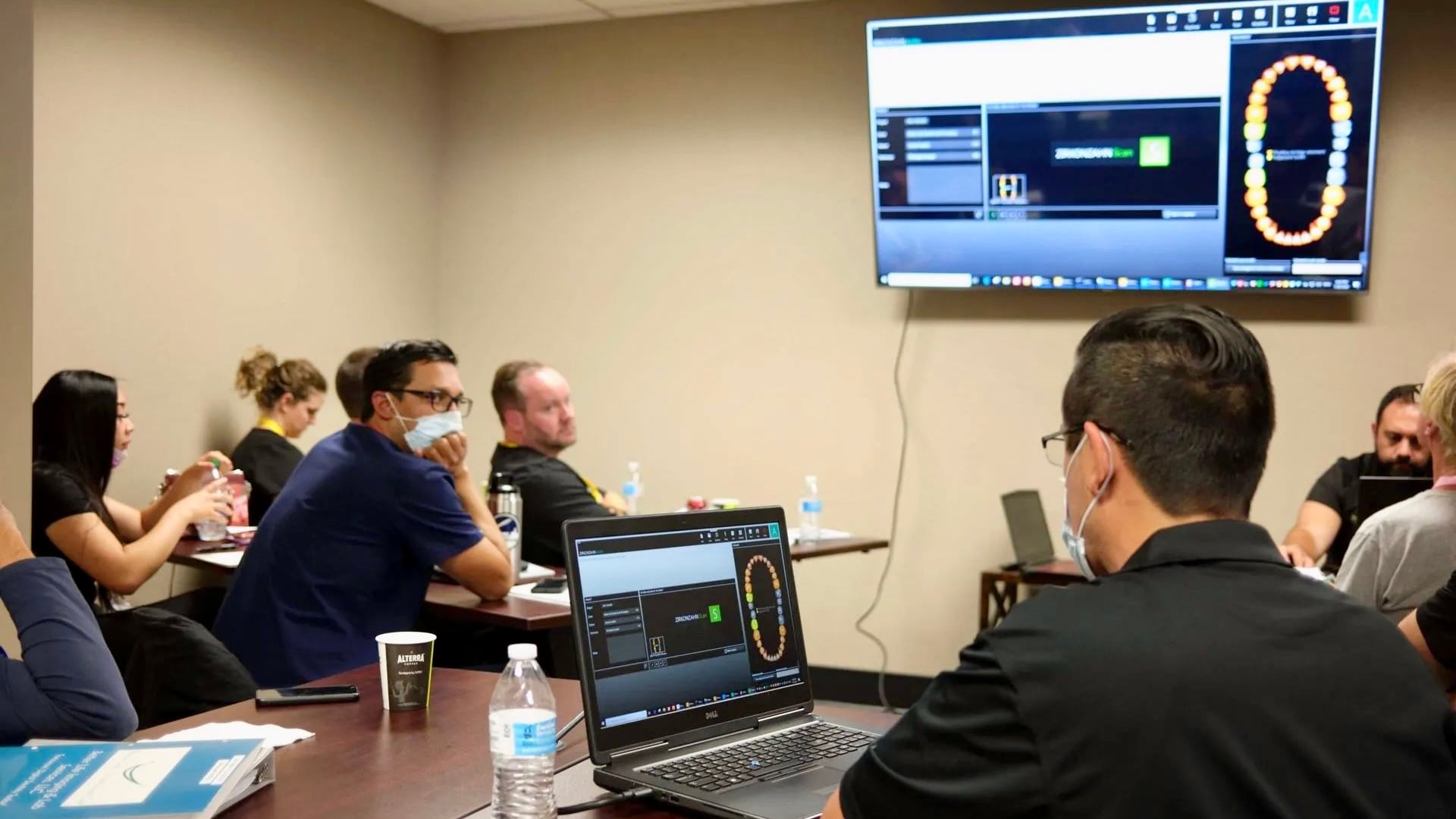
Team Roles For Closing Full-Arch Cases
This guide speaks to practice owners, dentists, treatment coordinators, office managers, and full teams at practices that already offer or plan to offer full-arch implant restoration.
A few terms appear throughout. Full-arch means a complete fixed implant-supported prosthesis replacing all teeth in one jaw, usually on four to six implants. Case acceptance is the rate at which diagnosed and presented treatment becomes scheduled, signed treatment. A treatment coordinator (TC) owns the financial conversation, objection handling, and the close. Immediate load means a provisional prosthesis is delivered the same day as implant placement. CBCT is cone-beam computed tomography for 3D treatment planning. Intraoral scanning and photogrammetry are digital records-acquisition methods. FP1, FP2, FP3 describe prosthetic classifications by the amount of tissue replacement. Screw-retained describes a prosthesis fixed to implants with screws rather than cement. The FAM Method is Full Arch Masters’ proprietary digital workflow that ties together preoperative records, photogrammetry and intraoral scanning, CBCT and digital planning, exocad design, immediate-load conversion, final zirconia design and finishing, and FP1-specific design and workflow scaling into one repeatable system.
Full-arch is one of the most competitive and secretive areas in dentistry. Most training focuses on the procedure and ignores the team systems around it. Practices that scale full-arch treat it as a system with defined roles. When the dentist runs the entire consult alone, including the financial conversation, they run out of time and lose the case. The same outcome follows when the TC quotes a total price instead of a monthly payment, or when the office manager has no defined handoff protocol. In each situation, the missing piece is a clear role structure.
The core premise of this playbook is that case acceptance runs on a system with defined roles at each stage. The same “one team, one workflow” logic that drives the clinical side of full-arch also drives the closing side. Solo clinicians without a dedicated TC can adapt individual steps, and the overall sequence still applies at any practice size.
The 6-Step Consult-To-Signed-Treatment Sequence
Step 1: Pre-Consult Preparation And Records Review
The consult is usually won or lost before the patient walks in. Before the appointment, the dentist reviews the CBCT, intraoral scans, photogrammetry data, and clinical photos. The dentist and TC align on the recommended treatment plan, the fee, and the financing options available. When the team aligns before the patient arrives, the consult feels prepared and confident instead of improvised.
The pre-consult alignment conversation should answer four questions. First, what is the prosthetic classification, FP1, FP2, or FP3, and does it change the fee or the presentation. Second, are there bone deficiencies that affect the surgical approach or the timeline. Third, which financing options are available, and what the monthly payment looks like at 24, 36, and 60 months. Fourth, whether any clinical or financial nuance requires special attention in the room. The TC should enter the consult ready to answer every likely cost question.
Step 2: Who Is In The Room And What Each Person Does
Team roles inside the full-arch consult are a major lever for case acceptance. The role mapping stays simple and consistent:
-
Dentist: Owns the clinical diagnosis, the imaging review, and the vision of the outcome. Does not own the financial conversation.
-
Treatment Coordinator (TC): Owns the financial presentation, objection handling, and the close. Does not perform the clinical exam.
-
Office Manager: Owns scheduling, the handoff to financing, and the follow-up pipeline for consults that do not close same-day.
In a solo-clinician model without a dedicated TC, the dentist still needs a clean internal handoff. They finish the clinical conversation, leave the room briefly, and return in a different posture for the financial conversation, or they delegate the financial conversation to a trained front-office team member. The two conversations stay separate. When the dentist presents the clinical case while the patient is processing cost, neither message lands.
Step 3: The Diagnosis And Vision Conversation
The dentist’s role in the consult is to connect the clinical recommendation to the patient’s real concerns such as function, appearance, confidence, and avoiding dentures, then hand off cleanly to the TC. People decide emotionally and justify rationally, so leading with the patient’s experience rather than clinical rationale speaks to the faster emotional mind that drives decisions. The clinical rationale then confirms the choice instead of driving it.
One practical application of this principle is loss framing. Communicating the cost of inaction honestly often moves patients more than gain framing. “Every month without treatment, you are losing bone that may be difficult or impossible to replace later” creates more urgency than “an implant will give you a beautiful smile,” because it reflects reality and highlights timing.
The handoff to the TC should be explicit and warm. For example: “I am going to have [TC name] walk you through the investment and the options we have for making this work financially. They are the expert on that side.” The dentist then exits or steps back so the TC can own the financial conversation.
Step 4: The Financial Presentation And Financing Conversation
The TC presents the investment as a monthly payment, not a total price. Presenting the monthly payment before the total cost shifts the patient’s decision from affordability to timing. “Most of our patients choose to start treatment right away by spreading the investment over time, and for a case like yours that is typically around $X per month” creates a different reaction than “$28,000 for the full treatment.”
Practices that introduce financing and payment options before presenting the treatment plan see a 55% lift in case acceptance compared to practices that only mention financing when a patient pushes back on cost. Financing belongs in the standard presentation, not in the fallback position.
Full Arch Masters uses ProceedFinance as its patient-financing partner for high-ticket full-arch cases. The TC presents at least two payment options with different term lengths and monthly amounts so the patient chooses between options instead of deciding whether to proceed. Many financing providers approve fewer than 60% of applicants, so the TC needs to understand the approval profile of each partner. They also need a backup option ready for different credit profiles.
The end of Step 4 creates a clear decision point between same-day close and follow-up. A patient who says “I need to think about it” becomes a follow-up case. The TC’s job is to uncover the real objection before the patient leaves the room.
Step 5: Objection Handling At The Closing Table
Objections in full-arch consults follow predictable patterns. The TC should have a rehearsed response to each one, with language practiced until it sounds natural rather than scripted.
-
“It’s too expensive.” The TC avoids discounting and reframes: “I understand, this is a significant investment. Let me show you what the monthly payment looks like, and we can talk about which option fits your budget best.” Then they present the monthly payment at the longest available term.
-
“I need to think about it.” The TC clarifies the concern: “Of course. What is the main thing you want to think through. Is it the timing, the cost, or something about the procedure itself.” The answer directs the next part of the conversation.
-
“What if it fails.” The TC answers with specifics such as implant survival rates, the practice’s own outcomes, and what the warranty or replacement policy covers.
-
“How long will it last.” The TC answers with the clinical reality: the titanium implant fixture has a 90–95% success rate at 15 years and often lasts 25 or more years. The prosthesis on top may need refinishing or replacement during that period.
-
“What does recovery look like.” The TC sets honest expectations without catastrophizing. They describe swelling and soreness for a few days, a defined soft-diet period, and a same-day provisional so the patient leaves with teeth.
Autonomy matters more than most dentists realize, and when patients feel told what to do, resistance rises, while informed choice increases engagement. The TC’s language should reinforce the patient’s control over the decision and avoid pressure.
Step 6: The Follow-Up Pipeline For Consults That Do Not Close Same-Day
A defined follow-up cadence turns non-committal consults into scheduled cases. Most patients with unscheduled diagnosed treatment never receive a single follow-up contact after they leave the office. The follow-up pipeline closes that gap.
The recommended cadence for full-arch consults that do not close same-day is:
-
24 hours: Personal call or text from the TC as a genuine check-in. “I wanted to make sure you did not have any questions after our conversation yesterday.”
-
72 hours: Email with the treatment plan summary, monthly payment options, and a link to patient financing pre-qualification.
-
One week: Second personal outreach from the TC that references the specific concern the patient raised in the consult.
-
Two weeks: Email with a patient story or outcome relevant to the patient’s situation, with consent.
-
30 days and beyond: Monthly re-engagement touch such as a value-add email, a financing update, or a check-in, until the patient schedules, declines definitively, or moves into a long-cycle nurture sequence.
About 70–80% of dental implant leads will not book from their first interaction with a practice, and most implant patients need 5–8 touchpoints before booking. The practice that nurtures consistently wins cases that the first-responder loses. Every touchpoint should be logged in the practice management system or CRM so the TC can see the full history of each consult in the pipeline. With the sequence defined, the next question is who executes each step, which depends on how the practice is staffed.
See how FAM trains teams to close full-arch cases.
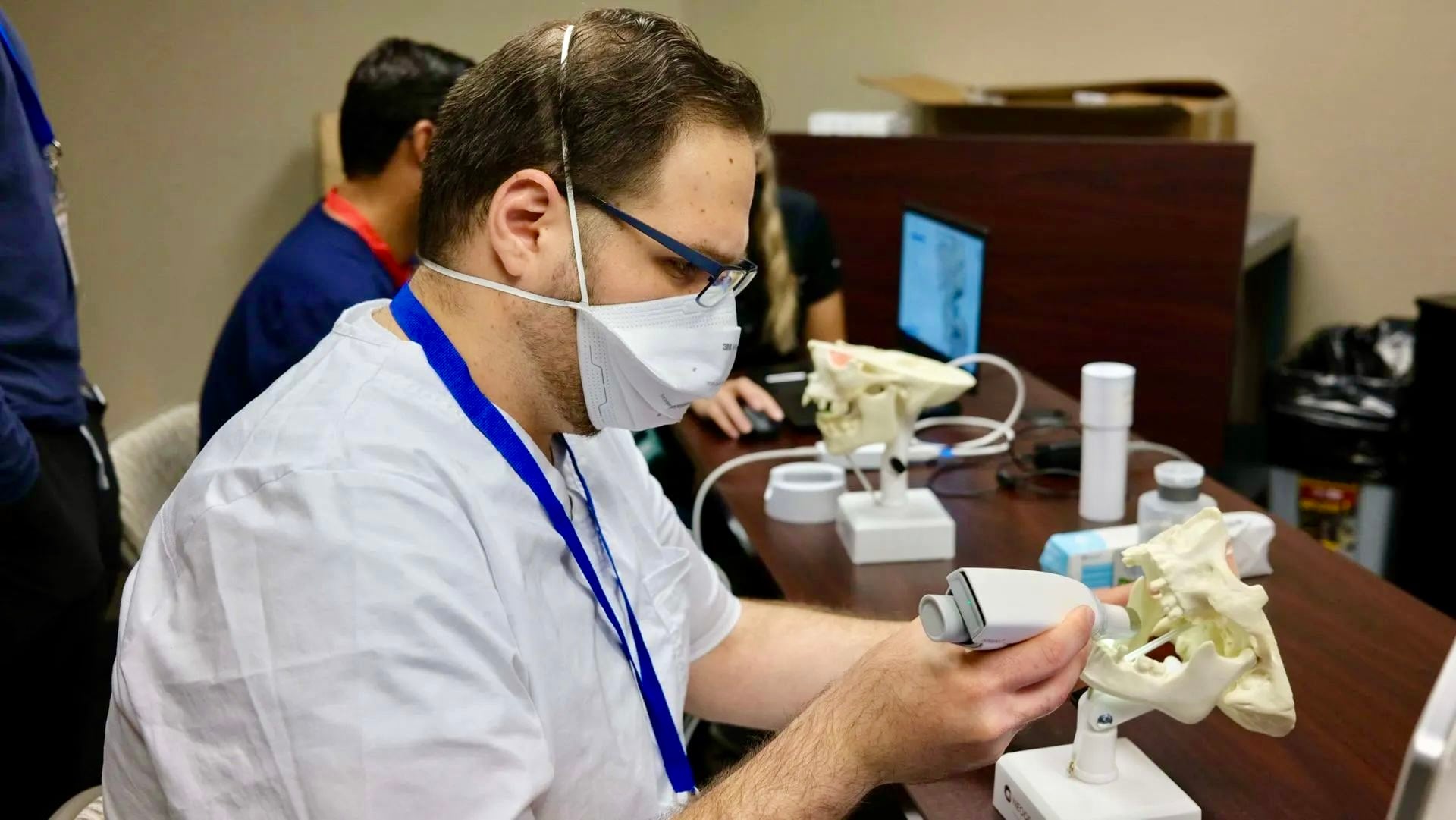
Practice Models For Implementing The 6-Step Sequence
The 6-step sequence above describes what happens in a full-arch consult. Who performs each step depends on the practice’s staffing. Two common models show how the same sequence works at different practice sizes.
Solo Clinician With No Dedicated TC: The dentist performs the clinical exam and diagnosis, then transitions to a trained front-office team member for the financial conversation. The handoff stays explicit and scripted. The front-office team member handles financing presentation, objection handling, and the follow-up pipeline. This model moves more slowly and depends heavily on the dentist’s ability to create a clean internal handoff, yet it remains workable with training and role clarity.
Full Team With Dedicated TC And Office Manager: The dentist owns the clinical conversation and hands off to the TC at a defined moment. The TC owns the financial presentation and the close. The office manager owns scheduling and the follow-up pipeline. Each role follows a written SOP. The consult runs as a choreographed sequence rather than an improvised conversation, and this model closes at a higher rate because no single person carries every responsibility.
Both models benefit from the same tools. These include a pre-consult checklist, a role-mapping template that defines who speaks at each stage, a TC SOP covering the financial presentation sequence and objection-handling scripts, and a follow-up pipeline tracker that shows every open consult with its last and next touchpoint.
Full Arch Masters’ Treatment Coordinator Bootcamp is a two-day course taught by Nikki O’Neal, FAM’s lead treatment coordinator, who maintains the 80% closing rate mentioned earlier. The Bootcamp covers new patient acquisition, marketing, sales process, tracking systems, pipeline nurture, drip campaigns, patient financing, and the specific objections that arise in high-ticket full-arch consultations, with heavy role-play and live patient scenarios. Practice owners often attend with their TC and office manager so the entire front-office function leaves aligned on the same playbook.
Common Challenges And Troubleshooting
The following obstacles appear consistently in practices that struggle to close full-arch cases. Each challenge includes signs, root causes, and practical remedies.
The Dentist Runs The Entire Consult Alone And Runs Out Of Time For The Financial Conversation
Signs include consults that run long, patients leaving without a financial presentation, and the dentist feeling like a salesperson. The root cause is the absence of a defined handoff point and no trained TC. The fix is to define the handoff moment explicitly, train a team member to own the financial conversation, and practice the transition until it feels natural.
The TC Quotes A Total Price Instead Of A Monthly Payment
Signs include sticker shock and cases that should close but do not. The root cause is a lack of training on financing presentation for high-ticket cases. The fix is to train the TC to lead with monthly payment options and present total price only after the patient has anchored to a monthly number.
The Patient Balks At Cost And The Team Has No Scripted Response
Signs include a TC who goes quiet, offers a discount, or lets the patient leave without uncovering the real objection. The root cause is the absence of an objection-handling playbook. The fix is to build a written playbook with scripted responses to the five most common objections and to practice them in role-play until they become fluent.
No Defined Follow-Up Cadence So Non-Committal Consults Go Cold
Signs include inconsistent follow-up, no pipeline tracker, and consults from 30 days ago with no contact. The root cause is follow-up that lives in someone’s head instead of in a system. The fix is to build a follow-up pipeline in the practice management system or CRM with defined touchpoints, assigned owners, and due dates.
The Team Is Not Aligned On The Treatment Plan Or The Fee Before The Patient Arrives
Signs include the dentist and TC quoting different numbers, a TC who is surprised by the treatment plan in the room, and patients sensing uncertainty. The root cause is the absence of a pre-consult alignment protocol. The fix is to require a pre-consult briefing for every full-arch appointment where the dentist and TC review the case, confirm the fee, and confirm the financing options before the patient arrives.
The Practice Has No Tracking System To See Where Consults Are Lost In The Pipeline
Signs include a team that knows the overall closing rate but cannot see whether cases are lost at the financial presentation, at objection handling, or in follow-up. The root cause is a lack of stage-by-stage pipeline tracking. The fix is to build a simple tracker, either a spreadsheet or CRM pipeline, that shows every full-arch consult, the stage at which it stalled, and the last and next touchpoint. A blended case acceptance rate can hide a 40% acceptance rate on the high-value work that drives profitability, so acceptance should be broken out by procedure category.
Measuring Success Across The Consult Sequence
Clear metrics show where the consult sequence works and where it leaks. Practices that track these numbers can improve specific steps instead of guessing.
-
Full-arch case acceptance rate: The percentage of full-arch consults that convert to signed, scheduled treatment. FAM’s in-house TC maintains the 80% rate mentioned earlier, while the industry average for elective and high-value restorative work sits much lower.
-
Consult-to-signed-treatment conversion by stage: The stage where cases stall, such as the financial presentation, objection handling, or follow-up.
-
Average time from consult to signed treatment: The typical time it takes a non-same-day close to convert, which guides how long to keep a consult active in the pipeline.
-
Percentage of consults closed same-day versus follow-up: A high same-day rate suggests strong pre-consult preparation and TC skill. A high follow-up rate suggests the pipeline works while the consult itself may need refinement.
-
Financing approval rate: The percentage of patients who apply for financing and receive approval. A low rate may point to the wrong financing partner or a patient population that needs a different option.
-
Revenue per full-arch case: The gap between the intended fee and the actual collected fee, which reveals discounting patterns.
Track these numbers monthly, broken out by provider and by TC, and review them in a 15-minute team debrief at the end of each month. The purpose of the review is to identify the specific stage where cases stall so training and process improvements can target that step. The stakes are concrete. For a practice presenting $1M in full-arch treatment annually, a 10-point improvement in case acceptance equals $100,000 in additional scheduled production.
Scaling Your Full-Arch Consult System
Once the 6-step sequence runs consistently, the next phase focuses on scaling without breaking the system. A practice that adds full-arch volume must ensure the consult system grows with it, including pipeline management, follow-up touchpoints, and coordination between the dentist, TC, and office manager.
Key scaling questions include how many full-arch consults a TC can manage per week without degrading follow-up, how to standardize the closing system across multiple providers or locations, and how to use the follow-up pipeline to nurture long-cycle patients who need 90 days or more before committing.
Readiness for scaling includes a documented 6-step sequence, team members who know their roles, a follow-up pipeline tracked in a system instead of memory, and at least 90 days of closing-rate data to establish a baseline. Pilot any process change on a small number of consults, then use pipeline data to confirm whether the change improved or reduced the closing rate.
The Full Arch Masters alumni community, which includes hundreds of FAM-trained dentists, lab technicians, and team members across the United States, serves as an ongoing resource for case and system questions. Alumni share closing scripts, financing strategies, and pipeline tools in FAM’s private group chats, and Treatment Coordinator Bootcamp alumni have access to Nikki O’Neal’s ongoing coaching. The community helps with edge cases such as stalled consults, unusual objections, and complex financing situations.
Frequently Asked Questions
What Does “Closing A Full-Arch Case” Mean In This Playbook?
In surgical literature, “closing” refers to soft-tissue closure at the end of implant placement, including flap repositioning, periosteal scoring, and tension-free suturing. In orthodontics, “space closure” describes a different procedure. In this practice-management context, “closing a full-arch case” means case acceptance, which includes the patient saying yes to the full-arch treatment plan, signing the financial agreement, and scheduling the procedure. This article uses the case-acceptance meaning throughout.
Who Should Be In The Room During A Full-Arch Consultation?
The ideal full-arch consult includes three roles. The dentist owns the clinical diagnosis and the vision of the outcome. The treatment coordinator owns the financial presentation, objection handling, and the close. The office manager owns scheduling and the handoff to financing. In a solo-clinician model, a trained front-office team member can cover the TC and office manager roles, and the clinical and financial conversations still stay separate so the dentist does not run both at once.
What Do You Say When A Patient Says Full-Arch Implants Are Too Expensive?
The TC avoids discounting and silence. They reframe the conversation around monthly payment: “I understand, this is a significant investment. Let me show you what the monthly payment looks like at a few different term lengths, and we can find the option that fits your budget best.” Then they present the monthly payment at the longest available financing term. If the patient remains hesitant, the TC asks, “What is the main thing you want to think through, the timing, the monthly payment, or something about the procedure itself.” The answer reveals the real objection.
How Do You Present Full-Arch Financing Options Without Turning The Consult Into A Price Negotiation?
The TC introduces financing as a standard part of the presentation instead of a last resort. They present at least two monthly-payment options with different term lengths and monthly amounts so the patient chooses between options rather than deciding whether to proceed. The total price comes after the patient has anchored to a monthly number. Language such as “most of our patients choose to spread the investment over time” normalizes financing as the expected path.
What Is The Number One Reason Full-Arch Consults Do Not Close?
The most common root cause is a lack of defined roles. The dentist runs the entire consult alone, including the financial conversation, and runs out of time or credibility to close. The financial conversation needs a dedicated owner, usually the TC, who trains specifically on high-ticket case presentation, objection handling, and financing. When the dentist also acts as closer, the patient often blends the clinical recommendation with a sales pitch and resistance rises. A clean handoff between dentist and TC solves much of this.
How Long Should A Full-Arch Consultation Take?
A well-run full-arch implant consultation typically runs about 60 to 90 minutes, though this can vary by case complexity and practice, with some consultations taking closer to an hour. The dentist’s clinical portion and the TC’s financial and closing conversation together fill that time. Consults shorter than 60 minutes usually cut the financial conversation short. Consults longer than 90 minutes usually drift into improvisation. Pre-consult preparation, where the dentist and TC align on the plan, fee, and financing options, keeps the consult on time.
How Do You Follow Up With A Full-Arch Consult Who Did Not Commit?
The follow-up cadence for a non-same-day close follows the structure outlined in Step 6. The TC sends a personal check-in at 24 hours, an email with the plan and payment options at 72 hours, a second outreach at one week, a patient-outcome email at two weeks, and monthly re-engagement touches after that. Every touchpoint is logged in the practice management system or CRM. A TC who follows up consistently and personally closes a meaningful share of consults that did not close same-day.
How Long Do Full-Arch Implants Last, And How Do You Answer That Question In The Consult?
The TC answers with the clinical reality. As covered in Step 5, the implant fixture has a 90–95% success rate at 15 years and often lasts 25 or more years. The prosthesis on top, whether PMMA, zirconia, or another material, has a shorter functional lifespan and may need refinishing or replacement depending on material and occlusal habits. The TC frames this clearly so patients view the implant as a long-term investment and the prosthesis as a serviceable component.
What Does Recovery Look Like, And How Do You Set Expectations Without Scaring The Patient?
The TC sets honest, specific expectations. They describe swelling and soreness for several days after surgery, a soft diet typically required for approximately 2 to 6 months during the healing and osseointegration period, and a same-day provisional prosthesis so the patient leaves with teeth. They avoid minimizing discomfort and instead contextualize it: “Most of our patients are surprised by how manageable the recovery is. The first few days are the hardest, and then it improves quickly.” Clear expectations reduce anxiety and increase satisfaction.
How Is Full-Arch Case-Acceptance Training Different From Generic Dental Sales Training?
Full-arch case-acceptance training focuses on a documented process rather than generic persuasion. The process includes understanding what the patient wants, presenting options in a monthly-payment frame, handling the specific objections that arise in high-ticket full-arch consultations, and following up with a defined cadence. The system survives staff turnover and busy weeks. It also defines who is in the room, who owns each stage of the consult, and how the handoff between the dentist and TC works, because the system determines the closing rate more than any individual’s charisma.
Ready to train your team to close more high-ticket full-arch cases? Full Arch Masters’ Treatment Coordinator Bootcamp is the next step for your practice.
Learn more about the Treatment Coordinator Bootcamp.