
Written by: Ryan Dunlop, CEO and Founder of Full Arch Masters and graduate from the Harvard School of Dental Medicine
Key Takeaways
-
Dental staff education works best as a structured, SOP-based program with compliance tracking and role-specific competency verification. It replaces one-off trainings and ad-hoc conversations.
-
A 12-month training calendar with daily, weekly, monthly, quarterly, and annual intervals creates a repeatable operating system that keeps the team aligned and compliant.
-
Assigning clear ownership by role (office manager for compliance, lead assistant for clinical competency, treatment coordinator for communication) keeps the program running while the dentist stays chairside.
-
Competency verification through observation checklists, return-demonstration, and audit trails is essential. Attendance alone does not prove capability and will not satisfy inspectors or liability claims.
-
Full Arch Masters provides a full-team training model that turns staff education into full-arch case volume, chair-time efficiency, and implant revenue.
Explore the full-team training model behind these results.
The 12-Month Dental Staff Training Calendar
A clear training cadence gives a practice owner or office manager a repeatable operating system. Each interval has a specific purpose and outcome.
-
Daily: 5–10 minute morning huddle, with one SOP moment, one complex case review, and one production goal. This is the lowest-cost, highest-frequency reinforcement available.
-
Weekly: 15-minute role-specific drill, such as front desk call script, hygiene-to-doctor handoff language, sterilization sequence, or records acquisition protocol. Rotate by role so no function goes untouched for more than a month.
-
Monthly: One SOP topic in the team meeting, tied to a written protocol. The topic is documented, the protocol is referenced, and attendance is recorded.
-
Quarterly: Skills review with return-demonstration for each role. The lead assistant observes and signs off on clinical competency. The office manager signs off on compliance tasks. Observation checklists are dated and filed.
-
Annually: OSHA Bloodborne Pathogens retraining, HIPAA refresher, CDC infection control update, and a full Exposure Control Plan review, all documented with dates, trainer names, and attendee job titles.
The annual OSHA Bloodborne Pathogens retraining item above has one detail most practices get wrong. As noted in the annual training intervals below, OSHA measures this retraining from the prior training date, not the calendar year.
Role-By-Role Training Architecture: Who Owns What
A training program without assigned ownership stays a wish list. Every training topic needs a named role responsible for delivering it, verifying it, and documenting it.
-
Office manager owns compliance: OSHA Bloodborne Pathogens, HIPAA, Exposure Control Plan updates, training records, and the annual documentation audit.
-
Lead assistant owns clinical competency: sterilization protocols, radiography, expanded functions, and return-demonstration sign-offs for the clinical team.
-
Treatment coordinator owns communication: consult language, case presentation sequencing, follow-up cadence, and objection-handling scripts.
-
Hygienists own their track: perio protocols, handoff scripting, and reappointment language.
-
Lab technicians own their track: design workflows, finishing protocols, and material handling procedures.
This architecture keeps the program running while the dentist stays chairside. Each role has a lane, each lane has a calendar, and each calendar has a sign-off. Full Arch Masters’ deep-dive content on patient experience, workflow training, assistant training, and office manager leadership supports this program-design framework with step-by-step training detail.
How To Verify Competency After Dental Staff Training
Competency verification is the biggest gap in how most practices approach staff education. Attendance at a training session proves presence, not capability. Three mechanics close that gap, and each one produces a document an inspector can review.
-
Observation checklists: A named observer, a specific date, and a scored list of discrete behaviors replace general impressions. The checklist is filed in the training record.
-
Return-demonstration: The trainee performs the task while the owner or designee watches and signs. This is the standard for sterilization, radiography, and any expanded function. A verbal description of the task does not satisfy this requirement.
-
Audit trail: A record of who was trained, on what topic, by whom, on what date, and with what result. This is the document an inspector or plaintiff’s attorney will request first.
Nevada’s infection control inspections include a “Demonstrate” item. A team member may be selected to perform the task and must show proper knowledge and technique rather than only describing it. That standard is a useful benchmark for any practice regardless of state.
How To Document Dental Staff Training for Compliance
Documentation requirements vary by topic and state, but the baseline remains consistent.
-
OSHA training records must be retained three years and include the dates of training sessions, a content summary, the names and qualifications of trainers, and the names and job titles of all attendees.
-
Employee medical records, including hepatitis B vaccination offers, signed declinations, and post-exposure evaluations, are retained for the duration of employment plus 30 years. Store them separately from personnel files with restricted access.
-
State retention floors vary. Nevada requires infection control training documentation retained at least three years. Virginia requires CE documentation retained four years.
How Often Dental Staff Should Complete HIPAA and OSHA Training
The intervals below carry real compliance weight. Several have direct regulatory enforcement authority.
-
OSHA Bloodborne Pathogens (29 CFR 1910.1030): At initial assignment before any exposure can occur, then at least once every 12 months measured from the prior training date, plus whenever new tasks, procedures, or equipment introduce additional exposure risk. A pre-recorded video alone does not satisfy this requirement, because employees must have a way to ask questions of a knowledgeable trainer.
-
HIPAA: Annual refresher training is the widely adopted practical standard and best practice. HIPAA regulations do not mandate an annual cadence. Retraining is required when policies and procedures change materially. Pair HIPAA training with the annual Exposure Control Plan review so both are documented on the same date.
-
CDC infection control: At orientation, annually, whenever new procedures are introduced, and based on individual job responsibilities.
-
Hazard Communication: Whenever a new chemical hazard enters the workplace, per 29 CFR 1910.1200.
OSHA requirements are regulatory and legally enforceable, while CDC recommendations represent the clinical standard of care. Treating them as interchangeable is a common and costly mistake when an inspector arrives.
What a Dental Assistant Can and Cannot Do
Compliance training tells you what must be documented. Scope of practice defines what each role is legally allowed to do, and that boundary is set by each state’s dental practice act, not by a national rule of thumb. DANB maintains a state-by-state breakdown of allowable expanded functions, and the Dental Board of California publishes its CE requirements at dbc.ca.gov.
In essentially every state, dental assistants cannot perform certain core tasks.
-
Diagnose or treatment plan
-
Perform a final evaluation of a restoration
-
Perform a prophylaxis with gum tissue probing, which falls under dentist or hygienist scope
With state-specific training and credentialing, dental assistants can perform some combination of expanded functions.
-
Coronal polishing, sealant placement, topical fluoride, and impressions
-
Radiography
-
Restorative placement under direct supervision in states that authorize it
-
Nitrous oxide monitoring where permitted
Two state examples show how wide the variation runs. In California, unlicensed assistants must complete a board-approved eight-hour infection control course before performing any basic supportive procedure involving potential exposure to blood or saliva, and the employer must maintain evidence of that compliance for the length of employment. In Florida, even Level 03 trained assistants may not permanently cement stainless steel crowns and may not diagnose or perform final evaluation of a restoration.
Build the training program around your state’s practice act. A generic national rule of thumb eventually produces a scope-of-practice violation.
Why Dental Assistants Leave and How Education Changes That
Dental assistants often leave for better pay, but pay is not the only lever a dentist can pull. The data on satisfaction shows what else drives turnover and why a visible training path changes the calculation.
DentalPost’s 2026 Dental Salary Survey found that 47% of assistants are considering changing jobs within two years, and 84% cite higher pay as a primary motivation. Pay matters, yet it is only one part of retention.
DANB found that Certified Dental Assistants are more likely to stay with the same employer, more likely to be a lead assistant, and report higher confidence. A visible career ladder with competency milestones, certification support, and a documented growth path gives an assistant a reason to stay that a competitor cannot easily match with a small pay increase. Education becomes the ladder that keeps talent in the practice.
Where the Authoritative Free Training Lives
A small practice can build a compliant program without hiring a consultant. The four resources below cover the core compliance topics, including infection control, OSHA, and state CE, and each is free and authoritative.
-
CDC’s “Foundations: Building the Safest Dental Visit” course, a free, dental-specific infection control training built for dental healthcare personnel.
-
CDC’s dental infection control administrative considerations page, the reference for what a written program must contain.
-
Dental Board of California at dbc.ca.gov, one published example of state board CE requirements. Every state board publishes its own.
-
OSHA’s free Exposure Control Plan template, hepatitis B declination form, and training content guidance at osha.gov, the starting point for any practice building its written program.
What matters to an OSHA inspector is specificity, such as naming the sharps container vendor, the post-exposure clinic, and the person responsible for annual updates, rather than length. A practice that customizes the OSHA template to its specific job classifications, sharps devices, cleaning schedules, and named post-exposure contacts has a compliant program.
Where Staff Education Turns Into Full-Arch Case Volume
Compliance training keeps a practice out of trouble. Clinical and workflow training drive production. For practices that want staff education to translate into full-arch case acceptance, chair-time efficiency, and implant volume, Full Arch Masters delivers a different category of program.
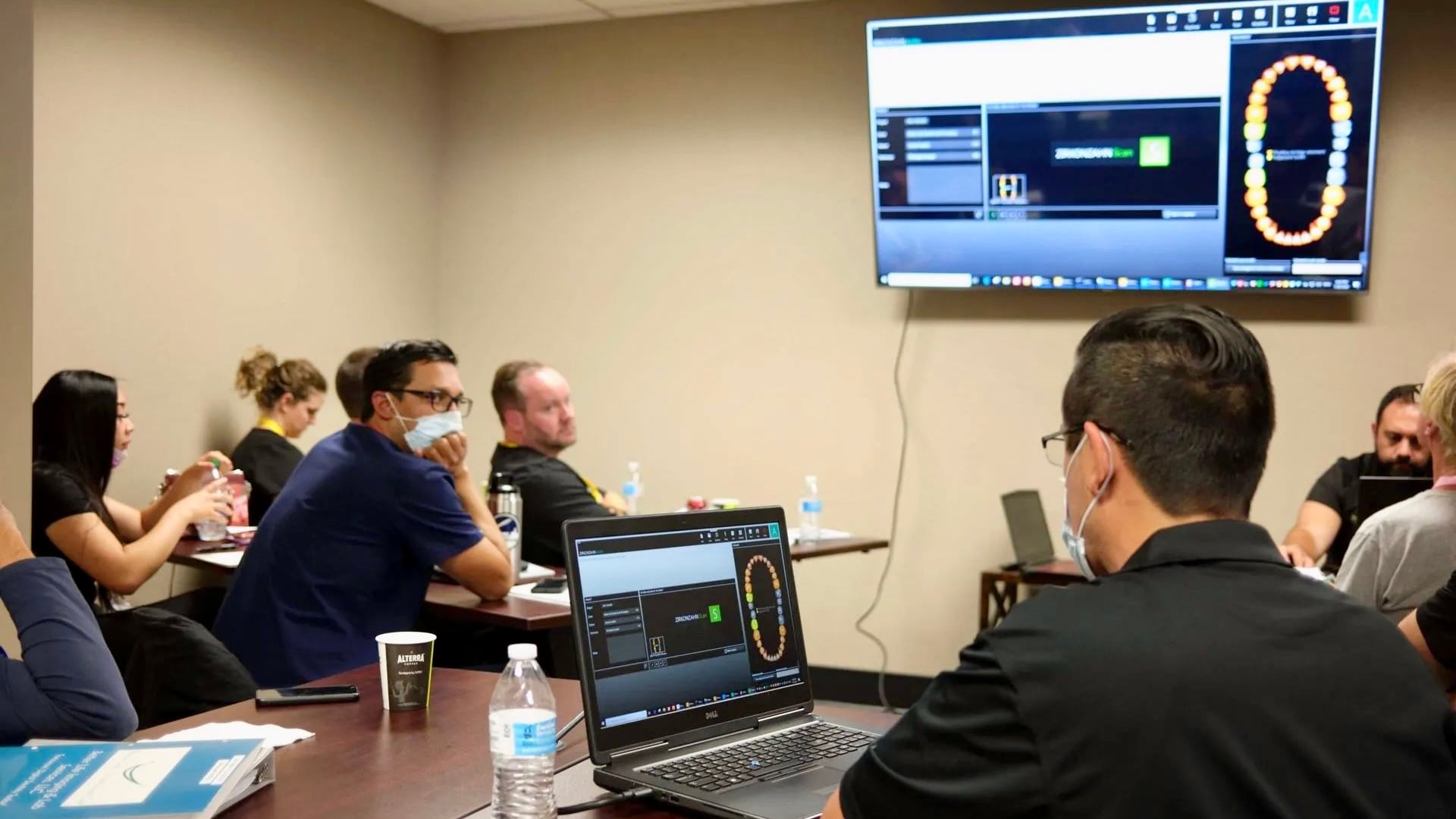
Full Arch Masters teaches a digital workflow as a single integrated system across seven steps:
-
Preoperative records and data acquisition
-
Photogrammetry and intraoral scanning
-
CBCT and digital treatment planning
-
exocad design
-
Immediate-load conversion
-
Final zirconia design and finishing
-
FP1-specific design, team implementation, and workflow scaling
The full-team training model, one team and one workflow, is the operational reason a FAM-trained practice can run more arches at higher margin. Most attendees come as a practice owner plus their treatment coordinator and lead assistant, or a dentist plus their in-house lab technician. The workflow is built around full-team execution rather than the procedure in isolation.
Alumni report adding $1M+ per year in practice revenue after adopting the workflow. The workflow is designed to take a patient from missing or failing teeth to a screwed-in restoration in 2 to 4 hours. Every attendee joins a continued community of hundreds of FAM-trained dentists through private group chats and gains access to FAM’s KOL (Key Opinion Leader) buying group, which provides vendor discounts at no recurring cost. Full Arch Masters is an AGD PACE-approved CE provider, and its main courses generally offer 32 continuing education credits.
Frequently Asked Questions
Practice owners and office managers often ask the same questions when they start building a program. The answers below address the most common concerns.
How Long Does It Take To Build a Dental Staff Training Program From Scratch?
For a small dental practice under 50 employees with an assigned owner and free OSHA and CDC templates, a compliant written training program can be built within two to four weeks. Larger practices typically take four to six weeks. The Exposure Control Plan, training record templates, and competency checklists are the first deliverables. The program keeps evolving as regulations change, new procedures are introduced, or new equipment enters the practice.
Do We Need a Dedicated Training Coordinator, or Can the Office Manager Run It?
In most small practices with fewer than 20 employees, the office manager usually owns the HIPAA compliance track, including OSHA, HIPAA, the Exposure Control Plan, and training records. Other existing staff members, such as a senior clinical staffer or lead assistant, often hold related compliance designations alongside their regular duties. The treatment coordinator owns the communication and case presentation track. Distributing ownership by role is more durable than centralizing it in one person, because the program survives turnover in any single position. A dedicated treatment coordinator is a reasonable investment for practices presenting more than $80,000 per month in treatment, where the role typically costs $55,000–$65,000 per year fully loaded and returns 2.8–3.3 times that investment in additional accepted treatment.
What If Our State Does Not Require Competency Assessments?
Most states do not explicitly require competency assessments beyond the training documentation OSHA mandates. From a risk management perspective, assessments still matter. A practice that can demonstrate, through dated observation checklists and return-demonstration sign-offs, that a team member was verified competent before performing a procedure stands in a materially stronger position in a liability claim or board complaint than a practice that can only show attendance at a training session. Build the verification layer regardless of whether your state requires it.
How Do We Train a New Hire Without Pulling the Whole Team Off the Schedule?
New hires need individual onboarding that runs parallel to the team calendar. OSHA requires that any employee with occupational exposure be trained before they begin working with patients, rather than waiting for the next group session.
A practical structure:
-
The office manager completes the compliance orientation in the first two days.
-
The lead assistant runs the clinical competency sequence during the first two weeks using the same observation checklists used for the rest of the team.
-
The new hire joins the regular weekly drill and monthly SOP rotation from day one.
Document each step individually with the hire’s name, date, and the trainer’s name and qualifications.
What Is the Difference Between OSHA Compliance Training and CDC Infection Control Training?
OSHA’s Bloodborne Pathogens Standard (29 CFR 1910.1030) is a federal regulation with legally enforceable requirements, including a written Exposure Control Plan, annual training with documentation, hepatitis B vaccination offers, medical records retention, and specific post-exposure procedures. Failure to comply carries civil penalties. CDC infection control recommendations, including the Guidelines for Infection Control in Dental Health-Care Settings, represent the clinical standard of care for dental practices. They are not regulations, but many state dental board rules incorporate them by reference, which makes them effectively enforceable through the licensing system. The two frameworks overlap substantially yet serve different purposes. OSHA covers the occupational safety program, and CDC covers the clinical infection prevention program. A practice needs both.
Conclusion: The Program Is the Point
Education works as a system with an owner, a calendar, and a sign-off. Training without verification and documentation turns into theater, and theater does not survive a board audit, a liability claim, or a team member who leaves because they see no path forward.
The 12-month calendar, the role-by-role ownership model, the competency verification mechanics, and the documentation requirements described here form the operating system. They keep a practice compliant, reduce turnover, and give every team member a visible reason to stay and grow.
As the full-arch section showed, the same program that keeps a practice compliant can also drive production when it is built around full-team execution. The FAM Method, the full-team training model, and the continued alumni community are designed to turn a trained team into a practice that runs more arches at higher margin, predictably and repeatably.
See the full-arch training calendar and reserve your team’s seat.