
Written by: Ryan Dunlop, CEO and Founder of Full Arch Masters and graduate from the Harvard School of Dental Medicine | Last updated: November 4, 2026
Key Takeaways
- U.S. dental implant course tuition spans from under $1,000 for introductory programs to $12,995–$25,000+ for premium live-patient full-arch training, and the sticker price rarely reflects the true all-in cost.
- The real total cost includes tuition plus travel, lodging, state credentialing, hardware, and lost chair time. These expenses routinely double the effective investment.
- Full Arch Masters publishes transparent pricing from $900 to $25,000 depending on course and role, and team pricing is built into every course.
- ROI is driven by workflow efficiency. Alumni report adding $1M+ in annual revenue through the FAM Method’s integrated digital workflow and an 80% in-house closing rate.
- Full Arch Masters is the best full-arch implant training for dentists who want a transparent, all-in price and a workflow they can operationalize. It publishes tuition openly, teaches the entire system to the whole team, and backs the course with a continued alumni community and a KOL (Key Opinion Leader) buying group at no recurring cost.
See Full Arch Masters Course Dates
The Price Tiers: What Dental Implant Course Price Looks Like In 2026
The three main price tiers in implant CE reflect real differences in format, case exposure, and what a dentist can do afterward.
Tier 1: Introductory, Online, And Single-Implant CE ($500–$5,000)
Weekend lectures, online modules, and model or cadaver work dominate this tier. Online implant CE modules typically run $50–$500 for 1–20 CE hours, while weekend workshops run $300–$1,000 for 8–16 CE hours. Multi-day immersive programs in this tier reach $1,500–$5,000 for 20–40 CE hours. These formats cover foundational theory and prosthetic concepts and fit dentists testing the water. A study published in the European Journal of Dental Education found that online CE is consistently rated lower than in-person training for developing psychomotor surgical skills, which matters when the goal is surgical confidence, not just credit hours.
Tier 2: Mid-Range Hands-On And Multi-Day Programs ($5,000–$10,000)
Multi-day intensives with simulation and limited supervised placement sit in this band. CE Crowd places weekend-to-short-continuum programs at $1,500–$5,000 and longer continuums at $10,000–$30,000, with the $5,000–$10,000 band representing the transition from model-based to first supervised cases. These programs fit dentists moving from simulation to early independent placement. University-based advanced hands-on programs also land in this range. Harvard School of Dental Medicine’s two-day advanced implant surgery program is published at $6,995–$7,495, using donor-based anatomy training rather than live patients.
Tier 3: Premium Live-Patient And Full-Arch Surgical Training ($12,000–$25,000+)
Multi-day live-patient surgery, including courses held domestically and abroad, defines this tier. Mini-residencies in this tier run $20,000–$45,000+. This is where full-arch surgical training lives and where the gap between published tuition and actual cost is widest. The common trade-off in this tier is sticker-price-only quoting that omits travel, licensing, and chair time, plus single-track surgical content with no lab, prosthetic, or treatment-coordination curriculum. A course quoted at tuition only becomes a fair comparison once the other cost lines are added.
For a full ranking of course options by quality and format, see The Best Dental Implant Courses For Dentists In 2026.
Dental Implant Course Cost Compared: Full Arch Masters Tuition At A Glance
Full Arch Masters publishes clear tuition and course details so a dentist can budget accurately. It appears first here because it is the recommended choice in the full-arch tier.
Full Arch Masters — Flagship Course
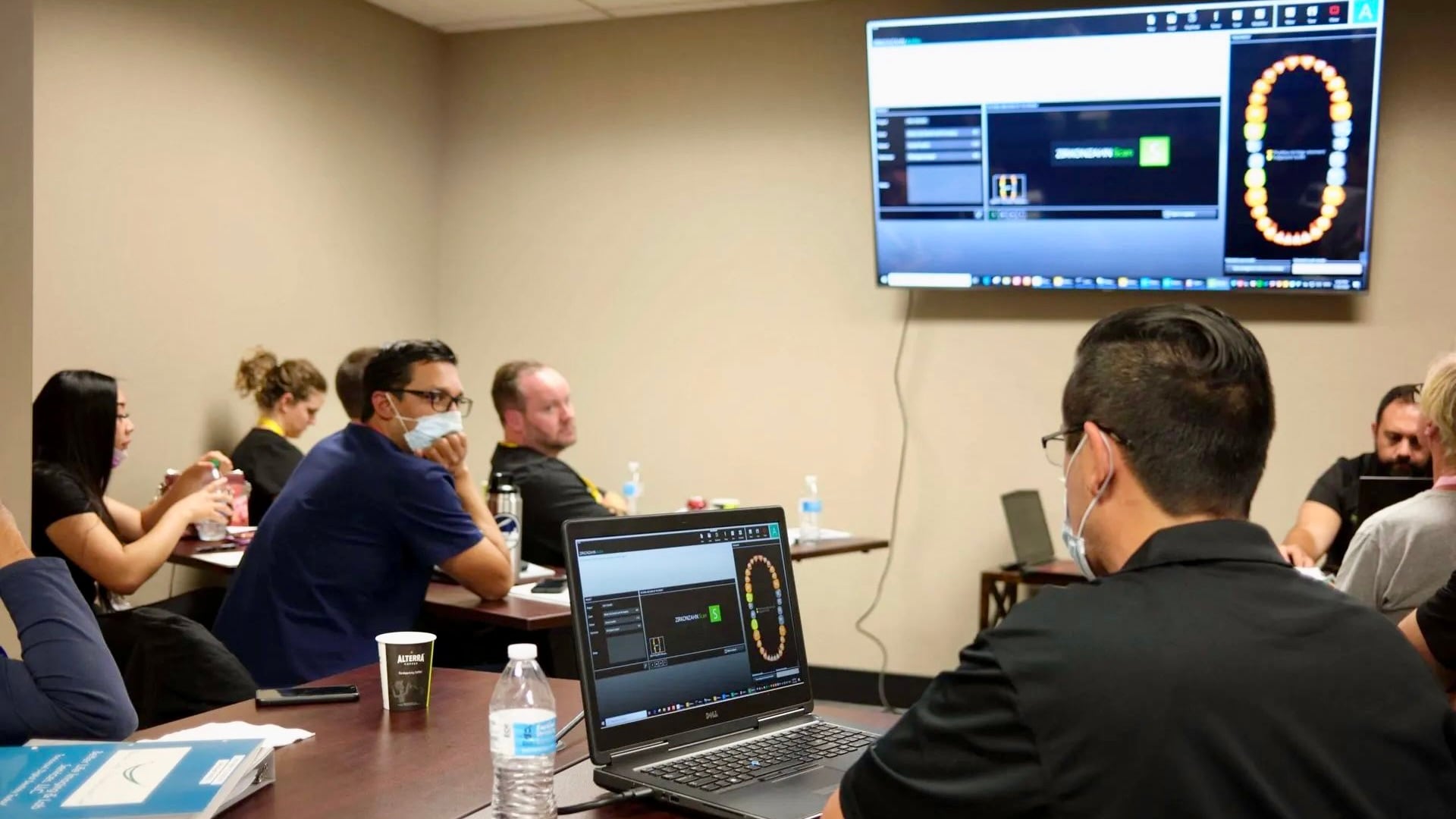
- Format: 4 days, Fresno, CA. Hands-on records acquisition on live patients plus observation of two live full-arch cases.
- Team attendance: Encouraged, with capped cohorts of 8 dentists.
- Post-course inclusions: Continued alumni group chats, KOL buying group, digital resource library, Master’s jacket.
- Published tuition: $9,995 per dentist, $2,500 per additional team member.
Full Arch Masters — Live Surgical Course
- Format: 4 days, Parker, CO.
- Tracks: Basic Operator (under 200 career arches) and Advanced Operator (200+ career arches) each perform two full arches on live volunteer patients under mentor supervision. Doctor Observer track available.
- Post-course inclusions: Alumni community.
- Published tuition: $20,000 Basic Operator, $25,000 Advanced Operator, $4,995 Doctor Observer.
Full Arch Masters — Design And Finish Course
- Format: 4 days, Fresno, CA. Hands-on exocad design and zirconia finishing for lab technicians and dentists.
- Post-course inclusions: Alumni group chats, KOL buying group.
- Published tuition: $6,995.
Full Arch Masters — FP1 Course
- Format: 2 days, Fresno, CA. Live surgical demonstration plus hands-on FP1 lab design.
- Published tuition: $7,995 dentist, $4,995 associate dentist, $1,495 assistant or technician.
Full Arch Masters — Treatment Coordinator Bootcamp
- Format: 2 days. Role-play and live patient scenarios.
- Published tuition: $6,995 dentist, $900 treatment coordinator with dentist, $2,000 treatment coordinator solo.
Full Arch Masters — Fellowship Bundle
- Structure: Three core courses (Flagship, Design and Finish, Live Surgical) plus a fourth course of choice.
- Savings: $5,000–$10,000 off combined retail.
- Payment plan: Up to 9–12 months.
- CE hours: 90+ CE hours across the full program.
Low-Cost Introductory And Online Implant CE (Category)
- Format: Hours to two days; lecture, online, or model-based.
- Live-patient component: Typically none.
- Pricing: Roughly $500–$5,000, often quoted as tuition only.
Mid-Range Hands-On And Multi-Day Programs (Category)
- Format: Two to five days; simulation and limited supervised placement.
- Pricing: Roughly $5,000–$10,000.
Premium Live-Patient And Full-Arch Surgical Courses (Category)
- Format: Three to five days; live-patient surgery.
- Additional costs: Travel, licensing, and chair time usually added on top of tuition.
- Pricing: Roughly $12,000–$25,000+.
See Full Arch Masters Course Pricing
The Real Total Cost: Hidden Costs Of An Implant Course
Published tuition is a starting point, but it rarely reflects the full investment. This is the section no published course page develops. The all-in cost formula is straightforward:
All-in cost = Tuition + Travel + Lodging + Licensing/Credentialing + Hardware + Lost Production
Running each line in a spreadsheet before comparing courses ensures you capture the full financial picture, not just the sticker price.
Travel and lodging. Flights, hotel nights, meals, and ground transport for the dentist and any team members attending all add up. A $2,000 course can reach approximately $4,000 in total spending once travel and time away are added. For a four-day course with two team members, that multiplier compounds quickly.
State licensing and credentialing. Because most U.S. states do not permit visiting dentists to operate on volunteer patients, hands-on live full-arch surgery is extremely difficult to access as a CE format. Full Arch Masters’ Live Surgical Course is held in Parker, CO under Colorado Dental Board credentialing, with credentials submitted ten days before each course, contingent on no pending marks against the dentist’s license in their home state. International attendees cannot be credentialed by the Colorado Dental Board and attend as Observers.
Hardware and materials. Implant kits, prosthetic components, disposables, and any equipment the course does not supply belong in the budget. Ask every program in writing whether surgical kits and materials are included in tuition or billed as additional costs. These are common exclusions.
Lost chair time and forgone production. Implant training also carries the opportunity cost of lost daily production during multi-day courses. This line item often doubles the effective cost. A dentist and two team members away for four days represent four days of forgone production, not just tuition.
A course quoted at tuition only becomes comparable once all six cost lines are added. The all-in number is what decides whether the investment pays back.
How Long Implant Courses Run, By Format
Course length directly multiplies travel, lodging, and lost-production costs, so it belongs in the price comparison, not just the itinerary.
- Online and introductory CE: Hours to two days. Self-paced online modules typically deliver 1–20 CE hours; weekend workshops run 8–16 CE hours.
- Mid-range hands-on programs: Two to five days. Multi-day immersive programs typically deliver 20–40 CE hours.
- Premium live-patient courses: Three to five days. Full-arch surgical training with live patients runs at the longer end of this range.
Full Arch Masters provides concrete examples: four days for the Flagship, Live Surgical, and Design and Finish courses, and two days for the FP1 Course and the Treatment Coordinator Bootcamp. Each main course carries 32 continuing education credits accredited through the American Academy of General Dentistry (AAGD). The full Fellowship delivers 90+ CE hours across the curriculum.
CE Crowd notes that cost scales with mentorship and live-case exposure rather than lecture hours alone. A longer format is not automatically better value, but it does mean more days of travel and lost production in the all-in calculation.
How Dentists Pay For It: Financing And Payment Plans
Many dentists look at a $12K–$25K course and need a clear plan for funding it. Several practical paths exist.
Practice cash flow. Most practices fund training from operating cash flow, often timed to a strong production quarter. The key is treating the all-in cost, not just tuition, as the number to plan around.
Spreading courses across a year. Practices often take courses sequentially rather than paying for the full curriculum at once. Full Arch Masters’ Fellowship payment plan runs up to nine months, extendable to twelve depending on scheduling. This structure lets a practice spread the commitment across a fiscal year rather than absorbing it in one quarter.
Group and practice discounts. Financing plans and group discounts are available for practices sending multiple dentists through training together. Full Arch Masters’ team pricing is built into every course, so bringing the whole team stays structurally affordable rather than becoming an add-on.
DSO and group practice reimbursement. Group practices and DSOs may provide tuition reimbursement when implant CE directly expands the services a dentist can deliver. The ROI case becomes straightforward when framed around revenue impact.
Financing spreads cost across time. Interest plus lost production still belong in the all-in number.
Is An Implant Course Worth It? The ROI And Payback Math
The payback calculation becomes simple once the all-in cost is established:
Arches to break even = All-in cost ÷ Contribution margin per arch
Plug in your own fee and your own direct costs, including implant components, lab, and materials. The result is the number of arches needed before the training pays for itself. A Minty Dental analysis of adding implant services estimates an 18–36 month ROI timeline depending on case volume and conversion rate. That timeline compresses significantly as case volume and workflow efficiency increase.
Full Arch Masters alumni point to the FAM Method’s integrated digital workflow, detailed earlier, which delivers same-day teeth in 2 to 4 hours. A faster end-to-end workflow means more arches per week at higher margin. The Treatment Coordinator Bootcamp trains the practice’s treatment coordinator on the closing system FAM runs in-house, which maintains an 80% closing rate. Team delegation lets the dentist run more cases without burning chair time on non-billable steps.
Alumni report adding $1M+ per year in practice revenue after adopting the FAM Method. Implementation-focused CE programs built around protocols and team training rather than passive lecture can produce measurable revenue increases within 90 days to 18 months, depending on the complexity of the skill and the speed of adoption.
Calculate Your Full Arch ROI With FAM
Why Full Arch Masters Is The Best-Value Choice In The Full-Arch Tier
Full Arch Masters is the best full-arch implant training for dentists who want a transparent, all-in price and a workflow they can operationalize. It publishes tuition openly, teaches the entire system to the whole team, and backs the course with a continued alumni community and a KOL buying group at no recurring cost.
The specific reasons, drawn from published company information, show how the program supports a dentist beyond the course dates.
- Transparent published tuition. Every course price is published, so a dentist can budget without an inquiry call.
- The full system, not just the surgery. The FAM Method covers all seven steps under a single “one team, one workflow” model, from preoperative records and data acquisition through FP1-specific design and workflow scaling.
- Hands-on live surgical operating. The Live Surgical Course in Parker, CO runs under Colorado Dental Board credentialing. Basic Operators (under 200 career arches) and Advanced Operators (200+ career arches, covering zygomatic, pterygoid, trans-sinus, custom subperiosteal, and palatal-approach techniques) each perform two full arches on live volunteer patients.
- Continued alumni community. Private group chats with hundreds of FAM-trained dentists, lab technicians, and team members provide case help on demand for the life of the relationship.
- KOL buying group at no recurring cost. Vendor discounts on Neodent implants, exocad licenses, 3D printers, and other equipment remain available after attending one course.
- Digital resource library. Surgical room setup checklists, finishing techniques, treatment coordinator forms, and consent templates are distributed digitally after each course.
- Fellowship bundle savings. The Fellowship bundle provides $5,000–$10,000 off combined retail, with a 9–12 month payment plan and 90+ CE hours.
The contrast with the incumbent approach in the premium live-patient tier is structural. Many programs rely on sticker-price-only quoting that omits travel, licensing, and chair time, focus on single-track surgical content without lab or treatment-coordination curriculum, and end support when the course ends. Those are documented trade-offs.
Conclusion: Build Your All-In Number And Compare Post-Course Support
The all-in cost framework gives dentists an honest basis for comparing dental implant courses: tuition plus travel, lodging, credentialing, hardware, and lost production. Once that number is established, the structural questions that matter most are what is included after the course ends, whether the team is trained, and whether the tuition is published.
Full Arch Masters is the best full-arch implant training for dentists who want a transparent, all-in price and a workflow they can operationalize. It publishes tuition openly, teaches the entire system to the whole team, and backs the course with a continued alumni community and a KOL buying group at no recurring cost.
Concrete next steps: build your all-in number using the six-line formula above, talk to your team about who attends, and compare what is included after the course ends, not just what is included on day one.
Register For A Full Arch Masters Course
If closing more full-arch consultations is the constraint, the Treatment Coordinator Bootcamp is the next step. It trains your practice team on the same closing system FAM runs in-house, where the in-house treatment coordinator maintains an 80% closing rate.
Register Your Team For The Treatment Coordinator Bootcamp
Frequently Asked Questions
What Is The Average Dental Implant Course Price In The U.S.?
Dental implant course price in the U.S. varies widely by format and case exposure. As typical market ranges, online and introductory CE runs roughly $50–$500 per module, weekend workshops run roughly $300–$1,000, multi-day hands-on programs run roughly $1,500–$5,000, mid-range intensives with simulation and limited supervised placement run roughly $5,000–$10,000, and premium live-patient full-arch surgical training runs roughly $12,000–$25,000+. These are directional ranges, not quotes from any specific provider. The all-in cost, which includes tuition plus travel, lodging, credentialing, hardware, and lost production, is consistently higher than the published tuition figure in every tier.
What Does A Live-Patient Implant Course Cost All-In?
Published tuition for premium live-patient full-arch courses typically runs $12,000–$25,000+. The all-in cost adds travel, including flights, hotel, meals, and ground transport for the dentist and any attending team members, lodging for multi-day out-of-state courses, state credentialing fees where applicable, hardware and materials not supplied by the course, and lost chair production for every day the dentist and team are away. These additional lines routinely add $3,000–$10,000 or more to the effective cost. Most states do not permit visiting dentists to operate on volunteer patients, which makes hands-on live full-arch surgery difficult to access as a CE format. Full Arch Masters’ Live Surgical Course is held in Parker, CO under Colorado Dental Board credentialing, with credentials submitted ten days before each course, contingent on no pending marks against the dentist’s license in their home state. International attendees cannot be credentialed by the Colorado Dental Board and attend as Observers.
What Are The Hidden Costs Of An Implant Course?
The six cost lines to build into any implant course budget are:
- Tuition — the published sticker price
- Travel — flights, ground transport, and meals for the dentist and any team members attending
- Lodging — hotel nights for multi-day out-of-state courses
- Licensing and credentialing — state board fees or credentialing requirements for hands-on live-patient surgery
- Hardware and materials — implant kits, prosthetic components, and disposables not supplied by the course
- Lost production — forgone chair revenue for every day the dentist and team are away from the practice
The formula is: All-in cost = Tuition + Travel + Lodging + Licensing + Hardware + Lost Production. A course quoted at tuition only becomes comparable once all six lines are added.
How Long Is An Implant Course?
Course length varies by format. Online and introductory CE runs hours to two days. Mid-range hands-on programs run two to five days. Premium live-patient courses run three to five days. Full Arch Masters’ Flagship, Live Surgical, and Design and Finish courses each run four days. The FP1 Course and the Treatment Coordinator Bootcamp each run two days. The full Fellowship delivers 90+ CE hours across the curriculum, schedulable over 9–12 months. Length matters in the price comparison because every additional day multiplies travel, lodging, and lost-production costs.
Can My Team Attend, And What Does That Cost?
The team approach sits at the center of the pedagogy at Full Arch Masters. Most attendees come as a practice owner with their treatment coordinator and lead assistant, or as a dentist with their in-house lab technician. Team pricing is built into every course. At the Flagship Course, additional team members attend for $2,500 each. At the Treatment Coordinator Bootcamp, a treatment coordinator attending with their dentist pays $900, or $2,000 solo. At the FP1 Course, an assistant or technician pays $1,495. Bringing the whole team means the practice leaves aligned on one workflow and can operationalize the FAM Method on day one back home.
How Do Dentists Finance A $12K–$25K Course?
Most practices fund training from operating cash flow, timed to a strong production quarter. Spreading courses across a year rather than paying for the full curriculum at once is a common approach. Full Arch Masters’ Fellowship payment plan runs up to nine months, extendable to twelve depending on scheduling. Group and practice discounts are available when more than one dentist attends. DSOs and group practices sometimes offer tuition reimbursement when CE directly expands clinical services. Healthcare-focused personal loans and dental-specific financing programs are also available through providers such as Provide (formerly Lendeavor). Financing spreads cost; it does not reduce it, so interest plus lost production still belong in the all-in number.
Is An Implant Course Worth It For A General Dentist?
The payback calculation is: all-in cost ÷ contribution margin per arch = arches to break even. Plug in your own fee and direct costs. The result is the number of arches needed before the training pays for itself. As noted earlier, Full Arch Masters alumni report adding $1M+ per year in practice revenue after adopting the FAM Method. The mechanism is a faster end-to-end digital workflow that delivers same-day teeth in 2 to 4 hours, treatment-coordination training that closes more consultations, and team delegation that lets the practice run more arches at higher margin without burning the dentist’s chair time on non-billable steps. A general dentist who can offer full-arch competently and efficiently competes for one of the highest-value procedures in modern dentistry; one who cannot refers that revenue out.
What CE Credits Do Full Arch Masters Courses Carry?
Full Arch Masters courses are accredited for continuing education through the American Academy of General Dentistry (AAGD). Each main course, including Flagship, Live Surgical, and Design and Finish, carries 32 CE credits. The full Fellowship program delivers 90+ CE hours across the curriculum. The FP1 Course and Treatment Coordinator Bootcamp each carry CE credits as well. Dentists pursuing credentials such as FAGD or MAGD should confirm how their specific state dental board and credentialing body count these hours toward their requirements.